







Brief Description
The SOP for Microbial Enumeration Test for Raw Material, Semi-Finished and Finished Products describes the procedure used in the Quality Control microbiology laboratory to determine the microbial quality of pharmaceutical materials and products. Its objective is to establish a standardized method for microbial enumeration testing of raw materials, semi-finished products and finished products. The procedure includes sample pretreatment for water-soluble, water-insoluble and fatty products, followed by microbial testing using the pour plate method. Total Aerobic Microbial Count (TAMC) is performed using Soyabean Casein Digest Agar, while Total Yeast and Mould Count (TYMC) uses Sabouraud Dextrose/Chloramphenicol Agar under specified incubation conditions. The SOP also covers testing for specified microorganisms such as E. coli, Salmonella, Pseudomonas aeruginosa, Staphylococcus aureus, bile-tolerant Gram-negative bacteria, Shigella and Candida albicans, including positive, negative and test controls. Results are calculated as CFU/g or CFU/ml and documented in designated annexures and test-report formats.
Skip to PDF content1. Flow Diagram:
The flow diagram summarizes the Microbial Enumeration Test for Raw Material, Semi-Finished and Finished Products in a clear stepwise manner. The process begins with sample receipt and identification, followed by sample pretreatment according to whether the product is water-soluble, water-insoluble, or fatty.
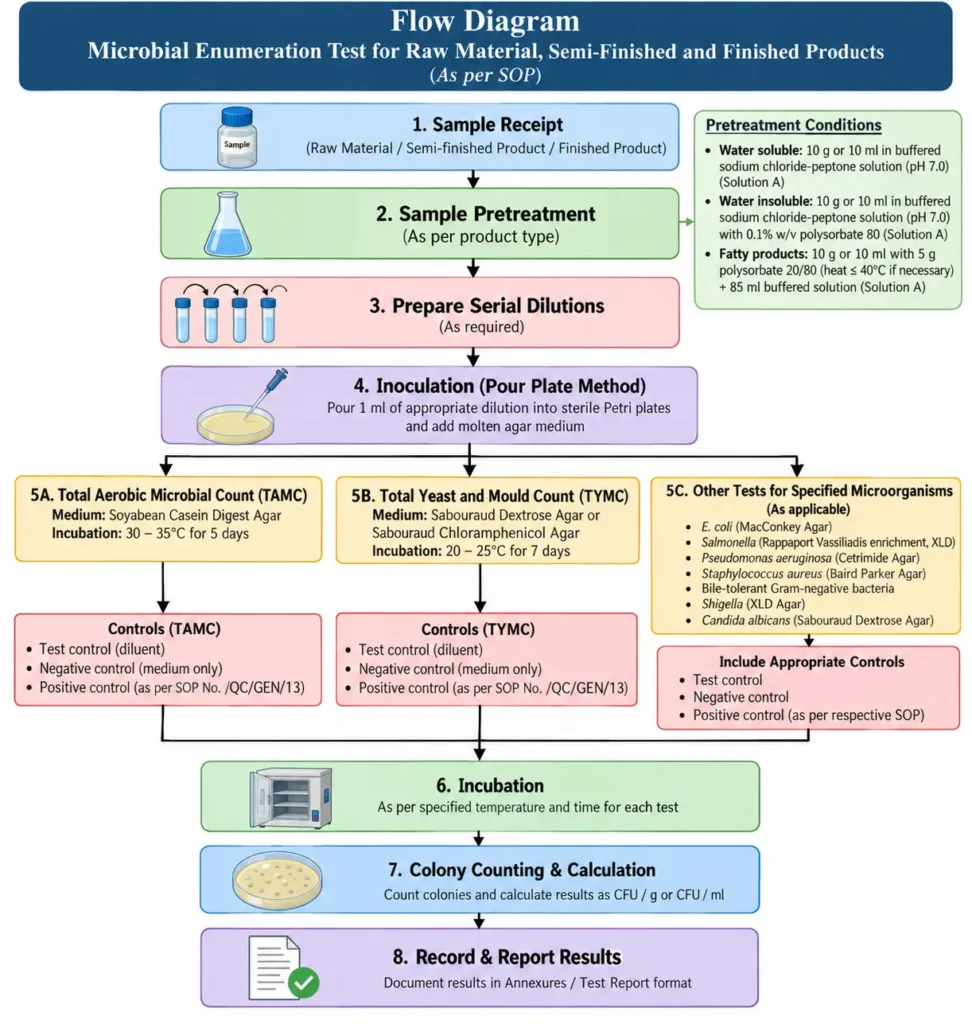
After suitable preparation, the sample is inoculated into sterile Petri plates using the pour plate method. Separate testing is performed for Total Aerobic Microbial Count (TAMC) and Total Yeast and Mould Count (TYMC) using the specified culture media and incubation conditions. Test, negative, and positive controls are included to ensure reliability of the analysis. Where required, testing for specified microorganisms such as E. coli, Salmonella, Pseudomonas aeruginosa, Staphylococcus aureus, bile-tolerant Gram-negative bacteria, Shigella, and Candida albicans is also performed. After incubation, colonies are counted, results are calculated as CFU/g or CFU/ml, evaluated against specifications, and documented in the appropriate test report.
2. Brainstorming for SOP Failure:
The brainstorming diagram presents the possible causes of SOP failure in a pharmaceutical manufacturing area. It organizes potential reasons into key categories so that the investigation team can systematically identify where compliance may have broken down.
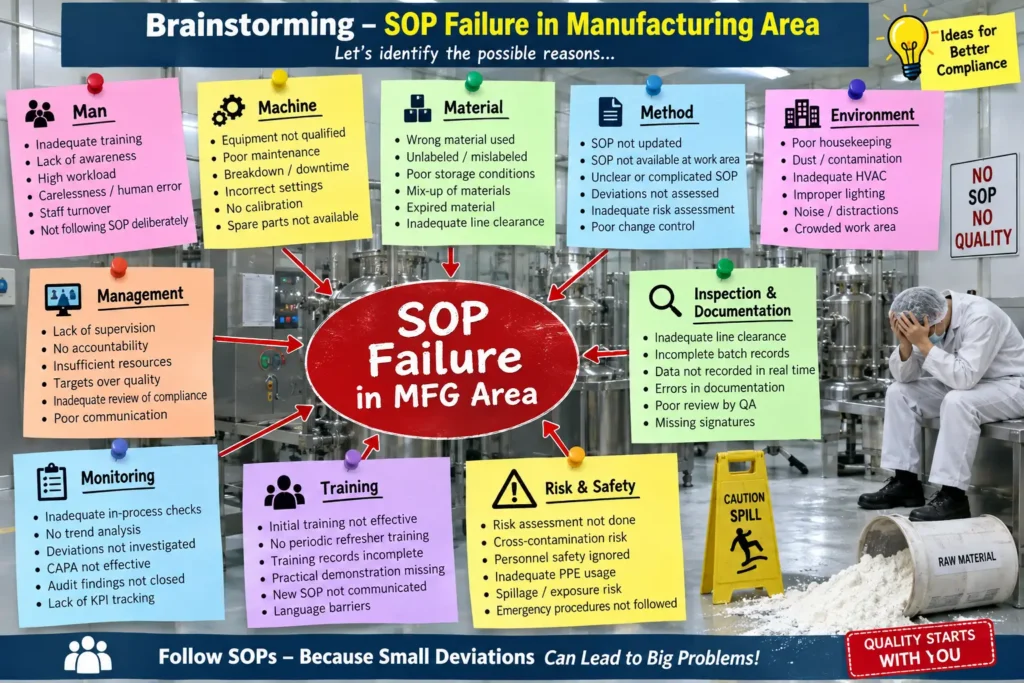
The major causes include personnel-related issues such as inadequate training, lack of awareness, workload, carelessness, and failure to follow approved procedures. Machine-related factors include equipment breakdown, poor maintenance, incorrect settings, lack of calibration, and qualification issues. Material-related causes may involve wrong, expired, mislabeled, or mixed-up materials and inadequate line clearance. The diagram also highlights method, environment, management, documentation, monitoring, training, and safety factors. Examples include outdated or unavailable SOPs, poor housekeeping, insufficient supervision, incomplete records, ineffective CAPA, inadequate refresher training, and incomplete risk assessment. This brainstorming approach helps investigators identify probable causes, prioritize investigation areas, determine the root cause, and establish suitable corrective and preventive actions (CAPA) to avoid recurrence.
3. 5-Why Analysis for SOP Failure:
The 5-Why Analysis for SOP Failure in the Manufacturing Area is used to identify the underlying root cause of a procedure not being followed correctly during manufacturing. The analysis begins with the main problem: the approved SOP was not followed, creating a potential product quality and compliance risk.
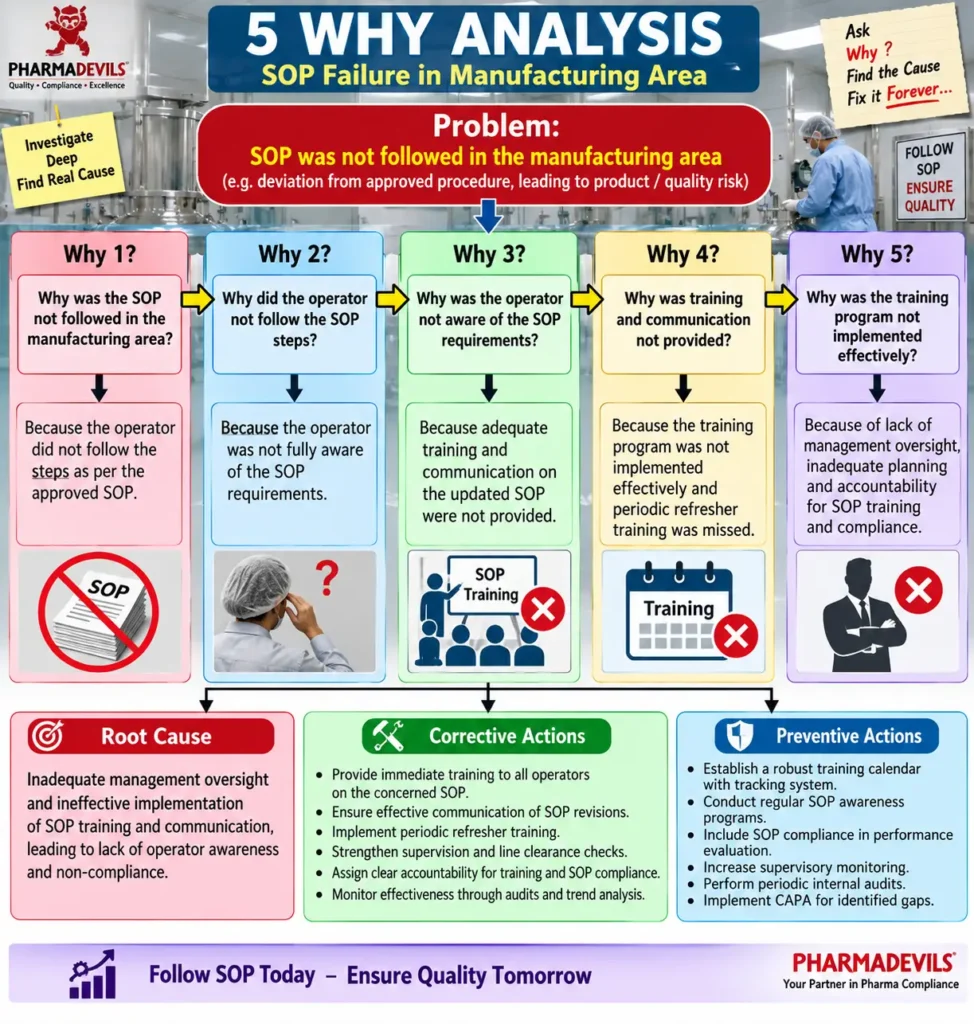
The first “Why” identifies that the operator did not perform the activity according to the approved SOP. Further questioning shows that the operator was not fully aware of the SOP requirements. This lack of awareness may be linked to inadequate training and communication, especially when procedures are revised or updated. The next level identifies ineffective implementation of training and missed refresher training. The final “Why” points toward insufficient management oversight, poor planning, and weak accountability for SOP training and compliance. The analysis therefore identifies ineffective training and management control as the likely root cause and supports corrective and preventive actions such as refresher training, stronger supervision, compliance monitoring, and periodic audits.
4. Fishbone Analysis for SOP Failure:
The Fishbone Analysis for SOP Failure in the Manufacturing Area is used to identify and organize the possible causes responsible for non-compliance with an approved procedure. The diagram groups potential causes into major categories such as Man, Machine, Method, Material, Environment, Measurement/Monitoring, Management, and Training.
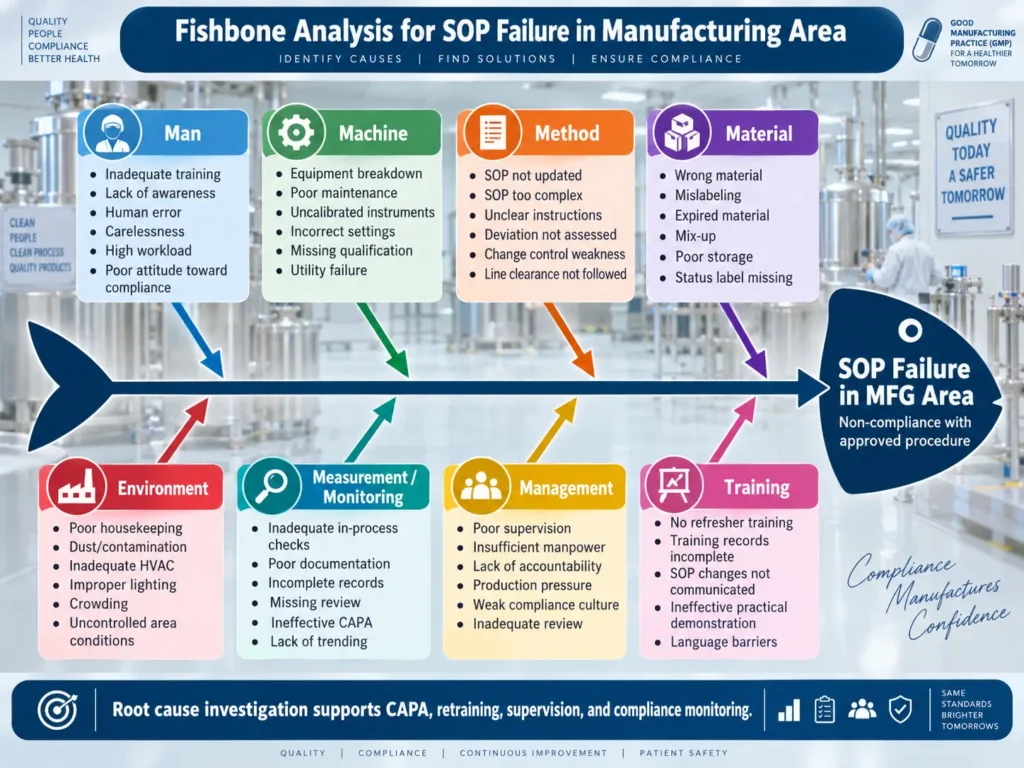
Personnel-related causes include inadequate training, lack of awareness, human error, carelessness, and high workload. Machine-related causes may involve equipment breakdown, poor maintenance, incorrect settings, missing qualification, or calibration issues. Method and material factors include outdated or unclear SOPs, weak change control, wrong or expired materials, mislabeling, and mix-ups. The analysis also considers poor housekeeping, inadequate HVAC, incomplete documentation, ineffective CAPA, weak supervision, insufficient manpower, and lack of refresher training. By reviewing all these contributing factors systematically, the fishbone diagram supports root-cause identification, CAPA development, retraining, stronger supervision, and improved SOP compliance in the manufacturing area.
5. Fault Tree Analysis for SOP Failure:
The Fault Tree Analysis (FTA) for SOP Failure in the Manufacturing Area is used to identify the possible basic events that can lead to non-compliance with an approved procedure. The top event is defined as SOP Failure in the Manufacturing Area, and the diagram shows that this failure may result from one or more contributing causes.
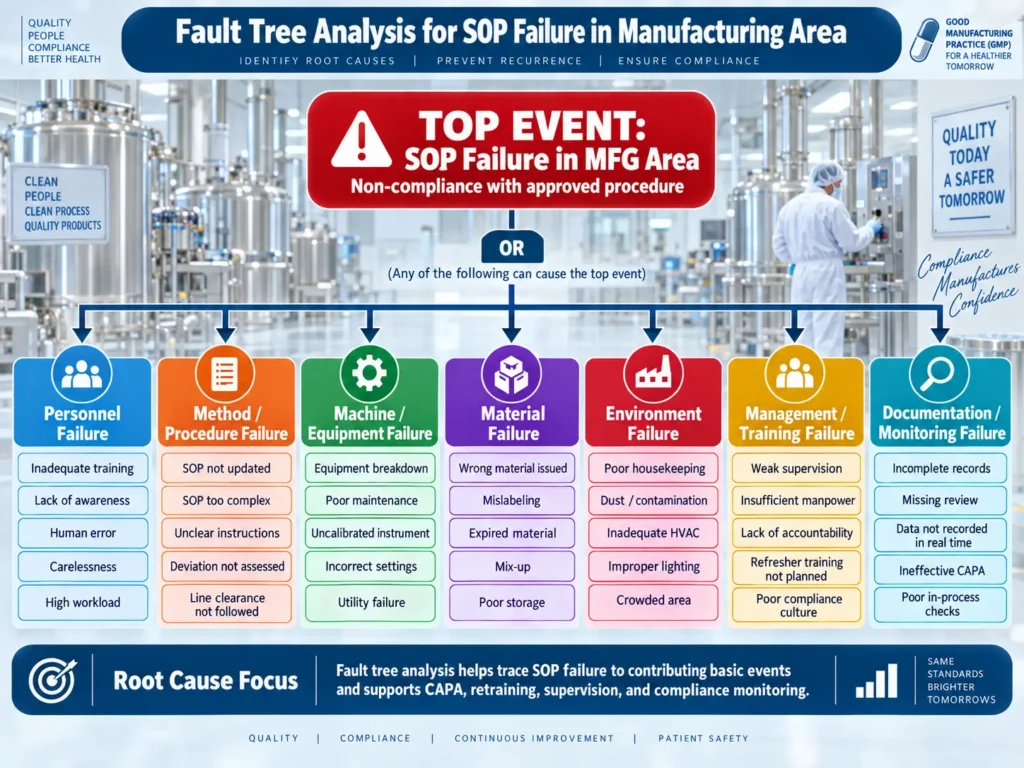
Major branches include Personnel Failure, Method/Procedure Failure, Machine/Equipment Failure, Material Failure, Environment Failure, Management/Training Failure, and Documentation/Monitoring Failure. Typical causes include inadequate training, lack of awareness, unclear or outdated SOPs, equipment breakdown, uncalibrated instruments, wrong or mislabeled materials, poor housekeeping, inadequate HVAC, weak supervision, incomplete records, ineffective CAPA, and insufficient in-process monitoring. FTA helps trace the failure from the top event down to its contributing causes. This supports effective root-cause investigation, CAPA, retraining, supervision, documentation improvement, and compliance monitoring, reducing the likelihood of recurrence.
Questions & Answers:
Q1. What is the objective of this SOP?
Answer: To define the procedure for performing the Microbial Enumeration Test for raw materials, semi-finished products, and finished products.
Q2. Who is responsible for performing the microbial enumeration test?
Answer: The Officer/Executive – Microbiologist is responsible for performing the activity as described in the SOP.
Q3. How are water-soluble samples prepared?
Answer: Dissolve 10 g or dilute 10 ml of the sample in buffered sodium chloride-peptone solution pH 7.0 and make the volume up to 100 ml to prepare Solution A.
Q4. How are water-insoluble samples prepared?
Answer: Suspend 10 g or 10 ml of the sample in buffered sodium chloride-peptone solution containing 0.1% w/v polysorbate 80 and adjust the volume to 100 ml.
Q5. Which method is used for microbial enumeration?
Answer: The SOP describes the Pour Plate Method, using two pre-sterilized Petri plates for TAMC and TYMC testing.
Q6. What are the incubation conditions for TAMC?
Answer: TAMC plates containing Soyabean Casein Digest Agar are incubated at 30–35°C for 5 days in an inverted position.
Q7. What are the incubation conditions for TYMC?
Answer: TYMC plates using Sabouraud Dextrose Agar or Sabouraud Chloramphenicol Agar are incubated at 20–25°C for 7 days.
Q8. Which specified microorganisms are covered in the SOP?
Answer: The SOP includes testing for organisms such as E. coli, Salmonella, Pseudomonas aeruginosa, Staphylococcus aureus, bile-tolerant Gram-negative bacteria, Shigella, and Candida albicans.
Q9. Why are positive, negative, and test controls important?
Answer: These controls help demonstrate that the media, test conditions, and testing procedure are functioning appropriately and help detect contamination or procedural failure.
Q10. How are microbial enumeration results calculated?
Answer: Colony counts from duplicate plates are averaged and multiplied by the applicable dilution factor to report the result as CFU/g or CFU/ml.
Q11. What can cause SOP failure in the manufacturing or testing area?
Answer: Potential causes include inadequate training, failure to follow approved instructions, equipment or material issues, poor documentation, weak supervision, environmental problems, and inadequate monitoring.
Q12. What should be done when an SOP failure is detected?
Answer: The event should be documented and investigated, the root cause identified using suitable tools such as 5-Why, Fishbone, or Fault Tree Analysis, and appropriate CAPA, retraining, supervision, and effectiveness monitoring should be implemented.
Reference Guidelines:
- USP–NF General Chapter <61> – Microbiological Examination of Nonsterile Products: Microbial Enumeration Tests
Covers TAMC, TYMC, sample preparation, method suitability, neutralization and microbial recovery. (USP)
USP official microbiology reference - USP–NF General Chapter <62> – Microbiological Examination of Nonsterile Products: Tests for Specified Microorganisms
Provides procedures for detection of specified objectionable microorganisms in non-sterile products. (USP) - USP <1111> – Microbiological Examination of Nonsterile Products: Acceptance Criteria for Pharmaceutical Preparations and Substances for Pharmaceutical Use
Used for establishing appropriate microbial acceptance criteria together with <61> and <62>. (USP) - European Pharmacopoeia (Ph. Eur.) 2.6.12 – Microbiological Examination of Non-Sterile Products: Microbial Enumeration Tests and 2.6.13 – Test for Specified Micro-organisms. The corresponding microbiological quality requirements are addressed in Ph. Eur. 5.1.4. (EDQM)
- Indian Pharmacopoeia (IP), current edition – relevant general chapters on microbiological examination/contamination testing of non-sterile pharmaceutical products. The Indian Pharmacopoeia Commission specifically identifies microbiological contamination testing of non-sterile pharmaceutical products within its microbiology activities. (Indian Pharmacopoeia Commission)
Indian Pharmacopoeia Commission – Microbiology