




Brief Description
This SOP describes the procedure for microbiological monitoring of drain points in manufacturing areas using the swab method. Its purpose is to detect objectionable pathogenic microorganisms and verify the microbiological condition of manufacturing-area drains. Sterile swabs, saline solution, Soyabean Casein Digest Medium (SCDM), required culture media, LAF, incubator and other microbiological materials are used. A sterile swab is rubbed over approximately 16 cm² of the drain surface, labelled according to location and transferred to the microbiology laboratory. The swab content is enriched in SCDM and incubated at 30–35°C for 18–24 hours. Testing is performed for Escherichia coli, Salmonella, Pseudomonas aeruginosa and Staphylococcus aureus. Drain monitoring is performed quarterly, and the acceptance criterion requires all specified pathogens to be absent. If any pathogen is detected, Production is informed, corrective action is taken, and the affected location is retested.
Skip to PDF content1. Flow Diagram:
The flow diagram describes the step-by-step procedure for microbiological monitoring of drain points in the manufacturing area by the swab method. The process begins with preparation of 0.9% saline solution, culture media, and sterile swabs, followed by sterilization in an autoclave at 121°C and 15 psi for 15 minutes.
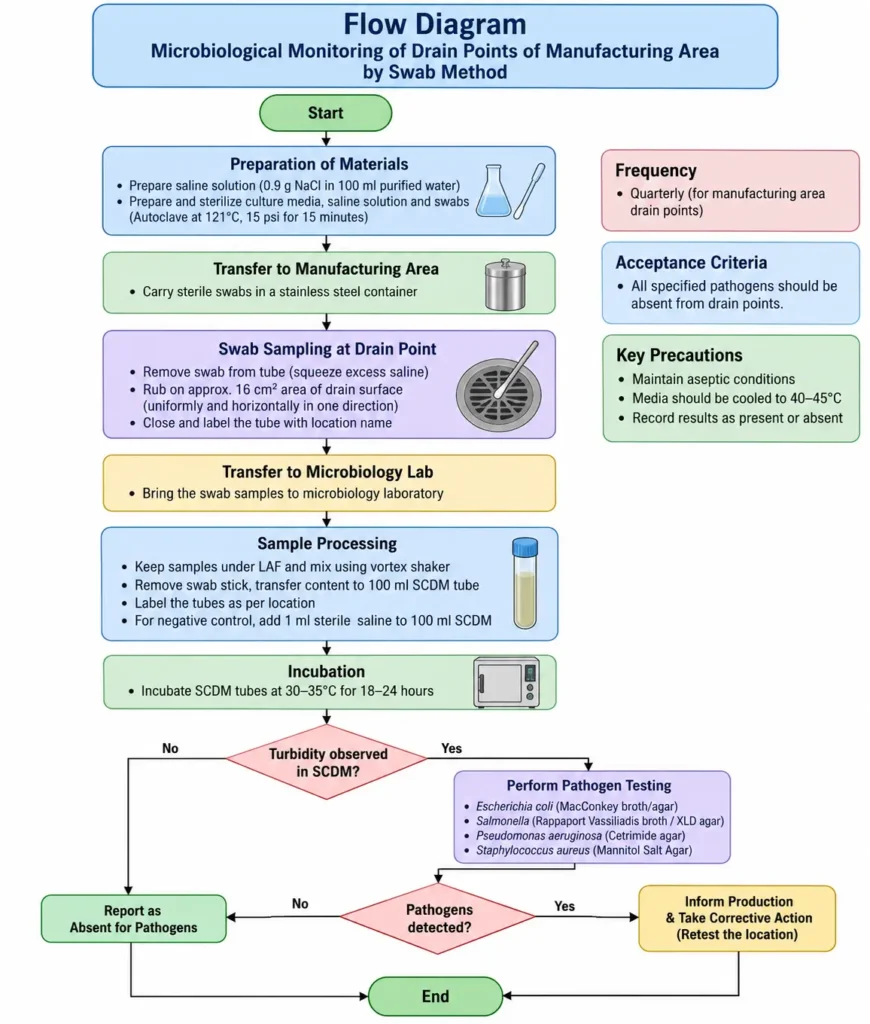
Sterile swabs are transferred to the manufacturing area in a stainless-steel container. Each drain point is sampled by rubbing the swab over approximately 16 cm² of surface, after which the tube is labelled and transferred to the microbiology laboratory. The samples are processed under LAF, mixed using a vortex shaker, transferred into SCDM and incubated at 30–35°C for 18–24 hours. If turbidity is observed, testing is performed for E. coli, Salmonella, Pseudomonas aeruginosa, and Staphylococcus aureus. All specified pathogens must be absent. If any pathogen is detected, Production is informed, corrective action is taken, and the affected drain point is retested. Monitoring is performed quarterly.
2. Brainstorming for SOP Failure:
The brainstorming diagram identifies possible reasons why the SOP for microbiological monitoring of manufacturing-area drain points may fail during implementation. The causes are grouped into six major areas: Man, Method, Material, Machine, Environment, and Management.
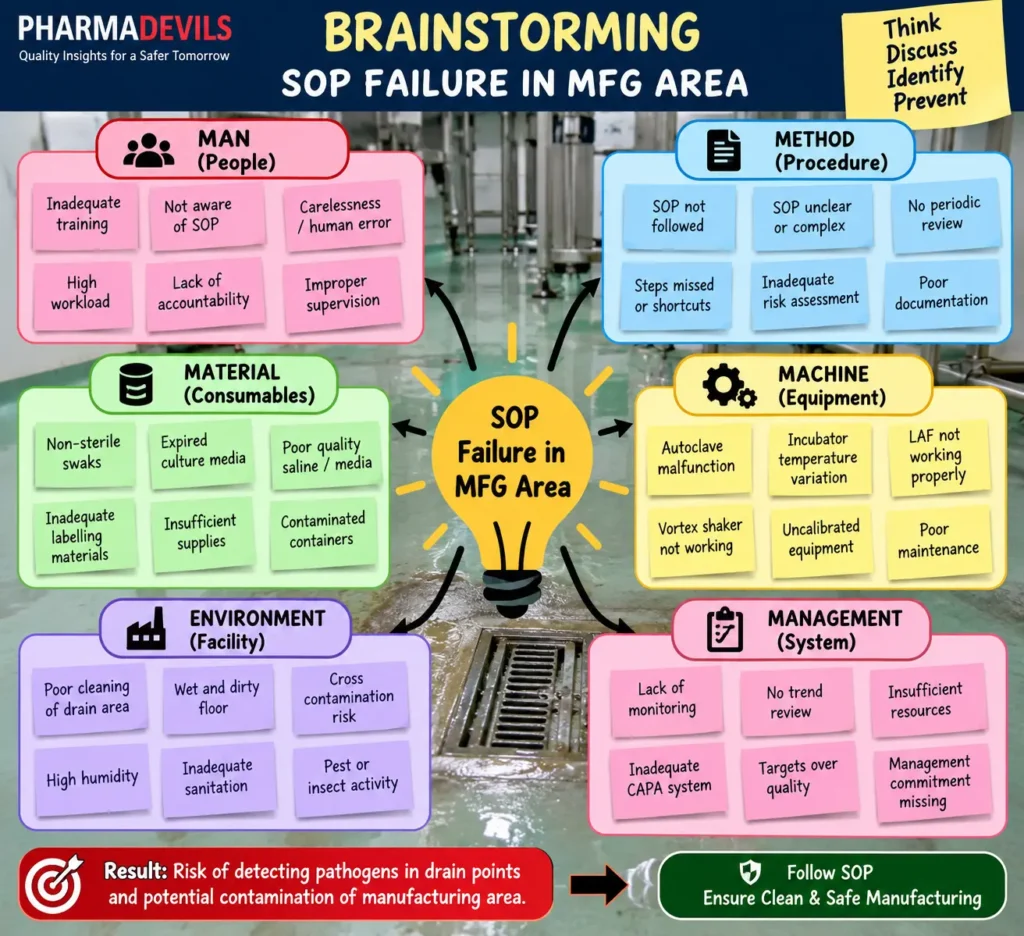
People-related causes include inadequate training, lack of SOP awareness, high workload, human error, poor supervision, and weak accountability. Method-related failures may occur when SOP steps are unclear, skipped, not reviewed, or poorly documented. Material issues include non-sterile swabs, expired culture media, poor-quality saline, contaminated containers, and insufficient supplies. Equipment problems such as autoclave malfunction, incubator temperature variation, ineffective LAF, uncalibrated equipment, and poor maintenance may also affect results. Environmental causes include poor drain cleaning, wet or dirty floors, high humidity, inadequate sanitation, and cross-contamination risk. Management failures may involve weak monitoring, inadequate CAPA, insufficient resources, and lack of periodic trend review. These failures can increase the risk of incorrect microbiological monitoring and possible contamination of the manufacturing area.
3. 5-Why Analysis for SOP Failure:
The 5-Why analysis identifies the root cause behind failure to effectively follow the SOP for microbiological monitoring of manufacturing-area drain points. The analysis begins with the problem that drain-point sampling and microbiological monitoring were not performed as required. It then traces the failure through missed activities such as aseptic swabbing, proper labelling, sample transfer, incubation, and documentation.
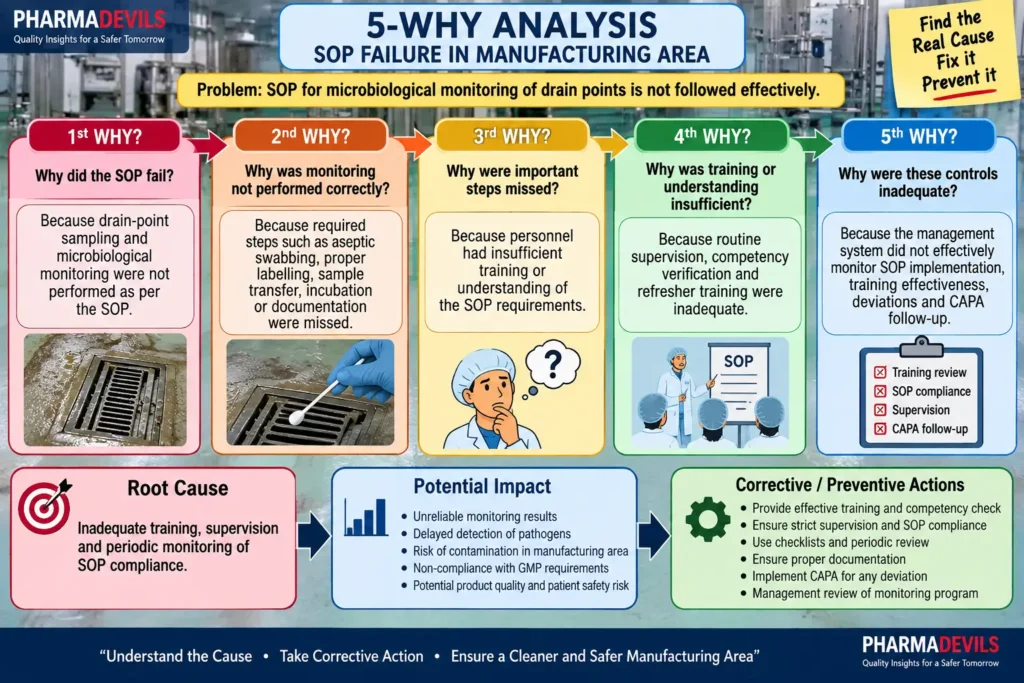
The next level identifies insufficient training and understanding of SOP requirements among personnel. Further investigation shows that routine supervision, competency verification, refresher training, and periodic compliance checks were inadequate. The final Why points to weakness in the management system, including insufficient monitoring of SOP implementation, training effectiveness, deviations, and CAPA follow-up. The likely root cause is therefore inadequate training, supervision, and periodic monitoring of SOP compliance. This can result in unreliable monitoring results, delayed detection of pathogens, contamination risk, and GMP non-compliance.
5. Fishbone Analysis for SOP Failure:
The Fishbone Analysis identifies the possible causes of SOP failure during microbiological monitoring of manufacturing-area drain points. The causes are grouped under six categories: Man, Method, Machine, Material, Environment, and Management.
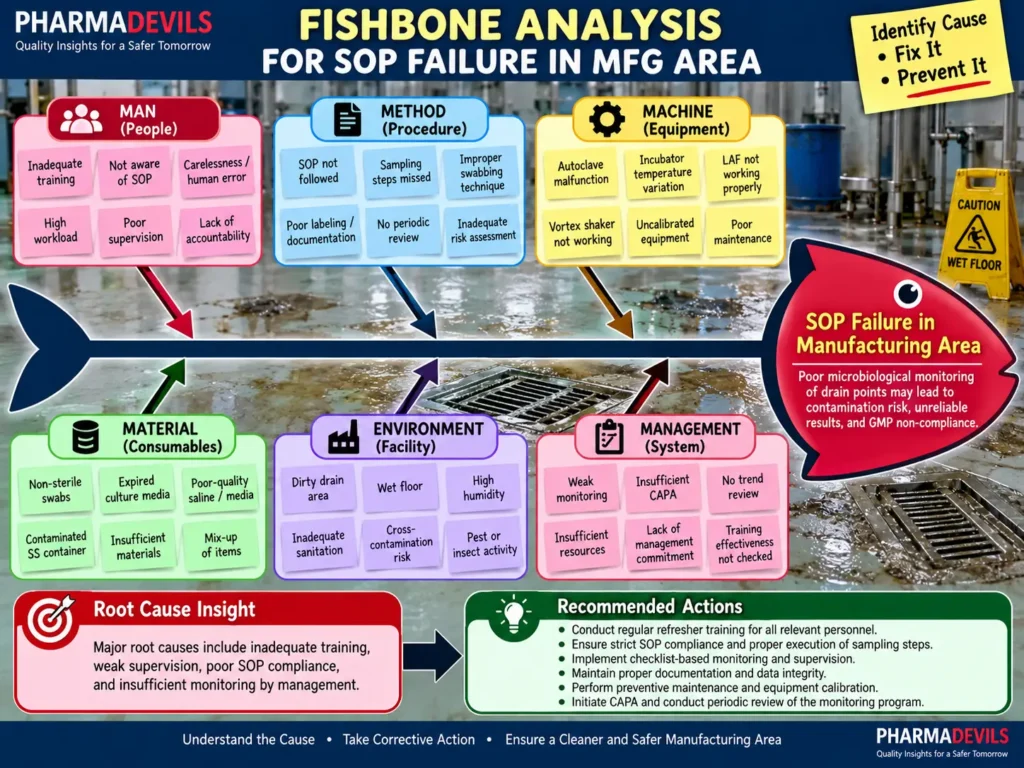
Man-related causes include inadequate training, human error, poor supervision, high workload, and lack of accountability. Method-related causes include missed sampling steps, improper swabbing, weak documentation, and poor SOP compliance. Machine-related causes may involve autoclave malfunction, incubator temperature variation, ineffective LAF, uncalibrated equipment, and poor maintenance. Material-related causes include non-sterile swabs, expired media, contaminated containers, and poor-quality saline or culture media. Environmental factors such as dirty drains, wet floors, inadequate sanitation, high humidity, and cross-contamination can further increase risk. Management-related causes include weak monitoring, inadequate CAPA, insufficient resources, and poor review of training effectiveness. These failures may lead to unreliable results, delayed pathogen detection, contamination risk, and GMP non-compliance. The SOP requires aseptic testing and absence of specified pathogens from drain points.
4. Fault Tree Analysis for SOP Failure:
The Fault Tree Analysis explains how different failures can combine to cause SOP failure in the manufacturing area during microbiological monitoring of drain points. The top event is ineffective implementation of the SOP, which can result from personnel failure, procedure failure, equipment/utility failure, or environmental and management failure.
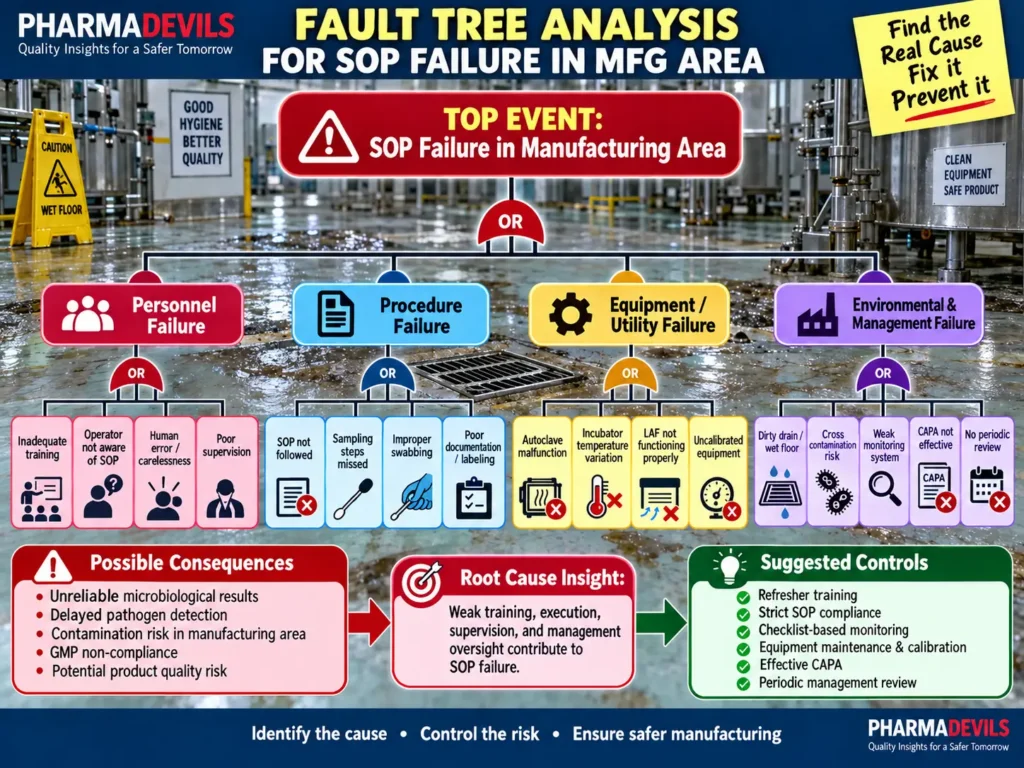
Personnel-related causes include inadequate training, poor SOP awareness, human error, and weak supervision. Procedure failures may involve skipped sampling steps, improper swabbing, poor labelling, and incomplete documentation. Equipment-related causes include autoclave malfunction, incubator temperature variation, ineffective LAF operation, and uncalibrated equipment. Environmental and management failures include dirty drains, wet floors, cross-contamination risk, weak monitoring systems, ineffective CAPA, and lack of periodic review. These failures may lead to unreliable microbiological results, delayed pathogen detection, contamination risk, GMP non-compliance, and potential product-quality impact. Effective controls include refresher training, strict SOP compliance, checklist-based monitoring, equipment calibration, CAPA implementation, and periodic management review.
Questions & Answers – Microbiological Monitoring of Drain Points by Swab Method
- Q: What is the objective of this SOP?
A: To provide guidelines for microbiological monitoring of drain points in the manufacturing area using the swab method. - Q: Where is this SOP applicable?
A: It is applicable to drain points located in the manufacturing area. - Q: Who is responsible for implementation of the SOP?
A: The Microbiologist is responsible for implementation; the Assistant Manager–QC is responsible for execution, and Head–QA/QC is responsible for review and approval. - Q: Which major equipment is required?
A: Autoclave, incubator, LAF, balance, and clean stainless-steel container are required. - Q: How is normal saline prepared?
A: Accurately weigh 0.9 g sodium chloride, dissolve it in purified water, and make the final volume to 100 mL with purified water. - Q: What are the sterilization conditions for media, saline solution, and swabs?
A: They are autoclaved at 121°C and 15 psi for 15 minutes. - Q: How much drain surface area is swabbed?
A: Approximately 16 cm² of the drain surface is swabbed uniformly and horizontally in one direction. - Q: What is done after taking the drain swab?
A: The PP tube is closed, labelled with the location name, and transferred to the microbiology laboratory. - Q: How are swab samples processed in the laboratory?
A: Samples are placed under LAF, mixed using a vortex shaker, and the contents are aseptically transferred into 100 mL SCDM. - Q: What negative control is used?
A: One millilitre of sterile saline solution from a sterile swab PP tube is added to 100 mL SCDM. - Q: What are the incubation conditions for SCDM?
A: SCDM tubes are incubated at 30–35°C for 18–24 hours. - Q: Which pathogens are tested when turbidity is observed?
A: The SOP includes testing for Escherichia coli, Salmonella, Pseudomonas aeruginosa, and Staphylococcus aureus. - Q: Which medium is used for confirmation of E. coli?
A: MacConkey broth followed by subculture on MacConkey Agar is used. - Q: Which medium is used for Salmonella testing?
A: Rappaport Vassiliadis Salmonella Enrichment Broth followed by Xylose Lysine Deoxycholate Agar is used. - Q: Which agar is used for Pseudomonas aeruginosa testing?
A: Cetrimide Agar is used. - Q: Which medium is used for Staphylococcus aureus?
A: Mannitol Salt Agar is used. - Q: What precautions are required during testing?
A: Aseptic conditions must be maintained, media should be cooled to 40–45°C, and results should be reported as present or absent. - Q: What is the monitoring frequency?
A: Manufacturing-area drain points are monitored quarterly. - Q: What is the acceptance criterion?
A: All specified pathogens must be absent from all drain points. - Q: What action is taken if a pathogen is detected?
A: Production is informed immediately, corrective action is taken, and the affected drain location is retested after corrective action.
Reference Guidelines:
- Revised Schedule M, Drugs Rules, 1945 – G.S.R. 922(E), 28 December 2023, CDSCO, India: applicable GMP requirements for premises, sanitation, contamination control, documented procedures, quality systems, and manufacturing controls. (CDSCO)
CDSCO Revised Schedule M - WHO TRS 961, Annex 2 – Good Practices for Pharmaceutical Microbiology Laboratories: relevant to microbiological laboratory practices, environmental monitoring, cleaning/disinfection, culture media, equipment qualification, calibration, and microbiological testing controls. (World Health Organization)
WHO TRS 961 Annex 2 - USP General Chapter <62> – Microbiological Examination of Nonsterile Products: Tests for Specified Microorganisms: useful technical reference for detection/absence testing of specified microorganisms such as E. coli, Salmonella, Pseudomonas aeruginosa, and Staphylococcus aureus. (USP)
- USP General Chapter <1116> – Microbiological Control and Monitoring of Aseptic Processing Environments: applicable where the drain-monitoring program forms part of environmental microbiological control in aseptic/sterile manufacturing areas. (USP)
- EU GMP Annex 1 – Manufacture of Sterile Medicinal Products: relevant for sterile facilities and contamination-control programs. It contains specific expectations for drains in classified areas and environmental/process monitoring. (Public Health)
- WHO GMP guidance for sterile pharmaceutical products, where applicable to sterile manufacturing. CDSCO has specifically referenced WHO TRS guidance along with revised Schedule M for implementation by sterile-product manufacturers. (CDSCO)