







Brief Description
This SOP describes the procedure for monitoring the efficiency of ultraviolet (UV) lights installed in Laminar Air Flow (LAF) units and pass boxes. It applies to all such UV lights installed within the plant, with the microbiologist responsible for performing the test and QC management responsible for review and effective implementation. The efficiency test uses SCDA plates inoculated with Bacillus subtilis. One inoculated plate is protected with aluminum foil as a control, while another is exposed directly to UV light for 30 minutes. The plates are then incubated at 30–35°C for 24–48 hours and examined for microbial growth.The test is performed once every month. UV efficiency is considered satisfactory when the exposed plate shows no growth, the foil-wrapped plate and positive control show growth, and the negative control remains free from growth. Results are documented in the prescribed UV Light Efficiency Monitoring Record (Annexure-I).
Skip to PDF content1. Flow Diagram:
The flow diagram illustrates the systematic procedure for evaluating the efficiency of UV lights installed in Laminar Air Flow (LAF) units and pass boxes. The process starts with preparation of SCDA media, pouring approximately 15–20 mL into sterile 90 mm Petri plates, solidification, labelling, and pre-incubation at 30–35°C for 24 hours to confirm that the plates are free from contamination.
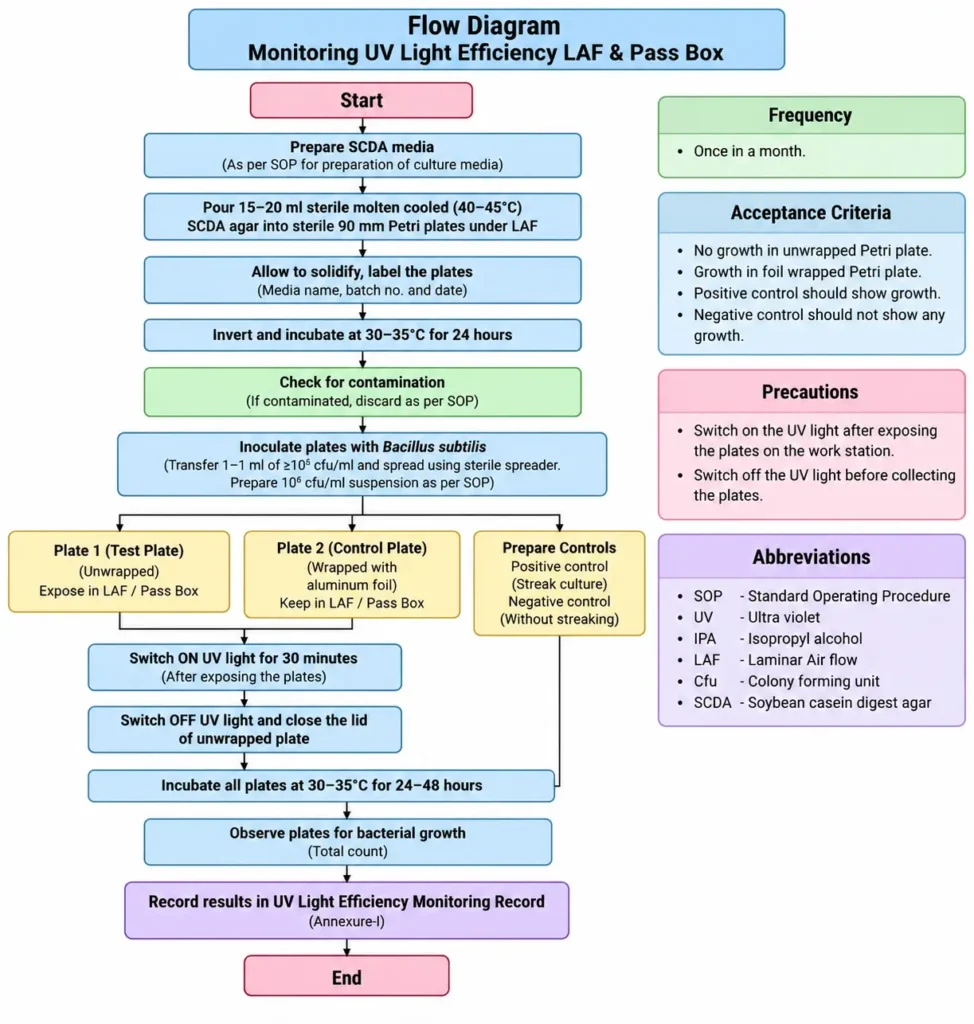
After pre-incubation, the plates are inoculated with Bacillus subtilis. One test plate remains unwrapped and is directly exposed to UV light, while another plate is wrapped in aluminium foil and serves as the protected control. The UV light is switched on for 30 minutes, after which the plates are incubated at 30–35°C for 24–48 hours. Positive and negative controls are also maintained. After incubation, the plates are examined for microbial growth and the results are documented in the UV Light Efficiency Monitoring Record (Annexure-I). The test is performed once every month. Satisfactory UV performance is demonstrated when the exposed plate shows no growth, the foil-wrapped plate and positive control show growth, and the negative control shows no growth.
2. Brainstorming for SOP Failure:
The brainstorming diagram presents a worst-case assessment of potential failures when the SOP for monitoring UV light efficiency of LAF and pass boxes is not properly followed. The SOP requires correct SCDA preparation, pre-incubation of plates, inoculation with Bacillus subtilis, proper use of wrapped and unwrapped plates, 30-minute UV exposure, controlled incubation, and documentation of results.
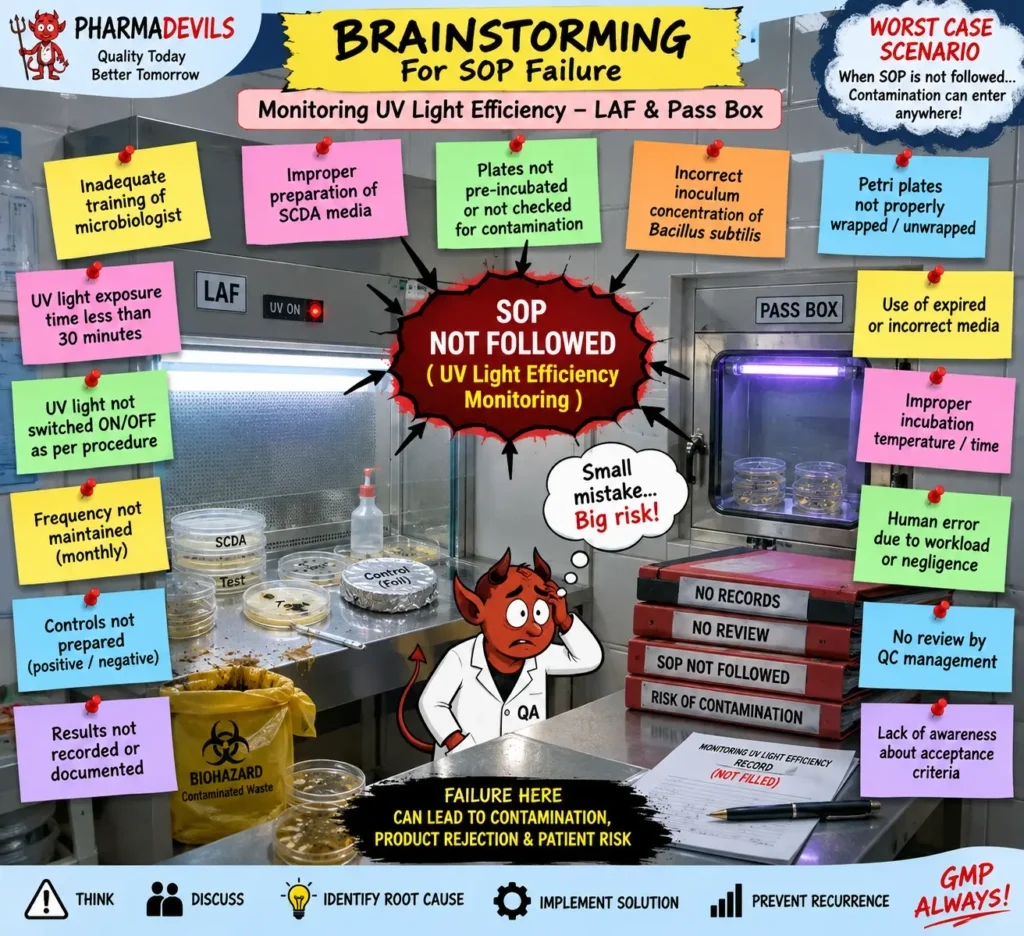
The diagram highlights possible causes such as inadequate microbiologist training, incorrect media preparation, contaminated plates, wrong inoculum concentration, improper plate wrapping, insufficient UV exposure, incorrect UV switching, missed monthly monitoring, absence of positive/negative controls, incomplete records, weak QC review, and lack of awareness of acceptance criteria. The SOP specifies monthly testing and defined growth/no-growth acceptance requirements.In the worst case, these failures may prevent detection of ineffective UV disinfection, increasing the risk of microbial contamination, unreliable environmental control, investigation, product rejection, and potential GMP compliance concerns.
3. 5-Why Analysis for SOP Failure:
The 5-Why analysis explains the potential root causes behind failure to follow the SOP for monitoring UV light efficiency of LAF and pass boxes. The SOP requires controlled preparation of SCDA plates, inoculation with Bacillus subtilis, correct use of wrapped and unwrapped plates, 30-minute UV exposure, incubation, observation, and documentation of results.
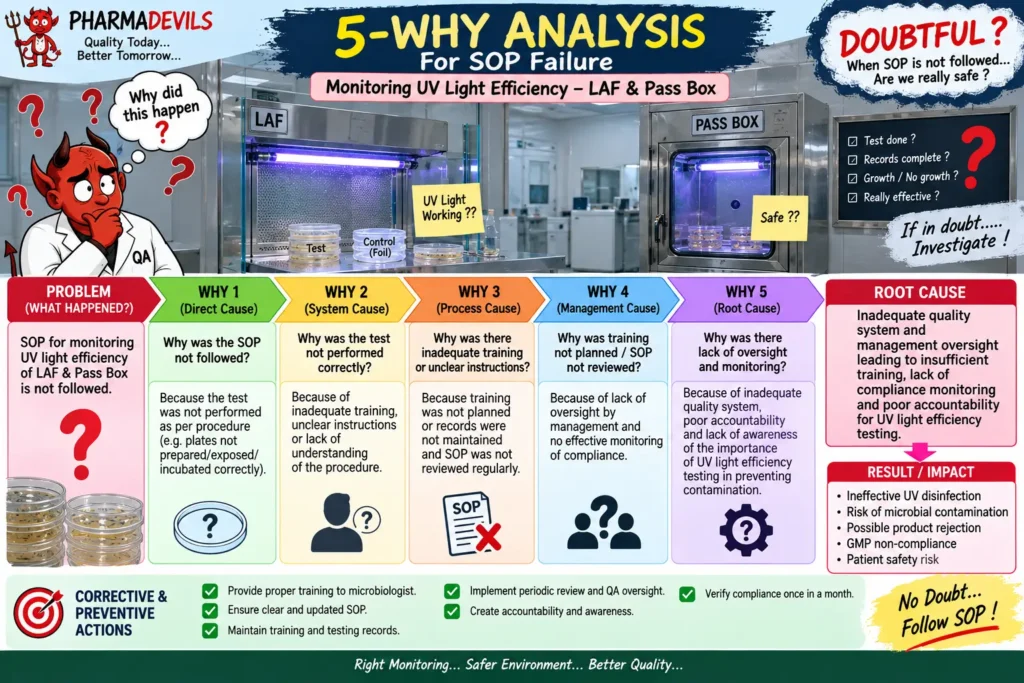
The analysis traces the failure from an immediate procedural lapse to deeper system issues such as inadequate training, unclear understanding of the procedure, incomplete records, insufficient supervisory review, poor compliance monitoring, and weak accountability. These weaknesses can create doubt about whether the UV system is actually effective. The probable root cause is identified as inadequate quality-system oversight and insufficient control over training and routine monitoring. Since the SOP requires testing once every month with defined growth/no-growth acceptance criteria, any failure in execution or review can result in unreliable UV-efficiency assessment and increased contamination risk.
4. Fishbone Analysis for SOP Failure:
The Fishbone Analysis diagram presents a structured root-cause evaluation for failure to properly follow the SOP for monitoring UV light efficiency of LAF and pass boxes. The possible causes are grouped under Man, Machine, Material, Method, Environment, Measurement, and Management to support systematic investigation.
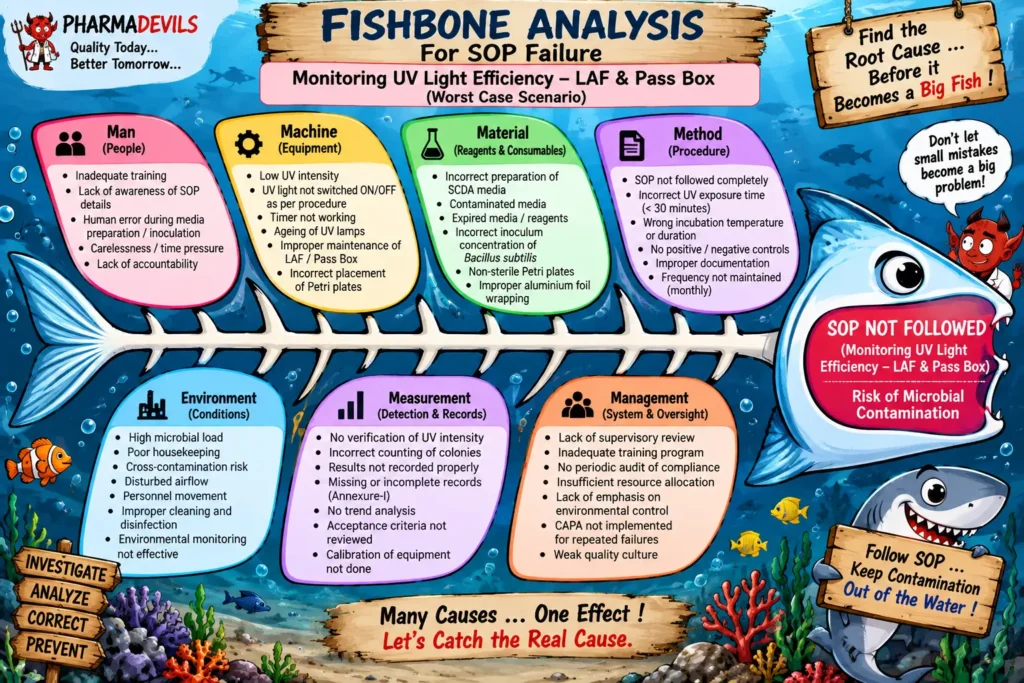
Key contributing factors include inadequate training, poor understanding of SOP requirements, low or ageing UV lamp intensity, improper switching or maintenance of UV lights, incorrect SCDA preparation, contaminated or expired media, improper Bacillus subtilis inoculum, incorrect UV exposure time, missing positive or negative controls, poor documentation, and failure to maintain the required monthly monitoring frequency. The SOP specifically requires controlled media preparation, inoculation, 30-minute UV exposure, incubation, observation, and recording of results. The diagram also highlights weaknesses in environmental control, result recording, supervisory review, training systems, and compliance oversight. In a worst-case situation, these combined failures may allow ineffective UV disinfection to remain undetected, increasing the risk of microbial contamination and GMP non-compliance. The defined acceptance criteria require no growth on the exposed plate, growth on the foil-wrapped control plate and positive control, and no growth on the negative control.
5. Fault Tree Analysis for SOP Failure:
The Fault Tree Analysis diagram evaluates the worst-case failure of the SOP for monitoring UV light efficiency of LAF and pass boxes in the manufacturing area. The top event is defined as failure to follow the UV light efficiency monitoring procedure, which may allow ineffective UV disinfection to remain undetected.
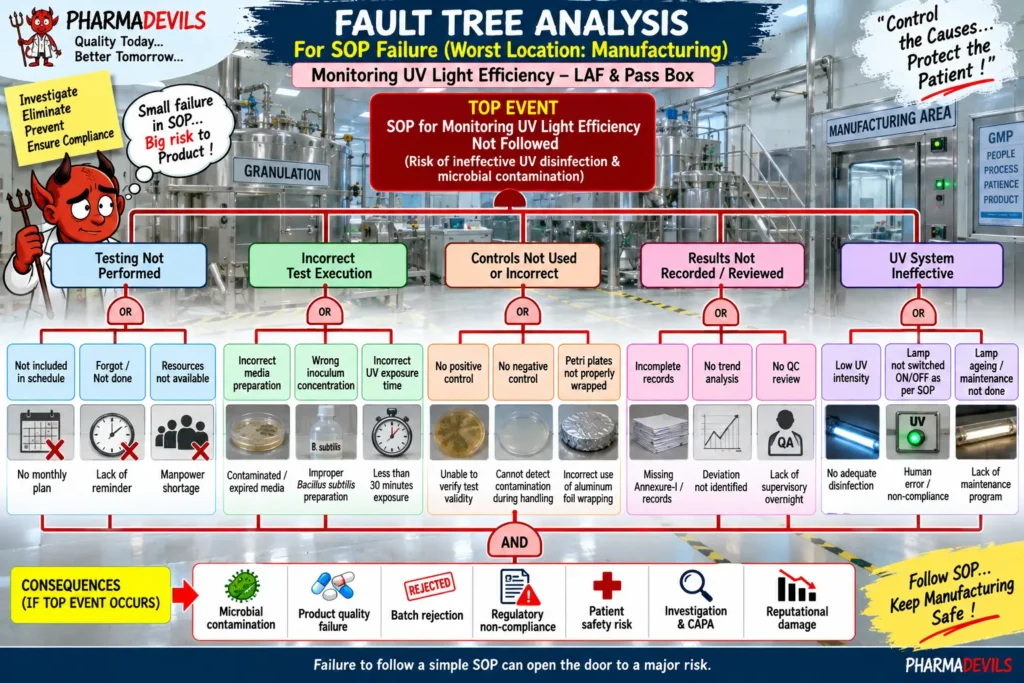
The diagram traces major contributing causes such as testing not being performed, incorrect test execution, improper or missing controls, incomplete recording and review of results, and ineffective UV lamp performance. Specific failure modes include incorrect media preparation, improper Bacillus subtilis inoculum, UV exposure for less than the required time, incorrect plate wrapping, lack of positive or negative controls, missing Annexure-I records, lack of QC review, low UV intensity, and inadequate maintenance. According to the SOP, the test requires 30 minutes of UV exposure, incubation at 30–35°C for 24–48 hours, defined controls, monthly frequency, and documented observation of microbial growth. In the worst case, these failures can result in microbial contamination risk, unreliable disinfection control, product quality impact, investigation, batch rejection, and GMP non-compliance. The analysis therefore emphasizes strong scheduling, correct execution, documentation, supervisory review, and preventive maintenance.
Questions & Answers – Monitoring UV Light Efficiency of LAF & Pass Box
Q1. What is the objective of this SOP?
Answer: The objective is to define the procedure for monitoring the efficiency of UV lights installed in LAF units and pass boxes.
Q2. Where is this SOP applicable?
Answer: It is applicable to all UV lights of LAFs and pass boxes installed in the plant.
Q3. Who is responsible for execution of the SOP?
Answer: The microbiologist is responsible for execution of the SOP.
Q4. Who is responsible for review and effective implementation?
Answer: The Senior Executive QC / Manager QC is responsible for review and effective implementation of the SOP.
Q5. Which microbiological medium is used for the UV efficiency test?
Answer: Soybean Casein Digest Agar (SCDA) is used. Approximately 15–20 mL of sterile molten cooled SCDA is poured into sterile 90 mm Petri plates.
Q6. At what temperature is the SCDA cooled before pouring?
Answer: The sterile molten SCDA is cooled to approximately 40–45°C before pouring into Petri plates.
Q7. Why are the prepared plates pre-incubated?
Answer: The plates are pre-incubated to check for contamination before performing the UV efficiency test. They are incubated at 30–35°C for 24 hours and physically inspected for microbial growth.
Q8. Which microorganism is used in the UV light efficiency test?
Answer: Bacillus subtilis is used as the test microorganism.
Q9. What concentration of culture is transferred to the test plates?
Answer: The SOP specifies transfer of 1 mL of not less than 10⁵ CFU/mL Bacillus subtilis culture to each of two SCDA Petri plates.
Q10. Why is one inoculated Petri plate wrapped in aluminium foil?
Answer: The foil-wrapped plate serves as a protected control because UV light should not directly act on the microorganisms present on that plate.
Q11. How long is the unwrapped plate exposed to UV light?
Answer: The UV light is switched on for 30 minutes.
Q12. What are the incubation conditions after UV exposure?
Answer: Both plates are incubated at 30–35°C for 24–48 hours.
Q13. What controls are required during the test?
Answer: A positive control is prepared by streaking Bacillus subtilis culture, while the negative control is maintained without streaking.
Q14. What are the acceptance criteria for satisfactory UV light efficiency?
Answer: There should be no growth on the unwrapped UV-exposed plate, growth should be present on the aluminium-foil-wrapped plate, the positive control should show growth, and the negative control should show no growth.
Q15. What is the monitoring frequency?
Answer: UV light efficiency monitoring is performed once in a month.
Q16. What precautions are specified during UV exposure?
Answer: The UV light should be switched on only after exposing the plates on the LAF workstation and must be switched off before collecting the plates.
Q17. Where are the test results recorded?
Answer: Results are recorded in the UV Light Efficiency Test Record / Efficiency Monitoring Record (Annexure-I).
Q18. What information is recorded in Annexure-I?
Answer: Annexure-I includes the serial number, location, date of plate exposure, date of observation, media used, observed CFU/plate after 30 minutes, and remarks.
Q19. Who provides training for this SOP?
Answer: The Senior QC Executive is designated as the trainer, and the microbiologist is the trainee. The training period specified is one hour.
Q20. What should be done if the exposed plate shows microbial growth?
Answer: The SOP’s acceptance criterion requires no growth on the exposed plate; therefore, growth would indicate that the acceptance criterion has not been met and the UV efficiency test would not comply with the specified limit.
Reference Guidelines:
- EU GMP – EudraLex Volume 4, Annex 1: Manufacture of Sterile Medicinal Products. Relevant for contamination control strategy, cleanrooms/clean-air equipment, disinfection, environmental monitoring, personnel, and quality-system oversight. (Public Health)
EU GMP Annex 1 – European Commission - PIC/S GMP Guide PE 009, Annex 1 – Manufacture of Sterile Medicinal Products. Covers cleanroom and clean-air equipment qualification, disinfection, environmental/process monitoring, and QC controls. (PIC/S)
PIC/S GMP Guide Annexes - WHO TRS 1044, Annex 2 – Good Manufacturing Practices for Sterile Pharmaceutical Products. Provides GMP expectations for sterile manufacturing and contamination-control systems and was developed in collaboration with the EU and PIC/S. (World Health Organization)
WHO TRS 1044 Annex 2 - US FDA – Sterile Drug Products Produced by Aseptic Processing: Current Good Manufacturing Practice. Useful for requirements relating to aseptic areas, environmental control, sanitization, microbiological monitoring, investigations, and documentation. (U.S. Food and Drug Administration)
FDA Aseptic Processing Guidance - USP General Chapter <1116> – Microbiological Control and Monitoring of Aseptic Processing Environments. Provides recommendations for microbiological control and monitoring of environments used for aseptic processing. (USP)
USP <1116>