





1. Introduction for Operator Exposure Level Test Procedure for Autocoater Flexible Canopy:
The Operator Exposure Level (OEL) Test Procedure for Autocoater Flexible Canopy is designed to evaluate the containment performance of the autocoater system and verify operator protection during routine operations. The test uses Naproxen Sodium tablets as surrogate material and follows SMEPAC-based principles. Operator exposure is assessed through personal breathing-zone air sampling, background/static sampling, continuous sampling, and surface swab testing. Sampling pumps are calibrated and positioned at predefined risk locations, while operating and environmental conditions are monitored. Multiple test cycles are performed to demonstrate consistent containment performance, with results compared against predefined air and surface contamination limits.
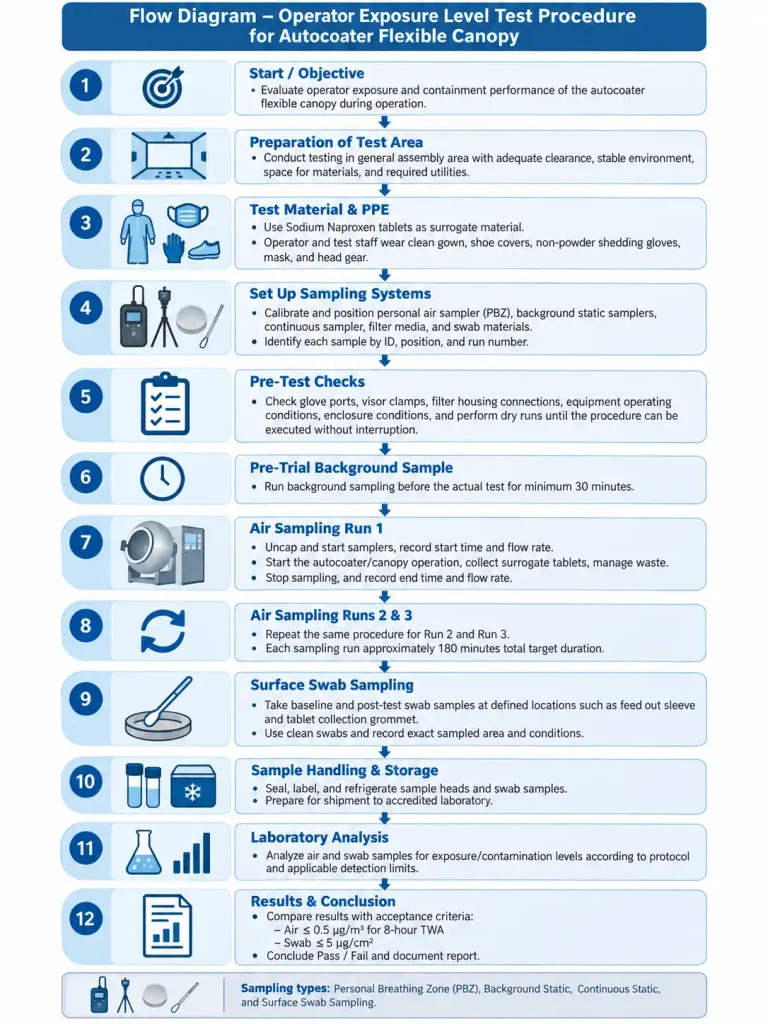
Skip to PDF content2. Flow Diagram – Operator Exposure Level Test Procedure for Autocoater Flexible Canopy:
The flow diagram presents the systematic sequence for evaluating operator exposure and containment performance of an Autocoater Flexible Canopy. It begins with preparation of the test area, selection of surrogate material, PPE requirements, and setup of calibrated air-sampling systems. Pre-test checks and background sampling are completed before conducting three operational air-sampling runs. Personal breathing-zone, background static, continuous, and surface swab samples are collected at predefined locations. Samples are then properly labelled, refrigerated, and sent to an accredited laboratory for analysis. Results are compared with specified acceptance limits, followed by final assessment, documentation, and Pass/Fail conclusion.
3. Brainstorming Analysis for Operator Exposure Level Test Procedure for Autocoater Flexible Canopy:
The brainstorming analysis identifies the major factors that may influence the reliability of the Operator Exposure Level Test Procedure for Autocoater Flexible Canopy. Key areas include test area preparation, surrogate material handling, PPE compliance, sampler calibration, pre-test checks, background contamination, air sampling errors, surface swab technique, sample identification, storage, shipment, environmental conditions, operator training, equipment integrity, laboratory analysis, and documentation. Reviewing these factors helps the team recognize potential sources of error, contamination, exposure, or data variability. This structured approach supports effective risk identification, improved test execution, accurate results, and reliable verification of containment performance.

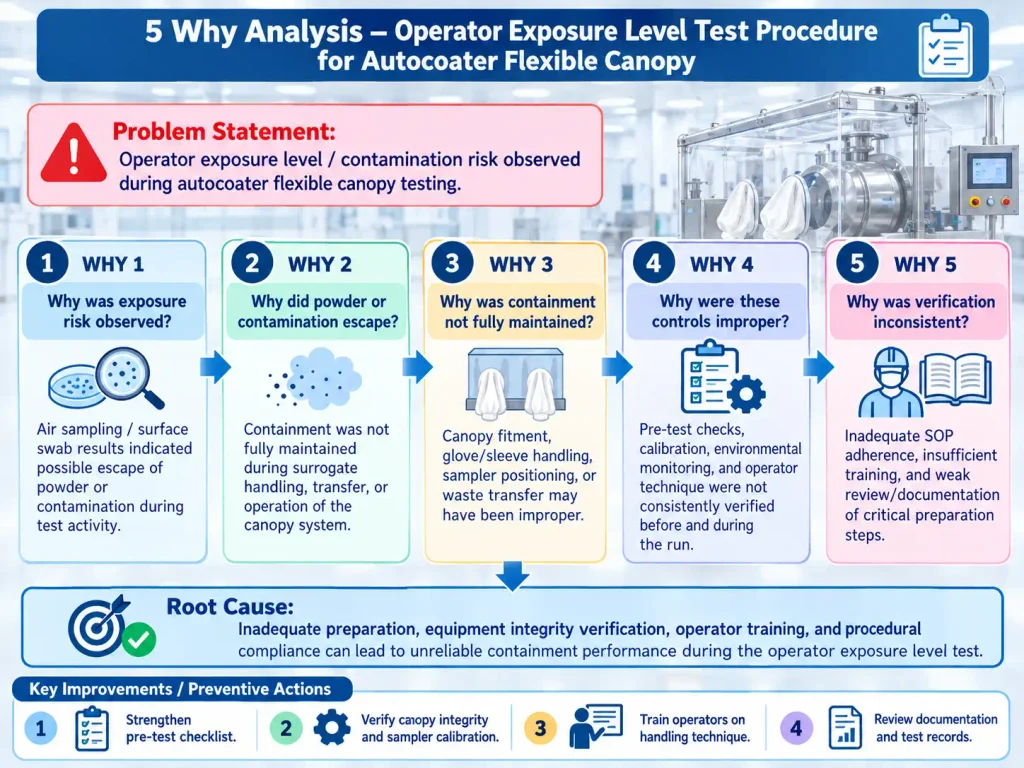
4. 5 Why Analysis for Operator Exposure Level Test Procedure for Autocoater Flexible Canopy:
The 5 Why Analysis evaluates possible reasons for increased operator exposure or contamination during the Autocoater Flexible Canopy OEL test. It begins with abnormal air-sampling or surface-swab results and progressively investigates potential loss of containment. The analysis considers improper surrogate handling, canopy fitment, glove or sleeve handling, sampler positioning, waste transfer, incomplete pre-test checks, calibration issues, environmental monitoring, and operator technique. The final root cause points toward inadequate preparation, equipment integrity verification, training, and procedural compliance. This structured approach helps identify underlying weaknesses and supports corrective actions to improve containment performance, test reliability, and operator protection.
5. Heatmap Analysis for Operator Exposure Level Test Procedure for Autocoater Flexible Canopy:
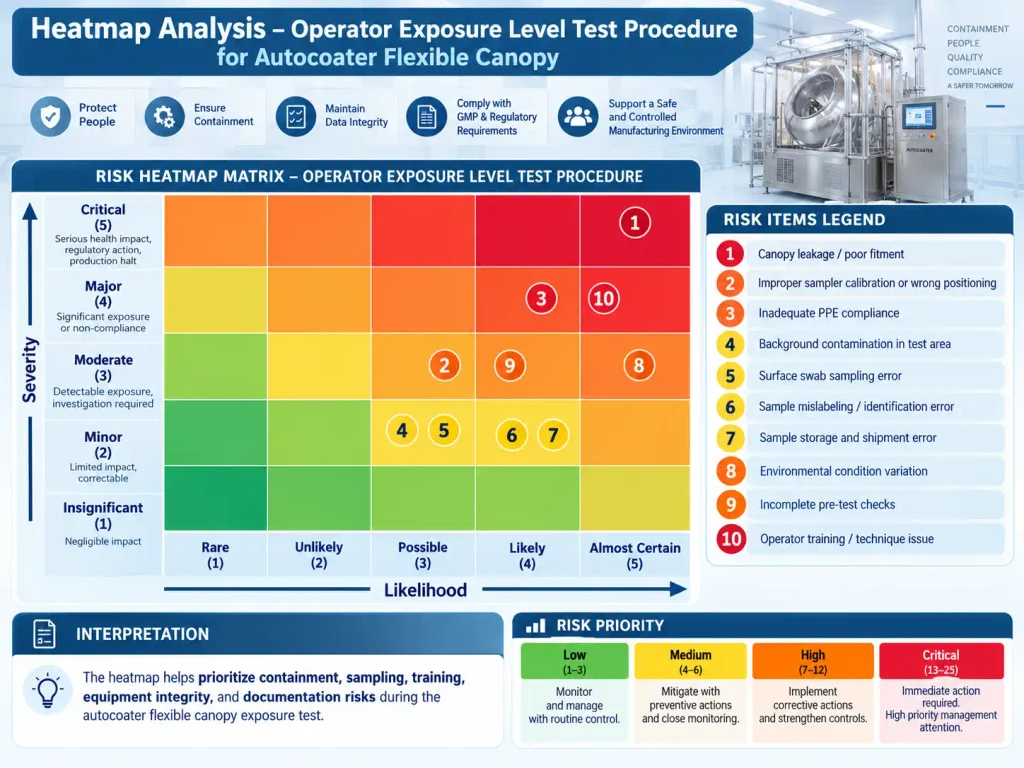
The Heatmap Analysis evaluates and prioritizes potential risks associated with the Operator Exposure Level Test Procedure for Autocoater Flexible Canopy based on severity and likelihood. Key risks include canopy leakage, improper sampler calibration or positioning, inadequate PPE compliance, background contamination, swab-sampling errors, sample mislabelling, storage issues, environmental variation, incomplete pre-test checks, and operator technique. Risks are categorized into Low, Medium, High, and Critical zones using a color-coded matrix. This analysis helps identify areas requiring stronger controls, corrective actions, training, equipment verification, monitoring, and documentation to ensure reliable containment performance and operator protection.
6. Fault Tree Analysis for Operator Exposure Level Test Procedure for Autocoater Flexible Canopy:
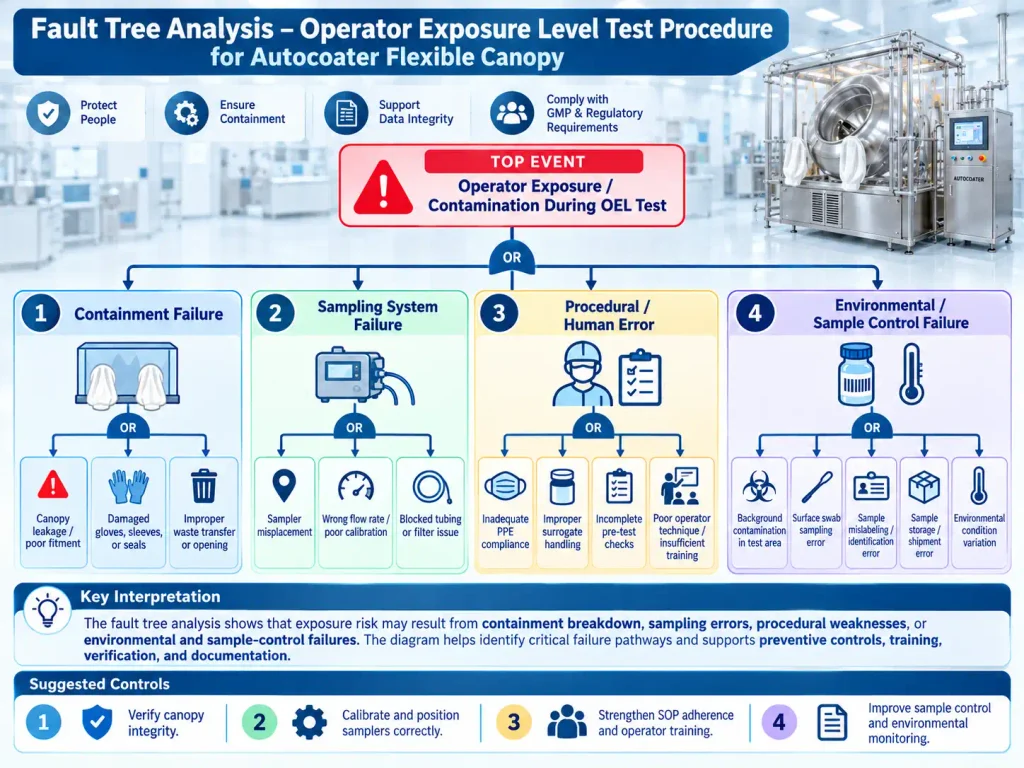
The Fault Tree Analysis identifies potential pathways that may lead to operator exposure or contamination during the Autocoater Flexible Canopy OEL test. The top event is linked to four major failure groups: containment failure, sampling system failure, procedural or human error, and environmental or sample-control failure. Contributing causes include canopy leakage, damaged gloves or seals, sampler misplacement, incorrect flow rate, poor PPE compliance, improper surrogate handling, incomplete pre-test checks, insufficient training, background contamination, swab errors, mislabelling, storage issues, and environmental variation. The analysis supports risk control, training, verification, and improved documentation.
7. Fishbone Analysis for Operator Exposure Level Test Procedure for Autocoater Flexible Canopy:
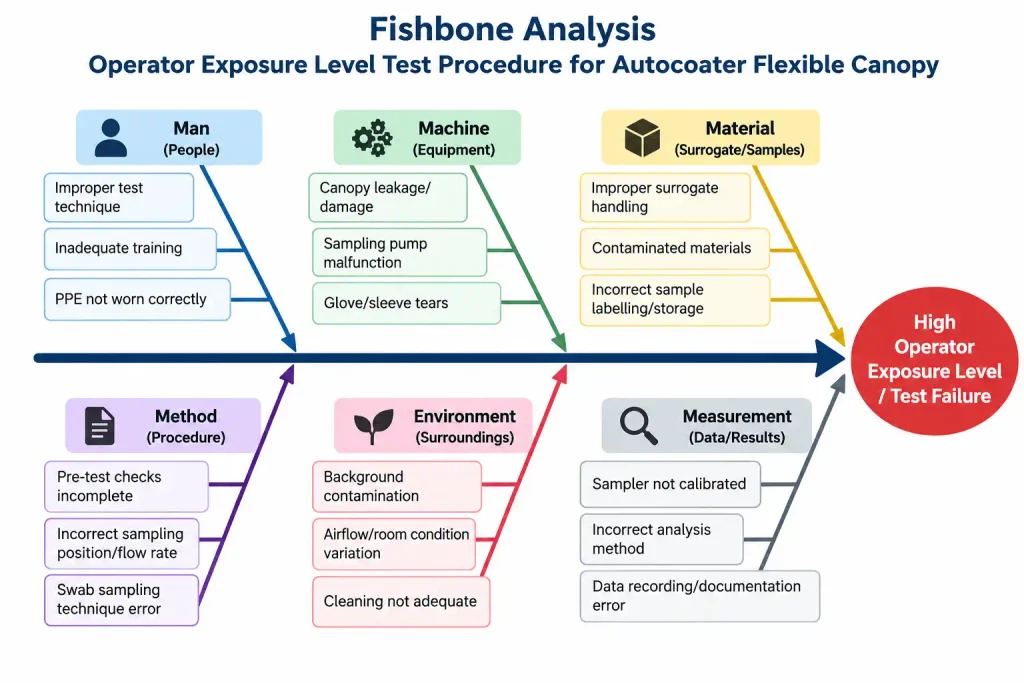
The Fishbone Analysis identifies the main causes that may contribute to a high operator exposure level or failure of the Autocoater Flexible Canopy OEL test. The causes are grouped into six categories: Man, Machine, Material, Method, Environment, and Measurement. Major factors include inadequate training, improper PPE use, canopy leakage, glove or sleeve damage, incorrect surrogate handling, incomplete pre-test checks, wrong sampling position or flow rate, background contamination, poor cleaning, sampler calibration problems, and documentation errors. This simple cause-and-effect analysis helps identify potential weaknesses and supports effective investigation, corrective action, and prevention of operator exposure.
8. Pareto Chart Analysis for Operator Exposure Level Test Procedure for Autocoater Flexible Canopy:
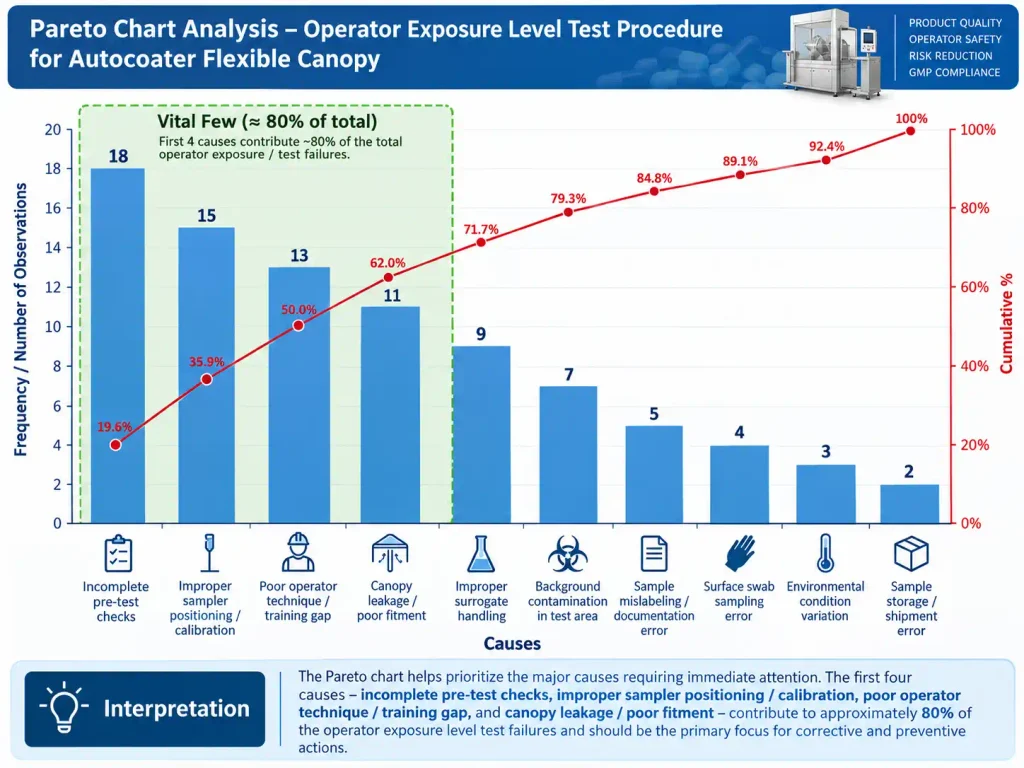
The Pareto Chart Analysis prioritizes the major causes contributing to failure or increased operator exposure during the Autocoater Flexible Canopy OEL test. The causes are arranged from highest to lowest frequency, while the cumulative percentage line highlights the most significant contributors. Major factors include incomplete pre-test checks, improper sampler positioning or calibration, poor operator technique or training, canopy leakage or poor fitment, surrogate handling errors, background contamination, and documentation issues. The analysis helps identify the “vital few” causes requiring immediate attention so that corrective and preventive actions can focus on the areas with the greatest impact.
9. Corrective Action and Preventive Action (CAPA) with Effectiveness Review – Autocoater Flexible Canopy OEL Test:
The CAPA should focus on restoring containment integrity, ensuring correct sampling, strengthening operator practices, and preventing recurrence of elevated operator exposure or unreliable OEL results. The protocol requires calibrated personal, background/static, and continuous samplers, defined sampling positions, pre-test checks, trained operators, controlled surrogate handling, and documented air and surface sampling.
| No. | Observation / Potential Cause | Corrective Action | Preventive Action | Effectiveness Review |
|---|---|---|---|---|
| 1 | Canopy leakage or poor fitment | Inspect flexible canopy, glove ports, sleeves, seals, clamps and connections; repair or replace damaged parts. | Introduce documented integrity inspection before every OEL test. | Repeat containment/OEL testing and confirm no leakage or abnormal exposure. |
| 2 | Sampling pump not correctly calibrated | Recalibrate affected sampling pumps and verify required flow rate before retesting. | Maintain calibration status and pre-/post-run flow verification checklist. | Verify flow remains within 2.0 L/min ± 0.1 L/min throughout sampling. Operator Exposure Level Test Pr… |
| 3 | Incorrect sampler positioning | Reposition PBZ and static samplers according to the approved sampling plan. | Mark predefined sampling locations and include photographs/diagrams in the protocol. | Confirm all samples are collected from specified locations during three consecutive runs. |
| 4 | Inadequate operator technique | Retrain operators on canopy operation, material transfer, waste handling, PPE and sampling precautions. | Establish periodic competency assessment and practical qualification. | Observe operator during repeat testing and verify 100% adherence to approved procedure. |
| 5 | Incomplete pre-test checks | Complete all missed checks before restarting the test. | Implement mandatory QA-approved pre-test checklist covering gloves, visor clamps, filter housing and equipment conditions. | Review completed checklist for three consecutive tests with no missed critical item. Operator Exposure Level Test Pr… |
| 6 | Background contamination | Stop test, investigate contamination source, clean area and equipment, and repeat background sampling. | Strengthen cleaning verification and restrict introduction of surrogate material until immediately before testing. | Pre-trial/background samples should show no unexplained contamination affecting interpretation. |
| 7 | Improper surrogate material handling | Correct handling method and clean contaminated external surfaces or containers. | Use sealed, externally cleaned containers and dedicated transfer procedure. | No visible spill, dust generation, or cross-contamination during repeat test. Operator Exposure Level Test Pr… |
| 8 | Surface swab sampling error | Repeat swabbing using correct defined area and technique. | Train samplers on repeatable swabbing, glove change, labelling and area recording. | Verify consistent sampling of approximately 100 cm², where feasible, before and after testing. Operator Exposure Level Test Pr… |
| 9 | Sample mislabelling / documentation error | Correct traceability where scientifically justified; otherwise repeat affected sampling. | Use controlled labels containing sample ID, location, run number, date and sampler details. | QA review confirms 100% sample traceability with no identification discrepancy. |
| 10 | Incorrect storage or delayed shipment | Secure samples under required conditions and evaluate impact of any excursion. | Define refrigerated storage, shipment timeline and chain-of-custody requirements. | Review shipment records and confirm samples were refrigerated and dispatched within the defined period. Operator Exposure Level Test Pr… |
| 11 | Environmental condition variation | Record conditions and assess impact before accepting test results. | Continuously monitor relevant temperature, RH, pressure and test-area conditions during testing. | Environmental records remain within predefined/protocol conditions or deviations are scientifically justified. |
| 12 | OEL / swab results exceed acceptance criteria | Initiate investigation, identify containment failure, correct cause and repeat affected testing. | Periodic containment verification and trend review of OEL and swab results. | Repeat test demonstrates air exposure ≤0.5 µg/m³ for 8-hour TWA and surface swab ≤5 µg/cm². Operator Exposure Level Test Pr… |
CAPA Effectiveness Review
CAPA effectiveness should be verified after implementation by repeating the Autocoater Flexible Canopy OEL test under representative operating conditions. Three sampling runs should be reviewed for consistent performance, together with sampler calibration records, pre-test checklists, environmental records, operator practices, air-sampling results, and surface-swab results. The protocol describes three repeat sampling runs and specifies that each run is approximately 180 minutes.
The CAPA may be considered effective when there is no recurrence of containment leakage or procedural failure, all critical checks are completed, operators demonstrate satisfactory technique, sampling and documentation remain accurate, and analytical results comply with the established design limits of ≤0.5 µg/m³ for 8-hour TWA and ≤5 µg/cm² for swab contamination. Any recurrence or adverse trend should trigger reopening of the investigation and further risk assessment.
Questions & Answers – Autocoater Flexible Canopy OEL Test Under Representative Operating Conditions
- What is the purpose of the Autocoater Flexible Canopy OEL test?
The purpose is to evaluate operator exposure and verify containment performance during representative operating cycles using air sampling and surface contamination assessment. - What surrogate material is used for the test?
Naproxen Sodium tablets are used as the surrogate material for containment performance testing. - What does OEL stand for?
OEL stands for Occupational Exposure Limit. - What types of air samples are collected during the test?
Personal Breathing Zone samples, background static samples, and continuous static samples are collected. - Where is the Personal Breathing Zone sampler positioned?
It is positioned within approximately 300 mm of the operator’s mouth and nose, typically on the lapel. - What is the specified air sampling flow rate?
Sampling is conducted at 2 litres per minute ± 0.1 litre per minute. - How many test runs are performed?
Three sampling runs are performed, with Runs 2 and 3 following the same procedure as Run 1. - What is the approximate duration of each sampling run?
Each sampling run is approximately 180 minutes. - What checks are required before starting the test?
Checks include glove-port integrity, visor clamps, filter housing connections, equipment operating conditions, enclosure conditions, and satisfactory dry runs. - Why is background sampling performed before the actual test?
Background sampling helps determine whether any existing airborne contamination is present before the operational test begins. - How long should the pre-trial background sampling continue?
The pre-trial background sample should run for a minimum of 30 minutes. - Why are surface swab samples collected?
Surface swabbing is performed to determine the degree of contamination on external surfaces potentially exposed during containment operations. - What surface area should normally be swabbed?
Where feasible, an area of 100 cm² (10 cm × 10 cm) should be swabbed. - When are surface swab samples taken?
Swab samples are taken both before and after completion of the three air-sampling iterations. - Why should new gloves be used for each swab sample?
New gloves help prevent cross-contamination between different swab locations and samples. - What PPE is required during testing?
Clean gown, shoe covers, non-powder-shedding gloves, mask, and headgear are specified for personnel involved in testing. - What is the air exposure acceptance criterion stated in the protocol?
The design value is ≤0.5 µg/m³ for an 8-hour TWA. - What is the surface swab acceptance criterion?
The specified surface contamination limit is ≤5 µg/cm². - Why is sampler calibration important?
Calibration ensures that the required air volume is sampled accurately, supporting reliable calculation and interpretation of operator exposure results. - What should happen if the canopy, gloves, sleeves, or seals are damaged?
The test should not proceed until the containment system is repaired, integrity is confirmed, and pre-test checks are satisfactory. - Why should representative operating conditions be used?
Representative conditions help ensure that the test reflects actual operator activities, material handling, equipment operation, and potential exposure during normal use. - Why are environmental conditions monitored during the test?
Environmental conditions are recorded because changes in temperature, humidity, airflow, or pressure may influence containment performance and test reliability. - Why must the surrogate material be kept in sealed containers before testing?
Sealed, externally cleaned containers help prevent unintended contamination that could produce misleading or invalid test results. - What happens to samples after completion of testing?
Samples are passed to an accredited laboratory, refrigerated as required, and shipped for analysis. - When can the test be concluded as satisfactory?
The test can be considered satisfactory when containment remains intact, sampling is valid, operations are performed as intended, and air and surface contamination results comply with predefined acceptance criteria.
Reference Guidelines – Autocoater Flexible Canopy OEL Test
The following references are directly supported by the uploaded procedure:
- SMEPAC – Standardised Measurement of Equipment Particulate Airborne Concentration
The procedure states that operator exposure testing should be performed in accordance with the latest SMEPAC guide. - Functional Design Specification (FDS)
The test sequence and operating activities are required to follow the defined FDS, including process operation and containment design criteria. - Approved Standard Operating Procedure for the Isolator / Flexible Containment System
A written SOP must be available before performing the containment performance test, and operators must be trained to simulate actual operating activities. - Factory Acceptance Test (FAT) Requirements
Pressure-hold or containment integrity testing should meet the applicable limits defined during FAT before OEL/containment performance testing. - Approved Sampling and Analytical Method
Filter membranes, swabs, analytical sensitivity, LOD/LOQ, and testing arrangements should be appropriate for the target OEL and established with the nominated laboratory. - Accredited Laboratory Testing Requirements
Collected air and swab samples should be transferred to an accredited laboratory for analysis, with appropriate storage and shipment controls. - Protocol Acceptance Criteria
The uploaded procedure specifies a design value of ≤0.5 µg/m³ for 8-hour TWA for airborne exposure and ≤5 µg/cm² for surface swab contamination.