







1. Introduction to Ofloxacin & Ornidazole Tablets IP 200 mg/500 mg – Batch Manufacturing Record (BMR):
Ofloxacin & Ornidazole Tablets IP are film-coated pharmaceutical formulations containing two active pharmaceutical ingredients: Ofloxacin IP 200 mg and Ornidazole IP 500 mg per tablet. Ofloxacin is a broad-spectrum fluoroquinolone antibiotic effective against susceptible bacterial infections, while Ornidazole is a nitroimidazole antimicrobial agent used against certain anaerobic bacteria and protozoal infections. The Batch Manufacturing Record (BMR) provides comprehensive documentation of manufacturing operations, ensuring product quality, consistency, traceability, and compliance with Good Manufacturing Practices (GMP). It includes raw material dispensing, material verification, granulation, drying, sizing, blending, lubrication, compression, coating, and associated quality control activities. The manufacturing process involves controlled operations using pharmaceutical equipment such as a Vibro Sifter, Rapid Mass Granulator (RMG), Fluid Bed Dryer (FBD), Multimill, Blender, and Tablet Compression Machine. Critical process parameters and in-process quality checks are monitored to maintain product specifications. The BMR also incorporates ingredient calculations, equipment clearance, environmental monitoring, batch reconciliation, deviation documentation, and Quality Assurance verification. Proper recording of each manufacturing stage supports batch-to-batch uniformity and regulatory compliance. This standardized documentation helps pharmaceutical manufacturers maintain product integrity, minimize manufacturing errors, facilitate investigations, and ensure consistent production of quality Ofloxacin & Ornidazole Tablets IP.
Skip to PDF content1. Flow Diagram of Manufacturing Process for Ofloxacin & Ornidazole Tablets IP (200 mg/500 mg):
The manufacturing flow diagram of Ofloxacin & Ornidazole Tablets IP illustrates the systematic sequence of pharmaceutical production activities performed under Good Manufacturing Practices (GMP). The process begins with dispensing and verification of approved raw materials, followed by sieving to obtain uniform particle sizes. Wet granulation is performed using a Rapid Mass Granulator (RMG), ensuring proper mixing of active pharmaceutical ingredients and excipients. The wet granules are dried using a Fluid Bed Dryer (FBD), followed by sizing through a Multimill. Subsequently, blending and lubrication are performed to achieve uniform distribution and suitable flow properties.
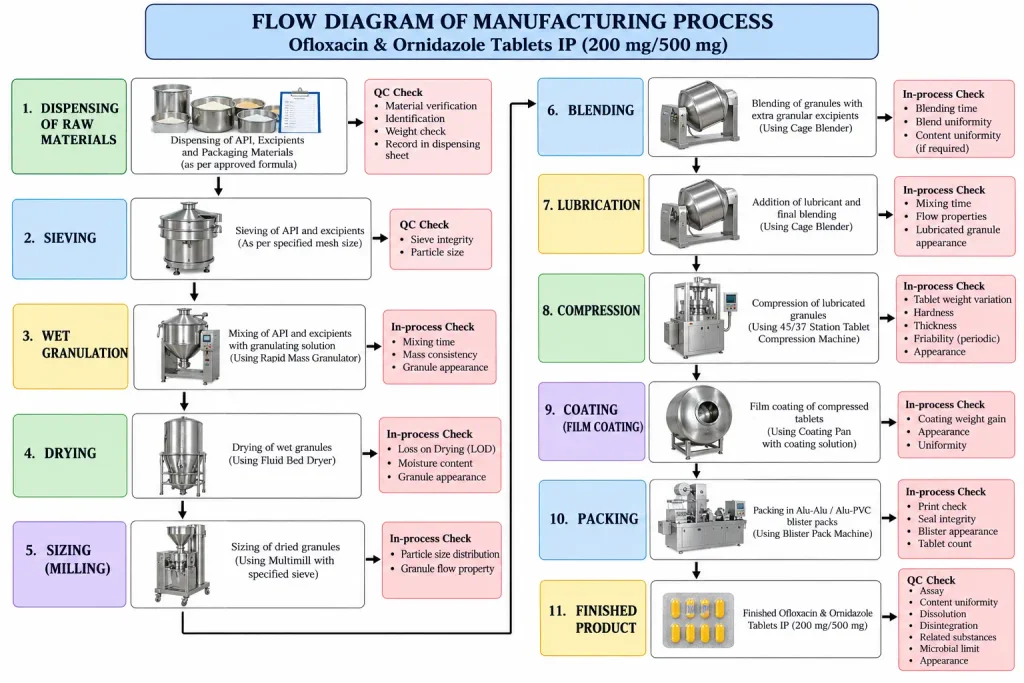
The lubricated granules undergo tablet compression, followed by film coating to achieve the required appearance and coating uniformity. Finished tablets are packed using approved packaging materials. Critical Process Parameters (CPPs) and Critical Quality Attributes (CQAs) are monitored throughout manufacturing to ensure product consistency, quality, traceability, and regulatory compliance.
3. Critical Process Parameters (CPPs) and Critical Quality Attributes (CQAs) of Ofloxacin & Ornidazole Tablets IP (200 mg/500 mg):
Critical Process Parameters (CPPs) and Critical Quality Attributes (CQAs) play an essential role in ensuring the consistent manufacturing quality, safety, and efficacy of Ofloxacin & Ornidazole Tablets IP.

Critical Process Parameters (CPPs) are manufacturing variables that require monitoring and control to maintain product quality. These include sieving mesh size, granulation mixing time, impeller speed, binder addition rate, drying temperature, loss on drying (LOD), blending time, lubrication time, compression force, turret speed, and coating conditions.
Critical Quality Attributes (CQAs) are physical, chemical, biological, or microbiological properties that must meet predetermined specifications. Important quality attributes include blend uniformity, granule moisture content, tablet weight variation, hardness, thickness, friability, disintegration time, dissolution, assay, content uniformity, and coating appearance.
Effective monitoring of CPPs helps maintain CQAs within approved acceptance limits throughout the manufacturing process. The Batch Manufacturing Record (BMR) documents manufacturing activities, in-process controls, equipment settings, test results, and quality verification to support Good Manufacturing Practices (GMP), batch consistency, product traceability, and regulatory compliance.
Note: The classification of individual parameters as critical and their acceptance limits must be established through product-specific development, process validation, and quality risk assessment.