



Brief Description
This SOP describes the standardized procedure for the operation, cleaning, and maintenance of the Sampling Booth used by the Quality Control Department. Its objective is to ensure that sampling activities are performed under clean, controlled conditions and that the booth is operated consistently.Before operation, the booth is checked for cleanliness, electrical supply is switched on, and the UV light and airflow are operated. After the required UV exposure, the booth is cleaned with 70% IPA, and Magnehelic gauge readings are verified before sampling. Sampling is then performed according to the applicable sampling procedure.The SOP defines Type A cleaning for routine/excipient change cleaning and Type B cleaning for API, color changeover, and post-maintenance cleaning. It includes cleaning of floors, balance, walls, ducts, doors, waste bins, filters, and related accessories.Records are maintained through the Sampling Booth Record and Sampling Booth Log Card provided as Annexures I and II.
Skip to PDF content1. Flow Diagram:
The flow diagram illustrates the operation and cleaning procedure of the Sampling Booth in a simple step-by-step sequence. It starts with pre-operation checks, including ensuring the booth is clean, checking the equipment base level, switching on the main electrical supply, and identifying the UV light, airflow, fluorescent light, and balance switches.
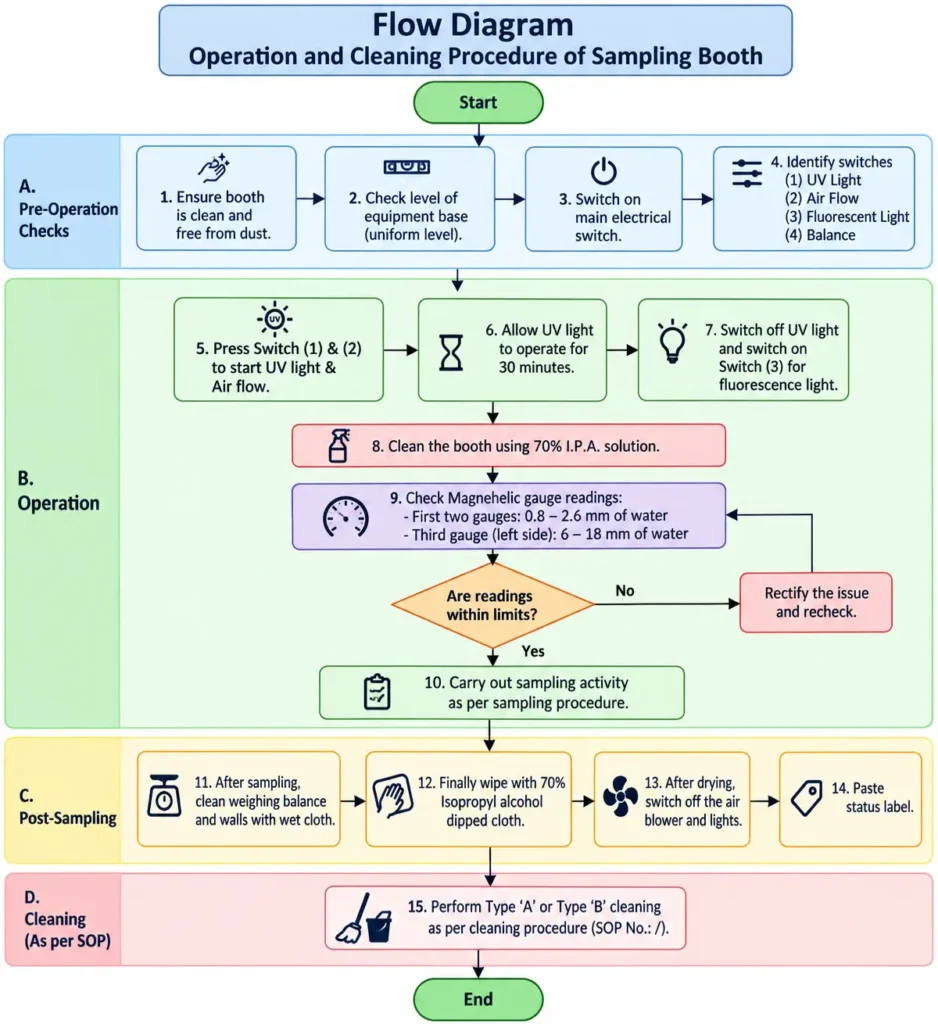
The operation stage includes starting the UV light and airflow, allowing UV exposure for 30 minutes, switching to fluorescent light, cleaning the booth with 70% IPA, and verifying the Magnehelic gauge pressure readings before sampling.After sampling, the weighing balance and booth walls are cleaned, followed by final wiping with 70% isopropyl alcohol. The air blower and lights are then switched off and a status label is pasted.The final stage covers Type A or Type B cleaning, selected according to routine operation, material changeover, API/color change, or maintenance requirements.
2. Brainstorming for SOP Failure:
The brainstorming diagram identifies possible reasons for failure of the Sampling Booth Operation and Cleaning SOP. The major failure points are linked to pre-operation checks, booth cleaning, equipment operation, airflow, UV exposure, pressure monitoring, post-sampling cleaning, filter maintenance, and documentation. The SOP requires the booth to be clean before use, the electrical system and airflow to be operated correctly, UV exposure to be maintained for the specified period, and Magnehelic gauge readings to be checked before sampling.
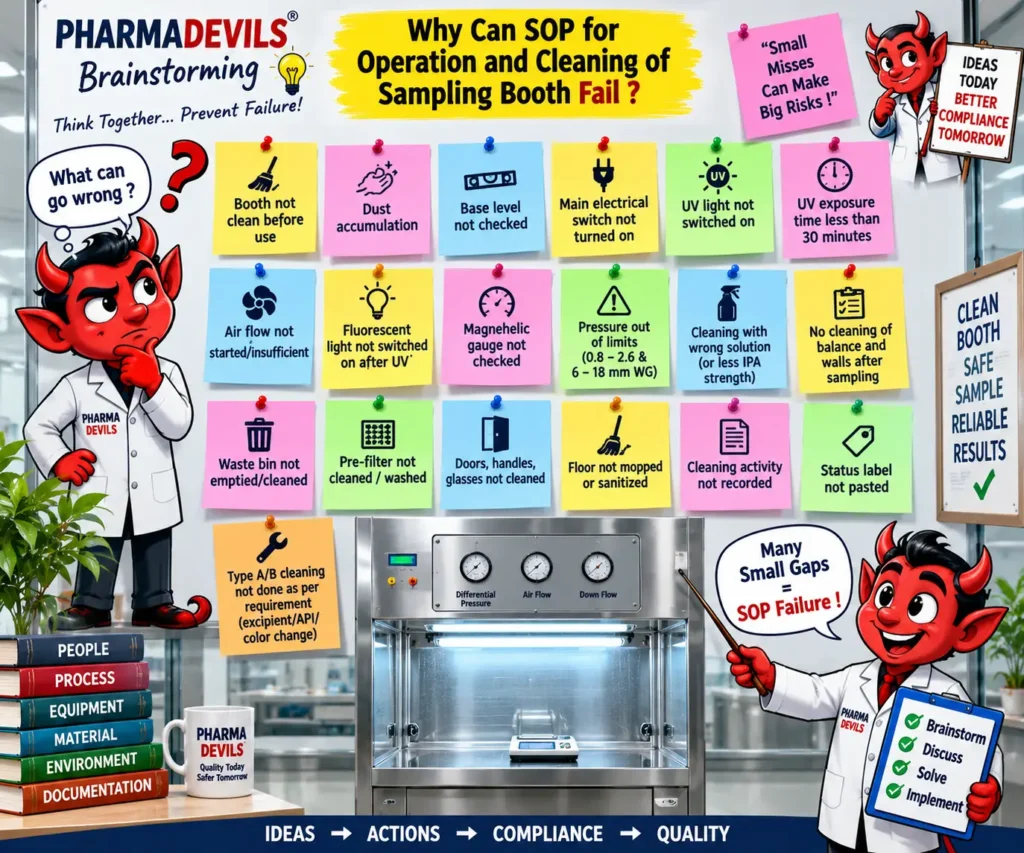
The sticky notes highlight risks such as inadequate cleaning, insufficient UV exposure, abnormal pressure readings, incorrect IPA cleaning, failure to clean the balance and booth surfaces, missed status labeling, and incomplete records. Type A and Type B cleaning requirements are also important controls during routine use and material/API changeover.Overall, the brainstorming exercise helps identify potential gaps early so that corrective actions, training, monitoring, and documentation controls can prevent SOP failure and contamination risk.
3. 5-Why Analysis for SOP Failure:
The 5-Why diagram explains the root cause of Sampling Booth SOP failure by progressively asking why the operation or cleaning process was not performed correctly. It begins with the immediate problem—such as the booth not being clean or ready for sampling—and traces the issue through missed cleaning steps, operator non-compliance, inadequate awareness, weak supervision, and insufficient training or monitoring.
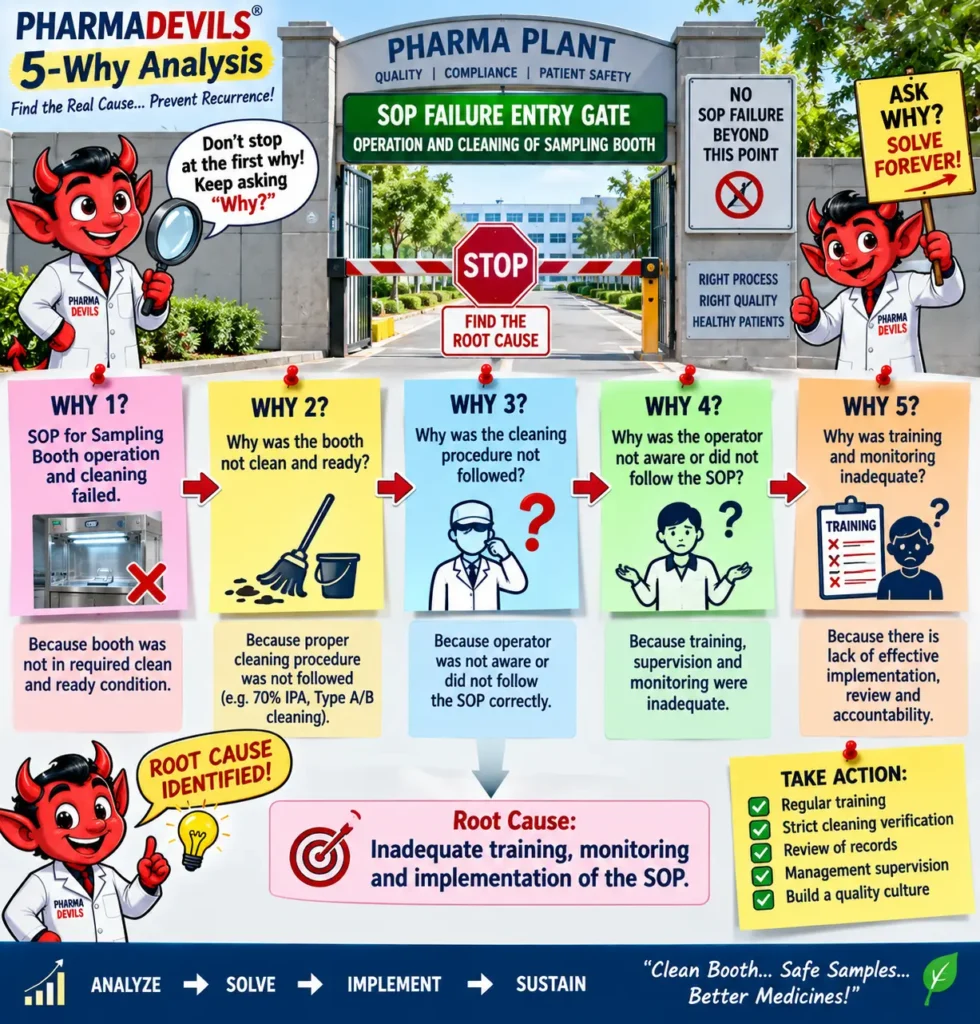
The SOP requires the booth to be clean before use, operated correctly, cleaned with 70% IPA, and checked for acceptable Magnehelic gauge readings before sampling. It also specifies Type A and Type B cleaning activities for routine conditions and product/API changeovers.The analysis therefore highlights inadequate training, monitoring, supervision, and SOP implementation as key underlying causes. Corrective actions should focus on effective training, cleaning verification, record review, supervisory checks, and sustained GMP compliance.
3. Fishbone Analysis for SOP Failure:
The fishbone diagram presents the possible causes of Sampling Booth SOP failure by grouping them into major categories such as People, Method, Machine, Measurement, Material, and Environment/Maintenance. This structure helps organize multiple potential causes and makes root-cause identification easier.
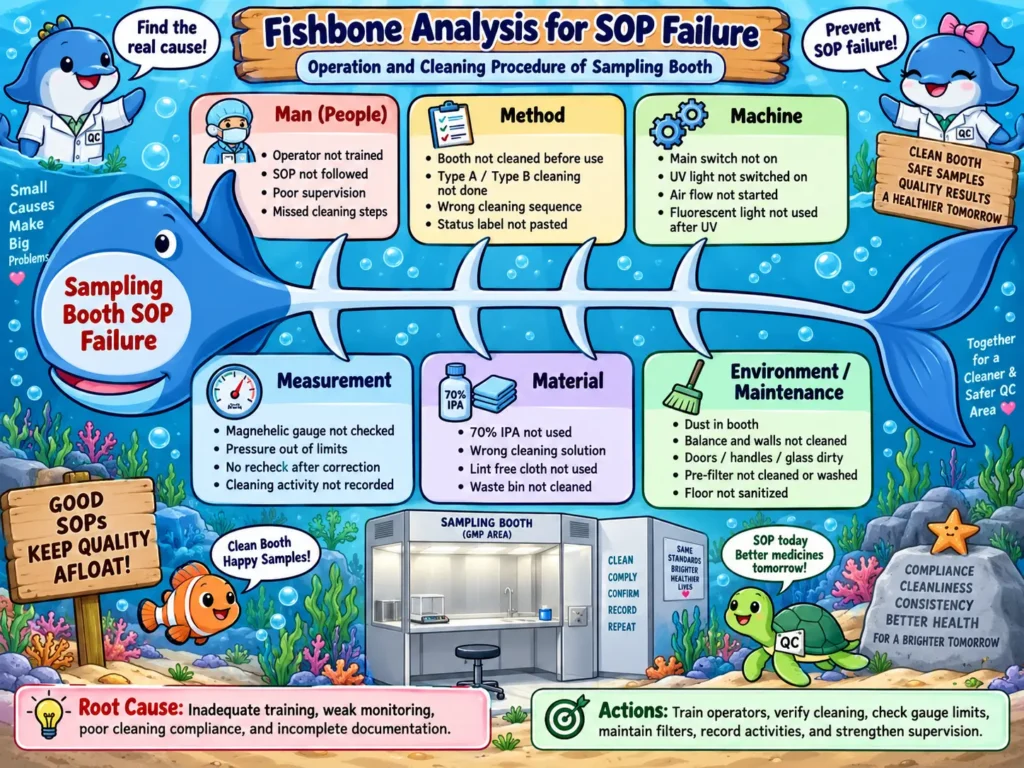
The analysis highlights issues such as inadequate operator training, failure to follow the SOP, incomplete Type A/Type B cleaning, incorrect operation of UV light or airflow, missed Magnehelic gauge checks, use of unsuitable cleaning materials, poor filter maintenance, and incomplete cleaning records. The SOP specifically requires proper booth cleaning, UV and airflow operation, pressure verification, 70% IPA cleaning, and defined routine/changeover cleaning activities.Overall, the fishbone analysis helps identify both human and system-related causes so that suitable actions such as training, supervision, equipment checks, cleaning verification, filter maintenance, and documentation review can be implemented to reduce recurrence of SOP failure.
5. Fault Tree Analysis for SOP Failure:
The Fault Tree Analysis diagram explains how Sampling Booth SOP failure can result from several contributing causes. The top event is failure to perform the operation and cleaning procedure as required. This may arise from improper cleaning, incorrect booth operation, missed monitoring checks, or people/system-related issues.
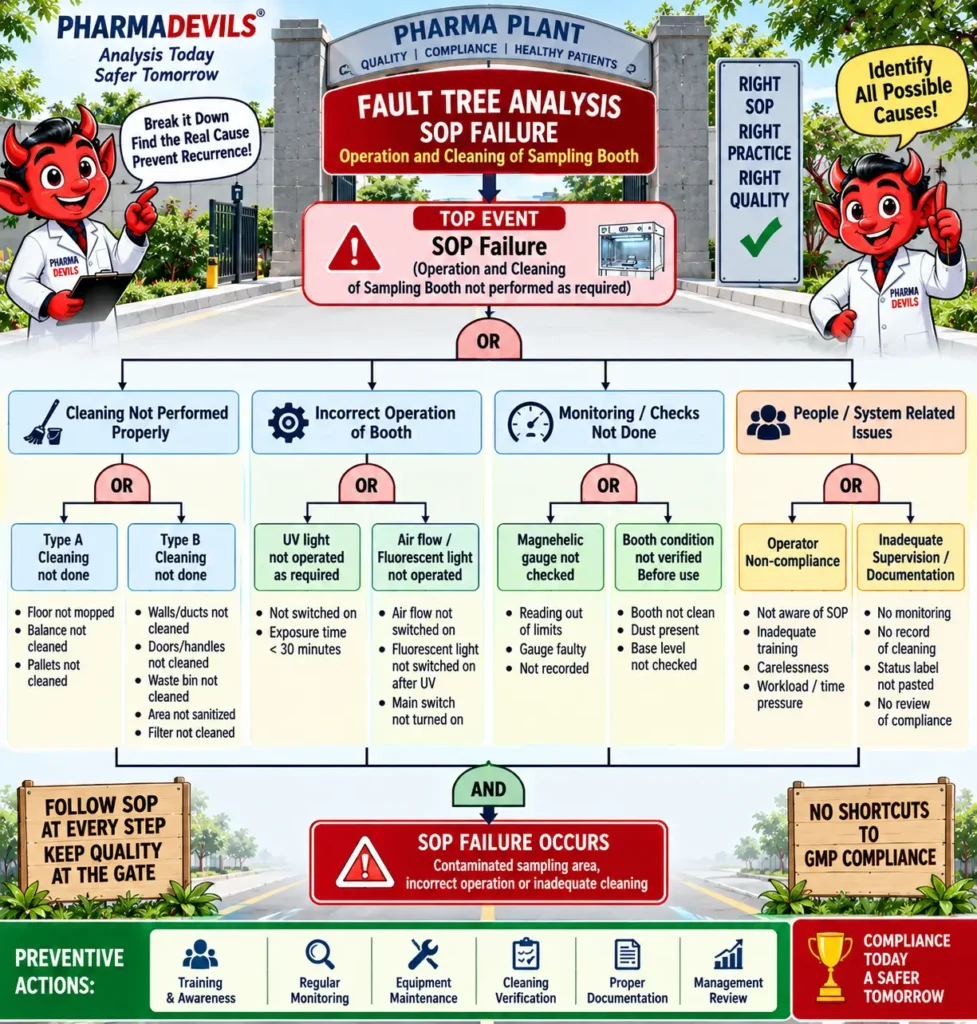
The SOP requires the booth to be clean before use, the UV light and airflow to be operated correctly, Magnehelic gauge readings to be checked, and sampling to be performed only after these controls are satisfied. It also specifies Type A and Type B cleaning requirements, including cleaning of floors, balance, walls, doors, waste bins, and filters.The analysis highlights that failures such as missed cleaning steps, inadequate equipment checks, poor documentation, insufficient training, and weak supervision can combine to produce SOP non-compliance. Preventive actions should therefore focus on training, routine monitoring, cleaning verification, equipment maintenance, proper recordkeeping, and management review.
Questions & Answers – Operation and Cleaning of Sampling Booth
Q1. What is the objective of this SOP?
Answer: To define the procedure for the operation and cleaning of the Sampling Booth.
Q2. Who is responsible for execution of this SOP?
Answer: The QC Chemist is responsible for execution of the SOP.
Q3. What should be checked before starting the Sampling Booth?
Answer: Ensure that the booth is clean and free from dust and that the equipment base is uniformly level.
Q4. What are the four switches provided on the booth?
Answer:
- UV Light
- Air Flow
- Fluorescent Light
- Balance
Q5. How long should the UV light operate before sampling?
Answer: The UV light should operate for 30 minutes before being switched off.
Q6. Which solution is used to clean the Sampling Booth before sampling?
Answer: The booth is cleaned using 70% IPA solution.
Q7. What are the specified Magnehelic gauge pressure limits?
Answer: The first two gauges should read 0.8–2.6 mm of water, while the third gauge should read 6–18 mm of water.
Q8. When can the sampling activity be started?
Answer: Sampling can be carried out after completing the required booth preparation and verifying the Magnehelic gauge readings.
Q9. What should be cleaned after completion of sampling?
Answer: The weighing balance and booth walls should be cleaned with a wet cloth and finally wiped with a cloth dipped in 70% isopropyl alcohol.
Q10. How long should the RLAF be stabilized before starting the activity?
Answer: The RLAF should be stabilized for 5 minutes before starting the activity.
Q11. When is Type ‘A’ cleaning performed?
Answer: Type A cleaning is performed between excipient changes and at the start and end of the shift.
Q12. What activities are included in Type ‘A’ cleaning?
Answer: Type A cleaning includes dry mopping the floor, cleaning the balance with lint-free cloth, and cleaning the pallets.
Q13. When is Type ‘B’ cleaning required?
Answer: Type B cleaning is required during changeover of different API, color, and after maintenance of contact parts.
Q14. How often should the pre-filter and intermediate filter be washed?
Answer: They should be washed weekly or whenever the pressure increases.
Q15. What records are associated with the Sampling Booth SOP?
Answer: The SOP contains two annexures: Annexure-I – Sampling Booth Record and Annexure-II – Log Card of Sampling Booth.