






Brief Description
This SOP describes the procedure for the operation, cleaning, and routine use of a pass box in the Quality Control/Microbiology and dispensing areas. Its objective is to ensure that sterilized materials and necessary tools are transferred through the pass box in a controlled manner. The SOP assigns responsibility for execution to microbiologists and store personnel, while the Store In-charge, Manager-QC, and Head QA/QC are responsible for effective implementation. Before use, the pass box is cleaned with 70% IPA solution, followed by switching on the main electrical supply. Sterilized materials and tools are placed inside, and the door is closed. The SOP specifies that the UV light remains ON when the pass box is closed and switches OFF automatically when opened. Materials are then transferred to the LAF/RLAF for further work. After completion, remaining materials are removed, the pass box is again cleaned with 70% IPA, and the electrical supply is switched off when no longer required.The SOP also includes training requirements, document distribution, abbreviations, revision history, and an Annexure-I Pass Box Cleaning Log Book for recording cleaning activities before and after work.
Skip to PDF content1. Flow Diagram:
The flow diagram presents the Operation of Pass Box in a simple comic-style training format where friendly devil characters guide personnel through each step. The process begins with cleaning the pass box using 70% IPA, followed by switching ON the main electrical supply. Sterilized materials and required tools are then placed inside the pass box and the door is closed. The diagram highlights that the UV light remains ON when the pass box is closed and turns OFF automatically when the door is opened.
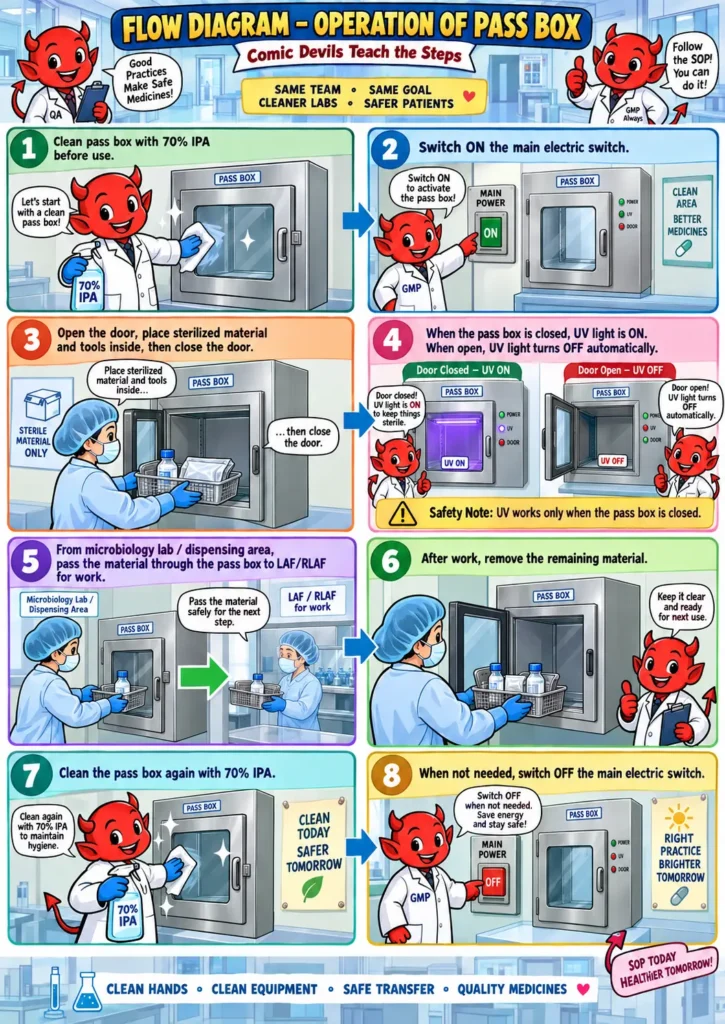
The materials are subsequently transferred from the microbiology laboratory or dispensing area through the pass box to the LAF/RLAF for further work. After completion of the activity, all remaining materials are removed, and the pass box is cleaned again with 70% IPA solution. Finally, when the pass box is no longer required, the main electrical switch is turned OFF. The comic presentation makes the SOP easy to understand and suitable for GMP training.
2. Brainstorming for SOP Failure:
The brainstorming diagram identifies possible causes that may lead to SOP failure during pass box operation. The comic-style presentation uses muscular devil characters as trainers to make the discussion engaging and easy to understand. Major failure possibilities include not cleaning the pass box with 70% IPA before use, failure to switch ON the main electrical supply, placement of unsterilized or incorrect materials, improper door handling, misunderstanding or malfunction of the UV light, incorrect transfer of materials to the LAF/RLAF, failure to remove remaining materials after work, and not cleaning or switching OFF the pass box after use.
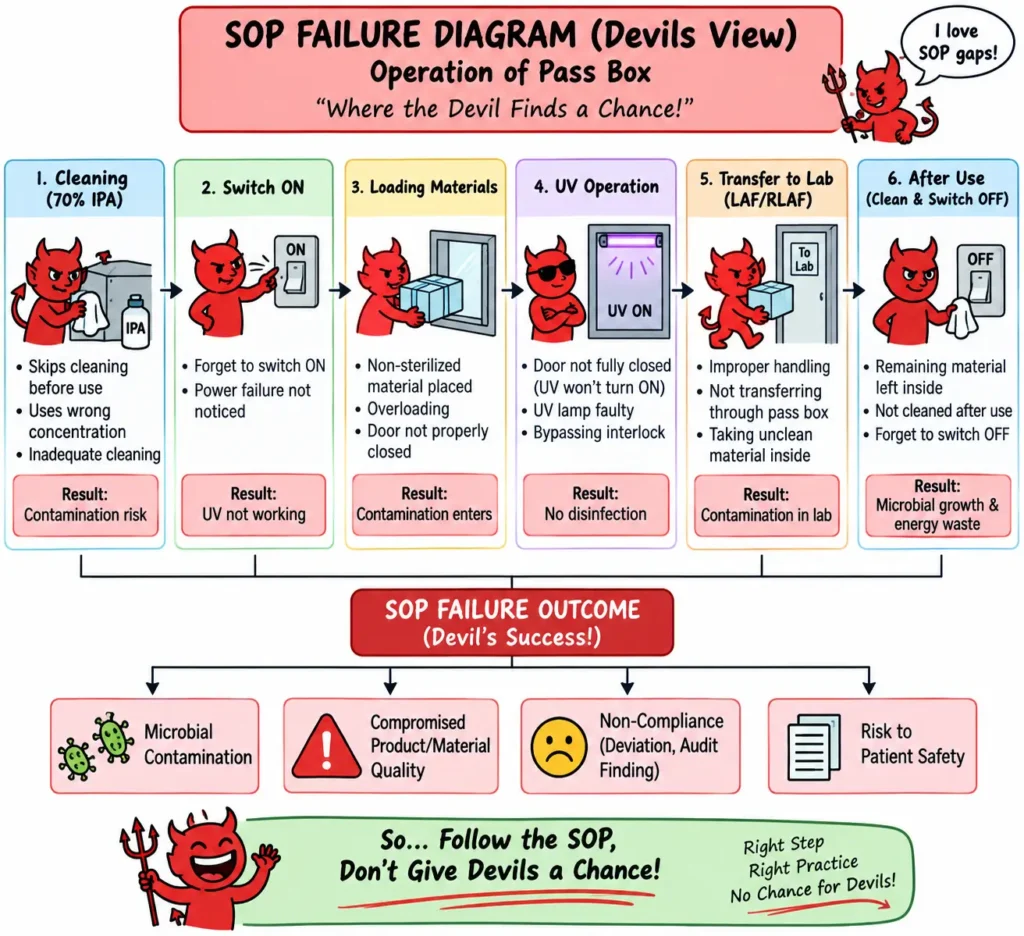
The diagram also highlights underlying causes such as lack of training, human error, poor supervision, and inadequate logbook recording. These points are consistent with the SOP steps requiring cleaning, correct operation, material transfer, post-use cleaning, and shutdown. The brainstorming approach helps the team discuss multiple possibilities, identify root causes, and develop corrective actions to prevent recurrence.
3. 5-Why Analysis for SOP Failure:
The 5-Why Analysis for SOP Failure diagram uses PharmaDevils characters to explain root-cause investigation in a simple and engaging way. It begins with the problem “SOP is not followed” and repeatedly asks “Why?” to move beyond the immediate error. The analysis identifies lack of operator awareness, poor communication of the revised SOP, missing training, absence of a training follow-up system, and unclear responsibility as contributing causes.
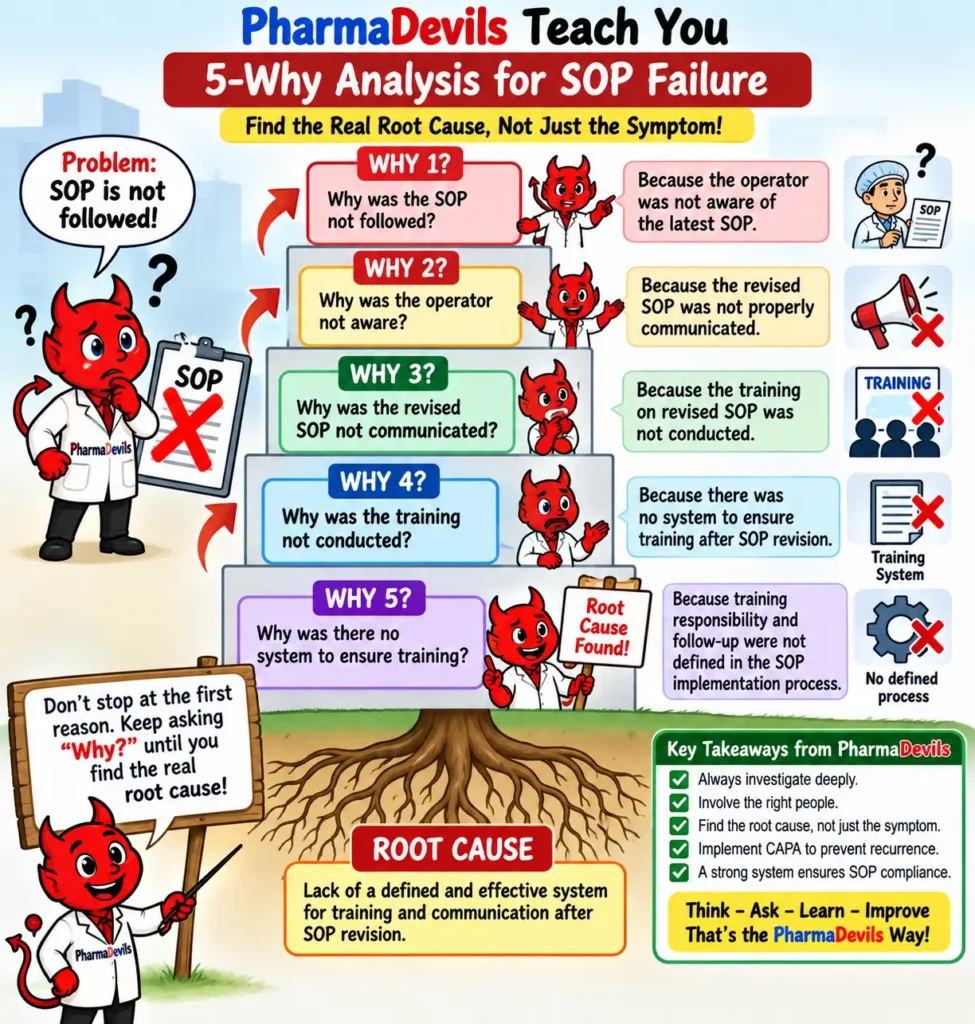
The final root cause is identified as the lack of a defined and effective system for training, communication, and follow-up after SOP revision. The diagram teaches employees not to stop at the first visible cause but to investigate deeper until the true systemic cause is found. Appropriate CAPA, defined responsibilities, documented training, and effectiveness checks can then be implemented to prevent recurrence and improve SOP compliance.
4. Fishbone Analysis for SOP Failure:
The Fishbone Analysis for SOP Failure diagram explains the possible causes of SOP non-compliance in a simple PharmaDevils training format. The causes are grouped under major categories such as Man, Machine, Method, Material, Measurement, Environment, and Management. Human-related causes may include lack of training, poor SOP awareness, complacency, and incorrect interpretation. Equipment issues can include breakdowns, inadequate maintenance, or utility failures. Method-related problems may involve unclear, outdated, or incomplete SOPs, while material-related causes include incorrect, unlabelled, or poor-quality materials.
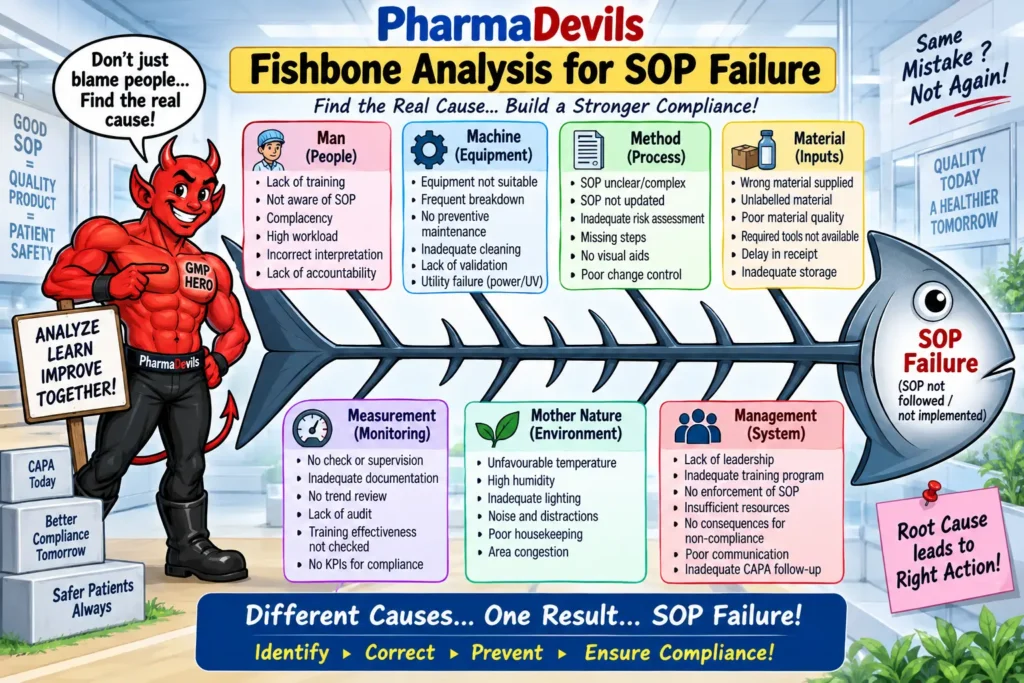
The diagram also highlights gaps in supervision, documentation, audits, environmental conditions, leadership, communication, and CAPA follow-up. By reviewing all these categories systematically, the investigation can identify the true root cause instead of blaming individuals. The PharmaDevils concept reinforces the message: Analyze, Learn, Improve, Correct, Prevent, and Ensure Compliance to avoid repeated SOP failures.
5. Fault Tree Analysis for SOP Failure:
The Fault Tree Analysis for SOP Failure diagram explains how different failures can combine and lead to the top event: SOP not followed or not properly implemented. The analysis groups possible causes into Human Error, System/Process Failure, Resource/Equipment Failure, and External/Environmental Factors. Key contributors include inadequate training, low SOP awareness, unclear or outdated procedures, poor change management, equipment breakdowns, utility failures, workload pressure, and weak supervision.
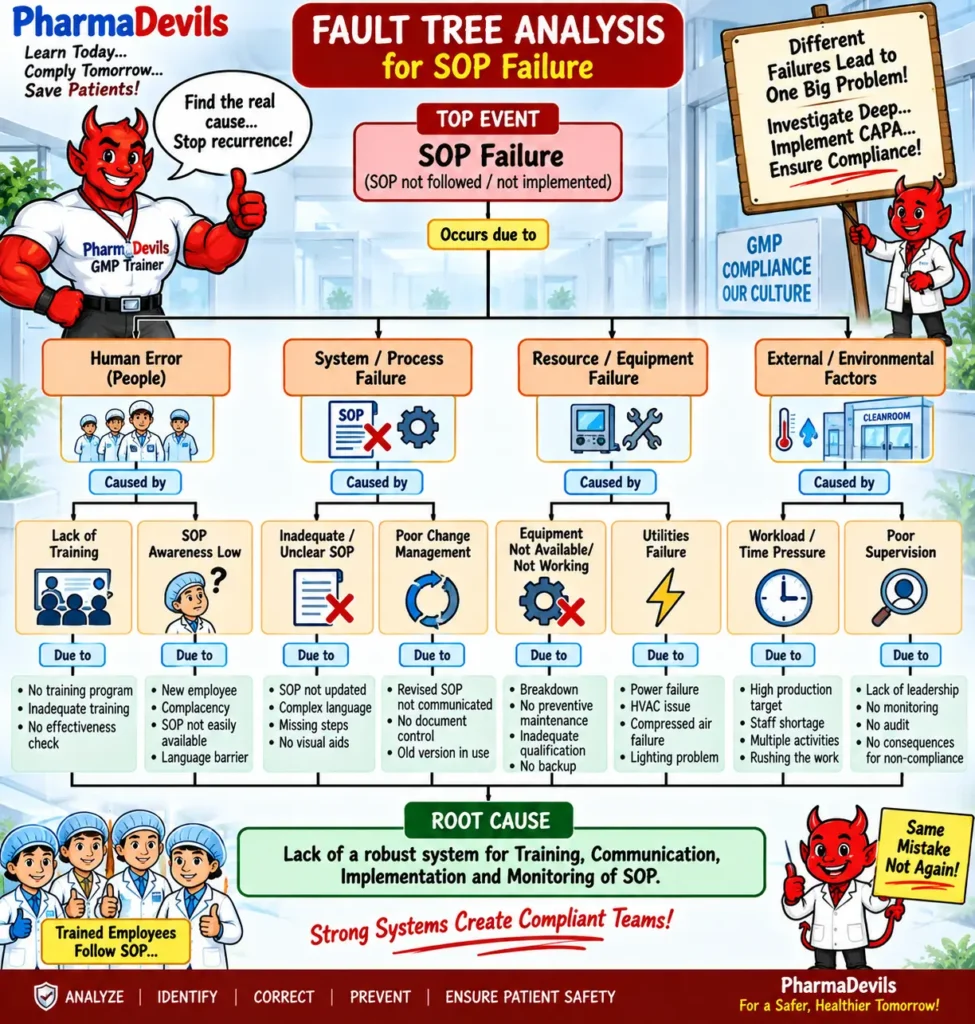
The diagram traces these contributing factors downward to a common root cause: lack of a robust system for SOP training, communication, implementation, and monitoring. It also highlights the importance of trained employees, effective supervision, proper document control, preventive maintenance, and CAPA follow-up. The PharmaDevils training concept reinforces a simple message: strong systems create compliant teams. Identifying and controlling root causes helps prevent recurrence, improve GMP compliance, and protect product quality and patient safety.
Questions & Answers – SOP for Operation of Pass Box
- Q: What is the objective of the SOP?
A: To lay down the operating procedure for the pass box. - Q: Who is responsible for executing the SOP?
A: The microbiologist and store personnel are responsible for execution of the SOP. - Q: Who is responsible for effective implementation of the SOP?
A: Store In-charge, Manager-QC, and Head QA/QC are responsible for effective implementation. - Q: How should the pass box be cleaned before use?
A: It should be cleaned with 70% IPA solution before working. - Q: What should be done after cleaning the pass box?
A: Switch ON the main electrical switch. - Q: What type of materials should be placed inside the pass box?
A: Sterilized materials and necessary tools should be placed inside and the door should then be closed. - Q: What happens to the UV light when the pass box door is closed?
A: According to the SOP, the UV light automatically turns ON when the pass box is closed. - Q: What happens to the UV light when the pass box door is opened?
A: The UV light automatically turns OFF when the pass box is opened. - Q: Where are materials transferred after passing through the pass box?
A: They are transferred to the microbiology laboratory/dispensing area and then to LAF/RLAF for working. - Q: What should be done after completion of work?
A: Remove all remaining materials from the pass box and clean it with 70% IPA v/v solution. - Q: What should be done when the pass box is no longer required?
A: Switch OFF the main electrical switch. - Q: Who provides training for this SOP?
A: The Head QA/QC is designated as the trainer. - Q: Who are the trainees for this SOP?
A: Store personnel and microbiologists. - Q: What is the specified training duration?
A: Half an hour. - Q: Which record is maintained for pass box cleaning?
A: Annexure-I – Log Book of Pass Box Cleaning, which includes before-work and after-work cleaning details, sanitized by, done by, and remarks. - Q: What does IPA stand for in this SOP?
A: Iso Propyl Alcohol. - Q: What does LAF stand for?
A: Laminar Air Flow. - Q: Why is proper pass box operation important?
A: The SOP requires controlled cleaning, sterilized material transfer, proper door operation, and post-use cleaning to support controlled material transfer through the pass box.