







1. Introduction – Batch Packing Record (BPR) for Paracetamol, Diclofenac & Magnesium Trisilicate Tablets:
The Batch Packing Record (BPR) for Paracetamol, Diclofenac and Magnesium Trisilicate Tablets is a comprehensive Good Manufacturing Practice (GMP) documentation system designed to ensure the systematic execution, monitoring, verification, and traceability of pharmaceutical packaging operations. This document provides a structured framework for recording all packaging activities, maintaining product quality, preventing mix-ups, and ensuring compliance with established quality assurance requirements. The formulation specified in the BPR contains Paracetamol IP 325 mg, Magnesium Trisilicate IP 100 mg, and Diclofenac Potassium BP 50 mg per uncoated tablet. The BPR covers the essential stages of packaging, including receipt of inspected tablets, dispensing and verification of packaging materials, overprinting operations, line clearance, machine setup, blister or strip packing, carton filling, shipper packing, and finished product transfer. Special emphasis is placed on documenting Critical Process Parameters (CPPs) such as sealing roller temperature, forming roller temperature, machine speed, environmental temperature, relative humidity, and packaging integrity. Routine in-process quality checks include leak testing, verification of printed information, carton and shipper fill quantities, and inspection of packaging defects. The record also includes provisions for packaging material reconciliation, rejection analysis, destruction records, yield calculations, and final verification by authorized Production and Quality Assurance personnel. These activities help ensure accountability, minimize packaging errors, and maintain complete batch traceability. Proper implementation of the BPR supports data integrity, Good Documentation Practices (GDP), regulatory compliance, and consistent packaging quality. It provides documented evidence that packaging operations have been performed and reviewed according to approved procedures before finished product release.
Skip to PDF content2. Flow Diagram for Paracetamol, Diclofenac & Magnesium Trisilicate Tablets:
The Batch Packing Record (BPR) flow diagram for Paracetamol, Diclofenac and Magnesium Trisilicate Tablets illustrates the systematic sequence of pharmaceutical packaging activities performed under Good Manufacturing Practices (GMP). The process begins with the receipt and verification of inspected tablets from the manufacturing department, followed by dispensing and checking approved packaging materials. Overprinting activities ensure accurate batch numbers, manufacturing dates, expiry dates, and other required labeling information.
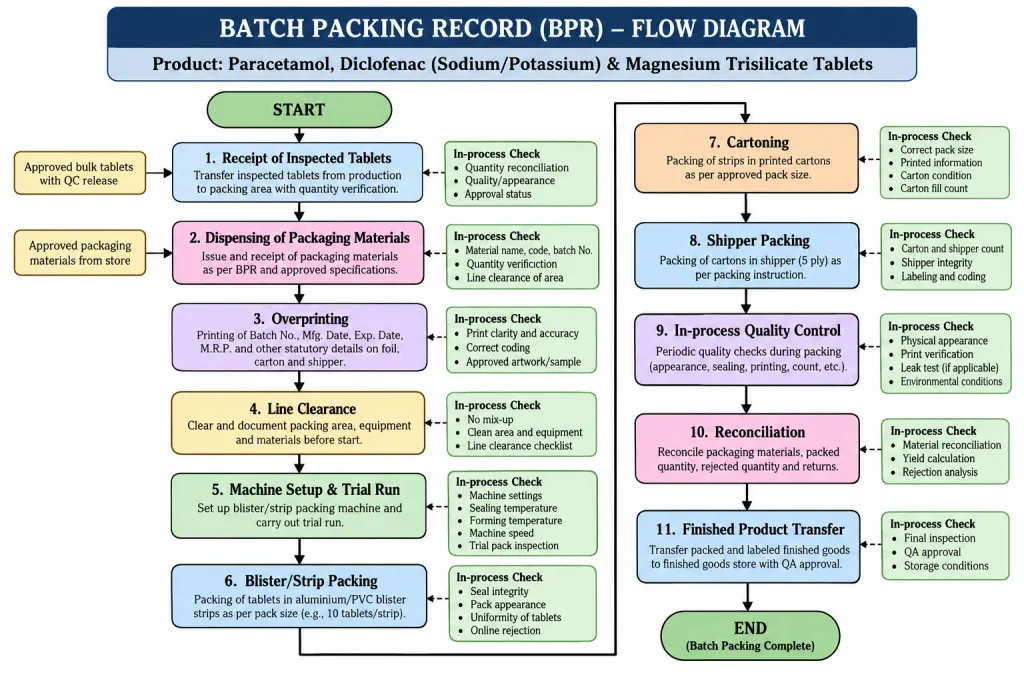
After documented line clearance, packaging machines are set up and verified for operating parameters, including sealing temperature, forming temperature, and machine speed. Tablets are subsequently packed into blisters or strips, followed by carton filling and shipper packing. In-process quality control checks include leak testing, packaging integrity, printed matter verification, environmental monitoring, and carton and shipper quantity verification. Finally, packaging materials and finished quantities are reconciled, rejections are documented, and packaging yield is calculated. The completed records undergo Production and Quality Assurance review to support the controlled transfer of finished products to the finished goods store.
3. Critical Process Parameters (CPP) and Critical Quality Attributes (CQA) for Paracetamol, Diclofenac & Magnesium Trisilicate Tablets:
The Batch Packing Record (BPR) for Paracetamol, Diclofenac and Magnesium Trisilicate Tablets highlights the importance of monitoring Critical Process Parameters (CPPs) and Critical Quality Attributes (CQAs) to ensure consistent packaging quality, product integrity, and compliance with Good Manufacturing Practices (GMP). The packaging process involves controlling important parameters such as machine speed, sealing temperature, forming temperature, packaging material specifications, environmental conditions, and line clearance. These parameters help prevent packaging defects, contamination, product mix-ups, and sealing failures. Critical Quality Attributes include tablet appearance, blister or strip integrity, correct printed information, packaging quantity, and proper labeling. In-process checks verify leak-test results, sealing quality, batch numbers, manufacturing and expiry dates, carton quantities, and shipper identification.
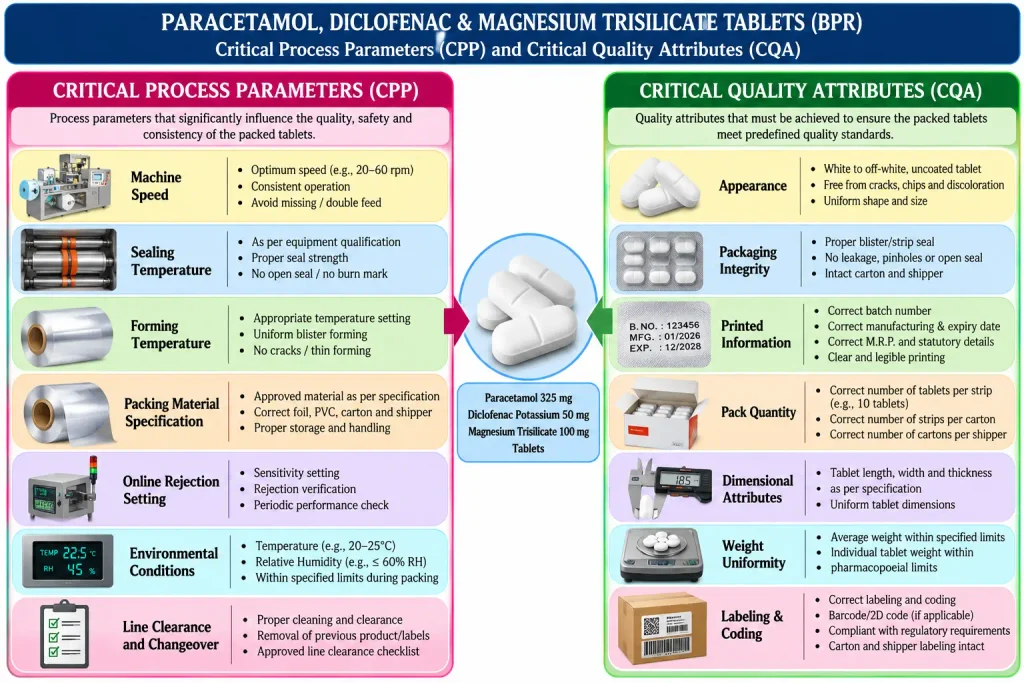
All monitoring activities, observations, deviations, and corrective actions must be documented in the BPR. Quality Assurance personnel review the completed records to verify compliance with approved specifications. Effective control of CPPs and CQAs supports product protection, packaging consistency, batch traceability, regulatory compliance, and patient safety.
Note: The uploaded BPR primarily addresses packaging operations. Tablet dimensional attributes and weight uniformity are generally controlled through manufacturing and finished-product specifications rather than the packaging record. Actual CPP classifications and operating limits should be established through approved process validation and risk assessment.