







1. Introduction to Batch Packing Record (BPR) for Paracetamol Tablets IP 500 mg
The Batch Packing Record (BPR) for Paracetamol Tablets IP 500 mg is a controlled document used to record and verify all activities associated with the packaging of the finished pharmaceutical product. It provides documented evidence that packing operations are performed according to approved procedures, specified packaging requirements, and established quality standards. The BPR includes details of product identification, batch number, batch size, manufacturing and expiry dates, packaging material dispensing, overprinting verification, line clearance, machine setup, and in-process quality checks. It also documents leak testing, packing line inspections, carton and shipper verification, packaging material reconciliation, rejection analysis, destruction of rejected materials, and yield calculations. These records help ensure correct product identification, prevent mix-ups and labeling errors, maintain traceability, and support the investigation of packing discrepancies. The record is completed by authorized personnel from Production and verified or approved by Quality Assurance, as applicable. Proper completion and review of the BPR provide assurance that the packaging process for Paracetamol Tablets IP 500 mg has been performed and documented in accordance with approved batch packaging instructions.
Skip to PDF content2. Flow Diagram for Batch Packing Record (BPR) – Paracetamol Tablets IP 500 mg
The flow diagram illustrates the major activities involved in the batch packing process of Paracetamol Tablets IP 500 mg. It begins with recording product and batch details, followed by dispensing and verification of packaging materials such as blister foil, PVC film, cartons, and shippers. Overprinting details, including batch number, manufacturing date, and expiry date, are checked for correctness before packing operations commence. Line clearance and machine setup are performed to ensure that the packing area and equipment are ready for use.
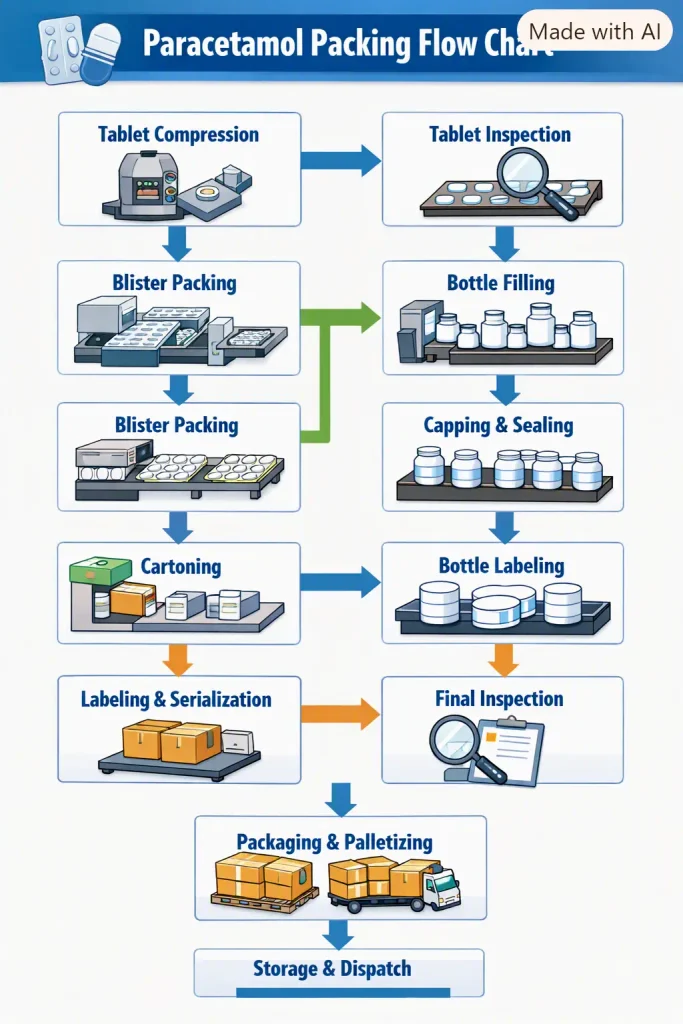
During packing, in-process quality checks, leak testing, seal integrity verification, and packing line inspections are carried out as applicable. Cartons and shippers are checked for correct packing and labeling. After completion, packaging materials are reconciled, rejected materials are recorded and handled appropriately, and the batch yield is calculated. Finally, the completed Batch Packing Record is reviewed and approved by authorized Production and Quality Assurance personnel, as applicable, to ensure proper documentation, traceability, and compliance with approved packing instructions.
3. Paracetamol CPP & CQA Overview:
The Paracetamol CPP & CQA Overview diagram illustrates the essential relationship between process control and product quality in tablet manufacturing and packing. On the left, the Critical Process Parameters (CPP) section highlights key operational factors that directly influence product consistency. These include sealing roller temperature, which ensures proper blister sealing; leak test frequency, maintaining packaging integrity; fill quantities, guaranteeing accurate dosage; and machine speed and settings, which affect uniformity and efficiency.
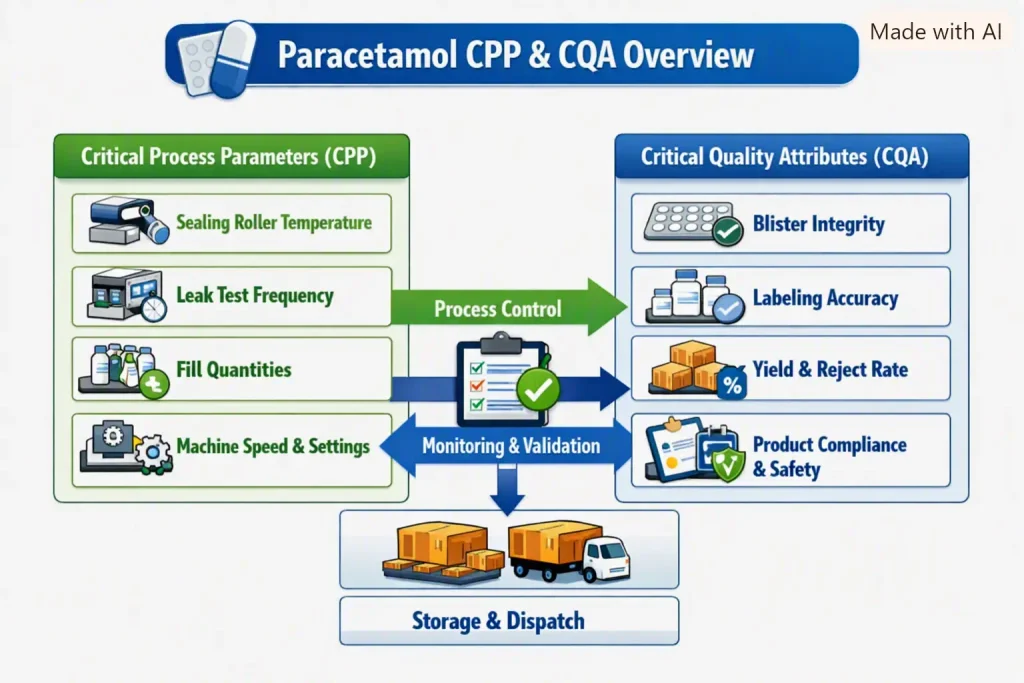
On the right, the Critical Quality Attributes (CQA) section defines measurable outcomes that determine product acceptability. These attributes include blister integrity, ensuring tablets are protected from moisture and contamination; labeling accuracy, confirming correct identification and traceability; yield and reject rate, reflecting process efficiency; and product compliance and safety, ensuring adherence to regulatory standards. At the center, the diagram connects CPP and CQA through process control and quality assurance, emphasizing monitoring and validation as the bridge between production and quality outcomes. This integrated approach ensures that every batch of Paracetamol tablets meets stringent pharmaceutical standards, maintaining both efficacy and patient safety throughout the packaging lifecycle.