







1. Introduction for Performance Qualification Protocol cum Report for Verification of Operating Parameters through SCADA System for Environment Monitoring System:
This Performance Qualification Protocol-cum-Report provides a structured approach for verifying the operating parameters of an Environmental Monitoring System through the SCADA-based Building Management System. It demonstrates that the system operates consistently according to approved functional specifications, user requirements, GAMP 5 principles, and its intended pharmaceutical environment. The protocol defines responsibilities for Quality Assurance, Engineering, Production, and the qualification team, along with training and documentation requirements. It covers verification of calibrated master instruments and sensors, DDC panel indications, input/output functions, user-access security, SCADA screens, parameter ranges, environmental conditions, alarms, interlocks, trends, audit trails, software controls, data backup and restoration, power-failure recovery, communication recovery, and integrated control loops. Each test includes its purpose, procedure, acceptance criteria, observation records, and approval fields. Deviations and changes must be documented, investigated, corrected, and closed. Successful execution provides documented evidence that the EMS reliably monitors, records, alarms, and continuously controls critical HVAC parameters within established limits.
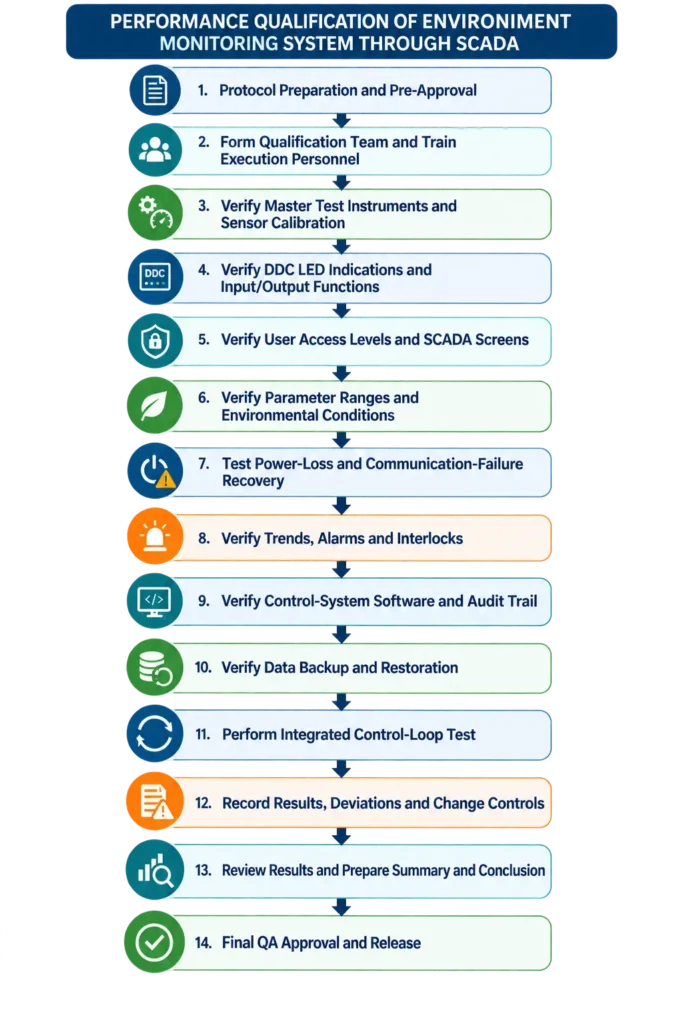
Skip to PDF content2. Flow Diagram for Performance Qualification Protocol cum Report for Verification of Operating Parameters through SCADA System for Environment Monitoring System:
The flow diagram presents the systematic process for performing the Performance Qualification of an Environmental Monitoring System through SCADA. The process begins with protocol preparation, review, and pre-approval, followed by formation and training of the qualification team. Calibration status of master instruments and environmental sensors is then verified. Functional checks include DDC indications, input/output operations, user-access levels, SCADA screens, parameter ranges, and environmental conditions. Recovery tests are conducted to confirm system performance following power loss or communication failure. Trends, alarms, interlocks, software functions, and audit trails are verified to ensure reliable monitoring and data integrity. Data backup and restoration functions are also challenged. An integrated control-loop test confirms that the system controls critical parameters within specified limits. All results, deviations, discrepancies, and change controls are documented and evaluated. Finally, the qualification results are reviewed, summarized, concluded, and submitted to Quality Assurance for final approval and release of the system.
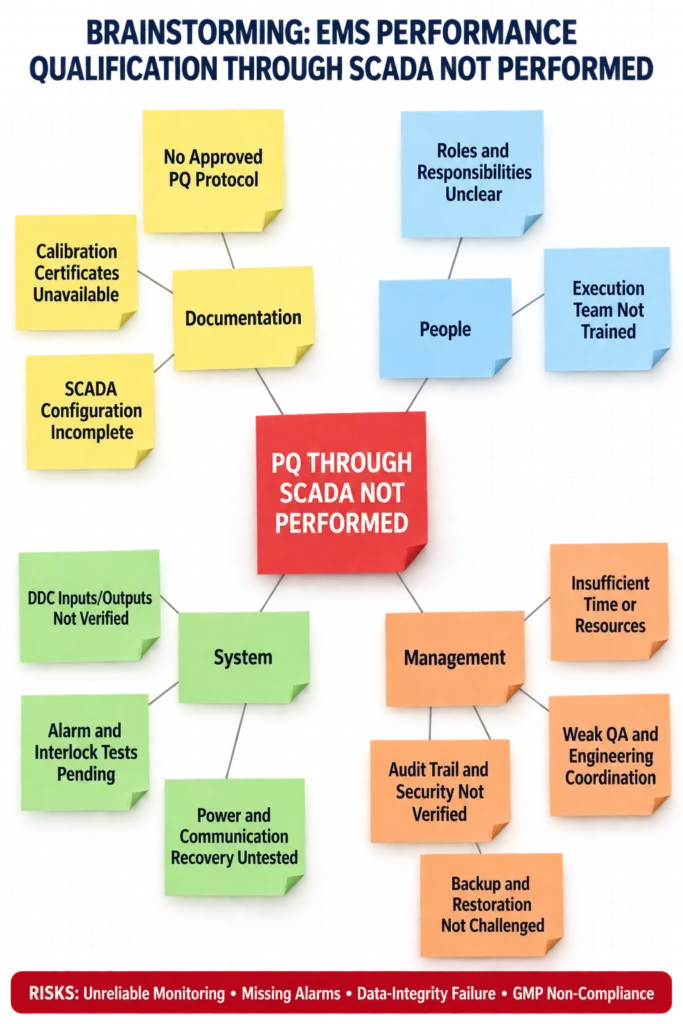
3. Brainstorming for Performance Qualification Protocol cum Report for Verification of Operating Parameters through SCADA System for Environment Monitoring System not done:
The brainstorming diagram identifies possible reasons why Performance Qualification of the Environmental Monitoring System through SCADA was not performed. The causes are grouped into four main areas: documentation, people, system, and management. Documentation concerns include the absence of an approved PQ protocol, unavailable calibration certificates, and incomplete SCADA configuration. People-related causes include unclear responsibilities and inadequate training of the execution team. System-related issues cover unverified DDC inputs and outputs, pending alarm and interlock tests, and untested recovery after power or communication failure. Management causes include insufficient time, limited resources, weak coordination between Quality Assurance and Engineering, unverified audit trails and security controls, and incomplete backup and restoration challenges. These weaknesses may result in unreliable environmental monitoring, missed alarms, data-integrity failures, ineffective control of critical parameters, and GMP non-compliance. The brainstorming exercise supports structured root-cause investigation, risk evaluation, CAPA development, assignment of responsibilities, and timely completion of qualification activities.
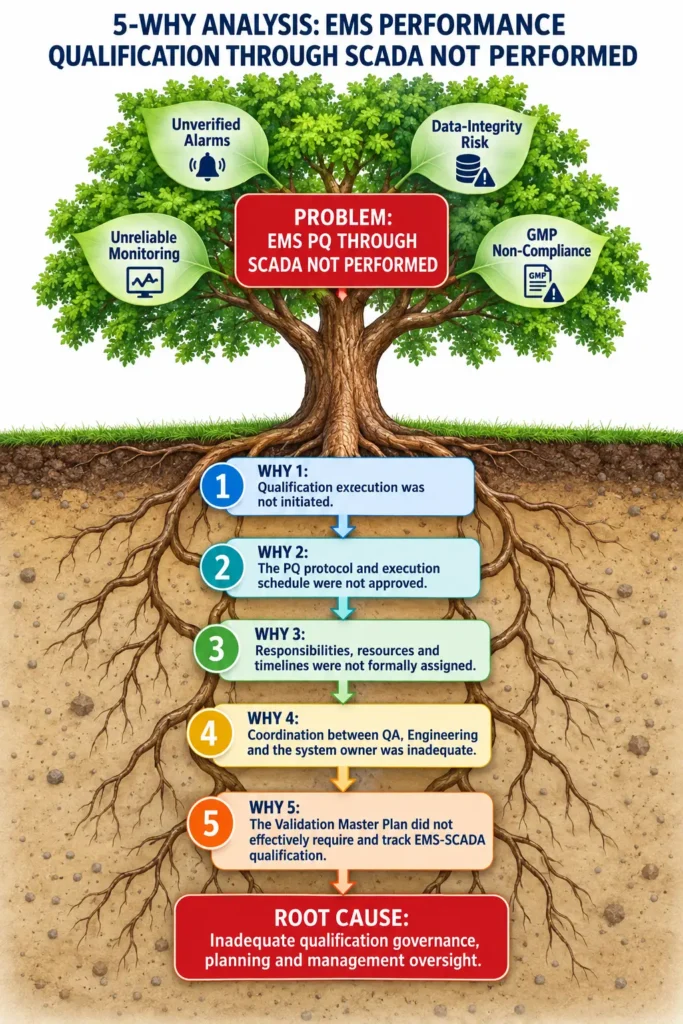
4. 5-Why Analysis for Performance Qualification Protocol cum Report for Verification of Operating Parameters through SCADA System for Environment Monitoring System not done:
The 5-Why analysis traces the failure to perform Performance Qualification of the Environmental Monitoring System through SCADA from the immediate event to its underlying organizational cause. The first why shows that qualification execution was never initiated. This occurred because the PQ protocol and execution schedule were not approved. Approval remained pending because responsibilities, resources, and timelines were not formally assigned. This gap resulted from inadequate coordination among Quality Assurance, Engineering, and the system owner. The deepest why identifies ineffective qualification governance: the Validation Master Plan did not adequately require, schedule, and track EMS–SCADA qualification activities. Consequently, alarms, monitoring functions, audit trails, data backup, recovery controls, and system security may remain unverified, creating data-integrity and GMP compliance risks. The analysis concludes that strengthening governance, updating the Validation Master Plan, assigning accountable owners, approving protocols, providing resources, and monitoring completion through QA oversight are necessary to prevent recurrence and ensure system reliability.
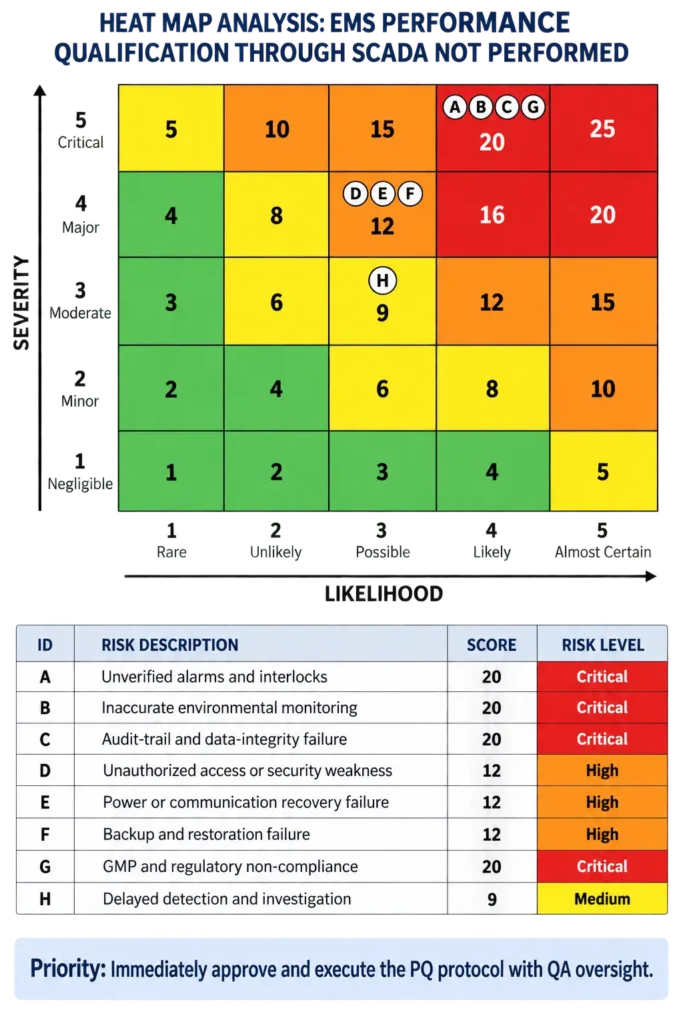
5. Heat Map Analysis for Performance Qualification Protocol cum Report for Verification of Operating Parameters through SCADA System for Environment Monitoring System not done:
The heat map analysis evaluates risks arising when Performance Qualification of the Environmental Monitoring System through SCADA is not performed. Risks are assessed using severity and likelihood scores from one to five, producing overall scores from one to twenty-five. Green cells represent low risk, yellow cells indicate medium risk, orange cells show high risk, and red cells identify critical risk. Unverified alarms and interlocks, inaccurate environmental monitoring, audit-trail or data-integrity failure, and GMP non-compliance receive critical scores of 20, requiring immediate action. Unauthorized access, recovery failure after power or communication loss, and unsuccessful backup and restoration receive high scores of 12. Delayed detection and investigation receives a medium score of 9. The analysis demonstrates that unqualified SCADA operation can compromise reliable monitoring, timely alarms, electronic records, security, and regulatory compliance. Immediate protocol approval, test execution, deviation resolution, documentation, and QA oversight are therefore essential to reduce risks to acceptable levels.
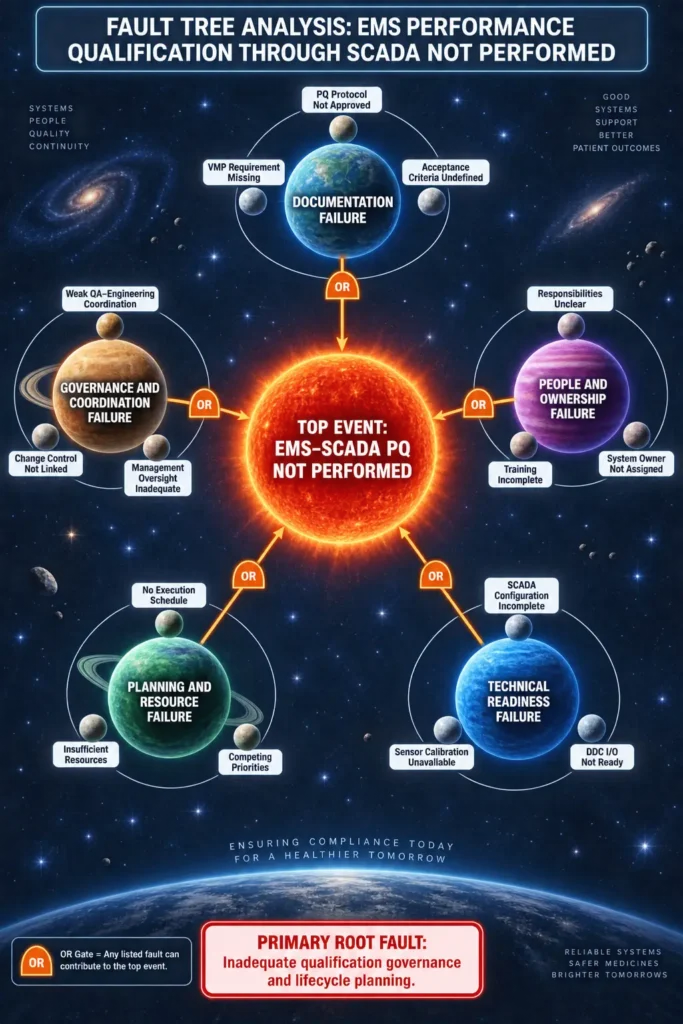
6. Fault Tree Analysis for Performance Qualification Protocol cum Report for Verification of Operating Parameters through SCADA System for Environment Monitoring System not done:
The Fault Tree Analysis identifies the major causes that can lead to Performance Qualification of the Environmental Monitoring System through SCADA not being performed. The central top event is connected through OR gates to five fault categories: documentation failure, people and ownership failure, technical readiness failure, planning and resource failure, and governance and coordination failure. Contributing faults include an unapproved protocol, missing VMP requirements, unclear responsibilities, incomplete training, unavailable calibration, unfinished SCADA configuration, insufficient resources, and weak QA–Engineering coordination. The analysis identifies inadequate qualification governance and lifecycle planning as the primary root fault requiring immediate corrective and preventive action implementation.
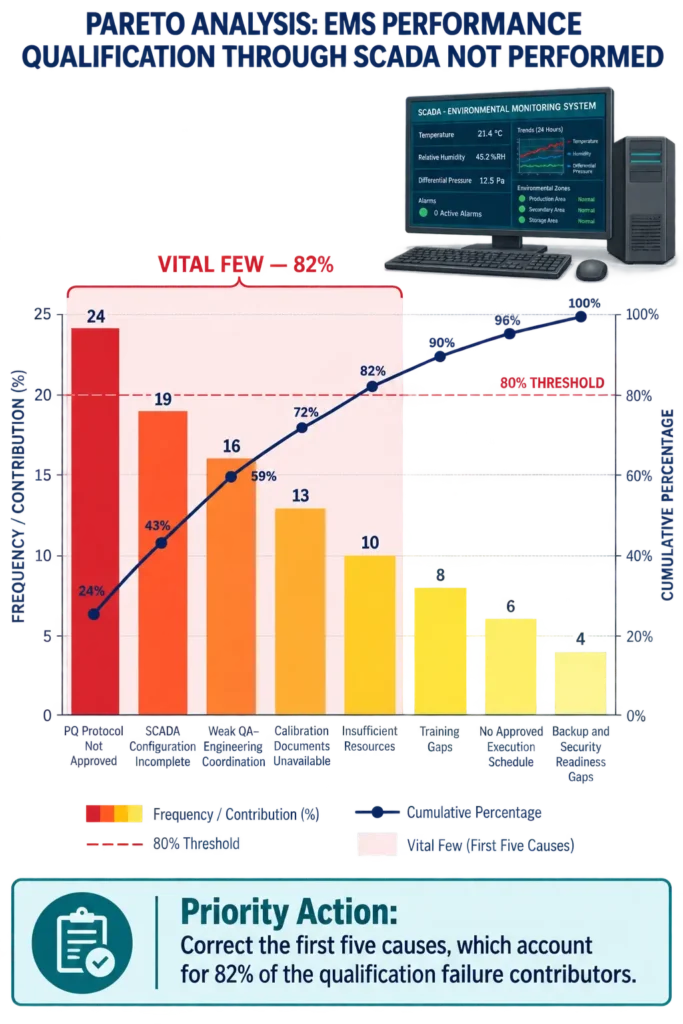
7. Pareto Chart analysis for Performance Qualification of the Environmental Monitoring System through SCADA not being performed:
The Pareto chart ranks the major contributors responsible for Performance Qualification of the Environmental Monitoring System through SCADA not being performed. The bars display each cause’s contribution, while the cumulative line shows their combined effect. The leading issues are an unapproved PQ protocol, incomplete SCADA configuration, weak QA–Engineering coordination, unavailable calibration documents, and insufficient resources. Together, these five causes account for 82% of the identified problem, exceeding the 80% threshold. Therefore, corrective actions should prioritize protocol approval, configuration completion, cross-functional coordination, calibration documentation, and resource allocation. Addressing these vital few causes will significantly improve qualification readiness and GMP compliance effectively.
8. Corrective and Preventive Action with Effectiveness Review:
| No. | CAPA type | Action | Responsibility | Completion evidence |
|---|---|---|---|---|
| 1 | Immediate correction | Restrict routine use of unqualified EMS–SCADA functions for GMP decisions. Establish approved manual monitoring and alarm-escalation controls until PQ completion. | QA and Engineering | Interim monitoring records and approved risk assessment |
| 2 | Corrective | Initiate deviation and assess the impact on environmental records, alarms, excursions, product batches, and data integrity. | QA | Approved deviation and impact-assessment report |
| 3 | Corrective | Prepare, review, and approve the EMS–SCADA PQ protocol with defined test procedures, responsibilities, and acceptance criteria. | Validation, Engineering and QA | Approved PQ protocol |
| 4 | Corrective | Verify sensor calibration, DDC inputs/outputs, user-access levels, SCADA screens, parameter ranges, trends, alarms, interlocks, and audit trails. | Engineering and Validation | Completed test sheets and supporting records |
| 5 | Corrective | Challenge power-loss recovery, communication-failure recovery, data backup, restoration, and integrated control loops. | Engineering and IT | Successful challenge-test results |
| 6 | Corrective | Record, investigate, and close all deviations observed during qualification before system release. | QA and Engineering | Closed deviation and CAPA records |
| 7 | Corrective | Prepare the PQ summary report and release the system only after QA approval. | Validation and QA | Approved PQ report and release authorization |
| 8 | Preventive | Update the Validation Master Plan to include EMS–SCADA qualification, periodic review, requalification, and change-control requirements. | QA | Revised and approved VMP |
| 9 | Preventive | Assign a qualified system owner and define responsibilities for QA, Engineering, IT, Validation, and users. | Management and QA | Responsibility matrix and appointment record |
| 10 | Preventive | Establish a qualification tracker with approved timelines, escalation levels, and management review. | QA | Tracker and review-meeting records |
| 11 | Preventive | Train relevant personnel on PQ execution, alarm handling, audit-trail review, backup, restoration, and data integrity. | QA and Department Heads | Training and assessment records |
| 12 | Preventive | Link software, hardware, sensor, set-point, alarm, and configuration changes to formal change control and requalification assessment. | QA, Engineering and IT | Revised change-control procedure |
Effectiveness Review
The CAPA effectiveness review should be conducted after 90 days of qualified system operation and again during the next periodic system review.
Effectiveness will be considered satisfactory when:
- All PQ tests meet approved acceptance criteria.
- All qualification deviations are investigated and closed.
- No critical alarm, trend, audit-trail, communication, backup, or restoration failure occurs.
- Environmental data remain complete, accurate, secure, and retrievable.
- Alarm challenges and escalation records demonstrate timely response.
- Monthly audit-trail reviews show no unauthorized access or unexplained changes.
- Backup and restoration challenges are completed successfully.
- Training effectiveness is at least 90%, with no critical knowledge gaps.
- No repeat deviation occurs due to missed qualification planning.
- The VMP and qualification tracker contain no overdue EMS–SCADA activities.
If any criterion fails, the CAPA shall be classified as ineffective, reopened, reinvestigated, and supported by additional actions.
9. Questions and Answers for Performance Qualification of the Environmental Monitoring System through SCADA not being performed:
1. What is the purpose of Performance Qualification of an EMS through SCADA?
It provides documented evidence that the system consistently monitors, records, displays, alarms, and controls environmental parameters within approved limits.
2. What is the main concern when PQ is not performed?
The reliability of environmental data, alarms, interlocks, trends, security controls, and system-recovery functions remains unverified.
3. Which parameters are generally monitored through the EMS–SCADA system?
Parameters may include temperature, relative humidity, differential pressure, airflow, filter status, equipment status, and other approved HVAC conditions.
4. Can an EMS–SCADA system be used for GMP decisions without PQ?
Routine GMP reliance should be avoided until qualification is completed. Approved interim controls and a documented quality-risk assessment should be established.
5. What immediate action should be taken?
Initiate a deviation, assess product and data impact, implement manual monitoring controls, prepare the PQ protocol, and establish an approved execution schedule.
6. Which departments should participate in the qualification?
Quality Assurance, Engineering, Validation, IT or automation, Production, and the designated system owner should participate according to assigned responsibilities.
7. What should be verified before PQ execution?
Approved specifications, system configuration, sensor calibration, test-instrument calibration, training records, SOPs, user accounts, backup arrangements, and supporting qualification documents should be verified.
8. Which SCADA functions should be challenged?
SCADA screens, user-access levels, audit trails, trends, alarms, interlocks, set points, data recording, report generation, and electronic-record controls should be challenged.
9. Why are DDC input and output checks necessary?
They confirm that signals received from field sensors are accurately displayed and that output commands correctly operate the connected equipment or control devices.
10. Why should alarms and interlocks be tested?
Testing confirms that abnormal environmental conditions are detected, displayed, recorded, communicated, and acted upon within the approved response time.
11. What recovery tests should be performed?
Power-failure recovery, communication-failure recovery, controller restart, data retention, system synchronization, backup, and restoration should be tested.
12. How should deviations observed during PQ be managed?
Every deviation should be documented, investigated, assessed for impact, corrected, reviewed, and closed by Quality Assurance before final system approval.
13. What is the acceptance criterion for successful PQ?
All approved test cases must meet predetermined acceptance criteria, critical deviations must be closed, and the system must demonstrate consistent and reliable operation.
14. What preventive action can avoid recurrence?
Update the Validation Master Plan, assign a system owner, establish qualification tracking, define responsibilities, provide training, and connect system changes with change control and requalification.
15. How should CAPA effectiveness be reviewed?
Review system performance after 90 days, confirm successful alarms and recovery tests, verify audit trails and backup records, check training effectiveness, and ensure no repeat qualification-related deviation.
16. Who provides final approval for system release?
Quality Assurance provides final approval after reviewing the executed protocol, results, deviations, supporting evidence, summary report, and CAPA status.
10. Reference Guidelines:
- EU GMP Annex 11 – Computerised Systems
Covers computerized-system validation, risk management, user access, audit trails, data storage, backup, incident management, electronic signatures, periodic evaluation, and business continuity.
European Commission – EudraLex Volume 4 - EU GMP Annex 15 – Qualification and Validation
Provides requirements for qualification planning, URS, DQ, IQ, OQ, PQ, acceptance criteria, deviation handling, change control, and requalification.
European Commission – Annex 15 - EU GMP Annex 1 – Manufacture of Sterile Medicinal Products
Applicable when the EMS monitors sterile or aseptic areas. It addresses environmental monitoring, alarm limits, cleanroom qualification, trending, and contamination-control strategy.
European Commission – Annex 1 - 21 CFR Part 11 – Electronic Records and Electronic Signatures
Requires validated systems, authorized access, secure time-stamped audit trails, record protection, accurate copies, operational checks, authority checks, and trained personnel.
Electronic Code of Federal Regulations – 21 CFR Part 11 - FDA Guidance – Part 11: Scope and Application
Explains FDA expectations for Part 11 records, computerized-system validation, audit trails, record retention, and electronic copies.
FDA Part 11 Guidance - FDA Guidance – Data Integrity and Compliance with Drug CGMP
Provides expectations concerning reliable electronic data, access control, audit-trail review, metadata, backup, record retention, and investigation of data-integrity deficiencies.
FDA Data Integrity Guidance - ISPE GAMP 5, Second Edition – A Risk-Based Approach to Compliant GxP Computerized Systems
Provides a lifecycle and risk-based framework for specification, configuration, verification, testing, operation, maintenance, and retirement of computerized systems.
ISPE GAMP 5 Guide - ICH Q9(R1) – Quality Risk Management
Supports risk identification, analysis, evaluation, control, communication, and review when planning EMS–SCADA qualification and CAPA.
ICH Q9(R1) Guideline - ICH Q10 – Pharmaceutical Quality System
Supports management responsibility, resource allocation, CAPA, change management, monitoring, management review, and continual improvement.
ICH Q10 Guideline