






1. Introduction of Permitted Daily Exposure for Acebrophylline:
This document presents a health based assessment of acebrophylline to establish a permitted daily exposure (PDE) for controlling residual drug carryover. It summarizes the drug’s use in asthma and COPD, pharmacology, pharmacokinetics, clinical effects, and available toxicity information. Because long term toxicology data are limited, the assessment applies adjustment factors for differences between individuals and the short study duration. Using a stated NOAEL of 4 mg/kg/day, a 50 kg body weight, and a combined adjustment factor of 100, the document calculates a PDE of 2 mg/day. This value can inform cleaning limits, subject to verification of the underlying toxicological evidence.
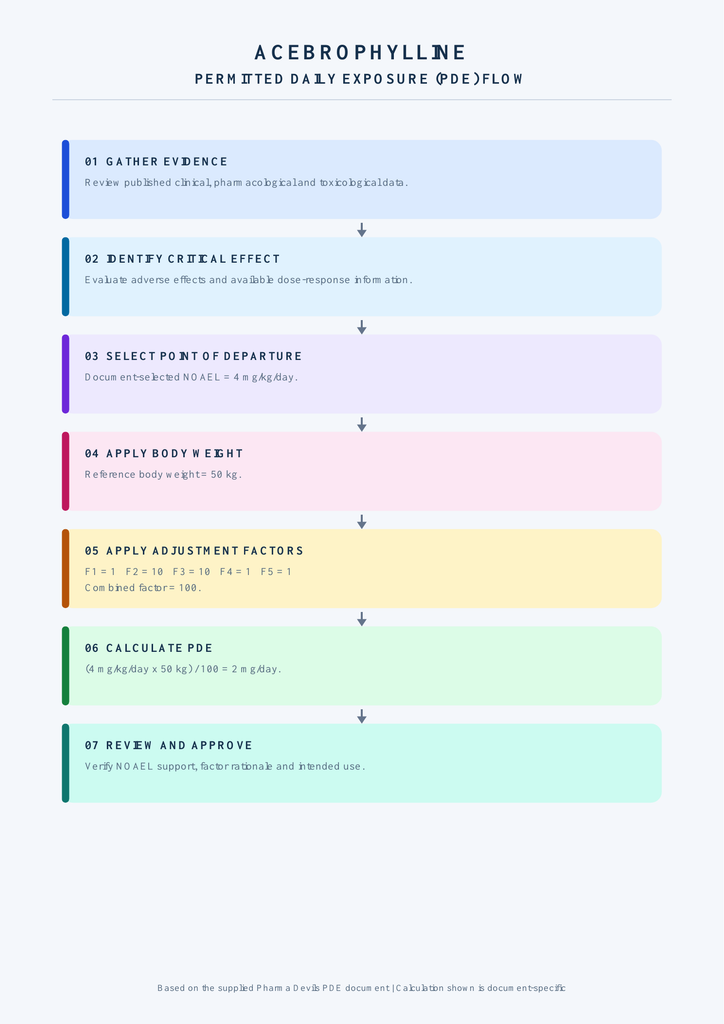
Skip to PDF content2. Introduction for Acebrophylline PDE Flow Diagram:
The flow diagram outlines the steps used in the attached document to calculate the permitted daily exposure (PDE) for acebrophylline. It begins with a review of pharmacological, clinical, and toxicological data, followed by identification of hazards and critical effects. The document selects a no observed adverse effect level (NOAEL) of 4 mg/kg/day and applies a 50 kg reference body weight. Adjustment factors F1 through F5 give a combined factor of 100. Dividing 4 × 50 by 100 produces the documented PDE of 2 mg/day. The final step is to verify the NOAEL evidence and factor rationale before approving the value for use.
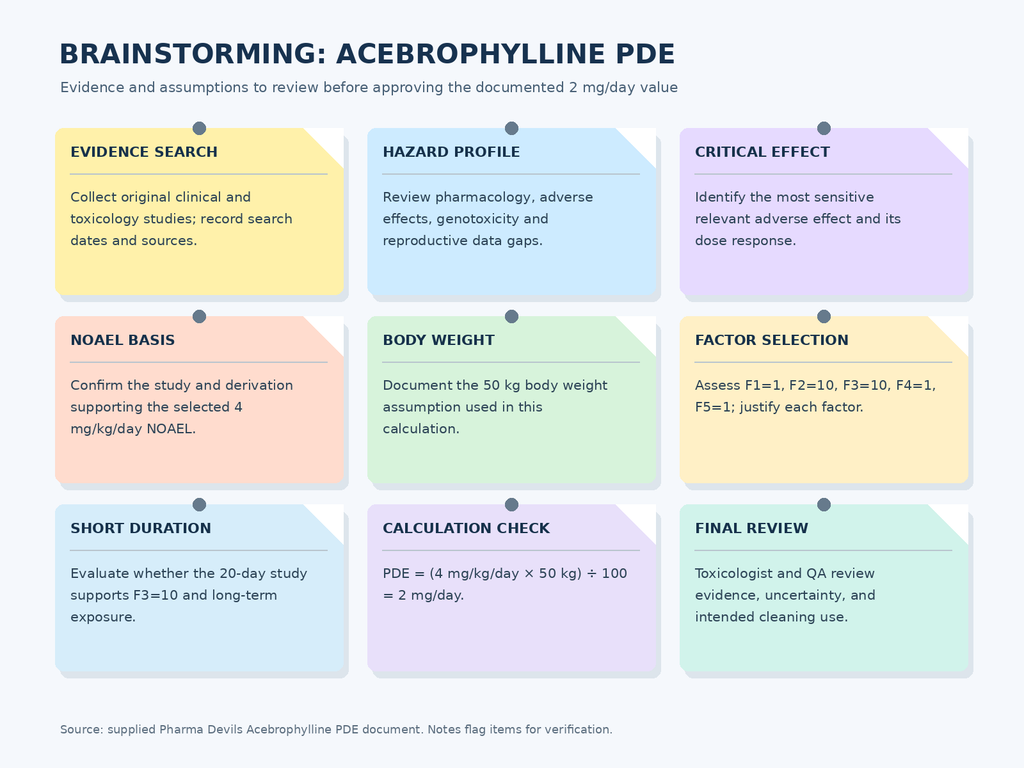
3. Brainstorming Analysis for Acebrophylline PDE:
The sticky notes identify the evidence and decisions needed to assess the Acebrophylline permitted daily exposure (PDE). They cover the literature search, hazard profile, critical effect, and basis for the document’s selected NOAEL of 4 mg/kg/day. The diagram also highlights the 50 kg body weight assumption and adjustment factors F1–F5, including the factor applied for the short study duration. These inputs produce the document’s calculated PDE of 2 mg/day. Before approving that value for cleaning validation, the original study, NOAEL derivation, data gaps, and factor justifications should be reviewed and documented by a qualified toxicologist and QA.
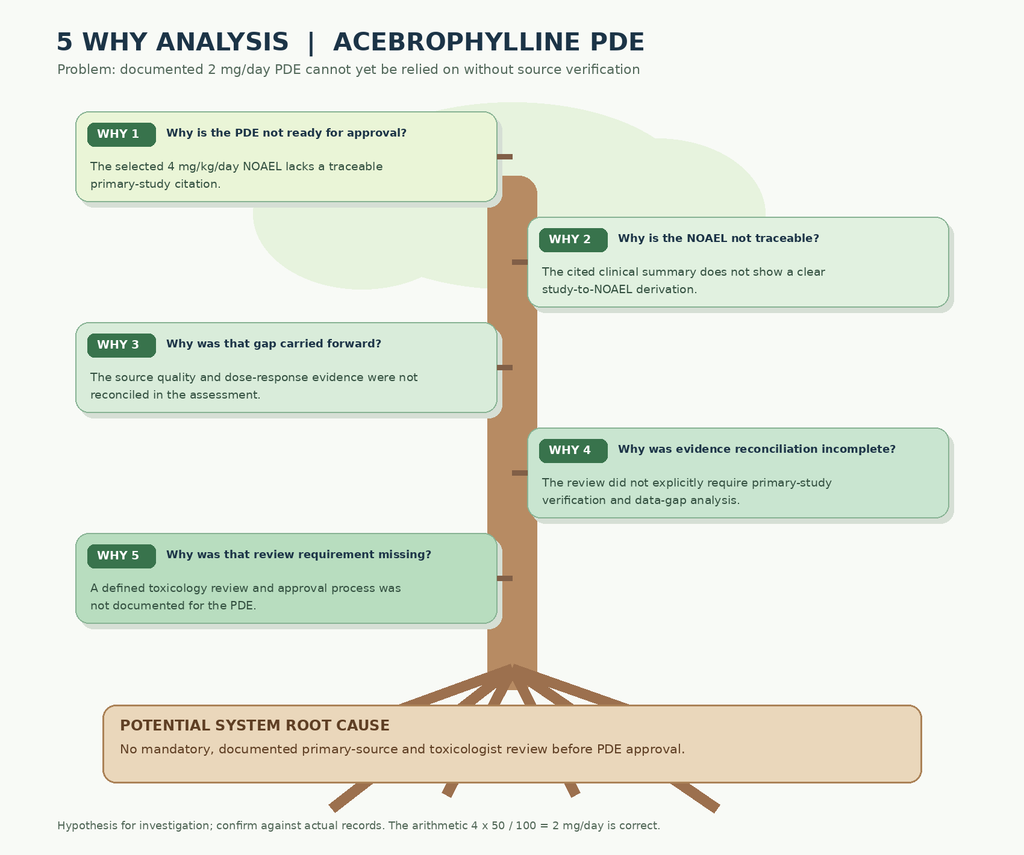
4. 5 Why Analysis for Acebrophylline PDE:
The 5 Why diagram explores why the documented acebrophylline PDE of 2 mg/day requires verification before approval. It traces the concern from an unclear source for the selected 4 mg/kg/day NOAEL through gaps in study review, dose response assessment, and documentation. The proposed system root cause is the absence of a defined process requiring primary source verification and toxicologist review. These are investigation hypotheses, not confirmed failures. The arithmetic in the document is correct: 4 mg/kg/day × 50 kg ÷ 100 = 2 mg/day. The underlying evidence and adjustment factor rationale still need review before the value is used.
5. Heatmap Analysis for PDE of Acebrophylline:
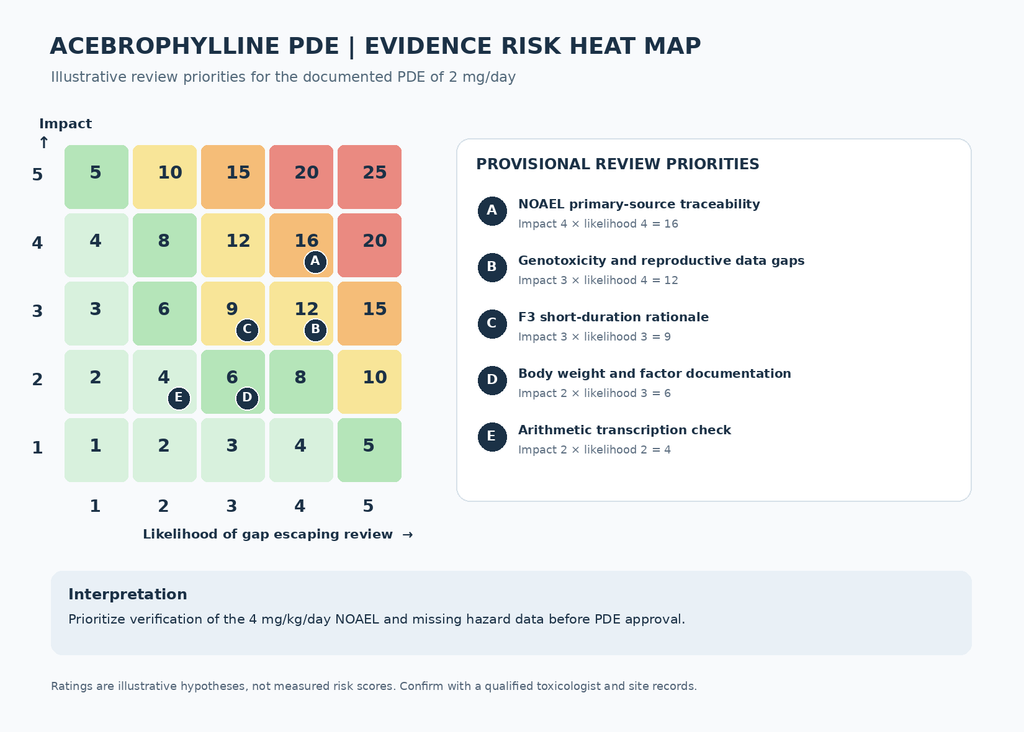
The heat map ranks evidence gaps for review before approving the documented Acebrophylline PDE of 2 mg/day. It places verification of the selected 4 mg/kg/day NOAEL at the highest priority, followed by gaps in genotoxicity and reproductive toxicity information. The rationale for the short study duration factor, body weight assumption, and other adjustment factors also require review. The arithmetic check has a lower priority because the stated calculation is correct. Each rating is illustrative, based on an assumed impact and likelihood of a gap escaping review. A qualified toxicologist should confirm the ratings against primary studies and site records.
6. Fishbone Analysis for PDE of Acebrophylline:
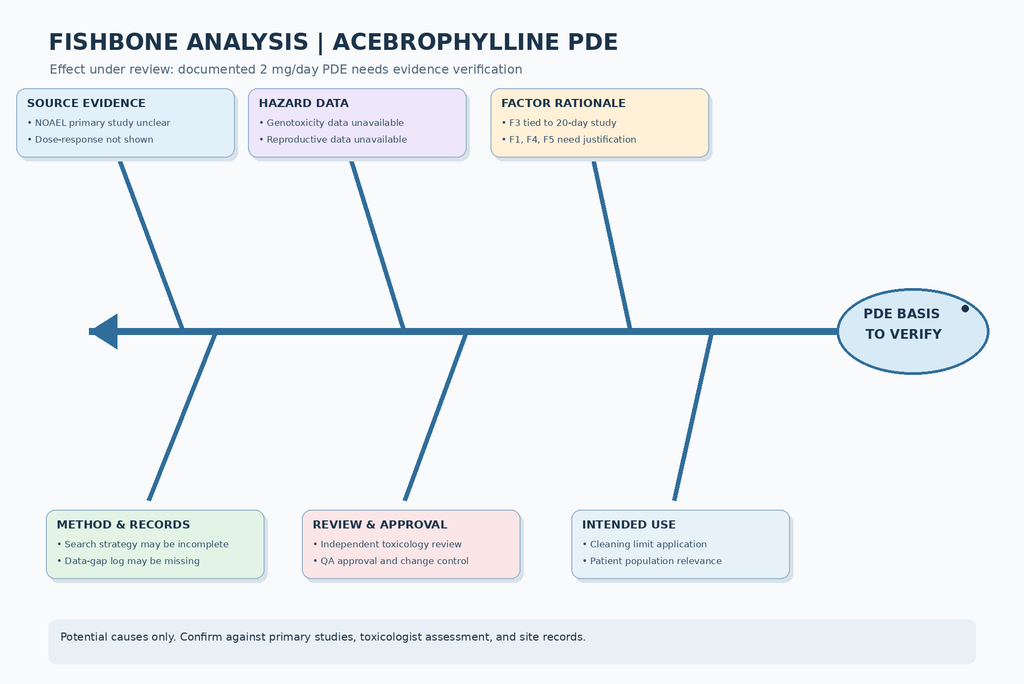
The fishbone diagram organizes factors that may affect confidence in the documented Acebrophylline PDE of 2 mg/day. Its branches cover source evidence, missing hazard data, adjustment factor rationale, methods and records, review and approval, and intended use. The key question is whether the selected 4 mg/kg/day NOAEL can be traced to a suitable primary study. The diagram also prompts review of the 20-day study duration and the justification for each factor. These branches are potential causes for investigation, not established deficiencies. A qualified toxicologist and QA should verify the evidence and document their conclusions before the PDE is applied to cleaning limits.
7. Fault Tree Analysis for PDE of Acebrophylline:
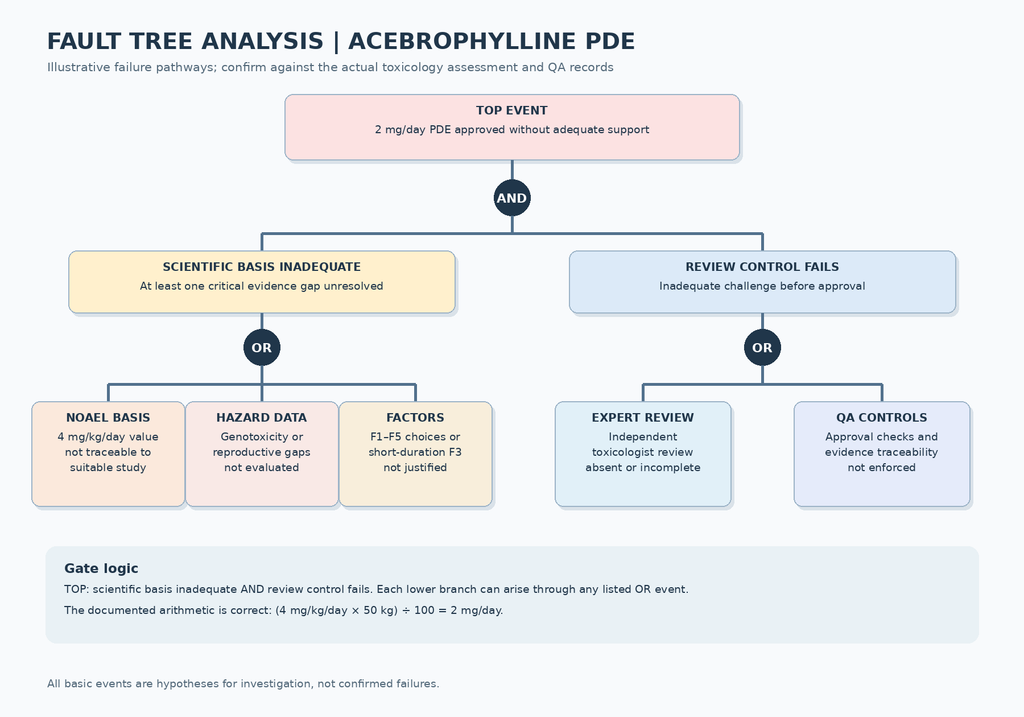
The fault tree examines how the documented Acebrophylline PDE of 2 mg/day could be approved without adequate scientific support. Its top event requires two conditions: an unresolved gap in the scientific basis and a failure of the review process to detect it. Possible scientific gaps include an untraceable 4 mg/kg/day NOAEL, unevaluated hazard data, or unjustified adjustment factors. Possible review gaps include incomplete toxicologist assessment or ineffective QA checks. The calculation itself is arithmetically correct. All lower-level events are investigation hypotheses, not confirmed deficiencies. Primary studies and approval records should be reviewed before drawing a conclusion or applying the PDE to cleaning limits.
8. Pareto Chart Analysis for PDE of Acebrophylline:
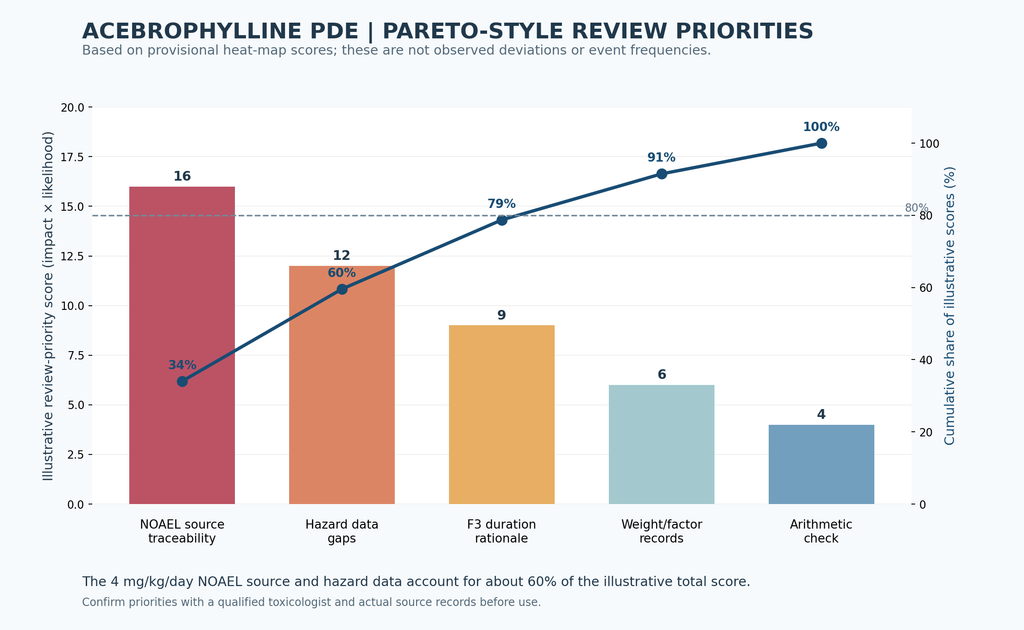
Permitted daily exposure (PDE) is a health based estimate of the amount of a substance a person may be exposed to each day over a lifetime without an appreciable health risk. The supplied Acebrophylline assessment selects a NOAEL of 4 mg/kg/day, a 50 kg body weight, and adjustment factors with a combined value of 100. It therefore calculates PDE = (4 × 50) ÷ 100 = 2 mg/day. This value can inform cleaning validation limits, but the source of the selected NOAEL, available toxicity data, and adjustment factor justifications should be verified by a qualified toxicologist before approval.
9. Corrective and Preventive Action – Acebrophylline PDE Assessment:
Issue under investigation: The supplied assessment calculates an Acebrophylline PDE of 2 mg/day, but the primary evidence supporting its selected 4 mg/kg/day NOAEL has not yet been verified. This is an evidence gap to investigate, not a confirmed incorrect PDE.
| Stage | Action |
|---|---|
| Immediate control | Place the PDE under QA review. Do not use it to establish new cleaning limits until the toxicological basis is approved. |
| Corrective action | Obtain and assess the primary study supporting the NOAEL. Reassess critical effects, missing toxicity data, the 50 kg body weight, and each F1–F5 factor. Have a qualified toxicologist recalculate and sign the PDE assessment. |
| Impact assessment | Identify cleaning limits and validation reports that used 2 mg/day. If the approved PDE changes, recalculate affected limits and assess relevant cleaning results and product impact. |
| Preventive action | Add a controlled PDE assessment template requiring traceable studies, documented data-gap and factor justifications, independent toxicologist review, and QA approval before use. Train applicable personnel. |
| Effectiveness check | Review the next three PDE assessments for complete source traceability, justified factors, correct calculations, and approvals. Close the CAPA only when all three meet the requirements and any affected cleaning limits have been resolved. |
10. Questions & Answers – Acebrophylline PDE:
1. What is the PDE stated in the supplied assessment?
The document calculates a permitted daily exposure of 2 mg/day for Acebrophylline.
2. How is 2 mg/day calculated?
The assessment uses a selected NOAEL of 4 mg/kg/day, a 50 kg body weight, and a combined adjustment factor of 100: (4 × 50) ÷ 100 = 2 mg/day.
3. What is the main point requiring verification?
The primary study and dose-response evidence supporting the selected 4 mg/kg/day NOAEL need to be traced and assessed.
4. Is the calculation mathematically correct?
Yes. The arithmetic is correct for the inputs stated in the document. That alone does not establish that the inputs are scientifically justified.
5. Why was an F3 factor of 10 applied?
The document attributes it to the short duration of an available 20-day study. A qualified toxicologist should confirm that rationale in the full evidence review.
6. How is a PDE used in cleaning validation?
An approved PDE can be used to derive a health based limit for residue carried into the next product. The calculation also depends on factors such as the next product’s batch size and maximum daily dose.
7. Can the 2 mg/day value be used immediately for new cleaning limits?
It should first receive a documented toxicological review and QA approval, including verification of the NOAEL, toxicity data, and adjustment factors.
8. What if the approved PDE differs from 2 mg/day?
Recalculate affected cleaning limits, identify validation work that used the earlier value, and document an impact assessment and any necessary follow-up actions.
11. Reference Guidelines – PDE of Acebrophylline:
| Reference | Relevance |
|---|---|
| EMA, Guideline on Setting Health Based Exposure Limits (EMA/CHMP/CVMP/SWP/169430/2012) | Primary guidance for deriving a PDE from pharmacological and toxicological evidence and applying adjustment factors. |
| EMA, Questions and Answers on Health Based Exposure Limits | Clarifies how HBEL assessments are used in cross-contamination risk management and cleaning limits. |
| EU GMP, Annex 15 – Qualification and Validation | Addresses cleaning validation and the toxicological basis for product residue carryover limits. |
| PIC/S PI 052-1, Aide-Memoire on Inspection of HBEL Assessments | Supports review of HBEL assessment quality and its use in quality risk management. |