







Brief Description
The SOP “Planning for Analysis and Reporting of Result” defines the systematic approach to be followed by the Quality Control department for planning laboratory activities, performing analyses, and accurately reporting test results. It assigns responsibility to QC personnel for execution, review, and effective implementation of the procedure.It requires analysts to review specifications and methods before starting, understand the analytical technique, prepare required reagents and glassware in advance, and organize testing to avoid unnecessary delays. All analyses must be performed strictly according to approved documented procedures without unauthorized changes.The SOP also establishes good documentation practices for recording observations, calculations, instrument/weight printouts, test dates, replicate results, and final conclusions. Incorrect entries must be corrected with a single-line strike-through without overwriting, preserving the original information and traceability. Analytical records are required to be retained for five years.
Skip to PDF content1. Flow Diagram:
The flow diagram illustrates the complete process for Planning for Analysis and Reporting of Results in the Quality Control department. It begins with reviewing the approved specification and analytical method, understanding the technique, preparing required reagents and glassware, and planning activities to avoid delays. The analyst then performs testing strictly according to documented procedures without unauthorized deviations or amendments. All observations, calculations, readings, printouts, replicate results, test dates, and conclusions are properly recorded and reported according to good documentation practices.
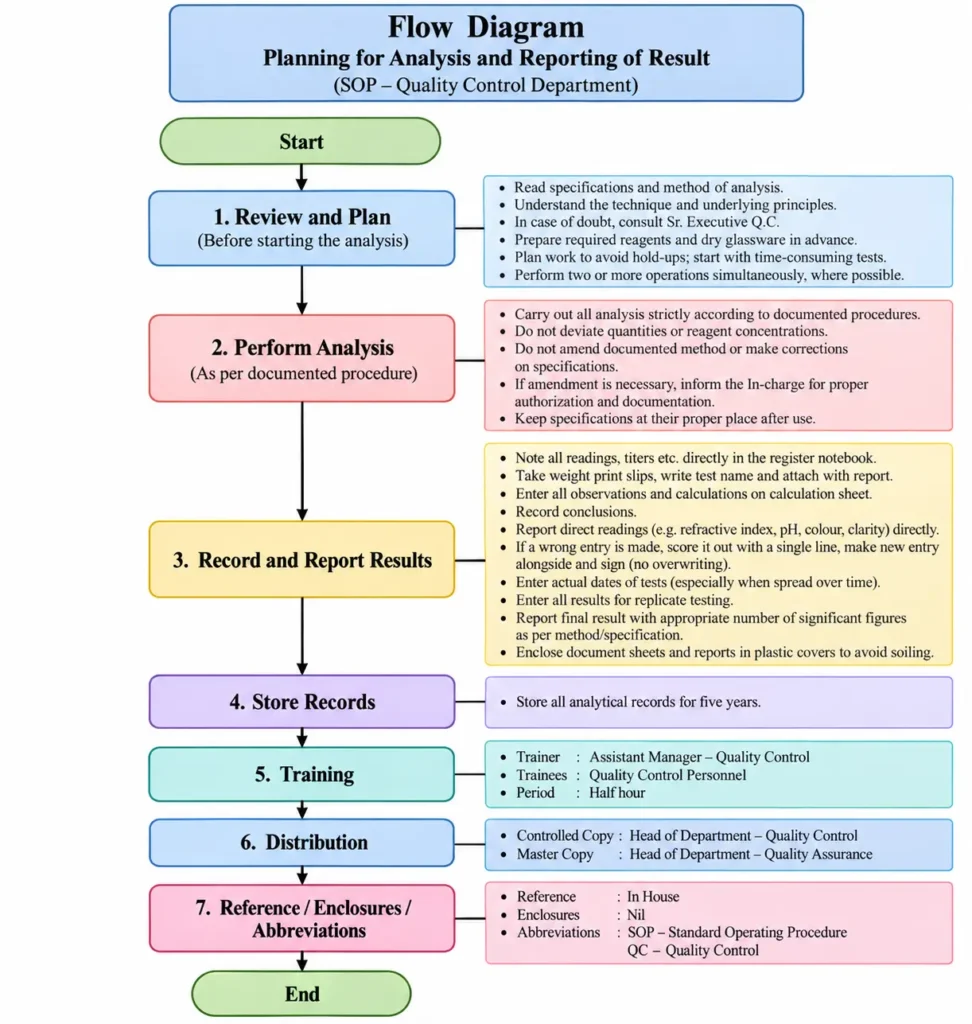
The flow further covers correction of erroneous entries without overwriting, appropriate reporting of final results, retention of analytical records for five years, QC personnel training, controlled SOP distribution, and document reference requirements.
2. Brainstorming for SOP Failure:
The brainstorming diagram identifies potential reasons for failure in implementing the SOP “Planning for Analysis and Reporting of Result.” Key concerns include inadequate understanding of the analytical method and principles, failure to review specifications before testing, poor work planning, lack of advance preparation of reagents or glassware, insufficient QC personnel training, and deviation from documented analytical procedures. These points directly reflect the SOP requirements for proper planning and controlled execution of analysis.
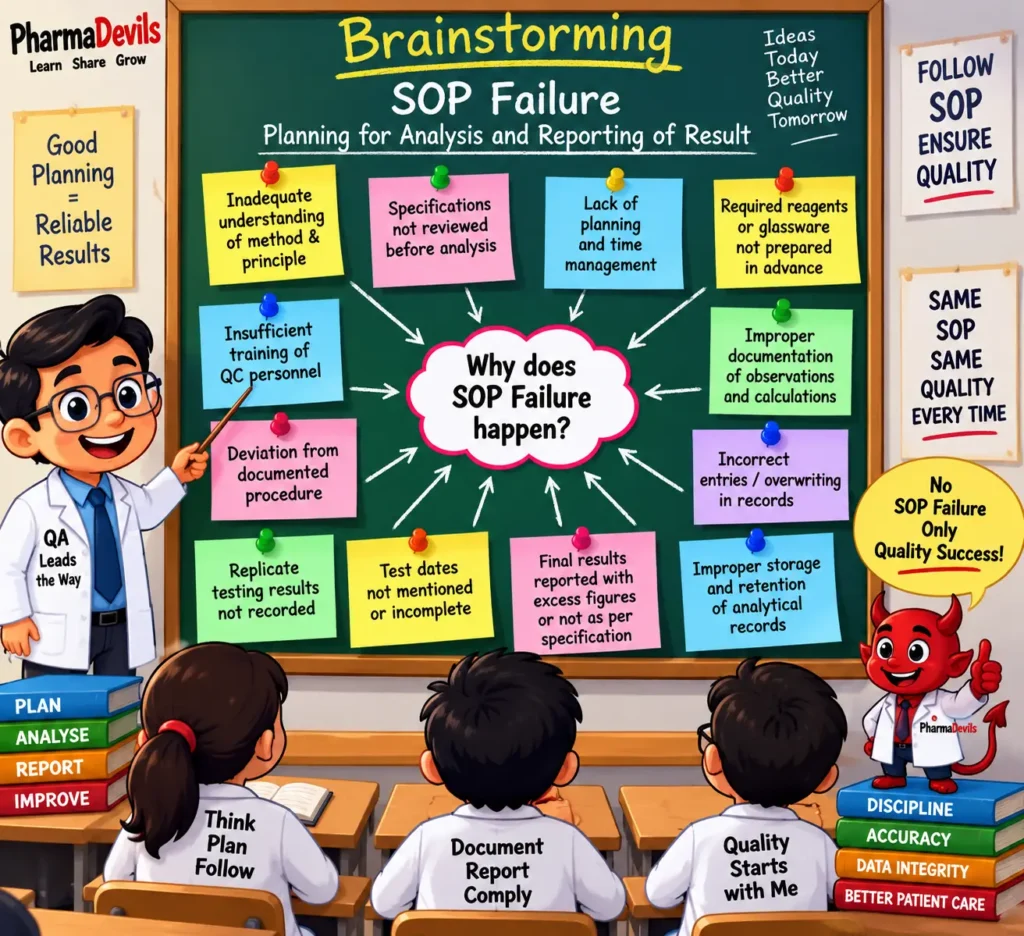
The brainstorming also highlights documentation-related failures such as incomplete recording of observations and calculations, incorrect entries or overwriting, failure to record replicate test results and actual test dates, inappropriate reporting of final results, and improper storage of analytical records. Such failures may compromise data integrity, traceability, result reliability, and GMP compliance.The overall purpose of the brainstorming exercise is to identify weaknesses in planning, analysis, documentation, training, and record control so that suitable corrective and preventive actions can be implemented to ensure consistent SOP compliance and reliable analytical results.
3. 5-Why Analysis for SOP Failure:
The 5-Why analysis identifies the progressive reasons behind failure to follow the SOP for Planning for Analysis and Reporting of Result. The issue begins with incomplete or unreliable analytical results caused by inadequate planning or execution of analysis. This may arise when the analyst does not properly understand the analytical method, specification requirements, or the importance of advance preparation before testing. The SOP specifically requires analysts to review specifications and methods, understand the technique, prepare required reagents and glassware, and plan work to avoid delays.
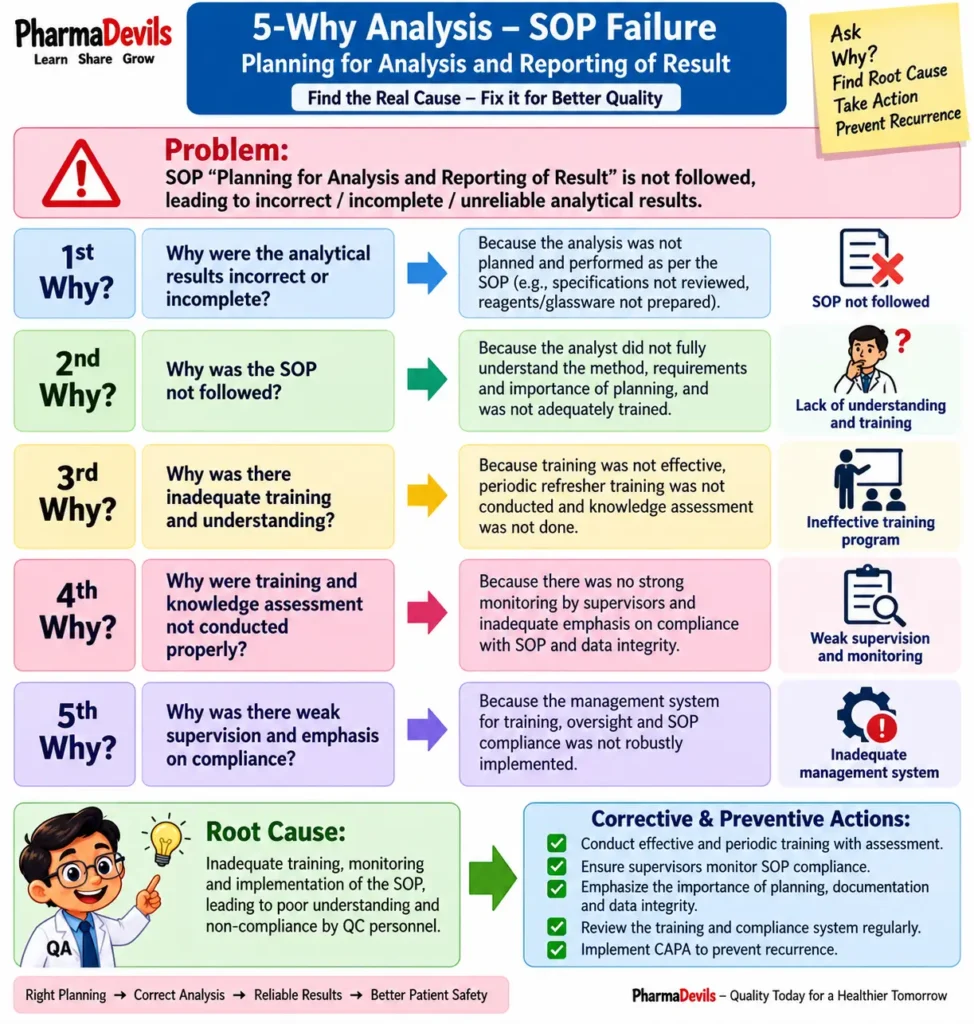
The analysis further links SOP failure to weaknesses in training, supervision, and implementation controls. These weaknesses can result in non-compliance with documented procedures and poor documentation practices. The SOP requires testing to be performed strictly according to approved procedures and results to be recorded with proper observations, calculations, dates, replicate results, and controlled correction of errors.The exercise helps identify the underlying root cause and supports development of suitable CAPA, such as effective training, stronger supervisory monitoring, periodic compliance review, and reinforcement of good documentation practices to prevent recurrence.
4. Fishbone Analysis for SOP Failure:
The Fishbone Analysis identifies potential causes of failure in implementing the SOP “Planning for Analysis and Reporting of Result.” The causes are grouped under key categories such as Man, Method, Material, Machine, Measurement, and Environment to support systematic root-cause evaluation.
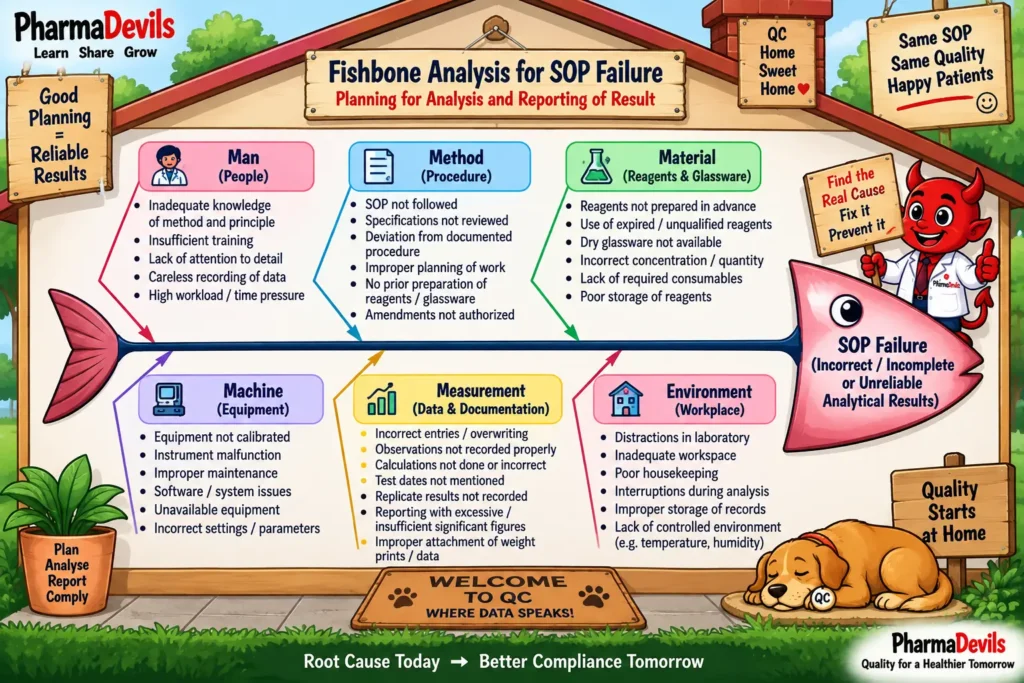
Major causes include inadequate analyst knowledge, insufficient training, failure to review specifications, deviation from documented procedures, poor work planning, non-availability of required reagents or dry glassware, and deficiencies in recording analytical observations and results. The SOP specifically requires analysts to understand the method, prepare necessary materials in advance, and perform analysis strictly according to approved procedures.Documentation-related causes may include incorrect entries, incomplete calculations, missing test dates, failure to record replicate results, and inappropriate reporting of final results. These issues can affect data integrity, traceability, reliability of analytical results, and GMP compliance.The Fishbone Analysis helps the investigation team identify the most probable contributing factors so that appropriate corrective and preventive actions can be implemented to strengthen SOP compliance and prevent recurrence.
5. Fault Tree Analysis for SOP Failure:
The Fault Tree Analysis illustrates how failure to follow the SOP “Planning for Analysis and Reporting of Result” can develop through multiple contributing pathways. The top event is SOP failure resulting in incorrect, incomplete, or unreliable analytical results.
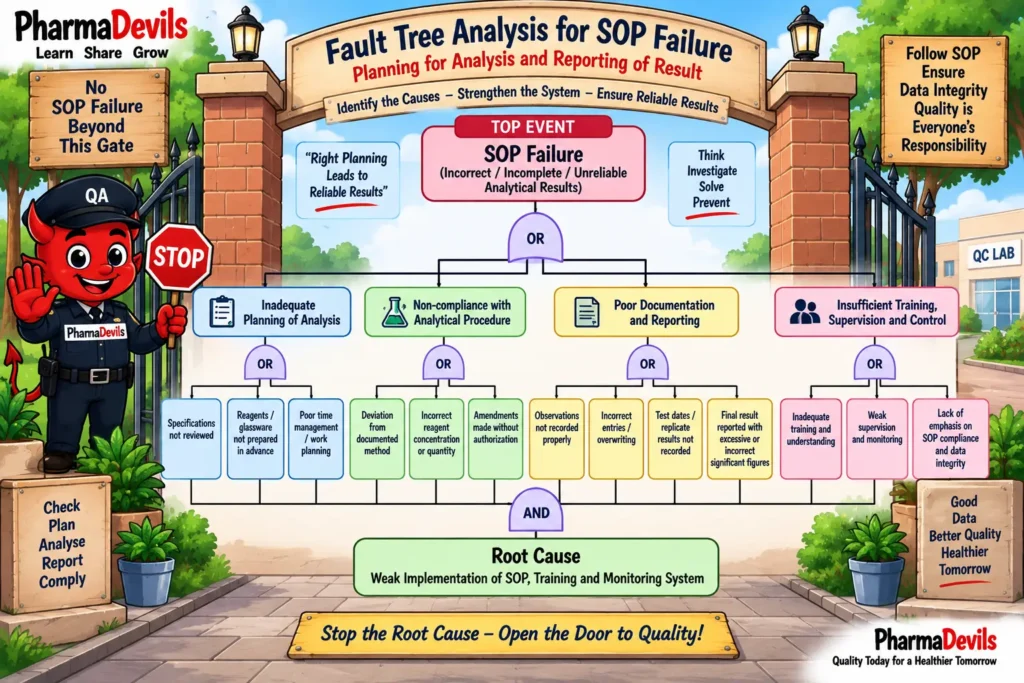
The main contributing branches include inadequate planning of analysis, non-compliance with the documented analytical procedure, poor documentation and reporting, and insufficient training or supervision. These branches reflect key SOP requirements such as reviewing specifications, preparing reagents and glassware in advance, following approved methods without unauthorized changes, and recording observations and calculations correctly.Lower-level causes include failure to review specifications, poor work planning, incorrect reagent concentration or quantity, unauthorized method amendments, improper entries or overwriting, missing test dates, incomplete replicate results, and incorrect final result reporting. The analysis helps trace these failures to a broader system weakness involving SOP implementation, training, monitoring, and control, supporting focused CAPA to improve compliance and analytical reliability.
Questions & Answers – Planning for Analysis and Reporting of Result
- What is the objective of this SOP?
Answer: To lay down the procedure for planning for analysis and reporting of results in the Quality Control department. - Who is responsible for execution of this SOP?
Answer: The QC Chemist is responsible for execution of the SOP. - Who is responsible for review and effective implementation of the SOP?
Answer: The Sr. Executive QC, Assistant Manager-QC, and Manager-QC are responsible for review and effective implementation. - What should an analyst do before starting analysis?
Answer: The analyst should carefully read the applicable specification and method of analysis and understand the technique and its basic principles. - What should be done if the analyst has a doubt regarding the analytical method?
Answer: The analyst should consult the Sr. Executive QC. - How should analytical work be planned?
Answer: Work should be planned to avoid hold-ups, with special reagents and required dry glassware prepared or made available before analysis begins. - Which determinations should preferably be started first?
Answer: Tests or determinations that require a long time to complete should be started first. - Can an analyst deviate from the documented analytical procedure?
Answer: No. All analyses must be carried out strictly according to documented procedures, without changing specified quantities or reagent concentrations. - Can an analyst directly amend an approved analytical method?
Answer: No. If an amendment is required, the In-charge must be informed so the change can be properly incorporated, authorized, and documented. - Where should analytical readings and titers be recorded?
Answer: They should be recorded directly in the register notebook, not on loose pieces of paper. - What should be done with weighing print slips?
Answer: The test name should be written on the print slip and it should be attached to the analytical report. - How should a wrong entry in an analytical report be corrected?
Answer: The incorrect entry should be struck through with a single line, the correct entry made alongside it, and the correction signed. Overwriting is not permitted, and the original entry must remain readable. - What should be recorded when analysis extends over several days?
Answer: The actual date on which each test was performed should be recorded against the relevant test result. - What should be done when replicate testing is performed?
Answer: All replicate results should be entered and reported. - How should final analytical results be reported?
Answer: Results should be reported with only the number of figures appropriate to the accuracy of the method and as required by the specification. - How long should analytical records be stored?
Answer: Analytical records should be retained for five years. - Who conducts training for this SOP?
Answer: The trainer is the Assistant Manager – Quality Control, and the trainees are Quality Control personnel. - What is the training duration mentioned in the SOP?
Answer: The training period is half an hour. - Who receives the controlled copy of this SOP?
Answer: The controlled copy is issued to the Head of Department – Quality Control. - Who maintains the master copy?
Answer: The Head of Department – Quality Assurance maintains the master copy.
Reference Guidelines:
- WHO Technical Report Series No. 1052, Annex 4 – WHO Good Practices for Pharmaceutical Quality Control Laboratories (2024). This is directly applicable to QC laboratory operations, including documentation, analytical worksheets, testing, evaluation of results, personnel, equipment, reagents, and records. (World Health Organization)
WHO Good Practices for Pharmaceutical Quality Control Laboratories - EU GMP – EudraLex Volume 4, Part I, Chapter 6: Quality Control. It covers QC organization, documentation, sampling, testing, specifications, analytical methods, records, OOS handling, and technical transfer of test methods. (Public Health)
EU GMP Volume 4 – Chapter 6 Quality Control - PIC/S GMP Guide PE 009 – Chapter 6: Quality Control. PIC/S Chapter 6 is aligned closely with EU GMP requirements and addresses QC laboratory controls, testing, documentation, and technical transfer of testing methods. (PIC/S)
PIC/S GMP Guidance - US FDA – 21 CFR Part 211.160, General Requirements for Laboratory Controls. It requires written specifications, standards, sampling plans and test procedures to be approved by the Quality Control Unit, followed during testing, and documented at the time of performance. Deviations must be documented and justified. (eCFR)
21 CFR 211.160 – Laboratory Controls - US FDA – 21 CFR Part 211.194, Laboratory Records. It requires complete laboratory data, identification of the analytical method, sample quantities, raw data, calculations, results, analyst signatures/dates, and independent review of laboratory records. (eCFR)
21 CFR 211.194 – Laboratory Records