







1. Brief Description:
The Post Risk Analysis for the Induction Cap Sealing Machine (Cepha Block) is a Quality Assurance risk assessment report prepared using the FMEA methodology. The study evaluates risks associated with the machine’s design, installation, operation, performance, and safety after implementation. Its objective is to confirm that the equipment can consistently support product quality and safety throughout its lifecycle, in line with ICH Q9 Quality Risk Management principles. The assessment reviews potential failure modes related to qualification documents, utilities, equipment components, calibration, material of construction, operational controls, safety features, cleaning, machine speed, and change control. Each risk is rated for Severity, Occurrence, and Detection to calculate the Risk Priority Number (RPN). The report defines risk acceptance criteria, evaluates existing controls, recommends actions where required, and ensures identified risks and control measures are reviewed and considered acceptable.
Skip to PDF content2. Flow Diagram:
The flow diagram presents the sequential operation of the Induction Cap Sealing Machine (Cepha Block), which is intended to provide effective container sealing, tamper evidence, protection against moisture and oxygen ingress, and prevention of leakage.
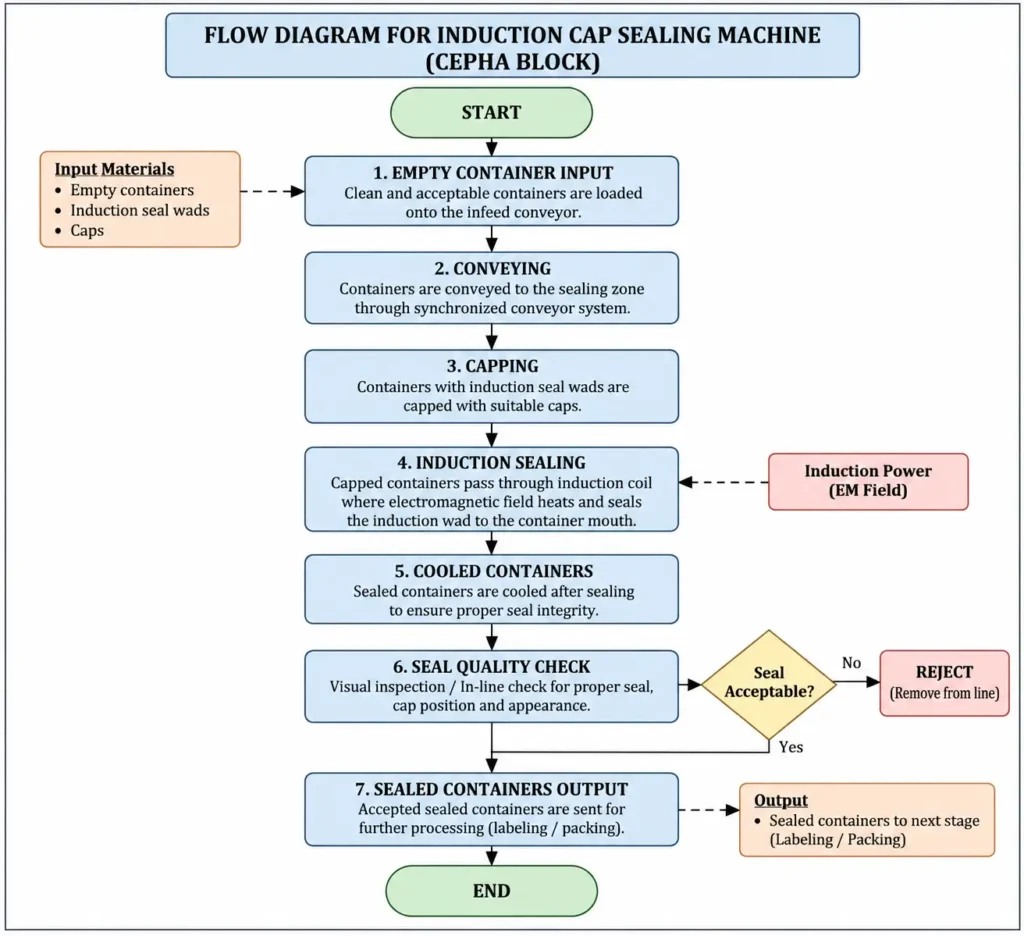
The process begins with the loading of clean containers, induction sealing wads, and suitable caps. Containers are conveyed to the sealing section, properly capped, and then passed beneath the induction sealing head. The electromagnetic field heats the induction wad and bonds it securely to the container mouth. After sealing, containers are allowed to cool and undergo a seal-quality inspection for proper sealing, cap position, integrity, and appearance. Acceptable containers proceed to the next stage, such as labeling or packing, while defective or improperly sealed containers are rejected. The flow emphasizes controlled machine operation, proper sealing integrity, product protection, and consistent product quality.
3. Brainstorming:
The brainstorming diagram identifies possible reasons why the Post Risk Analysis for the Induction Cap Sealing Machine (Cepha Block) was not completed. The original document defines the assessment as an FMEA-based risk assessment involving Quality Assurance, Engineering, Production, Quality Control, and Stores.
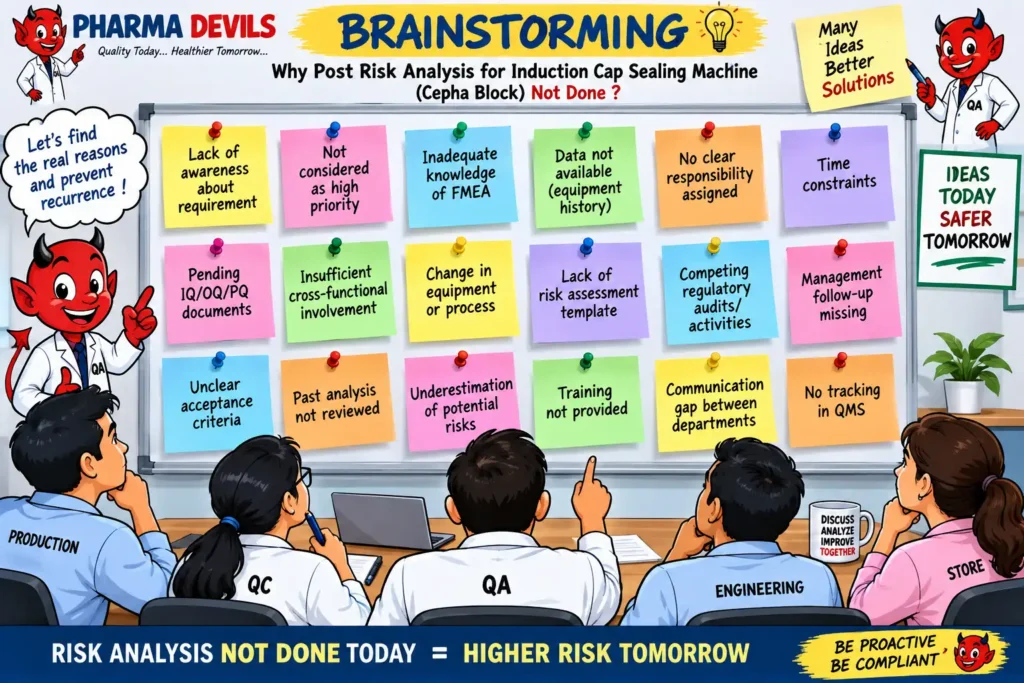
The sticky notes highlight potential contributing factors such as lack of awareness, inadequate FMEA knowledge, unclear responsibility, time constraints, pending IQ/OQ/PQ documentation, insufficient cross-functional involvement, unavailable equipment history, lack of a risk-assessment template, inadequate training, communication gaps, poor management follow-up, competing audit activities, and absence of QMS tracking. The brainstorming approach helps the team collect possible causes before performing detailed root-cause analysis. It supports systematic investigation, better departmental coordination, timely corrective actions, and prevention of recurrence so that equipment-related risks are properly identified, evaluated, controlled, and documented.
4. 5-Why Analysis:
The 5-Why Analysis investigates the potential reasons why the Post Risk Analysis for the Induction Cap Sealing Machine (Cepha Block) was not completed. The original document specifies that the post-risk assessment is performed using the FMEA methodology and involves QA, Engineering, Production, Quality Control, and Stores. The diagram progressively examines the issue from delayed completion of the risk assessment to incomplete FMEA review, insufficient equipment and qualification information, inadequate cross-functional coordination, and finally the absence of clearly assigned ownership, timelines, and follow-up tracking. The proposed root cause is inadequate ownership, departmental coordination, and QMS-based monitoring of the activity.
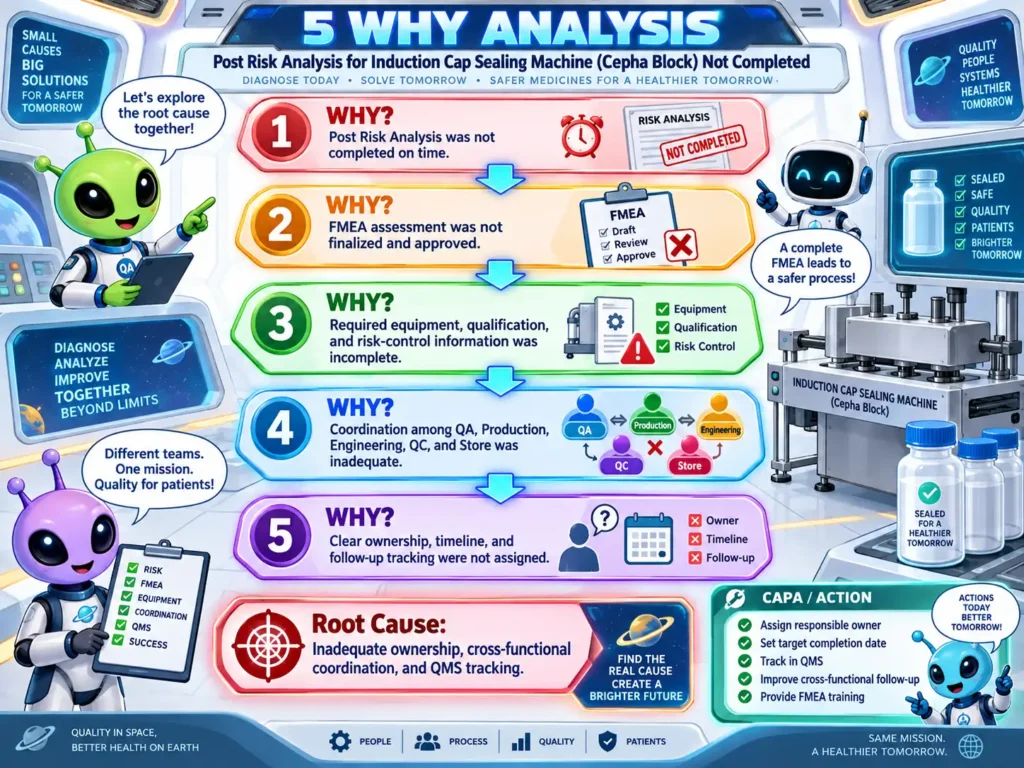
The analysis supports CAPA such as assigning a responsible owner, establishing a target completion date, tracking the assessment through QMS, improving interdepartmental follow-up, and providing appropriate FMEA training to prevent recurrence.
Heat Map
The Heat Map for Post Risk Analysis of the Induction Cap Sealing Machine (Cepha Block) not being completed visually ranks the potential contributing causes according to likelihood/occurrence and impact/severity. The source document itself uses an FMEA-based risk assessment approach and classifies risks using RPN categories ranging from minor to critical. In the heat map, factors such as unclear ownership, lack of QMS tracking, poor cross-functional coordination, and missing management follow-up are placed in the higher-risk zones. Other contributing factors, including inadequate FMEA knowledge, pending IQ/OQ/PQ documents, unavailable equipment history, competing audit activities, lack of a risk-assessment template, and time constraints, fall into moderate-to-major risk areas.
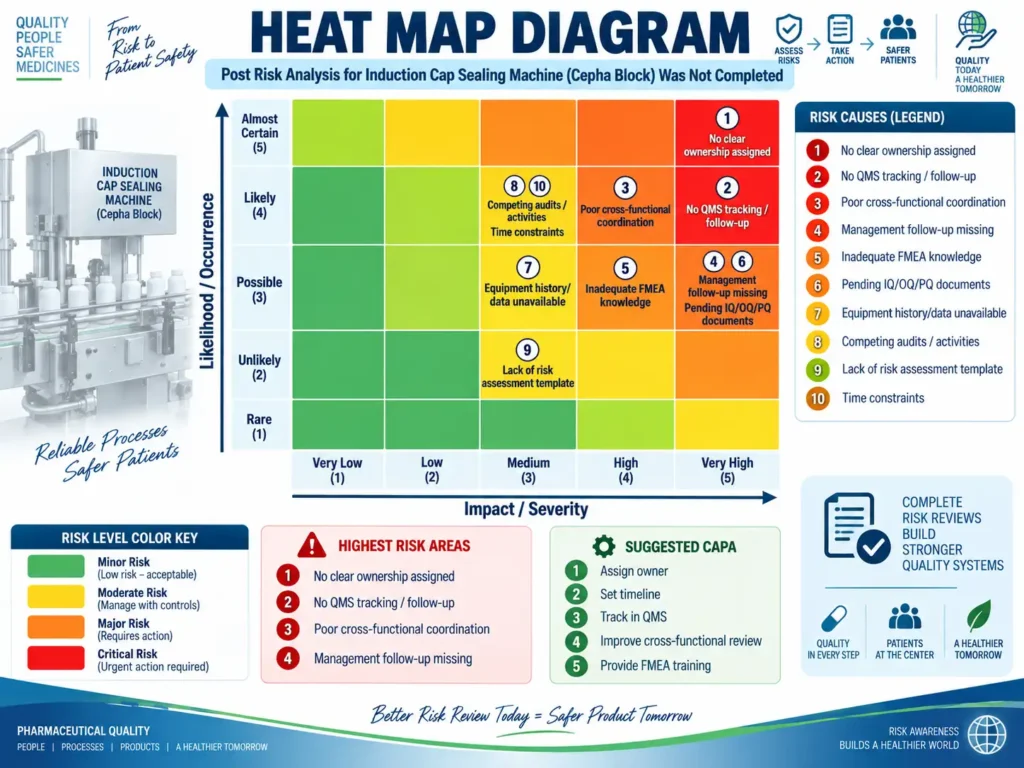
The diagram helps prioritize corrective actions by focusing first on high-risk causes. Suggested controls include assigning a responsible owner, defining timelines, tracking completion through the QMS, improving departmental coordination, and providing FMEA training.
Critical Process Parameters (CPP) & Critical Quality Attributes (CQA)
Induction Cap Sealing Machine – Cepha Block
The source document does not explicitly provide a separate CPP/CQA table. However, it states that successful sealing depends on proper caps, induction wads, container fit and compatibility, and that sealing is intended to prevent moisture/oxygen ingress and leakage. Based on those documented requirements and the listed FMEA failure modes, the following CPPs and CQAs can be derived.
| S.No. | Critical Process Parameter (CPP) | Why Critical |
|---|---|---|
| 1 | Induction sealing power / energy | Controls heating and bonding of the induction wad to the container mouth. |
| 2 | Conveyor / machine speed | Determines exposure time under the induction sealing head; the FMEA identifies incorrect desired speed as a product-quality risk. |
| 3 | Sealing head-to-cap distance | Influences electromagnetic energy transfer and uniform sealing. |
| 4 | Cap application / tightening condition | Proper cap positioning and fit are necessary for effective sealing. |
| 5 | Induction wad specification and placement | Correct wad material and positioning are essential for seal formation. |
| 6 | Container–cap–wad compatibility | Specifically identified in the document as necessary for proper sealing. |
| 7 | Container position under sealing head | Misalignment can lead to incomplete or non-uniform sealing. |
| 8 | Sealing exposure time | Insufficient exposure may cause weak sealing; excessive exposure may damage the liner/container. |
| 9 | Cooling / stabilization after sealing | Allows the heat-sealed layer to form a stable bond. |
| 10 | Machine cleanliness / line clearance | Inadequate cleaning is identified as a contamination risk in the FMEA. |
| 11 | Equipment control-function performance | The FMEA requires verification that control functions operate as intended. |
| 12 | Calibration status of critical instruments | Instrumentation and calibration checks are part of equipment qualification controls. |
Critical Quality Attributes (CQA)
| S.No. | Critical Quality Attribute | Expected Quality Requirement |
|---|---|---|
| 1 | Seal integrity | Continuous, intact and secure induction seal. |
| 2 | Leak resistance | No leakage through the container closure system. |
| 3 | Moisture barrier integrity | Seal should prevent moisture ingress. |
| 4 | Oxygen barrier integrity | Seal should minimize oxygen ingress. |
| 5 | Tamper evidence | Induction seal should provide visible evidence of opening/tampering. |
| 6 | Seal adhesion strength | Wad should be adequately bonded to the container mouth. |
| 7 | Seal uniformity | Complete sealing around the entire circumference. |
| 8 | Cap/wad position | Cap and induction wad should be correctly positioned. |
| 9 | Container appearance | No deformation, burning, melting or visible damage due to sealing. |
| 10 | Product protection | Product should remain protected from contamination and environmental exposure. |
| 11 | Container-closure compatibility | Container, cap and induction wad should remain compatible throughout use. |
| 12 | Cleanliness / contamination control | No contamination attributable to improperly cleaned equipment. |
Key relationship:
Induction Power + Machine Speed + Sealing Time + Head Distance + Cap/Wad/Container Compatibility → Seal Integrity → Leakage Protection + Moisture/Oxygen Protection + Tamper Evidence.
The document specifically identifies the intended sealing outcomes as tamper evidence, prevention of moisture and oxygen ingress, and avoidance of leakage, making these the most important quality attributes for the induction cap sealing operation.
Questions & Answers
Post Risk Analysis for Induction Cap Sealing Machine (Cepha Block)
- Q: What is the purpose of the Post Risk Analysis for the Induction Cap Sealing Machine?
A: The purpose is to assess risks associated with the Induction Cap Sealing Machine during post-assessment in the Cepha Block manufacturing facility, in line with the site risk-management system and ICH Q9. - Q: Which risk assessment methodology is used?
A: The document uses FMEA – Failure Mode and Effects Analysis. - Q: What is the scope of the risk assessment?
A: It covers the design, installation, operation, performance, and safety of the Induction Cap Sealing Machine. - Q: Which departments are responsible for the risk assessment?
A: Quality Assurance, Engineering, Production, Quality Control, and Store are involved. - Q: Why is proper induction sealing important?
A: Proper sealing provides tamper evidence, helps prevent moisture and oxygen ingress, and avoids leakage. - Q: What factors are important for achieving proper sealing?
A: Proper fit and compatibility of the caps, induction wads, and containers are important. - Q: What are the three main FMEA rating parameters?
A: The FMEA uses Severity, Occurrence, and Detection as the main rating parameters. - Q: How is the Risk Priority Number calculated?
A: The document defines RPN as Severity × Occurrence × Detection (S × O × D). - Q: What RPN value is classified as Critical?
A: An RPN of 76 or above is classified as Critical and requires CAPA. - Q: What RPN range is classified as Major?
A: An RPN of 51 to 75 is classified as Major and requires CAPA. - Q: What RPN range is classified as Moderate?
A: An RPN of 26 to 50 is classified as Moderate and requires CAPA. - Q: What RPN is considered Minor?
A: An RPN of up to 25 is considered Minor, for which CAPA is listed as not applicable. - Q: What risk is identified if MOC verification is not performed during IQ?
A: The document states that the product may become contaminated. This failure mode was assigned an RPN of 56 before the recommended action. - Q: What action was recommended for the MOC verification risk?
A: Procurement of a Molybdenum kit was recommended. - Q: Why is equipment cleaning important?
A: If the equipment is not cleaned properly, the product may become contaminated. The document states that line clearance and cleaning procedures are in place as controls. - Q: What happens if the machine does not operate at the desired speed?
A: Product quality may be affected. The control is that trained personnel perform the activity according to the SOP. - Q: Why are safety features important on the equipment?
A: Inadequate safety features may result in accidents. The document also identifies flame-proof motors and earthing as important safety considerations. - Q: What is the risk if major equipment changes are made without documentation?
A: Equipment performance may not be guaranteed and product quality may be affected. A change-control SOP is listed as the existing control. - Q: Why should IQ be completed before OQ?
A: The document states that OQ cannot proceed if IQ has not been successfully completed. - Q: What is the final requirement before approval of the risk assessment report?
A: All identified risks and critical control parameters should be reviewed, and the control measures should be documented and found acceptable before final approval.