







1. Brief Description:
This Post Risk Analysis evaluates the Automatic Rotary Vacuumatric Dry Syrup Filling with ROPP Capping Machine for powder oral dosage manufacturing in the Cepha Block. The assessment applies Failure Mode and Effects Analysis (FMEA) to identify, rank, and control risks related to equipment design, installation, operation, performance, safety, cleaning, calibration, documentation, utilities, and process monitoring. Risk Priority Numbers are determined from severity, occurrence, and detection ratings, with predefined acceptance criteria for critical, major, moderate, and minor risks. The study reviews potential failures such as inadequate qualification documents, missing reference records, improper installation, unavailable calibrated instruments, incomplete material-of-construction verification, unsafe operating conditions, equipment control or alarm failures, cleaning deficiencies, undocumented changes, and inadequate process validation guidance. Existing controls include trained personnel, SOPs, qualification checks, line clearance, change control, process validation, and APR monitoring. Corrective actions such as procuring molybdenum kits and dedicated finger bags are recommended to reduce residual risk effectively.
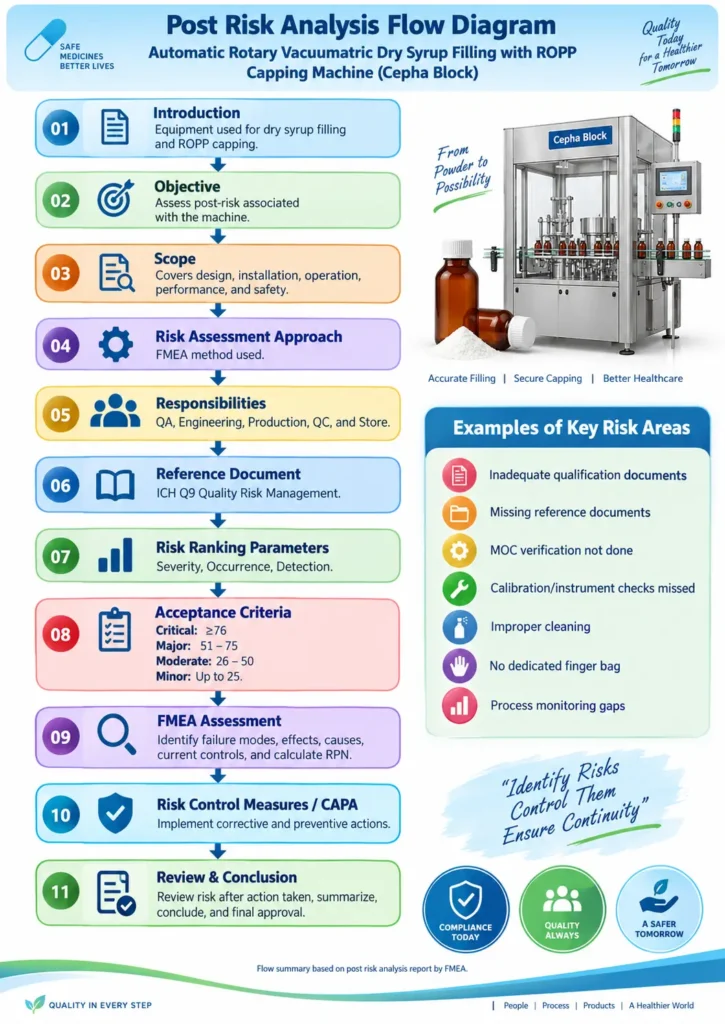
Skip to PDF content2. Flow Diagram:
The flow diagram presents a structured overview of the Post Risk Analysis for the Automatic Rotary Vacuumatric Dry Syrup Filling with ROPP Capping Machine used in the Cepha Block. It begins with the equipment introduction, objective, and scope, covering design, installation, operation, performance, and safety. The assessment follows the FMEA methodology, with responsibilities assigned to Quality Assurance, Engineering, Production, Quality Control, and Stores. Risk evaluation is performed using Severity, Occurrence, and Detection ratings to calculate the Risk Priority Number (RPN). Risks are classified as critical, major, moderate, or minor according to predefined RPN acceptance criteria. Potential failure modes, their effects, causes, and existing controls are systematically reviewed. Where required, risk-control measures and CAPA are implemented. Finally, risks are reassessed after actions are completed, followed by summary, conclusion, documentation of control measures, and final approval to confirm that identified risks remain adequately controlled.
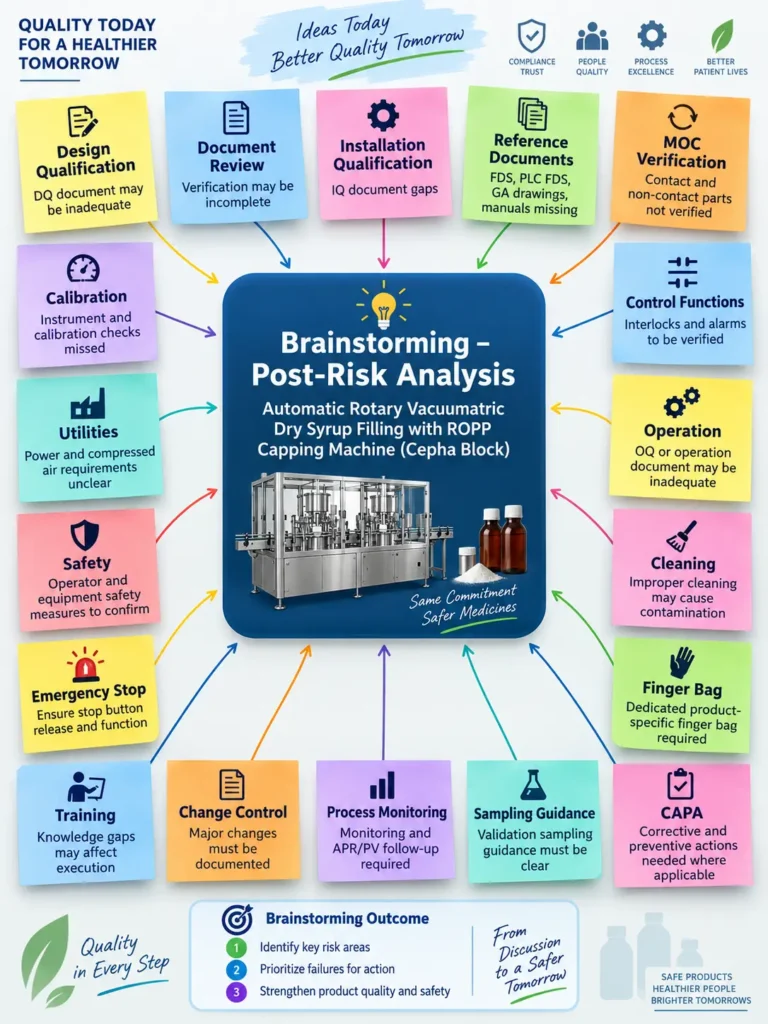
3. Brainstorming:
The brainstorming diagram identifies potential risk areas associated with the Post-Risk Analysis of the Automatic Rotary Vacuumatric Dry Syrup Filling with ROPP Capping Machine. It brings together key concerns related to design qualification, document review, installation qualification, reference documents, material-of-construction verification, calibration, utilities, safety, emergency stop functions, equipment controls, operation, cleaning, training, change control, process monitoring, validation sampling, dedicated finger bags, and CAPA. These areas reflect the types of failure modes and controls considered in the FMEA-based assessment, including qualification deficiencies, missing documentation, inadequate MOC verification, cleaning risks, and process-monitoring concerns. The brainstorming approach helps the multidisciplinary team systematically discuss possible causes, consequences, and existing controls before prioritizing risks for further action. It supports identification of weaknesses that may affect equipment performance, operator safety, product quality, and contamination control, helping focus corrective and preventive actions on the most important risk areas.
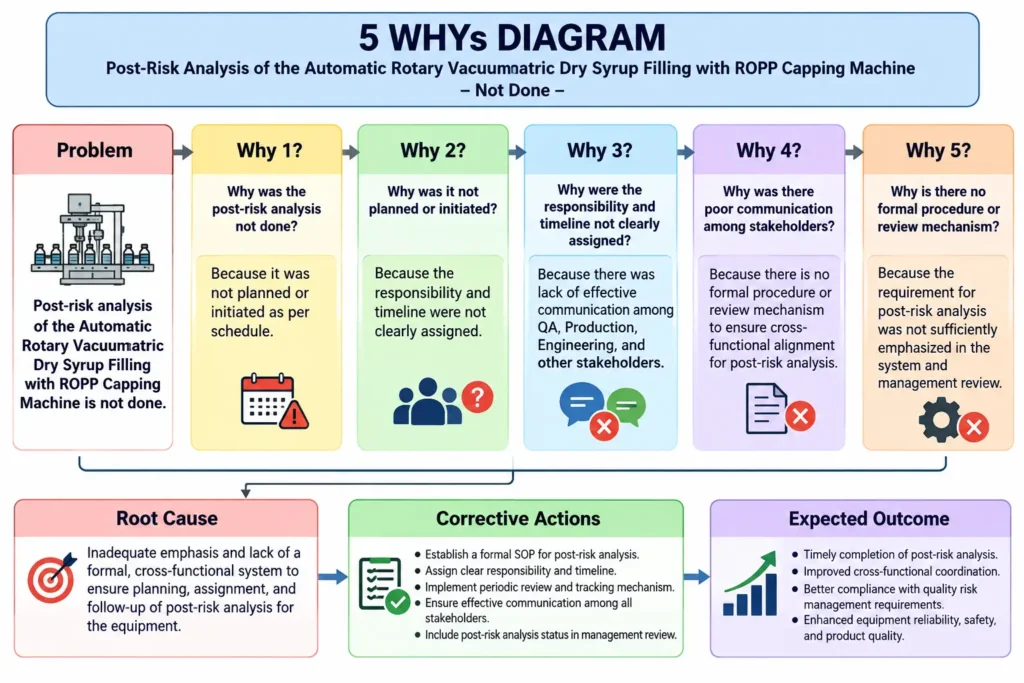
4. 5 Why Analysis:
The 5 Why Analysis identifies the root cause behind the Post-Risk Analysis for the Automatic Rotary Vacuumatric Dry Syrup Filling with ROPP Capping Machine not being completed. The analysis starts with the primary problem and progressively investigates why the activity was missed. The identified causes include failure to plan or initiate the assessment as scheduled, unclear assignment of responsibility and timelines, inadequate coordination between QA, Production, Engineering, and other concerned departments, and absence of a formal review or tracking mechanism. The final root cause indicates insufficient emphasis within the quality system to ensure timely planning, ownership, communication, and follow-up of post-risk assessments. Corrective actions include establishing a defined SOP, assigning responsibilities and target dates, implementing periodic tracking, strengthening cross-functional communication, and reviewing post-risk assessment status during management review. These measures help ensure timely risk reassessment, improved compliance, better equipment reliability, enhanced safety, and consistent product quality.
5. Heat Map Diagram:
The Heat Map Diagram visually evaluates the risk associated with non-completion of the Post-Risk Analysis for the Automatic Rotary Vacuumatric Dry Syrup Filling with ROPP Capping Machine. It uses Severity/Impact and Likelihood to categorize risks from low to critical. The diagram highlights important risk areas such as delayed initiation of the post-risk assessment, unclear responsibility and timelines, poor cross-functional communication, absence of a formal SOP or review mechanism, unidentified qualification gaps, potential compliance and product-quality impact, and delayed CAPA follow-up.
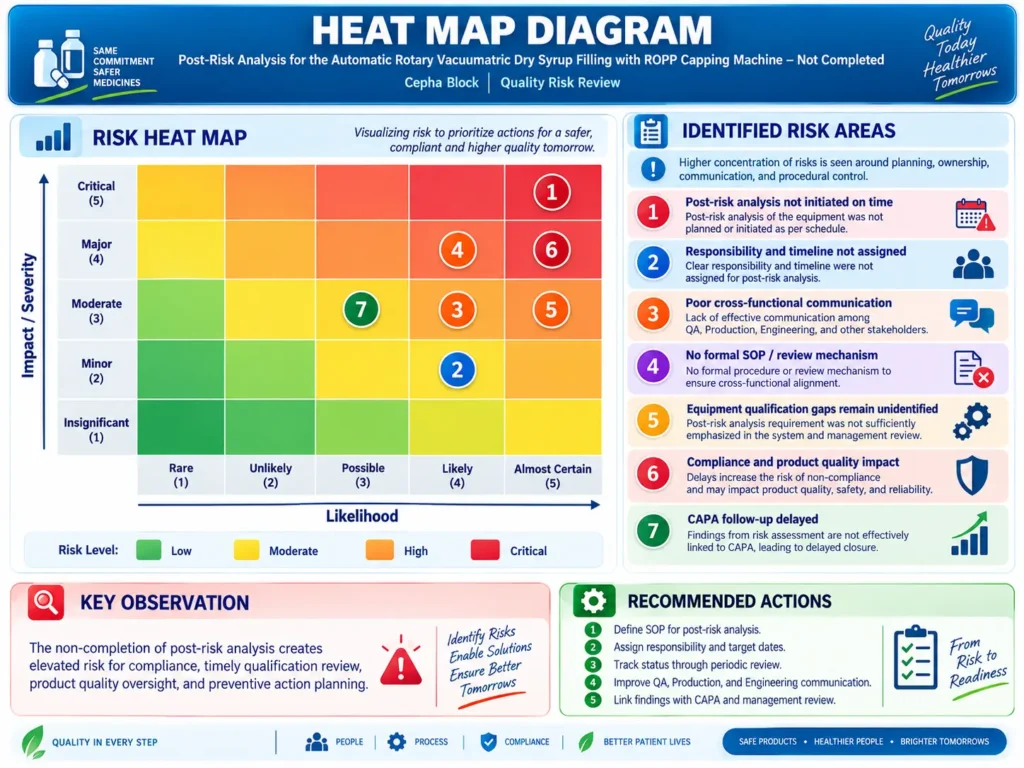
Higher-risk items are positioned in the orange and red zones, indicating the need for priority action, while lower-risk items appear in the green or yellow zones. The heat map helps management quickly identify which issues require immediate control. Recommended actions include defining a formal procedure, assigning responsible persons and target dates, periodically tracking assessment status, improving QA–Production–Engineering coordination, and linking findings with CAPA and management review for effective closure.
Critical Process Parameters (CPP) & Critical Quality Attributes (CQA)
The uploaded post-risk-analysis report does not explicitly define a formal CPP/CQA list or numerical acceptance limits. It does, however, identify equipment performance, utilities, cleaning, controls, qualification, process monitoring, and contamination risks relevant to defining CPPs and CQAs. The machine works on a volumetric filling principle using a hopper and filling head for dry-syrup powder filling.
Critical Process Parameters – Recommended for this Filling & ROPP Capping Process
| S.No. | CPP | Why Critical |
|---|---|---|
| 1 | Dry syrup fill quantity / target fill weight | Directly affects the quantity of product delivered into each bottle. |
| 2 | Filling machine speed | May influence filling consistency and powder handling. |
| 3 | Vacuum / filling system setting | Important for consistent volumetric powder filling. |
| 4 | Compressed-air supply/pressure | Compressed air is identified as a required equipment utility. |
| 5 | Hopper and filling-head settings | These components are used to achieve the desired filling operation. |
| 6 | ROPP capping machine setting | Controls proper application and securing of the bottle closure. |
| 7 | Machine control functions, interlocks and alarms | Failure of these controls may cause the equipment not to function as intended. |
| 8 | Equipment operating range/capacity | PQ is intended to consider minimum and maximum equipment capacity and design. |
| 9 | Cleaning parameters | Improper cleaning can result in product contamination. |
| 10 | Process monitoring and sampling controls | The report identifies process monitoring and validation sampling as important controls. |
Critical Quality Attributes – Recommended
| S.No. | CQA | Quality Concern |
|---|---|---|
| 1 | Filled quantity / net fill weight | Ensures the correct amount of dry syrup is filled into each bottle. |
| 2 | Uniformity of filled units | Ensures consistent filling from bottle to bottle. |
| 3 | Product identity and integrity | Prevents mix-up or deterioration of the intended product. |
| 4 | Freedom from contamination / cross-contamination | MOC verification and proper cleaning are specifically identified as contamination controls. |
| 5 | Container-closure integrity | Appropriate ROPP closure should protect the dry powder during storage. |
| 6 | Proper cap fit / closure condition | Prevents loose, improperly fitted, or defective closures. |
| 7 | Appearance of filled bottle and powder | Helps identify abnormal filling or physical product defects. |
| 8 | Product quality after filling and capping | The risk report recognizes that equipment performance and changes can affect product quality. |
Note: Parameters such as exact fill-weight limits, machine speed, vacuum level, compressed-air pressure, capping settings, and acceptance criteria are not provided in this risk-analysis report. They should be established from the BMR/MFR, equipment qualification, process-validation protocol, product specification, and manufacturer recommendations rather than invented from this document.
Questions & Answers
Q1. What is the purpose of this Post-Risk Analysis?
Answer: The purpose is to assess risks associated with the Automatic Rotary Vacuumatric Dry Syrup Filling with ROPP Capping Machine after implementation and to confirm that the equipment can consistently support product quality and safety throughout its lifecycle.
Q2. Which risk assessment methodology is used in the report?
Answer: The report uses FMEA – Failure Mode and Effects Analysis as the risk-assessment methodology.
Q3. What is the scope of the risk assessment?
Answer: The scope covers the design, installation, operation, performance, and safety of the equipment and identifies potential failure modes during post-assessment.
Q4. Which departments are involved in the risk assessment?
Answer: The responsible functions include Quality Assurance, Engineering, Production, Quality Control, and Store.
Q5. Which guideline is referenced for Quality Risk Management?
Answer: The report references ICH Q9 – Quality Risk Management.
Q6. Which parameters are used to calculate the Risk Priority Number?
Answer: RPN is calculated using Severity, Occurrence, and Detection, expressed as RPN = S × O × D.
Q7. What are the FMEA risk categories in this assessment?
Answer: The categories are: Critical ≥76, Major 51–75, Moderate 26–50, and Minor up to 25. CAPA is required for Critical, Major, and Moderate risks.
Q8. What risk is associated with inadequate Design Qualification documentation?
Answer: Inadequate DQ documentation may result in improper equipment functionality, unclear GMP requirements, unclear safety measures, incomplete P&ID information, and missing major components.
Q9. What control is used for Design Qualification verification?
Answer: Experienced personnel from QA, Engineering, and the user department verify DQ against the approved URS.
Q10. Why is Material of Construction verification important?
Answer: Failure to verify MOC for contact and non-contact parts may lead to product contamination. The report recommends procurement of a molybdenum kit for verification.
Q11. What happens if instrumentation and calibration checks are not performed?
Answer: If instrumentation and calibration verification are missed, Installation Qualification may not be properly completed. The report states that a procedure should be in place for verification during IQ.
Q12. Why must IQ be completed before OQ?
Answer: OQ cannot properly proceed if IQ is incomplete. The report specifies that OQ should be performed only after successful completion of Installation Qualification.
Q13. Why are equipment interlocks and alarms important?
Answer: Failure to verify control functions, interlocks, and alarms may cause the equipment to not function as intended. Verification during OQ is therefore required.
Q14. What is the risk if the equipment is not properly assembled after maintenance or cleaning?
Answer: Improper assembly after cleaning, preventive maintenance, breakdown, or calibration may lead to an accident or equipment malfunction.
Q15. Why is change control important for this equipment?
Answer: Major equipment changes without documentation may affect equipment performance and product quality. The report identifies the Change Control SOP as the existing control.
Q16. Why is process monitoring required?
Answer: Without process monitoring, equipment performance may not be adequately assured. The report states that Process Validation and APR provide monitoring controls.
Q17. What is the risk of improper equipment cleaning?
Answer: Improper cleaning may cause product contamination. Line clearance and cleaning procedures are identified as controls.
Q18. Why is a dedicated finger bag required?
Answer: The report identifies the absence of a product-specific finger bag as a contamination risk and recommends procurement of a dedicated product-specific finger bag.
Q19. What happens after corrective actions are implemented?
Answer: The risk assessment is reviewed again after action is taken by reassessing Severity, Occurrence, Detectability, and RPN, with remarks recorded.
Q20. What is required before final approval of the risk assessment?
Answer: All identified risks and critical control parameters must be reviewed, supporting documents attached where applicable, and the control measures documented and found acceptable before final approval.