





1. Introduction for Post Risk Assessment for Bin Blender:
The Bin Blender is an important equipment used in pharmaceutical manufacturing for uniform mixing of dried granules with sifted lubricants before compression or capsule filling. Blending takes place inside a closed container through the random movement of particles. Proper operation of the equipment helps achieve uniform distribution of ingredients while protecting the product from contamination, material loss and operator exposure. This Quality Risk Assessment evaluates the risks associated with the design, installation, operation, performance, cleaning, maintenance and safety of the Bin Blender used in the Cephalosporin manufacturing facility. The assessment is performed using the Failure Mode and Effects Analysis (FMEA) method in accordance with the principles of ICH Q9 Quality Risk Management. Possible failure modes are identified and assessed on the basis of Severity, Occurrence and Detection. These ratings are multiplied to calculate the Risk Priority Number (RPN), which helps classify each risk as minor, moderate, major or critical. The assessment covers important risks such as inadequate design qualification, improper equipment installation, ineffective blending, incorrect operating parameters, equipment malfunction, improper cleaning, gasket failure, missing safety guards and inadequate preventive maintenance. Existing control measures are reviewed to determine whether they are sufficient to protect product quality, patient safety and operator safety. Where the risk is not adequately controlled, suitable corrective and preventive actions are recommended. This assessment ensures that the Bin Blender remains suitable for its intended purpose and consistently produces a uniform and quality-compliant blend throughout its operational life cycle.
Skip to PDF content2. Flow Diagram for Post Risk Assessment for Bin Blender:
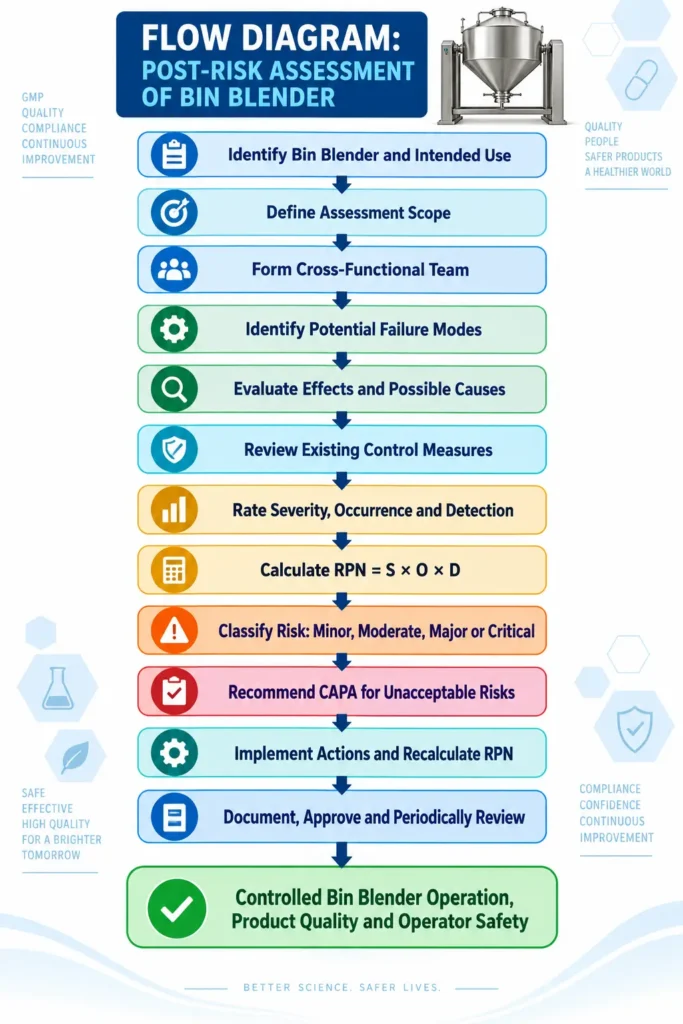
The flow diagram explains the step-by-step process for conducting a post-risk assessment of the Bin Blender. The process begins by identifying the equipment, its intended use and the scope of assessment. A cross-functional team from Quality Assurance, Production, Engineering, Quality Control and Stores reviews the equipment. The team identifies possible failure modes related to design, installation, operation, cleaning, maintenance, performance and safety. Each failure is evaluated for its possible effects, causes and existing control measures. Severity, occurrence and detection ratings are assigned, and the Risk Priority Number is calculated by multiplying these three values. Based on the RPN, risks are classified as minor, moderate, major or critical. Corrective and preventive actions are recommended for unacceptable risks. After completing the actions, the RPN is recalculated to confirm risk reduction. Finally, the assessment is documented, approved and periodically reviewed to ensure reliable equipment operation, consistent product quality and operator safety.