




1. Introduction for Post Risk Assessment for Colloid Mill:
The Post Risk Assessment for Colloid Mill (30 L) evaluates potential risks associated with the equipment’s design, installation, operation, performance, cleaning, maintenance, and safety using the Failure Mode and Effects Analysis (FMEA) methodology. The assessment considers failure modes such as inadequate qualification documents, improper installation, missing calibration checks, motor or control-function failures, improper cleaning, incorrect rotor–stator assembly, and safety-related deficiencies. Existing controls are evaluated through Severity, Occurrence, Detection, and Risk Priority Number (RPN) ratings. Risks requiring additional mitigation are identified, corrective measures are recommended, and residual risk is reviewed to ensure equipment reliability, product quality, operator safety, and continued GMP compliance.
Skip to PDF content2. Flow Diagram – Post Risk Assessment for Colloid Mill:
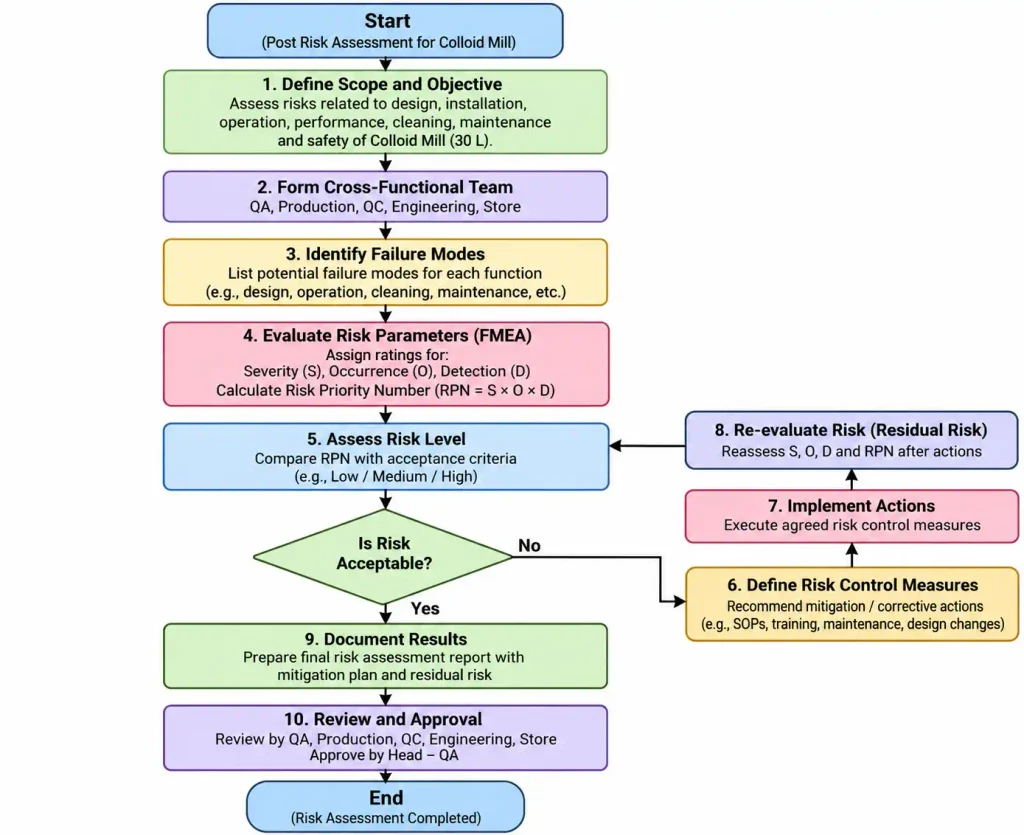
The flow diagram illustrates the systematic Post Risk Assessment process for the Colloid Mill (30 L) using the FMEA approach. It begins by defining the assessment scope and forming a cross-functional team from QA, Production, QC, Engineering, and Store. Potential failure modes are identified and evaluated using Severity, Occurrence, and Detection ratings to calculate the Risk Priority Number (RPN). Risks are then compared with predefined acceptance criteria. Unacceptable risks require control measures, implementation of corrective actions, and residual-risk reassessment. Acceptable risks are documented, reviewed by relevant departments, approved by Head-QA, and formally closed after confirming effective risk controls.
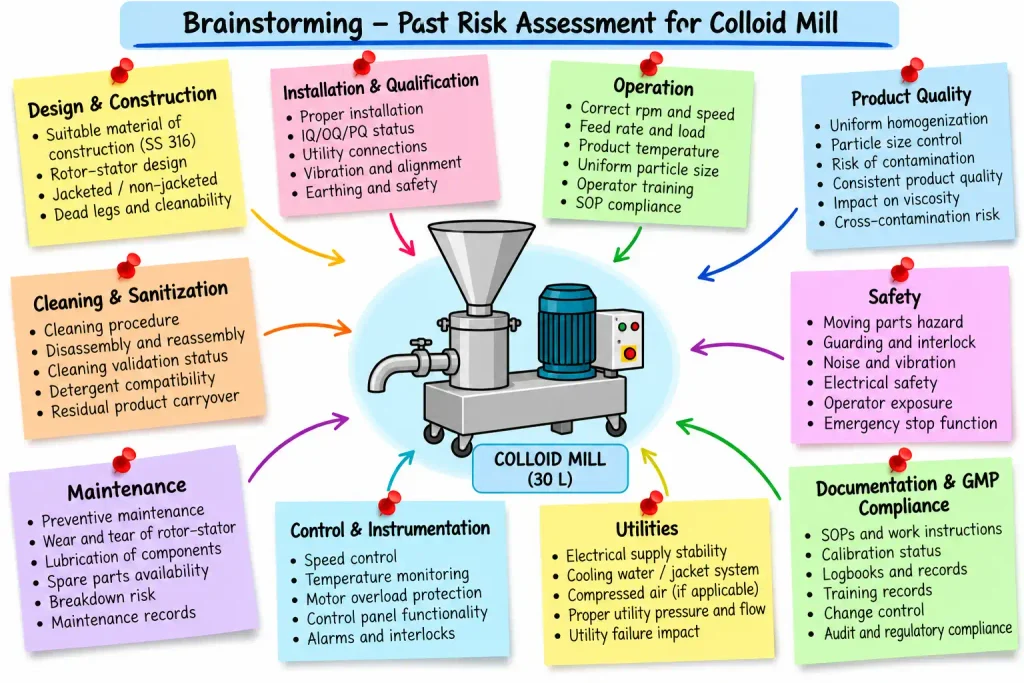
3. Brainstorming for Post Risk Assessment of Colloid Mill:
The brainstorming diagram identifies key areas considered during the Post Risk Assessment of the Colloid Mill (30 L). It evaluates risks related to equipment design and construction, installation and qualification, operation, product quality, cleaning and sanitization, maintenance, instrumentation, utilities, safety, and GMP documentation. Potential concerns include improper rotor–stator setup, inadequate cleaning, utility failure, calibration issues, equipment breakdown, contamination, operator safety, and incomplete records. These brainstorming inputs help the cross-functional team recognize possible failure modes before detailed FMEA evaluation. The identified risks are then assessed for severity, occurrence, detection, existing controls, and required mitigation actions.
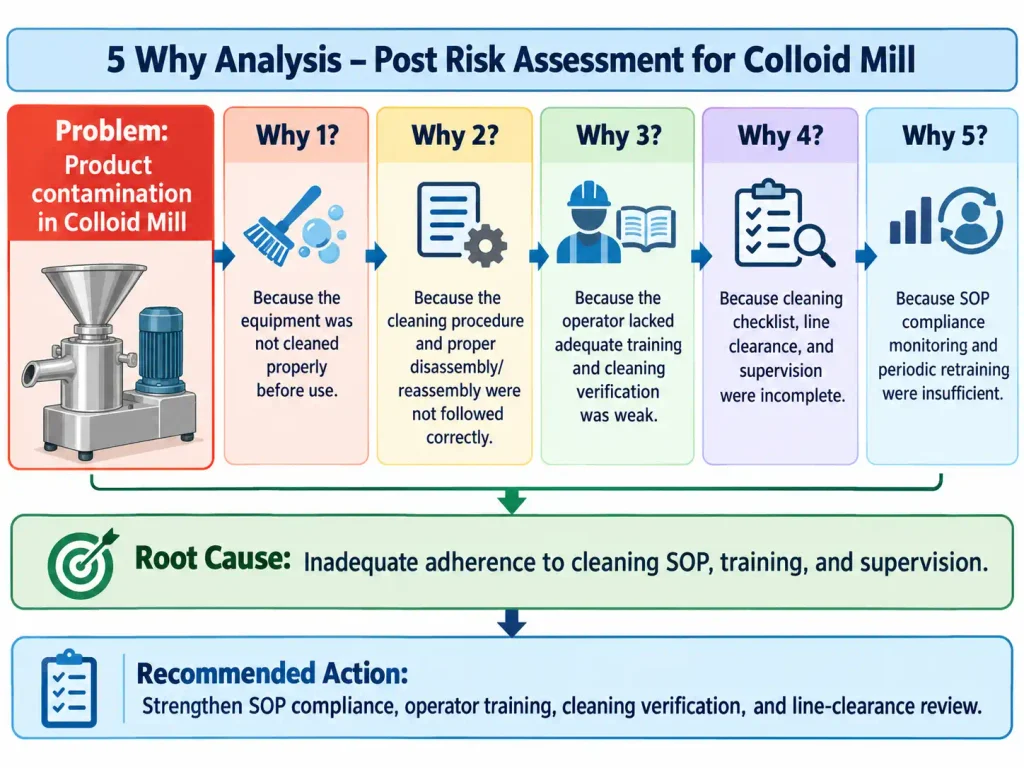
4. 5 Why Analysis for Post Risk Assessment of Colloid Mill:
The 5 Why Analysis for Post Risk Assessment of Colloid Mill investigates the root cause of potential product contamination associated with inadequate equipment cleaning. The analysis begins with improper cleaning before use and progressively identifies contributing causes such as incorrect disassembly and reassembly, insufficient operator training, weak cleaning verification, incomplete supervision, and inadequate SOP compliance monitoring. The final root cause is linked to insufficient adherence to established cleaning procedures, training requirements, and supervisory controls. Recommended actions include strengthening SOP compliance, providing periodic operator retraining, improving cleaning verification practices, ensuring effective line clearance, and maintaining documented supervisory review to prevent recurrence.
5. Heatmap Analysis for Post Risk Assessment of Colloid Mill:
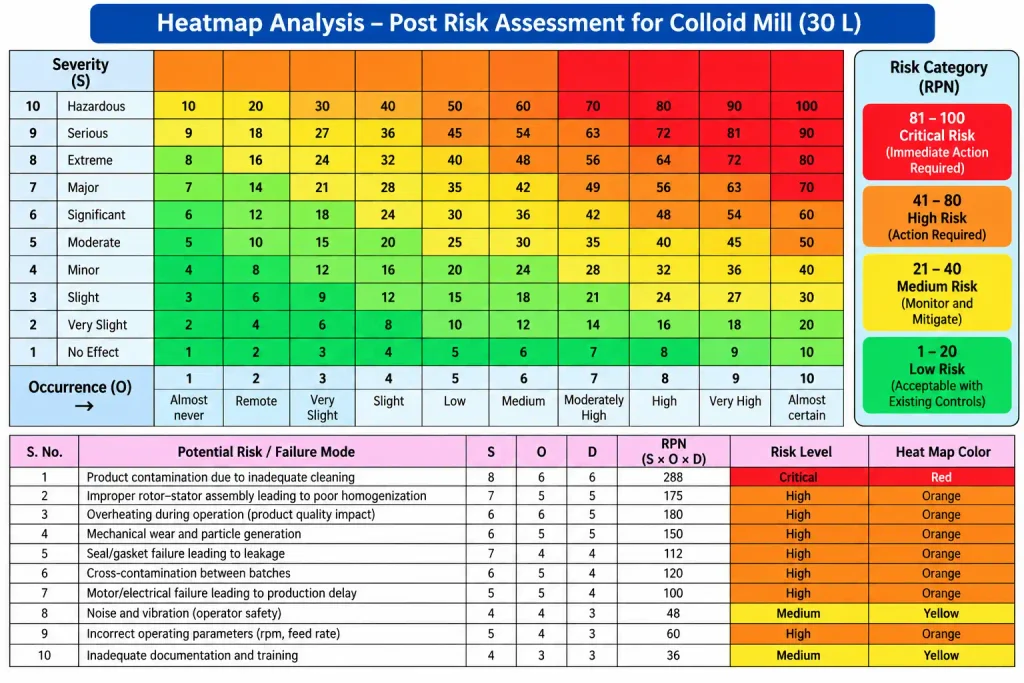
The Heatmap Analysis for Post Risk Assessment of Colloid Mill visually classifies identified risks according to Severity, Occurrence, Detection, and calculated Risk Priority Number (RPN). Risks are grouped into low, medium, high, and critical categories using color coding for easy interpretation. Major concerns include product contamination, improper rotor–stator assembly, overheating, mechanical wear, seal failure, cross-contamination, electrical failure, incorrect operating parameters, and inadequate documentation or training. The heatmap helps prioritize mitigation activities by highlighting higher-risk failure modes requiring immediate or planned action, while lower-risk items can be managed through existing controls, monitoring, and periodic effectiveness review.