



Brief Description
This Standard Operating Procedure (SOP) describes the controlled method for preparing 70% Isopropyl Alcohol (IPA) for use in the Quality Control and Microbiology sections. The objective is to ensure consistent preparation, filtration, identification, use, and documentation of the IPA solution. The procedure requires measuring the required quantity of IPA in a clean measuring cylinder and using freshly collected purified water. The solution is prepared in a 70:30 ratio of isopropyl alcohol to purified water. It is then filtered through a sterilized 0.45 µm, 47 mm membrane filter using a vacuum filtration assembly and transferred into a sterilized bottle.Each bottle is appropriately labelled with batch number, preparation date, use-before date, and preparer details. Batch numbering and preparation records are maintained, and the prepared solution is intended for daily use, with remaining quantity discarded. The SOP also defines training, document distribution, references, and the preparation/consumption record.
Skip to PDF content1. Flow Diagram:
The flow diagram presents the step-by-step preparation of 70% Isopropyl Alcohol (IPA) in a simple and easy-to-understand format. It begins with measuring the required quantity of IPA in a clean measuring cylinder, followed by addition of freshly collected purified water in a 70:30 proportion. The prepared solution is then passed through a sterilized 0.45 µm, 47 mm membrane filter using a vacuum filtration assembly. After filtration, the 70% IPA solution is transferred into a sterilized bottle.
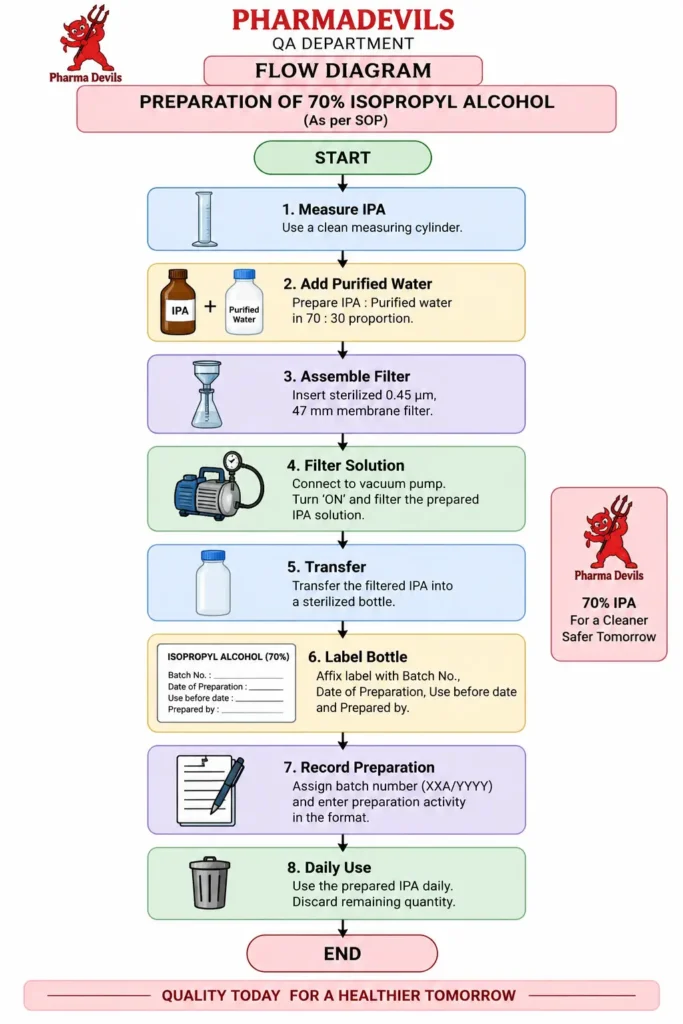
The bottle is then labelled with the batch number, date of preparation, use-before date, and prepared-by details. The preparation activity is recorded according to the defined batch numbering system. Finally, the prepared IPA is used on the same day, and any remaining quantity is discarded.The PharmaDevils-themed design makes the SOP process more visual, memorable, and suitable for training and awareness purposes.
2. Brainstorming for SOP Failure:
The brainstorming diagram shows a Goa-trip themed PharmaDevils discussion focused on identifying possible reasons for failure of the SOP for preparation of 70% Isopropyl Alcohol. The main failure causes include wrong measurement of IPA, incorrect 70:30 proportion, use of unsuitable purified water, incorrect or non-sterilized membrane filter, vacuum pump malfunction, incomplete filtration, use of a non-sterilized bottle, labeling errors, incorrect batch numbering, poor documentation, failure to use the prepared IPA on the same day, and improper disposal of remaining solution.
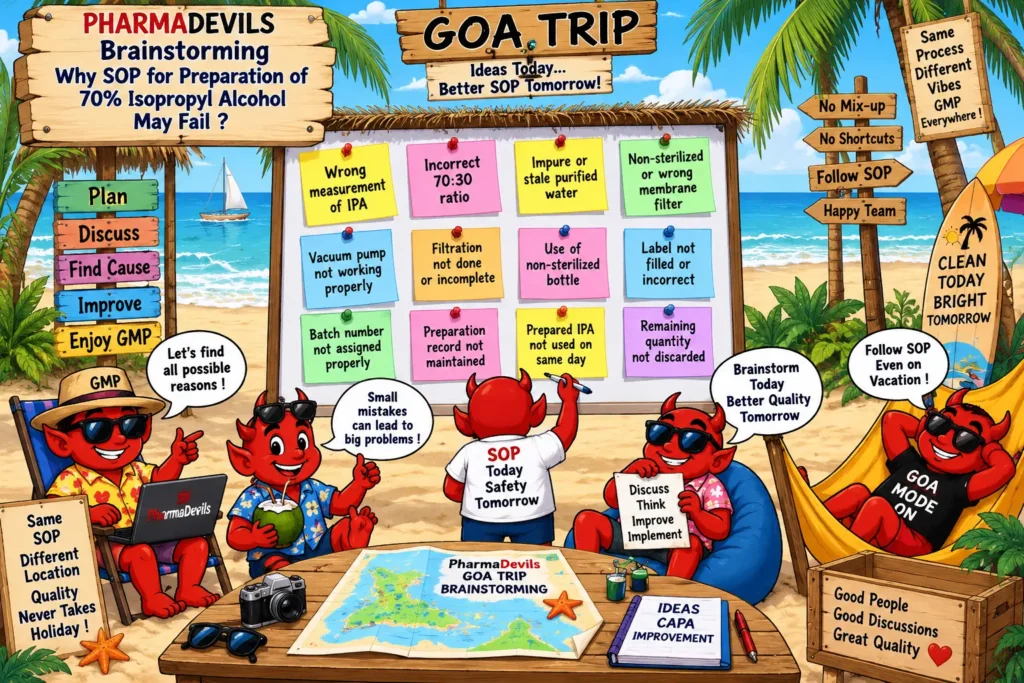
The beach setting, sticky notes, and PharmaDevils characters make the brainstorming exercise engaging and easy to understand while emphasizing that even small procedural errors can affect product quality and GMP compliance. The diagram promotes team discussion, identification of root causes, corrective actions, and continuous improvement to ensure the SOP is followed consistently and effectively.
3. 5-Why Analysis for SOP Failure:
The 5-Why analysis identifies the root causes for failure to follow the SOP for preparation of 70% Isopropyl Alcohol (IPA). The investigation begins with the operator missing or incorrectly performing preparation steps and progressively examines why this occurred. Key contributing factors include failure to consistently refer to the SOP, absence of an effective step-by-step verification checklist, inadequate practical training, insufficient supervisory follow-up, and weak competency assessment and compliance monitoring. The associated fishbone analysis further considers possible causes related to people, methods, equipment, materials, measurement, and the work environment.
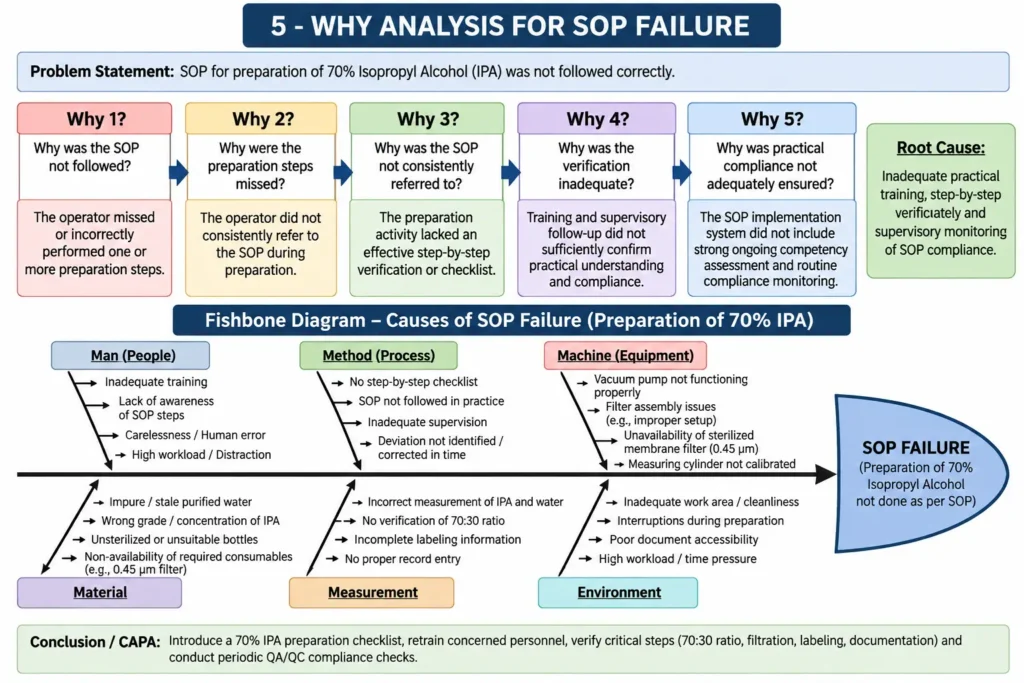
Since the SOP requires correct 70:30 preparation, filtration, transfer to a sterilized bottle, labeling, documentation, and daily disposal of remaining solution, failure in any of these activities can affect compliance. The analysis supports corrective actions such as retraining, competency assessment, preparation checklists, and periodic QA/QC monitoring.
4. Fishbone Analysis for SOP Failure:
The Fishbone Analysis identifies the possible causes for failure to follow the SOP for Preparation of 70% Isopropyl Alcohol (IPA). The causes are grouped under six major categories: Man, Method, Material, Machine/Equipment, Measurement, and Environment. Key issues may include inadequate training, failure to refer to the SOP, absence of a preparation checklist, incorrect measurement of IPA and purified water, improper filtration setup, incomplete labeling, poor documentation, interruptions, and insufficient supervisory monitoring.
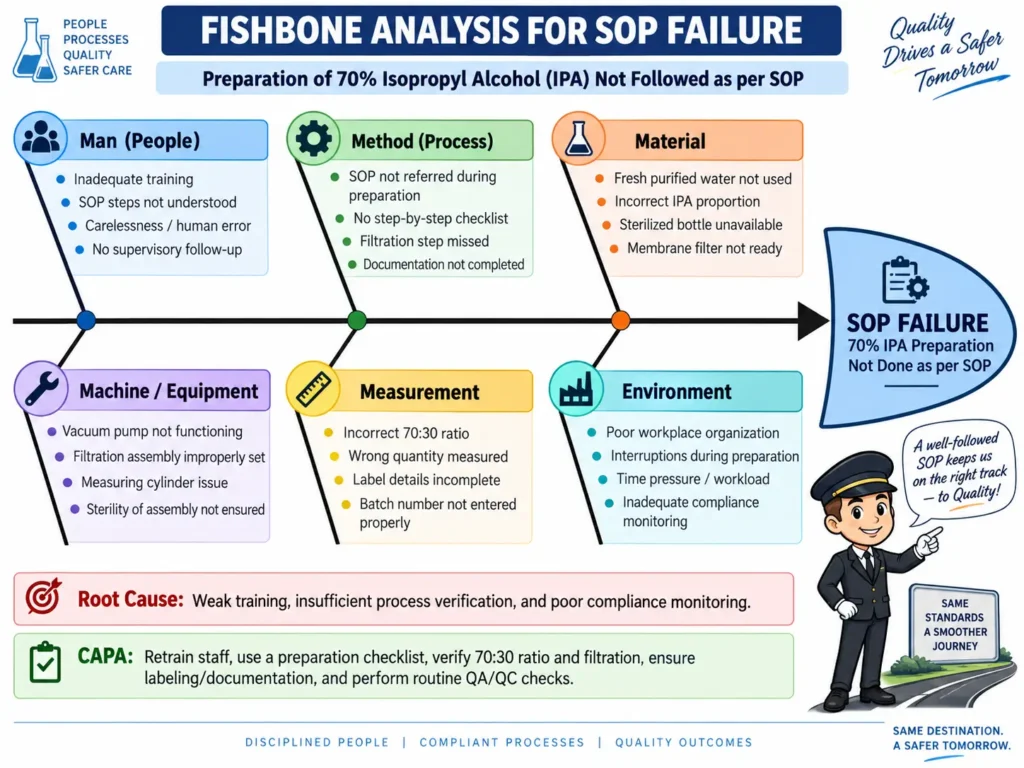
The SOP specifically requires use of freshly collected purified water, preparation in a 70:30 IPA-to-water ratio, filtration through a sterilized 0.45 µm membrane filter, transfer into a sterilized bottle, proper labeling, batch numbering, recording, and daily disposal of remaining solution. The analysis helps identify root causes and supports effective CAPA such as retraining, verification checklists, and routine compliance monitoring.
5. Fault Tree Analysis for SOP Failure:
The Fault Tree Analysis illustrates how failure to follow the SOP for preparation of 70% Isopropyl Alcohol (IPA) can result from several individual or combined events. The top event is “SOP for Preparation of 70% IPA Not Followed.” Major failure branches include incorrect preparation, filtration not performed, improper labeling or documentation, and prepared solution not used or discarded as specified.
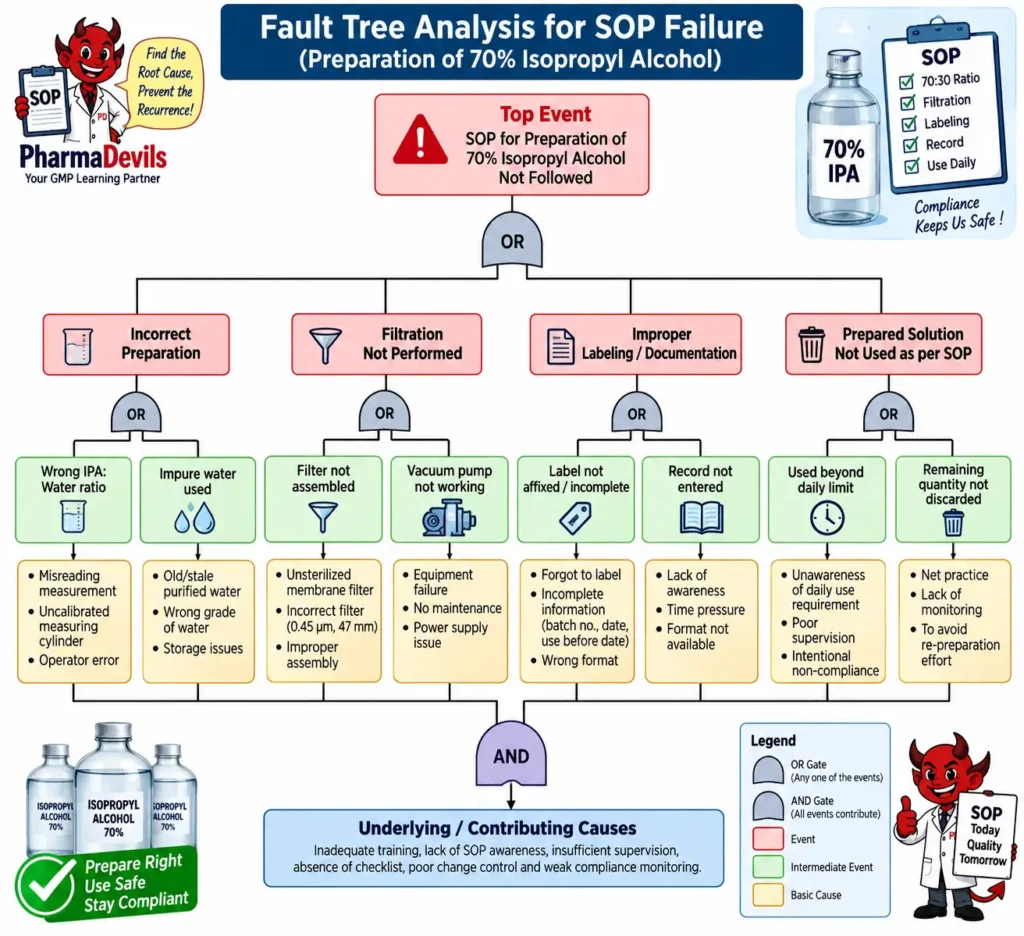
Possible basic causes include incorrect IPA-to-water ratio, use of unsuitable purified water, improper filter assembly, vacuum pump failure, incomplete labeling, missing preparation records, use beyond the daily limit, and failure to discard the remaining solution. The SOP requires a 70:30 IPA-to-purified-water proportion, filtration using a sterilized 0.45 µm membrane filter, transfer into a sterilized bottle, labeling, batch numbering, recording of preparation activity, and daily disposal of unused solution.The analysis helps identify underlying weaknesses such as inadequate training, poor supervision, lack of checklists, and insufficient compliance monitoring, supporting targeted CAPA and prevention of recurrence.
Questions & Answers – SOP for Preparation of 70% Isopropyl Alcohol
Q1. What is the objective of this SOP?
Answer: To provide guidelines for the preparation of 70% Isopropyl Alcohol (IPA).
Q2. Where is this SOP applicable?
Answer: It is applicable to the preparation of 70% IPA in the Quality Control and Microbiology sections.
Q3. Who is responsible for preparation of 70% IPA?
Answer: Microbiologist, QC Chemist, Executive QC, Assistant Manager QC, and Manager QC are listed as responsible personnel.
Q4. What proportion of IPA and purified water is used?
Answer: The SOP specifies a proportion of 70:30, Isopropyl Alcohol : Purified Water.
Q5. What type of water should be used?
Answer: Freshly collected purified water should be used for preparation.
Q6. What membrane filter is specified in the SOP?
Answer: A sterilized 0.45 µm, 47 mm diameter membrane filter is specified.
Q7. How is the prepared IPA filtered?
Answer: The filtration assembly is connected to a vacuum pump, the pump is switched on, and the prepared IPA solution is filtered.
Q8. Where should filtered 70% IPA be transferred?
Answer: The prepared IPA should be transferred into a sterilized bottle.
Q9. What information should appear on the IPA bottle label?
Answer: The label should include Batch No., Date of Preparation, Use Before Date, and Prepared By details.
Q10. How is the batch number generated?
Answer: The SOP specifies the format XXA/YYYY, where XX represents the current month, A is the sequential preparation number for that month, and YYYY represents the current year.
Q11. Is preparation activity required to be documented?
Answer: Yes. The preparation activity must be entered in the specified format/record.
Q12. How long should prepared 70% IPA be used?
Answer: According to the SOP, the prepared solution should be used daily.
Q13. What should be done with unused IPA remaining at the end of the day?
Answer: The remaining quantity should be discarded.
Q14. Who provides training on this SOP?
Answer: The Manager – Quality Control is designated as the trainer.
Q15. Who are the trainees for this SOP?
Answer: Quality Control Chemists and Microbiologists are listed as trainees.
Q16. What is the specified training duration?
Answer: The training period is half an hour.
Q17. What record is provided as an enclosure to the SOP?
Answer: Annexure I is the 70% v/v Isopropyl Alcohol preparation and consumption record.
Q18. What are common failure points in following this SOP?
Answer: Based on the procedure, key failure points include incorrect 70:30 preparation, failure to use freshly collected purified water, improper filtration, use of an unsuitable bottle, incomplete labeling, missing documentation, or failure to discard leftover solution daily. These are derived directly from the required procedural steps.
Q19. Why is documentation important in this SOP?
Answer: The SOP specifically requires batch numbering and entry of the preparation activity, providing traceability for each preparation.
Q20. What is the main control point for preventing SOP failure?
Answer: Ensuring that each required step—correct proportion, filtration, sterilized container, labeling, batch numbering, documentation, and daily disposal—is completed as written in the SOP.