







Brief Description
This SOP describes the standardized procedure for preparation of mobile phase required for HPLC analysis in the Quality Control laboratory. Its purpose is to ensure consistent preparation using suitable HPLC/AR/GR-grade chemicals, accurate measurement of individual components, proper sonication, filtration through a 0.45 µm filter, mixing in specified proportions, and pH adjustment where required. The prepared mobile phase should be adequately sonicated and visually checked to ensure it is free from particles or haziness. The SOP also defines mobile-phase stability validation, including evaluation of system-suitability parameters initially and over subsequent days. If validation has not been performed, the mobile phase is prepared daily. For extended HPLC sequences, suitability may be demonstrated using bracketing standards. The annexure provides a calculation format for determining the required mobile-phase volume based on number of injections, run time, flow rate, flushing time, and preparation requirements.
Skip to PDF content1. Flow Diagram:
The flow diagram illustrates the systematic procedure for preparing a mobile phase for HPLC analysis. The process starts with selection of suitable HPLC/AR/GR-grade chemicals, followed by accurate weighing or measurement of each component. Individual solvents and buffers are degassed by sonication and filtered through a 0.45 µm filter before being mixed in the specified proportion. Where required, the pH is adjusted within the specified limit, and the prepared mobile phase is further sonicated for at least 10 minutes.
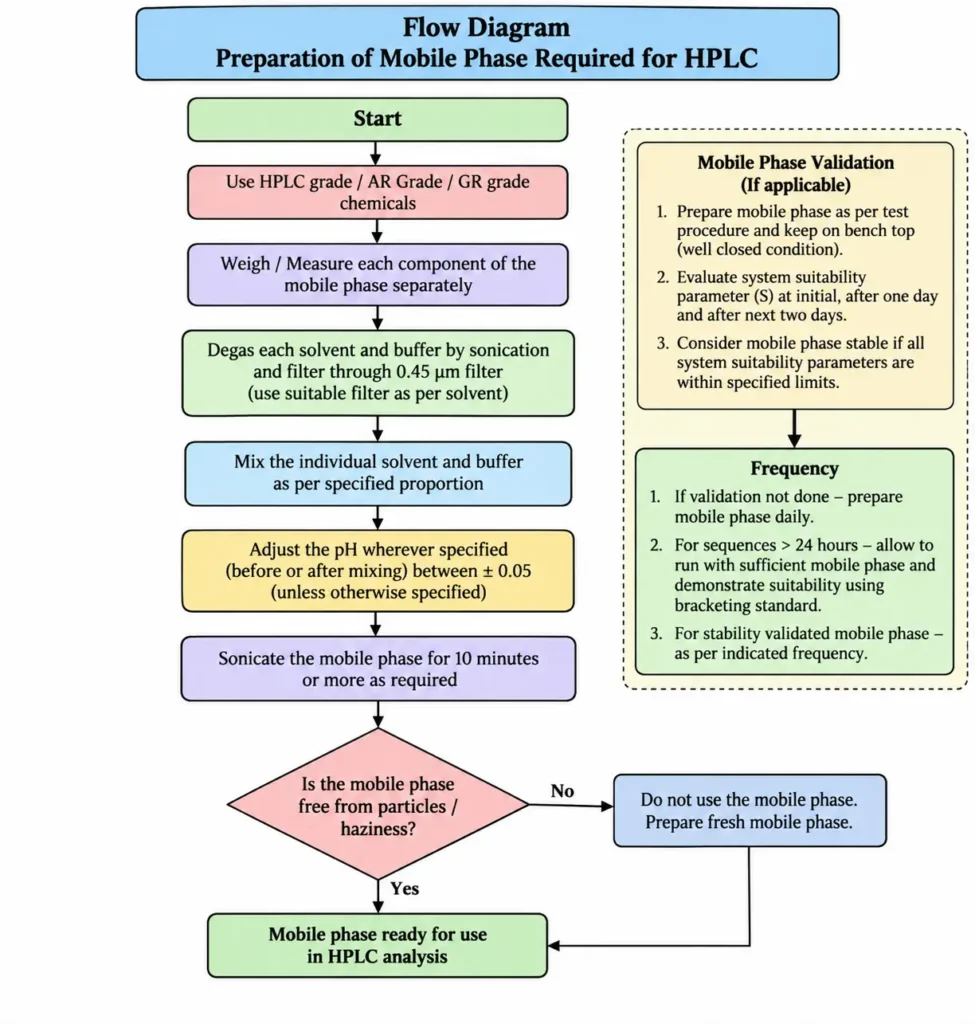
A visual check is then performed to confirm that the mobile phase is free from particles or haziness. Unsuitable mobile phase is rejected and freshly prepared. The diagram also highlights mobile-phase validation through system-suitability testing and defines preparation frequency depending on validation status and HPLC sequence duration.
2. Brainstorming for SOP Failure:
The brainstorming diagram illustrates the major factors that may lead to SOP failure in a pharmaceutical manufacturing area. It highlights potential causes such as inadequate training, lack of awareness, excessive workload, complicated or outdated SOPs, language barriers, poor supervision, weak communication, inadequate resources, equipment-related problems, time pressure, frequent manpower changes, poor monitoring, distractions, poor housekeeping, complacency, and lack of accountability.
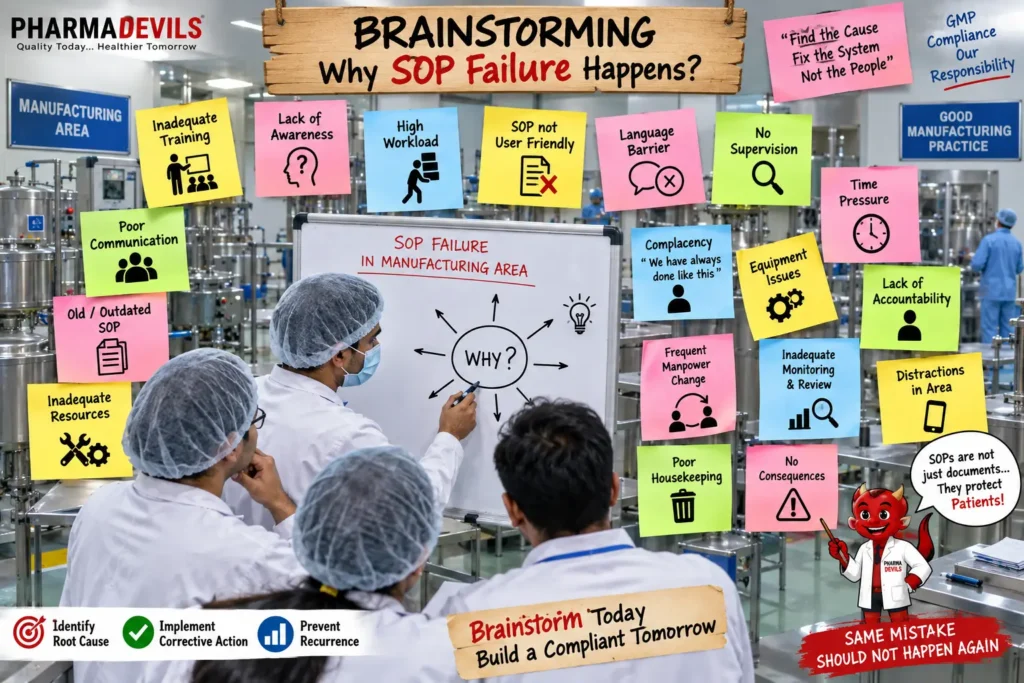
The purpose of the brainstorming exercise is to encourage a cross-functional team to identify all possible contributors before selecting the most probable root cause. Each identified factor should be evaluated using actual shop-floor evidence, deviation history, training records, equipment status, and operator practices. The diagram reinforces the principle of “find the cause and fix the system, not the people”, supporting appropriate corrective and preventive actions to avoid recurrence and strengthen GMP compliance.
3. 5 Why Analysis for SOP Failure:
The 5 Why Analysis diagram identifies the underlying causes of SOP failure in a pharmaceutical manufacturing area by progressively asking why the failure occurred. It begins with the problem statement that the required SOP was not followed correctly during manufacturing activities. The analysis then traces possible contributing factors such as inadequate operator awareness, insufficient training or retraining, weak supervision, poor communication of SOP revisions, and ineffective follow-up of training effectiveness.
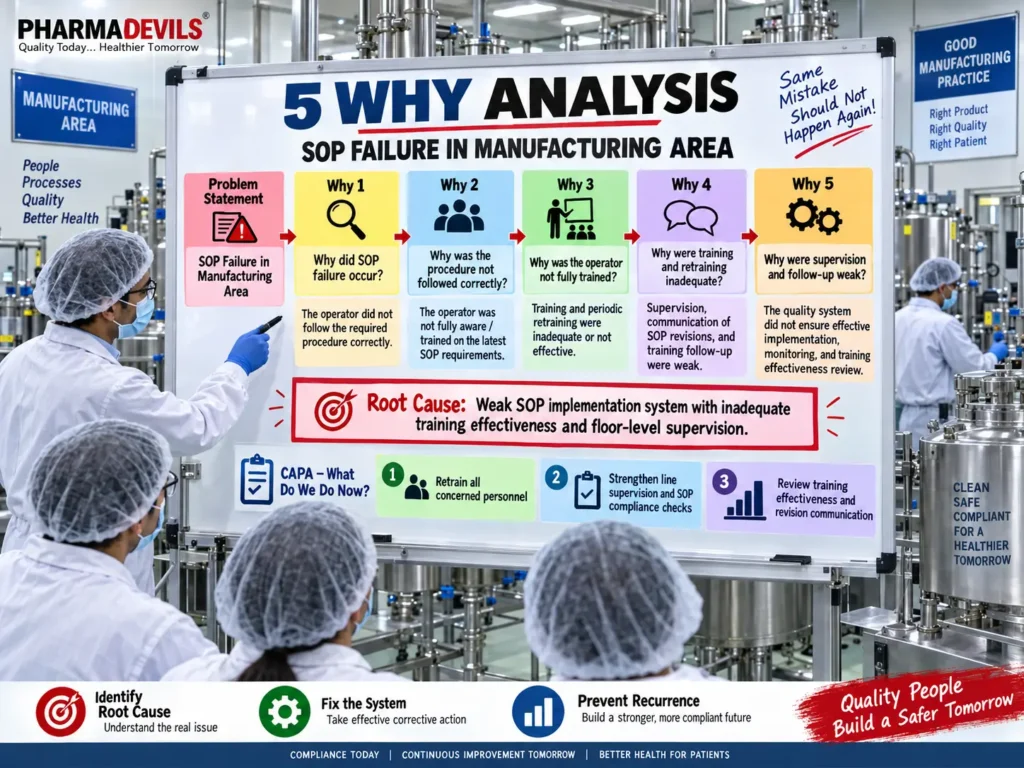
The analysis indicates that the deeper root cause may lie in a weak SOP implementation and monitoring system, rather than a single operator error. It emphasizes strengthening training effectiveness, supervisory controls, communication of revised procedures, and routine compliance monitoring. The diagram also supports appropriate CAPA, including retraining of concerned personnel, improved line supervision, periodic SOP compliance checks, and effectiveness verification to prevent recurrence and strengthen GMP compliance.
4. Fishbone Analysis for SOP Failure:
The Fishbone Analysis diagram presents a structured root-cause assessment for SOP failure in a pharmaceutical manufacturing area. Potential causes are grouped under six major categories: Man, Machine, Method, Material, Measurement, and Environment. The analysis considers factors such as inadequate training, lack of awareness, complacency, equipment malfunction, poor maintenance, outdated or unclear SOPs, incorrect material status, label mix-ups, weak monitoring, inadequate line-clearance checks, time pressure, distractions, poor housekeeping, and manpower shortages.
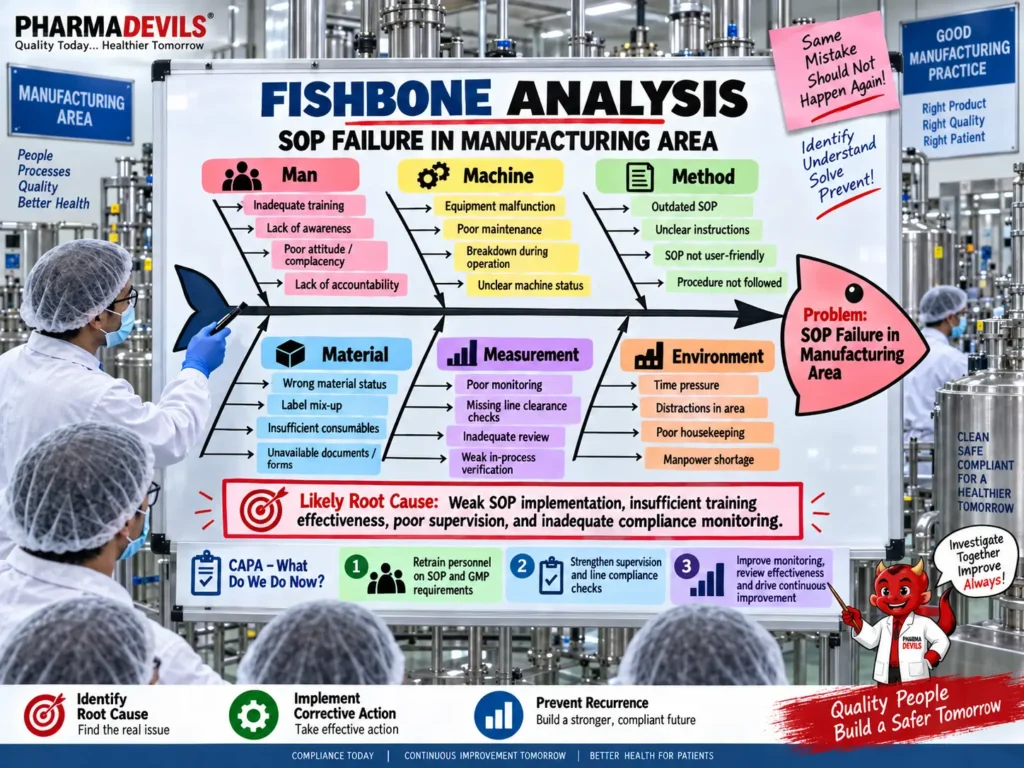
This approach helps the investigation team systematically evaluate both human and system-related causes instead of attributing the failure to a single individual. The diagram indicates that likely underlying causes may include weak SOP implementation, insufficient training effectiveness, poor supervision, and inadequate compliance monitoring. The analysis supports development of targeted CAPA such as retraining, strengthened supervision, improved compliance checks, and periodic effectiveness review to prevent recurrence and improve GMP compliance.
5. Fault Tree Analysis for SOP Failure:
The Fault Tree Analysis (FTA) diagram presents a structured evaluation of the possible causes leading to SOP failure in a pharmaceutical manufacturing area. The top event is SOP failure, which may arise from several major branches such as SOP not being available or accessible, personnel not understanding the SOP, procedure not being followed during execution, and inadequate monitoring or control.
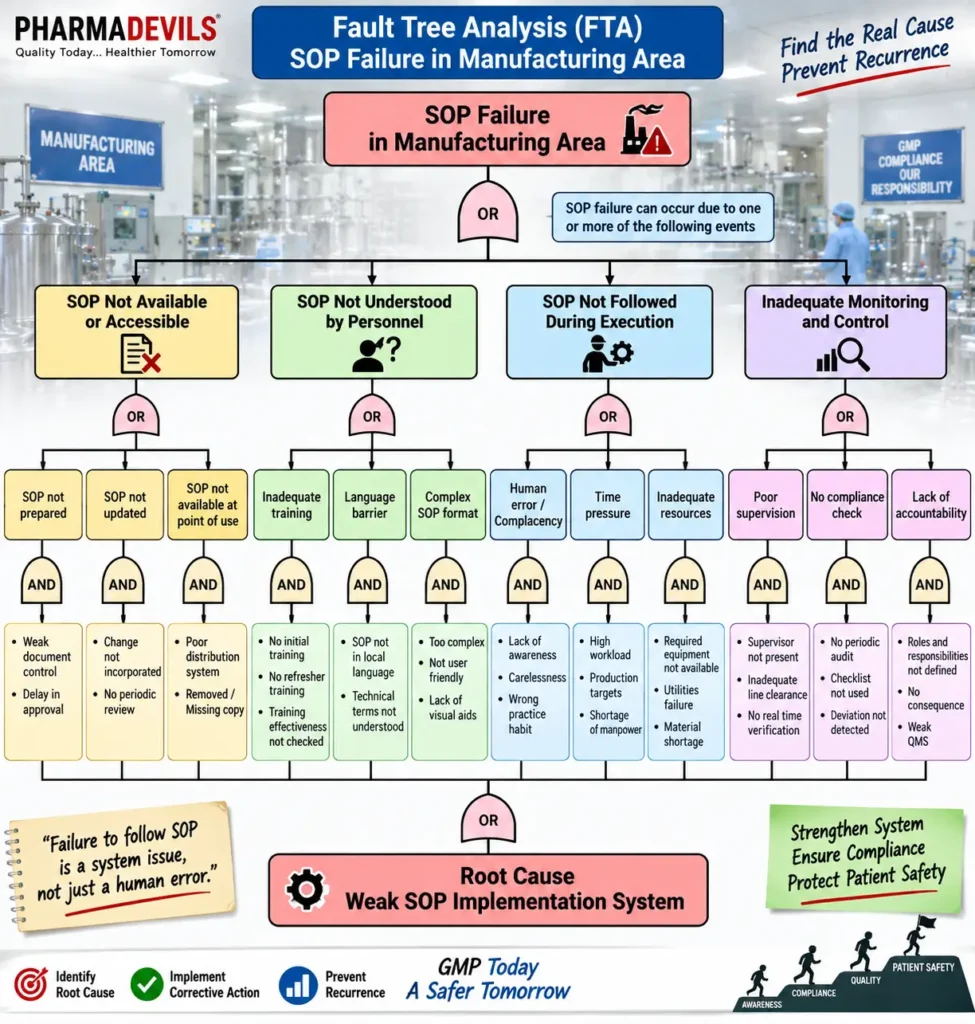
Each branch is further broken down into contributing factors including weak document control, outdated procedures, inadequate training, language barriers, complex SOP formats, human error or complacency, time pressure, insufficient resources, poor supervision, missing compliance checks, and unclear accountability.
The analysis helps distinguish immediate causes from deeper system weaknesses. The probable underlying root cause is a weak SOP implementation system, particularly where training effectiveness, document control, supervision, monitoring, and responsibility are not adequately managed. The FTA supports development of targeted CAPA to strengthen compliance and prevent recurrence.
Questions & Answers – Preparation of Mobile Phase Required for HPLC
- What is the objective of this SOP?
Answer: To provide guidelines for the preparation of mobile phase required for HPLC analysis. - Who is responsible for executing this SOP?
Answer: The QC Chemist is responsible for execution, while the Sr. Executive QC/Manager QC is responsible for review and effective implementation. - Which grades of chemicals should be used for mobile-phase preparation?
Answer: HPLC grade, AR grade, or GR grade chemicals should be used. - How should individual mobile-phase components be prepared before mixing?
Answer: Each component should be weighed or measured separately, degassed by sonication, and filtered separately through a 0.45 µm filter using a suitable filter for the solvent. - How is the pH of the mobile phase adjusted?
Answer: Where specified, pH should be adjusted before or after mixing the individual components within ±0.05, unless otherwise specified. - How long should the prepared mobile phase be sonicated?
Answer: It should be sonicated for 10 minutes or more, as required. - What should be done if particles or haziness are observed in the mobile phase?
Answer: The mobile phase should not be used if particles or haziness are observed. - How is mobile-phase stability validated?
Answer: The mobile phase is prepared according to the test procedure, stored on the bench top in a well-closed condition, and system-suitability parameters are evaluated initially, after one day, and after the next two days. - When is the mobile phase considered stable?
Answer: It is considered stable when all system-suitability parameters remain within their specified limits. - How frequently should mobile phase be prepared if validation has not been performed?
Answer: It should be prepared daily. - What is required when an HPLC sequence continues for more than 24 hours?
Answer: If sufficient mobile phase is available in the reservoir, the sequence may continue by demonstrating system suitability through injection of a bracketing standard. - What factors are considered when calculating the required volume of mobile phase?
Answer: The annexure considers the number of injections, sample run time, flow rate, flushing and saturation time, and the volume required for standard, sample, and blank preparation.
Reference Guidelines:
- WHO Technical Report Series No. 1025, Annex 4 – Good Chromatography Practices
Covers good practices for chromatographic analysis, including HPLC operations, system suitability, solutions, equipment use, documentation, and chromatographic controls. (World Health Organization)
WHO Good Chromatography Practices - USP–NF General Chapter <621> – Chromatography
Provides general requirements for chromatographic procedures, HPLC terminology, chromatographic conditions, calculations, and system-suitability requirements. (USP)
USP <621> Chromatography - ICH Q2(R2) – Validation of Analytical Procedures
Applicable where mobile-phase suitability or stability forms part of a validated analytical procedure and supports analytical-procedure performance. (U.S. Food and Drug Administration) - WHO TRS 1052, Annex 4 – Good Practices for Pharmaceutical Quality Control Laboratories
Provides current expectations for laboratory quality systems, analytical operations, documentation, equipment, reagents, and QC testing practices. (World Health Organization) - FDA – Analytical Procedures and Methods Validation for Drugs and Biologics
Provides recommendations for development, documentation, validation, and control of analytical procedures used for pharmaceutical testing. (U.S. Food and Drug Administration)