




1. Introduction – Procedure to Be Followed During Start Up, Breaks, Closing, Shut Down and Breakdown in Production:
The Procedure to Be Followed During Start Up, Breaks, Closing, Shut Down and Breakdown in Production is an important Standard Operating Procedure designed to ensure that manufacturing activities are performed in a controlled, safe, and GMP-compliant manner. The SOP establishes defined practices for starting production, temporarily stopping activities during breaks, closing operations at the end of work, managing planned shutdowns, and responding to equipment breakdowns. Its objective is to maintain product quality, equipment status, environmental conditions, material identification, and proper documentation throughout production operations. During production start-up, personnel are required to verify area and equipment cleanliness, environmental parameters, equipment status, balance calibration where applicable, line clearance, material identity, and relevant BMR/BPR instructions before beginning operations. The SOP also defines controls for securing materials during breaks, cleaning and labeling equipment during close-down, carrying out maintenance during shutdown, and immediately stopping equipment and informing Maintenance and Quality Assurance when breakdown occurs.
Skip to PDF content2. Flow Diagram – Procedure to Be Followed During Start Up, Breaks, Closing, Shut Down and Breakdown in Production:
The Procedure to Be Followed During Start Up, Breaks, Closing, Shut Down and Breakdown in Production provides a systematic approach for controlling manufacturing activities under different operating conditions. During production start-up, personnel must verify gowning compliance, machine and area cleanliness, environmental conditions, balance calibration where applicable, equipment status, line clearance, material identity, and relevant BMR/BPR requirements before initiating operations.
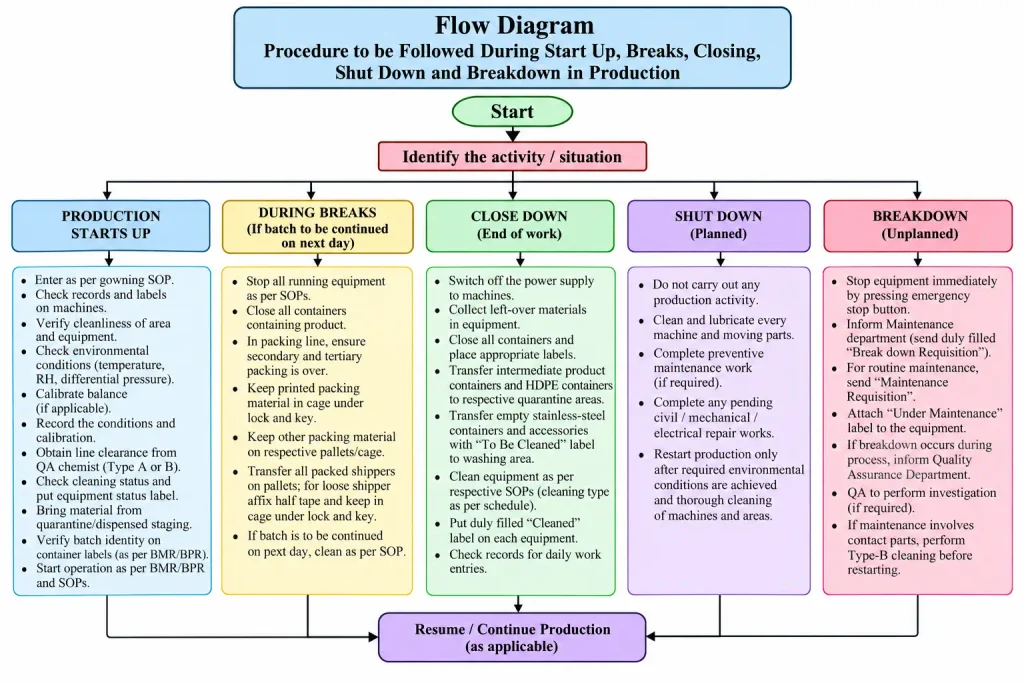
During breaks, equipment is stopped, product containers are closed, printed packing materials are secured, and materials are properly stored to maintain batch integrity. During close-down, equipment is switched off, leftover materials are collected, containers are properly labeled, equipment is cleaned, and records are checked. For planned shutdowns, production activities remain stopped while cleaning, lubrication, preventive maintenance, and repair work are completed. In case of equipment breakdown, the machine is stopped immediately, Maintenance and QA are informed, appropriate status labeling is applied, and required investigation and cleaning are completed before restarting production.
3. Benefits of Following SOP for Start Up, Breaks, Closing, Shut Down and Breakdown in Production:
Following the Procedure to Be Followed During Start Up, Breaks, Closing, Shut Down and Breakdown in Production helps maintain a controlled and GMP-compliant manufacturing environment. Proper adherence to the SOP ensures that equipment, materials, environmental conditions, and production activities are systematically checked before starting operations and appropriately controlled during breaks, close-down, shutdown, and equipment breakdown situations.
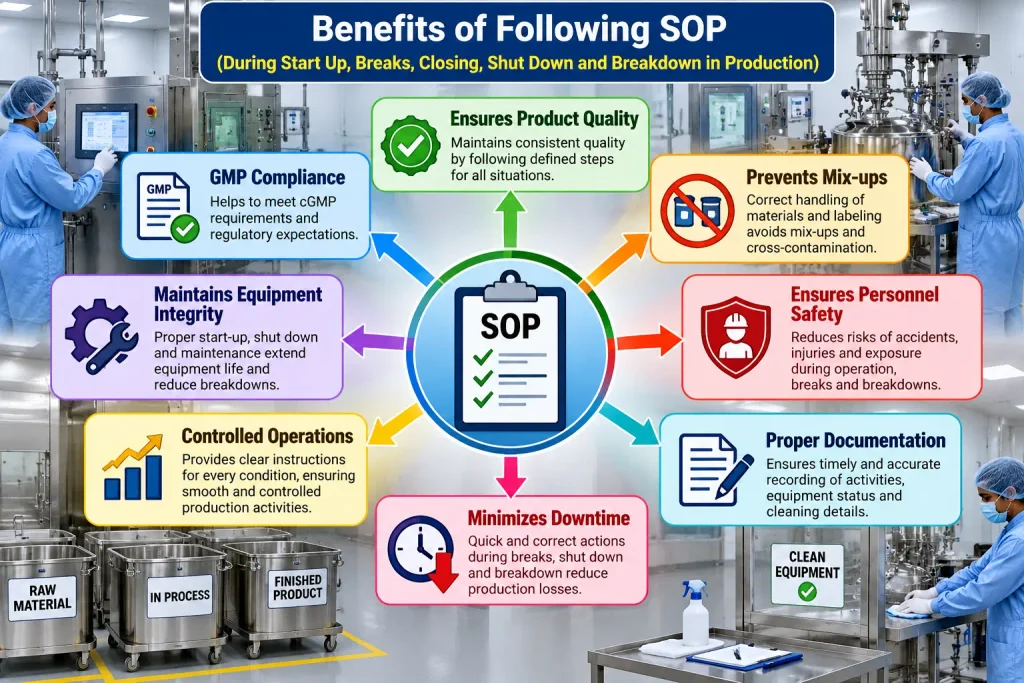
The SOP supports product quality, prevention of mix-ups, equipment integrity, personnel safety, proper documentation, and reduction of production downtime. During breaks and close-down, product containers and packing materials are secured, equipment is cleaned, and status labels are maintained. During shutdown or breakdown, maintenance, cleaning, QA involvement, investigation where required, and controlled restarting help prevent contamination, equipment-related failures, and uncontrolled production activities.
4. Brainstorming for SOP Failure – Procedure to Be Followed During Start Up, Breaks, Closing, Shut Down and Breakdown in Production:
Brainstorming for failure of the Procedure to Be Followed During Start Up, Breaks, Closing, Shut Down and Breakdown in Production helps identify possible weaknesses that may lead to GMP non-compliance, product quality risks, equipment problems, documentation gaps, or unsafe operations. Key failure possibilities include improper start-up checks, inadequate line clearance, incorrect material handling, failure to monitor temperature, relative humidity and differential pressure, poor cleaning and labeling, incomplete records, and improper control of materials during production breaks.
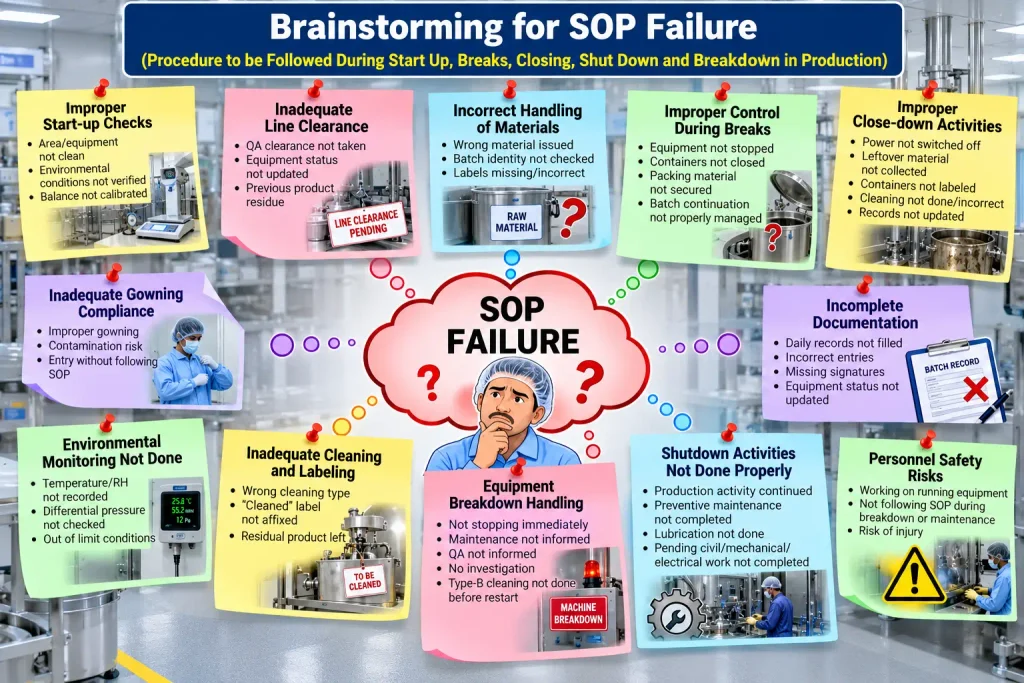
Additional concerns include failure to properly close down equipment, incomplete preventive maintenance during shutdown, delayed reporting of equipment breakdown, missing “Under Maintenance” status, lack of QA involvement, and failure to perform required Type-B cleaning after maintenance involving product-contact parts. This brainstorming exercise supports identification of potential causes before they develop into deviations, contamination, mix-ups, equipment damage, or production delays, and provides a basis for further root-cause analysis and CAPA.
5. 5-Why Analysis for SOP Failure – Procedure to Be Followed During Start Up, Breaks, Closing, Shut Down and Breakdown in Production:
The 5-Why Analysis for SOP Failure is used to identify the underlying causes when the Procedure to Be Followed During Start Up, Breaks, Closing, Shut Down and Breakdown in Production is not properly followed. The analysis begins with the problem that required production checks or controls were not completed as specified in the SOP. The SOP requires verification of area and equipment cleanliness, environmental conditions, balance calibration where applicable, line clearance, equipment status, material identity, and relevant BMR/BPR requirements before production starts.
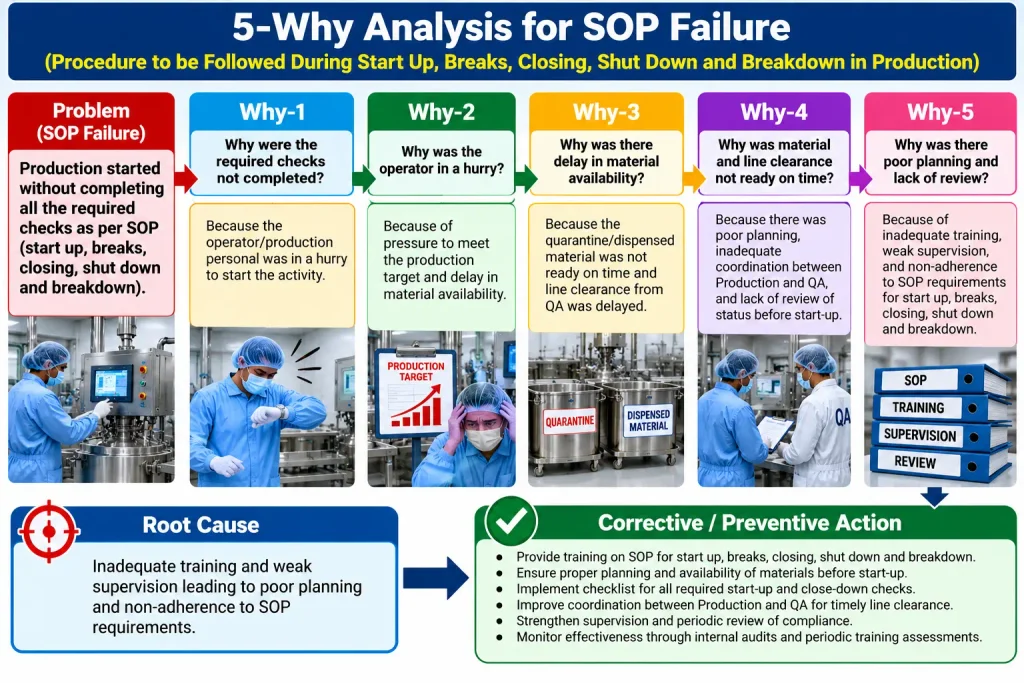
The successive “Why” questions may identify immediate causes such as rushing to meet production targets, delayed availability of material, late line clearance, poor planning, inadequate coordination, insufficient training, and weak supervision. Similar failures during breaks, close-down, shutdown, or breakdown can also result in improper material control, incomplete cleaning, missing status labeling, delayed maintenance notification, or failure to involve QA.
6. Fishbone Analysis for SOP Failure – Procedure to Be Followed During Start Up, Breaks, Closing, Shut Down and Breakdown in Production:
The Fishbone Analysis for SOP Failure for the Procedure to Be Followed During Start Up, Breaks, Closing, Shut Down and Breakdown in Production is used to systematically identify potential causes that may lead to non-compliance with the SOP. The analysis groups possible causes under major categories such as Man, Machine, Material, Method, Environment, and Measurement.Personnel-related causes may include inadequate training, improper gowning, rushing to meet production targets, or weak supervision. Equipment-related causes can involve poor cleaning, calibration issues, breakdowns, incomplete preventive maintenance, or incorrect equipment status. Material-related causes may include wrong material issuance, missing labels, inadequate line clearance, or improper storage during breaks.
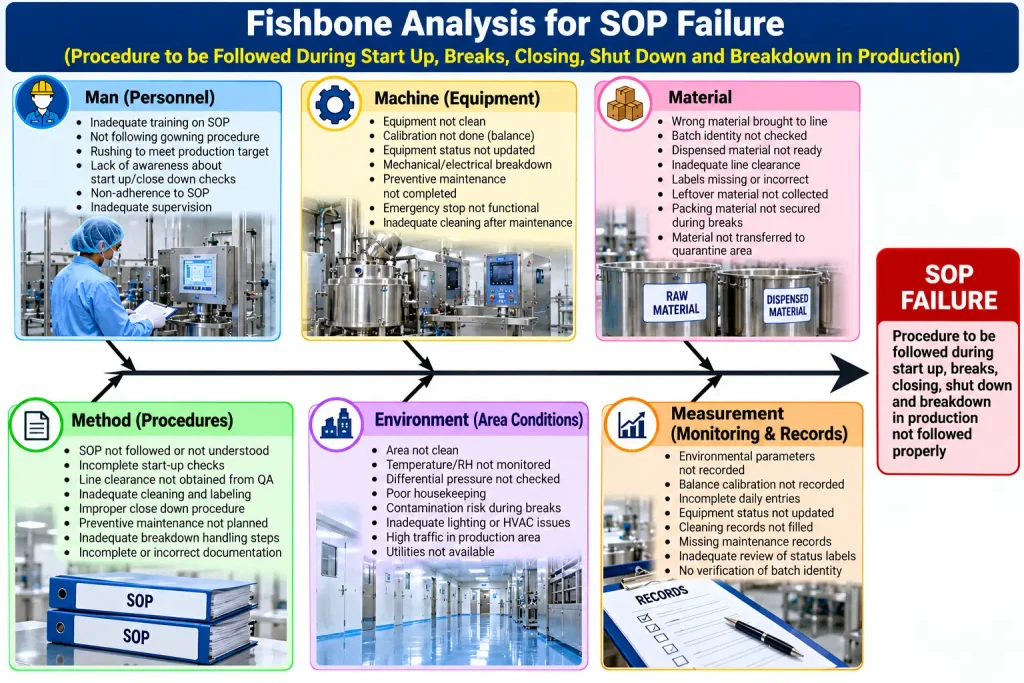
Method-related causes include failure to follow start-up, close-down, shutdown, or breakdown procedures. Environmental causes may involve unclean areas or failure to monitor temperature, relative humidity, and differential pressure, while measurement-related causes include incomplete records, missing entries, and inadequate verification of equipment and batch status. The SOP specifically requires environmental checks, line clearance, equipment-status verification, proper material identification, cleaning, and controlled actions during shutdown or breakdown.
7. Fault Tree Analysis for SOP Failure – Procedure to Be Followed During Start Up, Breaks, Closing, Shut Down and Breakdown in Production:
The Fault Tree Analysis for SOP Failure evaluates how failures in individual production controls can combine to result in non-compliance with the Procedure to Be Followed During Start Up, Breaks, Closing, Shut Down and Breakdown in Production. The top event is failure to follow the required SOP during any of these production stages.
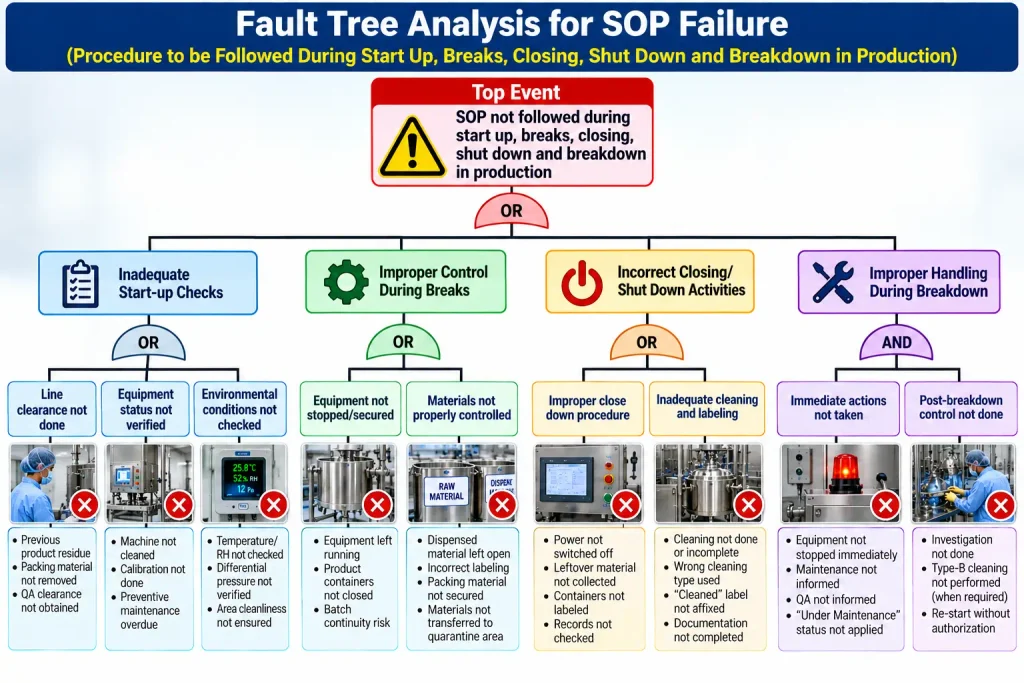
Major contributing branches include inadequate start-up checks, improper control during breaks, incorrect closing or shutdown activities, and improper handling of equipment breakdowns. Start-up failures may involve missing line clearance, unverified equipment status, or failure to check environmental conditions before operation. During breaks, failure to stop equipment, close product containers, secure printed packing materials, or properly control materials can increase the risk of mix-ups or contamination. Close-down and shutdown failures may include incomplete cleaning, incorrect equipment labeling, uncompleted maintenance, or restarting before required environmental conditions are restored. Breakdown-related failures can include failure to stop the equipment immediately, delayed Maintenance or QA notification, missing “Under Maintenance” labeling, lack of investigation, or omission of Type-B cleaning where contact parts are involved.
8. Impact Assessment for SOP Failure – Procedure to Be Followed During Start Up, Breaks, Closing, Shut Down and Breakdown in Production:
The Impact Assessment for SOP Failure evaluates the possible consequences when the Procedure to Be Followed During Start Up, Breaks, Closing, Shut Down and Breakdown in Production is not followed as defined. Failure of start-up checks may affect area cleanliness, equipment status, environmental conditions, balance calibration, line clearance, and material verification before production begins.
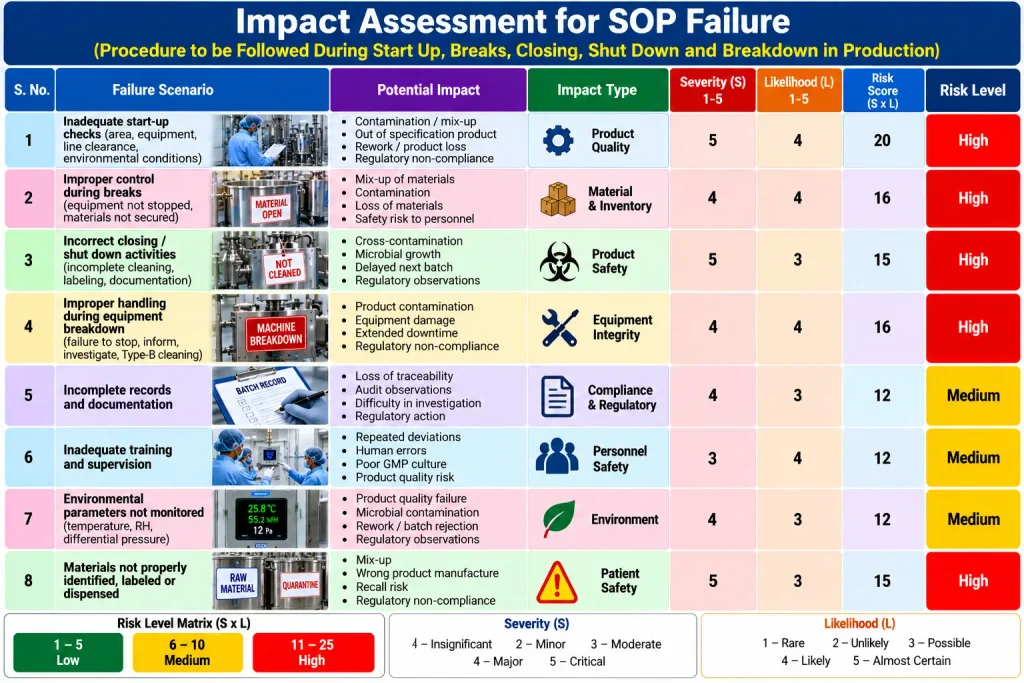
Improper control during breaks may result in unsecured materials, open product containers, or inadequate control of printed packing materials. Incorrect close-down or shutdown activities may lead to incomplete cleaning, improper equipment status, pending maintenance, or restarting production before acceptable environmental conditions are restored. Breakdown-related failures can be particularly significant if equipment is not stopped immediately, Maintenance and QA are not informed, investigation is not performed where required, or Type-B cleaning is omitted after maintenance involving product-contact parts.
9. CAPA for SOP Failure – Procedure to Be Followed During Start Up, Breaks, Closing, Shut Down and Breakdown in Production:
The Corrective and Preventive Action (CAPA) for SOP Failure is intended to eliminate identified causes of non-compliance with the Procedure to Be Followed During Start Up, Breaks, Closing, Shut Down and Breakdown in Production and to prevent recurrence. Corrective actions should address immediate deficiencies such as incomplete start-up checks, improper control of materials during breaks, inadequate cleaning or labeling during close-down, poor handling of shutdown activities, incomplete documentation, or incorrect response to equipment breakdown.
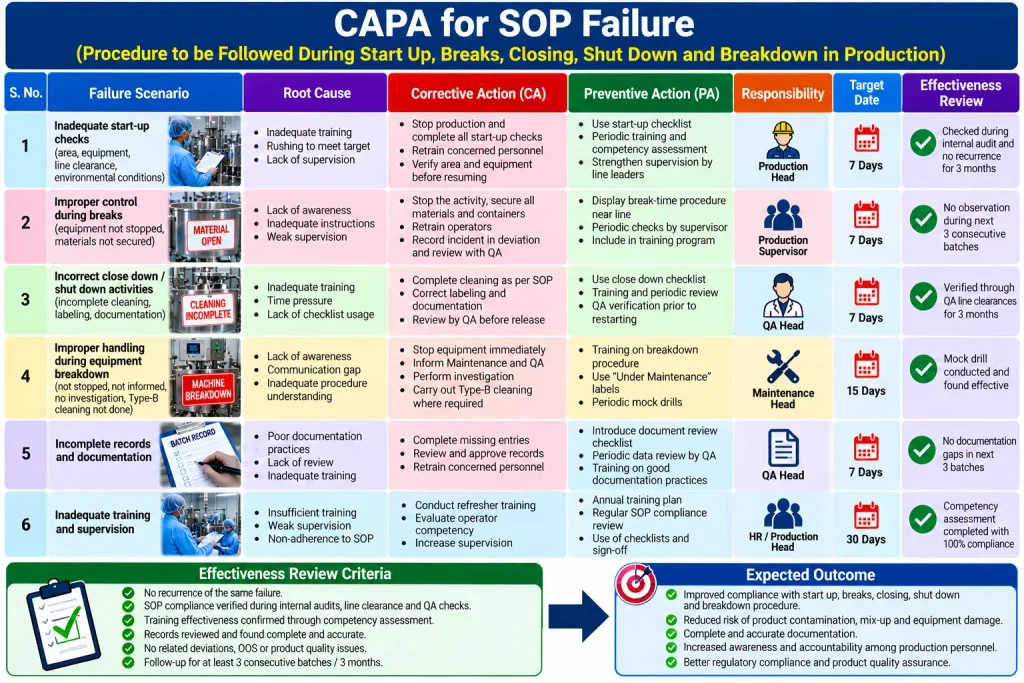
Typical corrective actions include completing missed checks, securing materials and containers, correcting cleaning and status labeling, stopping affected equipment, informing Maintenance and QA, performing investigation where required, and carrying out Type-B cleaning after maintenance involving product-contact parts. Preventive actions may include refresher training, introduction of start-up and close-down checklists, stronger supervision, periodic SOP compliance review, improved Production–QA coordination, and enhanced documentation controls. Effectiveness should be reviewed through internal audits, line-clearance verification, training competency assessment, record review, and monitoring for recurrence over consecutive batches or a defined period.
Questions & Answers – Procedure to Be Followed During Start Up, Breaks, Closing, Shut Down and Breakdown in Production:
Q1. What is the objective of this SOP?
Answer: The objective is to define the procedure to be followed during start-up, breaks, closing, shutdown, and breakdown in the manufacturing area.
Q2. Who is responsible for execution of this SOP?
Answer: Concerned Production personnel and the Production Chemist are responsible for execution, while Manager-Production, AGM Production, and Head-QA/QC are responsible for effective implementation.
Q3. What should be checked before starting production?
Answer: Personnel should check machine records and labels, visual cleanliness of the area and equipment, temperature, relative humidity, differential pressure, and balance calibration where applicable.
Q4. When can production activity be started?
Answer: Production can start after the Production Chemist is satisfied with environmental conditions and machine status and after required line clearance is obtained from QA.
Q5. How is material identity verified before processing?
Answer: Material identity is checked from the “In-process Stage/Container Status” label against the respective BMR/BPR.
Q6. What activities are required during close-down?
Answer: Machines are switched off, leftover materials are collected, containers are closed and properly labeled, intermediate materials are transferred to respective quarantine areas, and items requiring cleaning are sent to the washing area.
Q7. What should be done after equipment cleaning during close-down?
Answer: Equipment should be cleaned as per the respective SOP, a duly filled “Cleaned” label should be applied, and daily work records should be checked.
Q8. Can production continue during a planned shutdown?
Answer: No. The SOP states that production activity should not be carried out during shutdown.
Q9. What activities may be completed during shutdown?
Answer: Machines and moving parts may be cleaned and lubricated, preventive maintenance may be completed, and pending civil, mechanical, or electrical repair work may be carried out.
Q10. What conditions must be met before restarting production after shutdown?
Answer: Required environmental conditions must be achieved, and machines and areas must undergo thorough cleaning before production restarts.
Q11. What should be done with product containers during breaks?
Answer: All running equipment should be stopped as per respective SOPs, and all containers containing product should be properly closed.
Q12. How should printed packing material be controlled during breaks?
Answer: Printed packing material should be kept in the cage provided on the line under lock and key.
Reference Guideline – Procedure to Be Followed During Start Up, Breaks, Closing, Shut Down and Breakdown in Production:
1. Good Manufacturing Practices (GMP) – applicable GMP requirements shall be followed for start-up, breaks, close-down, shutdown, equipment breakdown, cleaning, maintenance, environmental control, material handling, documentation, and restart of production activities.