







Brief Description
The SOP “Procurement, Storage and Handling of Biological Indicator” describes the controlled procedure for purchasing, receiving, storing, using, maintaining, and disposing of biological indicators used for autoclave validation in the Quality Control Department. It specifically covers biological indicators containing Geobacillus stearothermophilus. The Microbiologist is responsible for executing the procedure, while QC supervisory personnel are responsible for its review and effective implementation. On receipt, the biological indicator pack is checked for physical condition, labeling details, certificates, and expiry date, then stored according to the manufacturer’s recommendations. Stock is maintained in the prescribed annexure. During use, indicator strips are handled aseptically under a culture cabinet using sterile forceps and placed at specified locations within the validated autoclave load. Expired remaining stock is decontaminated by sterilization at 121°C for 30 minutes before disposition. Annexure-I provides a stock and usage record covering quantity received, batch details, expiry, spore count, D-value, purpose of use, quantity issued, balance stock, and review details.
Skip to PDF content1. Flow Diagram:
The flow diagram illustrates the complete process for procurement, storage, handling, use, and disposal of Biological Indicators used for autoclave validation. The process begins by assessing the requirement and raising a Purchase Order. On receipt, the biological indicator pack is checked for its physical condition, labeling details, certificates, and expiry date, followed by storage according to the manufacturer’s recommendations and maintenance of stock records in Annexure-I.
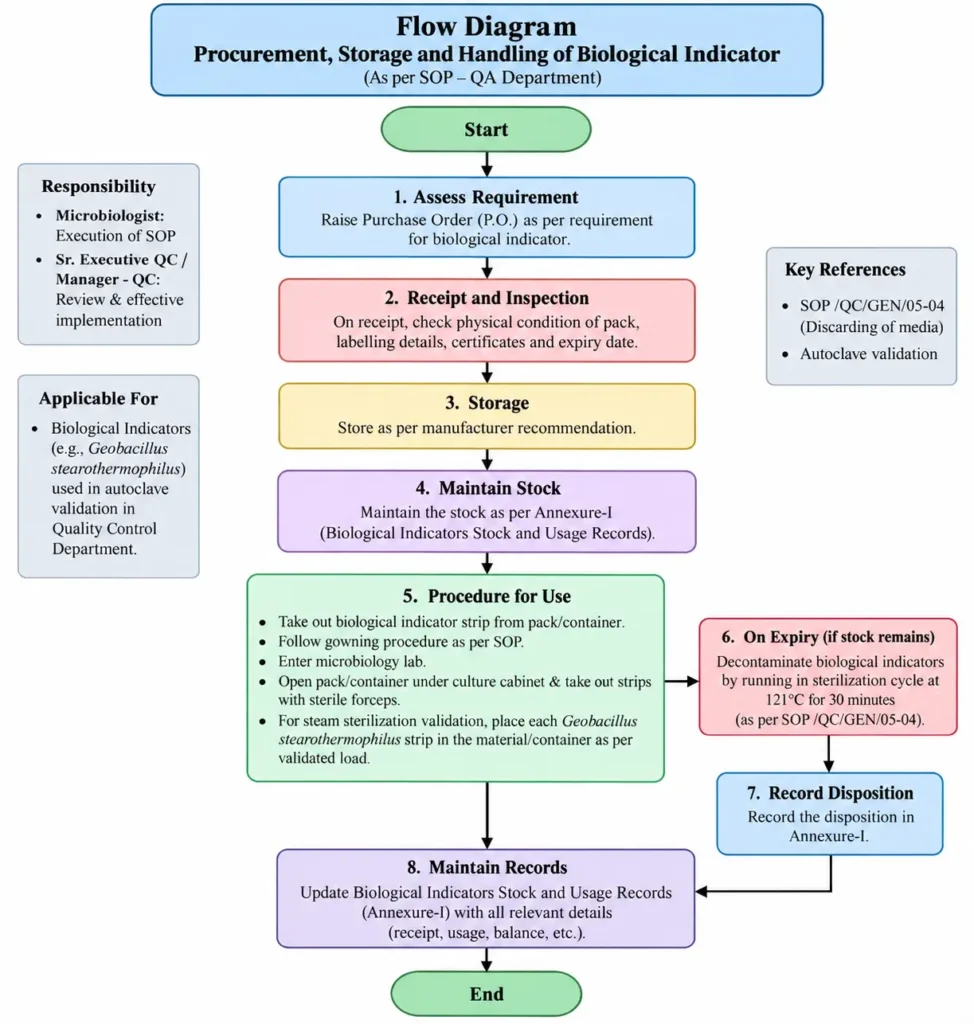
For use, the biological indicator strip is removed from the container, handled under a culture cabinet using sterile forceps, and placed at designated locations within the validated autoclave load after following appropriate gowning and microbiology laboratory procedures.If biological indicators remain after expiry, they are decontaminated through a sterilization cycle at 121°C for 30 minutes, and their disposition is recorded. All receipt, issue, usage, balance, spore count, D-value, and review details are maintained in the Biological Indicator Stock and Usage Record.
2. Brainstorming for SOP Failure:
The brainstorming diagram identifies possible causes of SOP failure in the manufacturing area related to the procurement, storage and handling of Biological Indicators. The SOP requires biological indicators to be properly received, checked for physical condition, labeling, certificates and expiry, stored according to manufacturer recommendations, and maintained through controlled stock records.

The diagram groups potential failure causes under Man, Method, Material, Machine/Equipment, Measurement, Environment and Management. Key concerns include inadequate training, failure to follow the SOP, improper storage, expired or damaged biological indicators, incorrect autoclave loading or cycle parameters, poor monitoring of BI results, unsuitable environmental conditions, incomplete documentation, and inadequate supervisory oversight. The brainstorming approach helps the investigation team systematically identify contributing factors before performing detailed root-cause analysis. It supports evaluation of personnel practices, equipment performance, material control, documentation, storage conditions and management systems so that appropriate CAPA actions can be established to prevent recurrence and ensure reliable autoclave validation.
3. 5-Why Analysis for SOP Failure:
The 5-Why Analysis for SOP Failure in the Manufacturing Area evaluates the underlying reasons for failures related to the procurement, storage, handling and use of Biological Indicators. The analysis begins with observable problems such as use of expired biological indicators, improper storage, incorrect handling, incomplete stock records, and incorrect placement of indicators during autoclave validation.
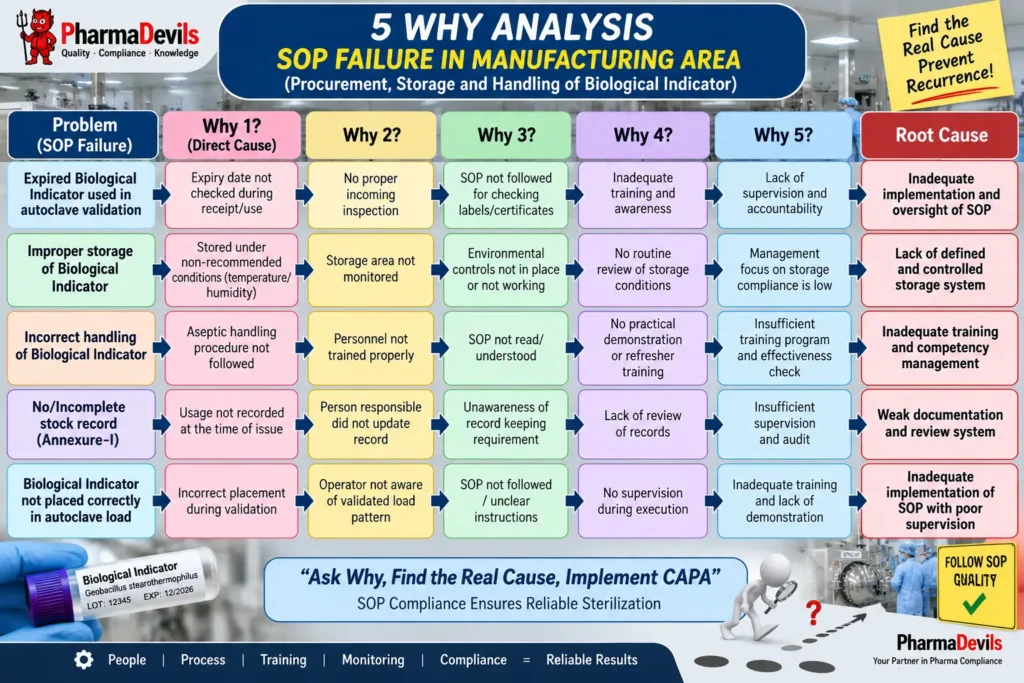
Each problem is progressively examined through five levels of “Why” questions to move from the immediate cause to the underlying systemic cause. The analysis highlights contributing factors such as inadequate incoming inspection, failure to follow the SOP, insufficient training, lack of storage monitoring, weak documentation practices, inadequate supervision, and poor awareness of validated load patterns. The resulting root causes mainly point toward weak SOP implementation, inadequate training and competency management, insufficient supervisory control, poor documentation review, and lack of a defined storage-control system. The analysis therefore supports targeted CAPA to strengthen training, monitoring, record review, accountability and overall SOP compliance. The source SOP itself requires receipt checks, manufacturer-recommended storage, stock maintenance, controlled handling, correct placement in validated loads, and documented disposition.
4. Fishbone Analysis for SOP Failure:
The Fishbone Analysis for SOP Failure in the Manufacturing Area systematically identifies potential causes that can lead to failure in the procurement, storage, handling, and use of Biological Indicators. The diagram groups causes under Man, Method, Material, Machine, Measurement, and Environment/Management, helping the investigation team examine the problem from multiple operational perspectives.
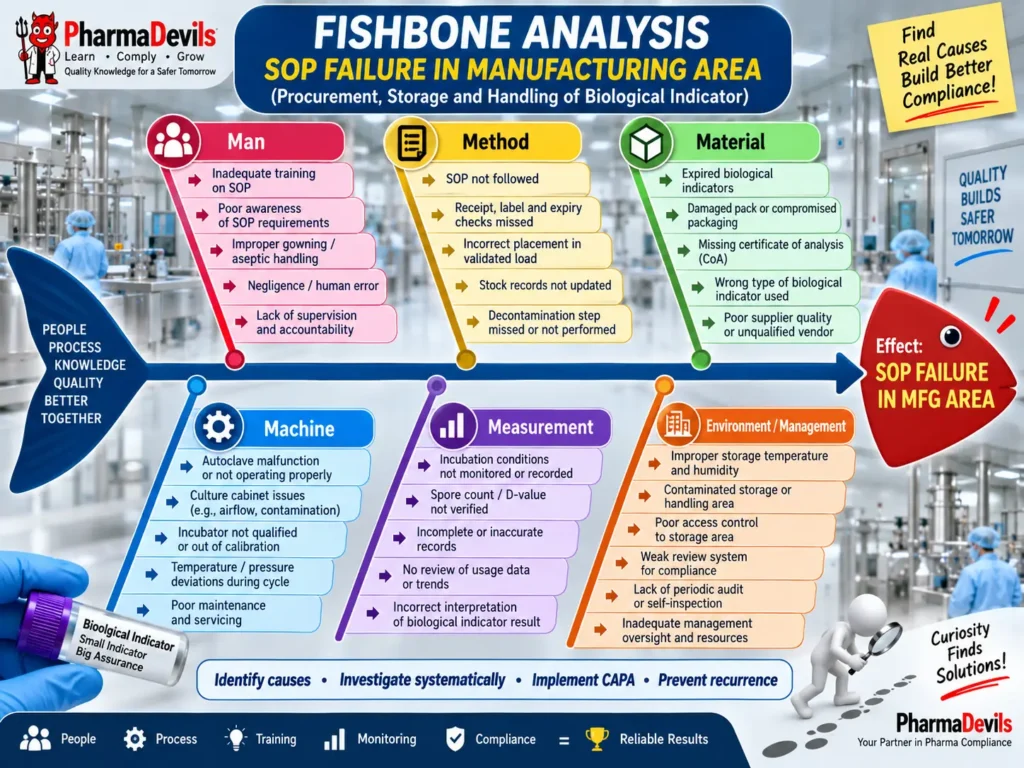
Typical causes include inadequate SOP training, poor awareness, incorrect gowning or aseptic handling, failure to check labeling or expiry, incomplete stock records, use of expired or damaged biological indicators, unsuitable storage conditions, equipment malfunction, incorrect incubation monitoring, weak supervision, and inadequate compliance review. These causes are relevant because the SOP requires receipt inspection, manufacturer-recommended storage, stock maintenance, aseptic handling, correct placement of biological indicator strips in validated autoclave loads, and proper decontamination and disposition of expired stock.The Fishbone approach supports structured root-cause investigation and CAPA development to strengthen SOP compliance and prevent recurrence.
5. Fault Tree Analysis for SOP Failure:
The Fault Tree Analysis (FTA) for SOP Failure in the Manufacturing Area identifies the possible pathways that can lead to failure in the procurement, storage, handling, and use of Biological Indicators. The top event, “SOP Failure in MFG Area,” is linked to five major failure categories: Human Failure, Procedural/Documentation Failure, Material Failure, Equipment/Process Failure, and Storage/Environment/Management Failure.
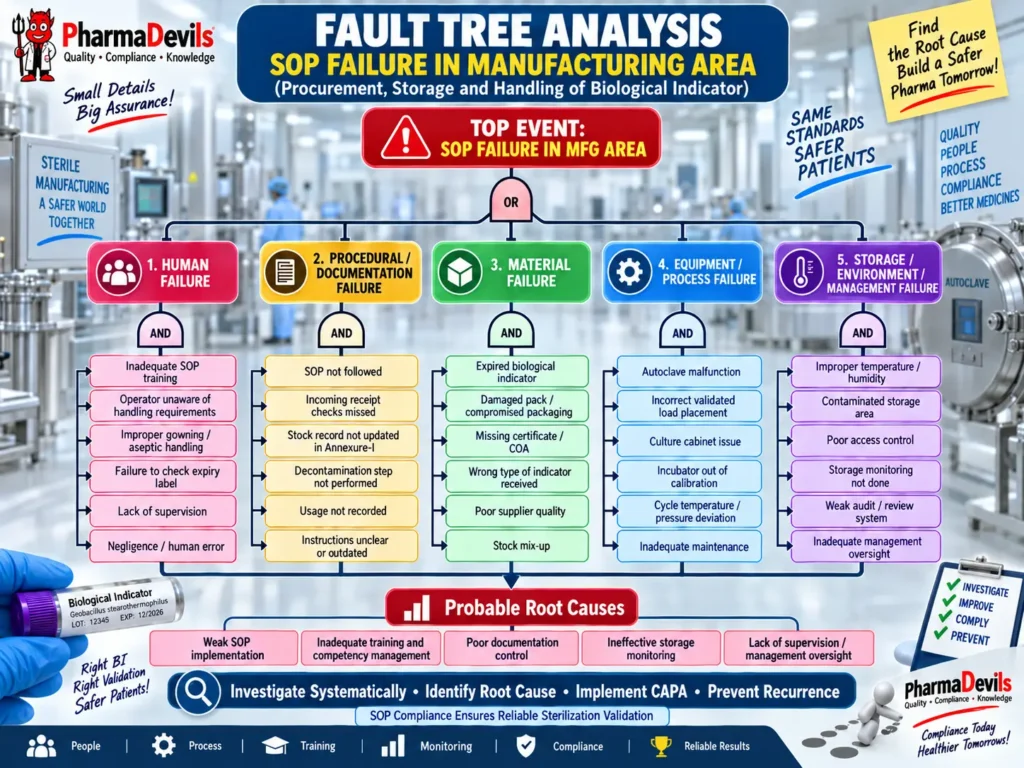
Potential causes include inadequate SOP training, poor aseptic handling, missed receipt and expiry checks, incomplete stock records, use of expired or damaged biological indicators, autoclave or incubator problems, incorrect validated-load placement, unsuitable storage temperature/humidity, weak monitoring, and inadequate management oversight. These failure pathways reflect key controls required by the SOP, including receipt verification, manufacturer-recommended storage, stock maintenance, controlled handling, correct placement in validated autoclave loads, and documented disposition of expired indicators. The FTA helps investigators trace the top event back to probable root causes and supports development of effective CAPA, stronger supervision, improved documentation, better training, and preventive controls.
Questions & Answers – Procurement, Storage and Handling of Biological Indicator
Q1. What is the objective of this SOP?
Answer: To define the procedure for procurement, storage, and handling of Biological Indicators.
Q2. Where is this SOP applicable?
Answer: It is applicable to Biological Indicators such as Geobacillus stearothermophilus used for autoclave validation in the Quality Control Department.
Q3. Who is responsible for execution of this SOP?
Answer: The Microbiologist is responsible for execution of the SOP.
Q4. Who is responsible for review and effective implementation of the SOP?
Answer: The Sr. Executive QC / Manager-QC is responsible for review and effective implementation.
Q5. How is the requirement for Biological Indicators initiated?
Answer: A Purchase Order is raised according to the requirement for Biological Indicators.
Q6. What should be checked on receipt of Biological Indicators?
Answer: The physical condition of the pack, labeling details, certificates, and expiry date should be checked.
Q7. How should Biological Indicators be stored?
Answer: They should be stored according to the manufacturer’s recommendations.
Q8. Where is Biological Indicator stock maintained?
Answer: Stock is maintained as per Annexure-I – Biological Indicators Stock and Usage Records.
Q9. How should Biological Indicator strips be handled before use?
Answer: The strip is taken from the pack/container after following the applicable gowning procedure and entering the microbiology laboratory.
Q10. Where should the Biological Indicator pack be opened?
Answer: It should be opened under the culture cabinet, and strips should be removed using sterile forceps.
Q11. How are Biological Indicators used during steam sterilization validation?
Answer: Geobacillus stearothermophilus strips are placed carefully in the material/container according to the validated autoclave load.
Q12. What should be done with expired Biological Indicators remaining in stock?
Answer: They should be decontaminated by treating them in a sterilization cycle at 121°C for 30 minutes as specified in the SOP.
Q13. Where should disposition of expired Biological Indicators be recorded?
Answer: The disposition should be recorded in Annexure-I.
Q14. What information is recorded in the Biological Indicator Stock and Usage Record?
Answer: It includes quantity received, receipt date, type, batch number, manufacturing and expiry dates, test and release dates, incubation details, quantity issued, pack number, spore count, D-value, purpose, issue details, balance stock, and review information.
Q15. What are the referenced procedures in this SOP?
Answer: The SOP refers to Discarding of Media and Autoclave Validation.
Reference Guidelines:
- EU GMP Annex 1 – Manufacture of Sterile Medicinal Products, Sections 8.36 and 8.42–8.43. It states that sterilization processes should be validated using physical measurements and, where appropriate, Biological Indicators. BIs should be placed at appropriate locations, stored and used according to manufacturer instructions, and handled carefully to avoid microbial contamination. It also requires control of BI suppliers, transport and storage conditions, and verification of population, purity, and identity for new BI lots. EU GMP Annex 1 – Official European Commission PDF
- WHO GMP for Sterile Pharmaceutical Products, Sections 8.42–8.43. WHO recommends suitable BIs as an additional tool for sterilization validation, manufacturer-specified storage/use, positive controls where applicable, qualified suppliers, controlled transportation/storage, and verification of BI population, purity, and organism identity. (World Health Organization)
- ISO 11138-1:2017 – Sterilization of health care products — Biological indicators — Part 1: General requirements. Covers general requirements for BI production, labeling, test methods, and performance characteristics used in sterilization validation and routine monitoring. (ISO) ISO 11138-1:2017
- ISO 11138-3:2017 – Biological indicators for moist heat sterilization processes. Particularly applicable to autoclaves because it specifies BI requirements and test methods for moist-heat sterilization processes. (ISO) ISO 11138-3:2017
- USP General Chapter <1229.5> – Biological Indicators for Sterilization. Provides principles for selection and appropriate use of BIs in development, validation, routine monitoring, and periodic reassessment of sterilization processes. (USP)
- USP General Chapter <55> – Biological Indicators—Resistance Performance Tests. Addresses BI population and resistance-performance testing, including parameters important for confirming suitability of the BI for the intended sterilization process. (USP)