







Brief Description
This SOP describes the Quality Control procedure for receiving, sampling, analysis, approval/rejection, and release of raw materials, packing materials, and finished products. Its main purpose is to ensure that only materials and products meeting approved specifications are accepted and released for use or dispatch. For raw and packing materials, QC personnel verify the receiving report, material identity, batch details, quantity, manufacturer/supplier information, container condition, and labeling before sampling. Samples are collected according to the approved sampling plan and properly identified. The analytical chemist performs testing according to approved procedures and records observations, calculations, standards used, and results in the raw data sheet. The QC Section Head reviews results against specifications and decides whether the material or product is approved or rejected. For finished products, samples are received from In-Process QA, tested by QC, and released after satisfactory results. After approval, the Certificate of Analysis (COA) is forwarded to Quality Assurance for product dispatch.
Skip to PDF content1. Flow Diagram:
The temple-style flow diagram presents the complete process for receiving, analysis, approval/rejection, and release of raw materials, packing materials, and finished products in a clear and attractive format. The process begins with receipt of material information, verification of the receiving report, inspection of containers and labels, and sampling according to the approved sampling plan.
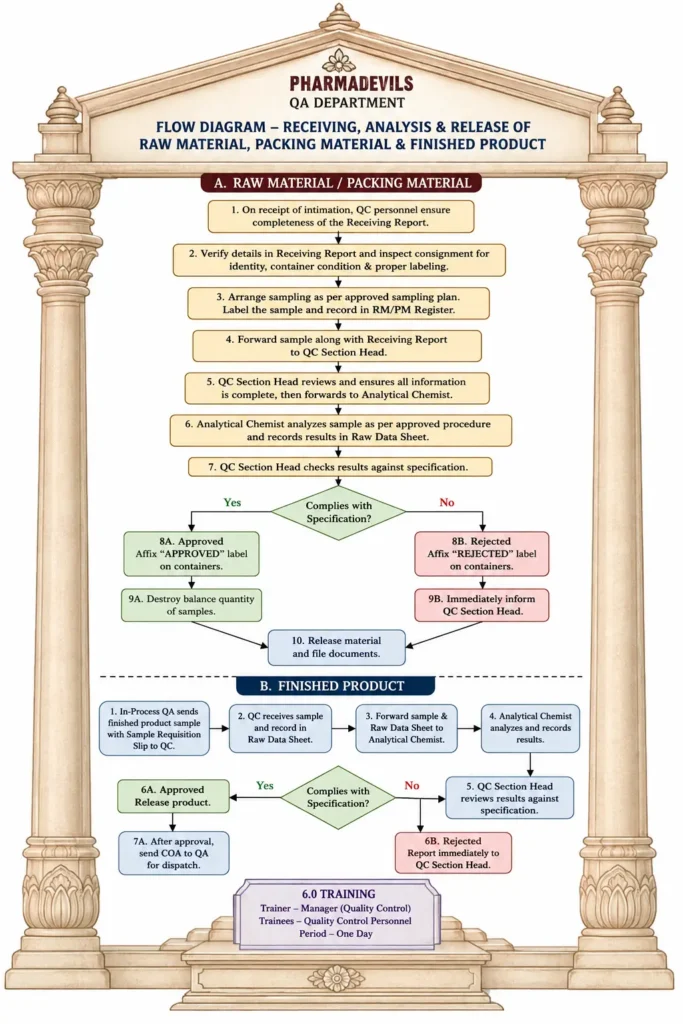
The sample is then forwarded to the QC Section Head and Analytical Chemist for testing. Test observations, calculations, standards used, and results are recorded in the raw data sheet. The QC Section Head reviews the results against approved specifications and decides whether the material is approved or rejected. For finished products, QA sends the sample to QC for analysis. After satisfactory results, the product is released and the COA is forwarded to Quality Assurance for dispatch.The temple design symbolically represents a strong, controlled, and structured quality system, with every step acting as a pillar supporting product quality and GMP compliance.
2. Brainstorming for SOP Failure:
Brainstorming for failure of the SOP for Receiving, Analysis & Release of Raw Material, Packing Material and Finished Product is used to identify all possible reasons why the procedure may not be followed correctly. The SOP requires verification of receiving documents, material identification, container condition, correct labeling, approved sampling, proper analysis, documentation of analytical data, specification review, and final release or rejection.
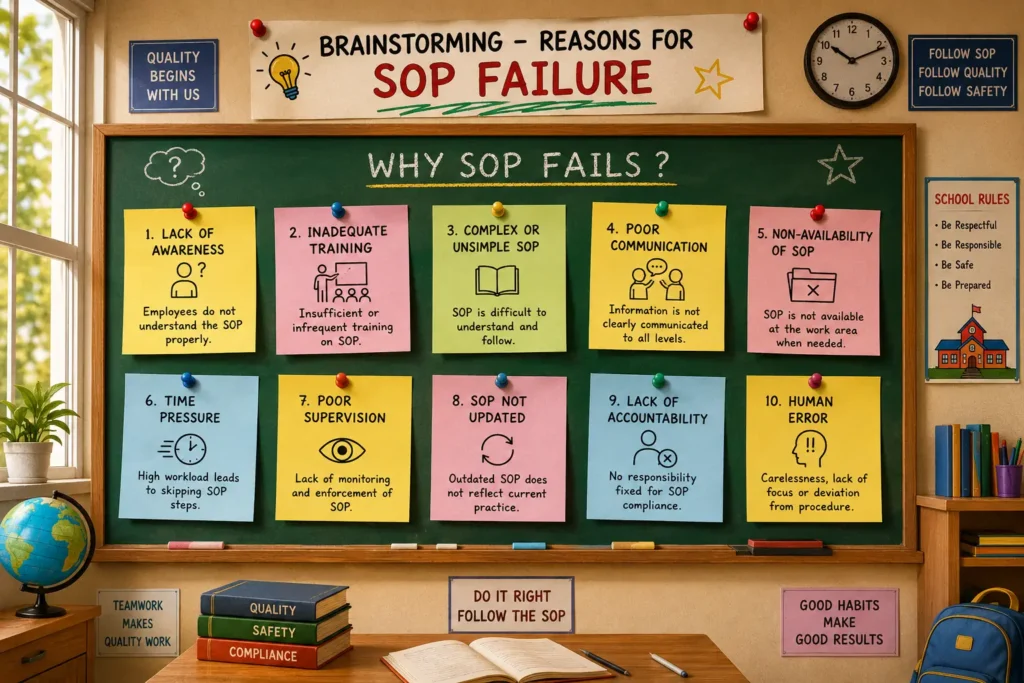
During brainstorming, the QC and QA team can consider possible causes such as incomplete receiving reports, incorrect sampling, wrong sample labeling, damaged containers, analytical errors, use of incorrect specifications, calculation mistakes, incomplete raw data, delayed reporting, incorrect approved/rejected labels, inadequate training, poor communication, and failure to follow the defined release process. The SOP also requires analytical results to be checked against specifications before material or product is released or rejected.The brainstorming exercise helps identify potential weaknesses and supports suitable root-cause investigation, CAPA, training, and process improvement.
3. 5-Why Analysis for SOP Failure:
The 5-Why Analysis for SOP Failure is a simple root-cause investigation method used to understand why the SOP for receiving, analysis, and release of raw material, packing material, and finished product was not followed correctly. The SOP requires proper receipt verification, material inspection, approved sampling, analytical testing, recording of raw data, specification review, and final release or rejection.
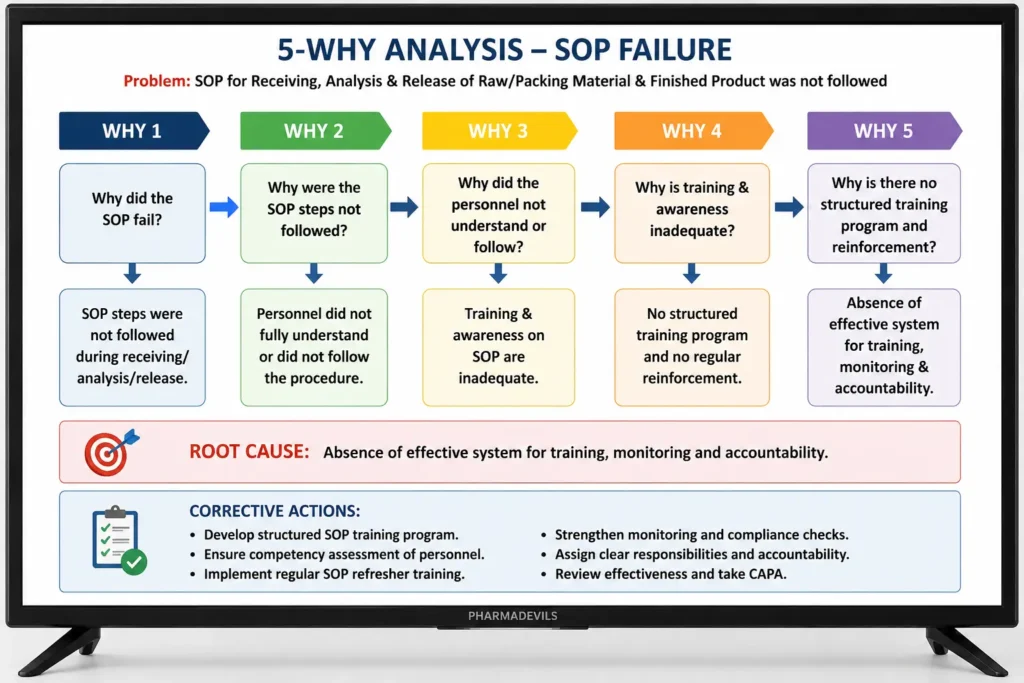
The analysis starts with the problem, such as SOP steps not being followed, and repeatedly asks “Why?” until the underlying cause is identified. Possible causes may include inadequate understanding of the procedure, insufficient training, lack of refresher training, weak supervision, or inadequate compliance monitoring. The final root cause can then be addressed through training, competency assessment, clear responsibilities, routine monitoring, CAPA implementation, and effectiveness checks to prevent recurrence.
4. Fishbone Analysis for SOP Failure:
The Fishbone (Ishikawa) Analysis is used to identify possible causes behind failure of the SOP for Receiving, Analysis & Release of Raw Material, Packing Material and Finished Product. The SOP requires proper verification of receiving documents, inspection of material and containers, correct sampling, analytical testing, recording of raw data, review against specifications, and final release or rejection.
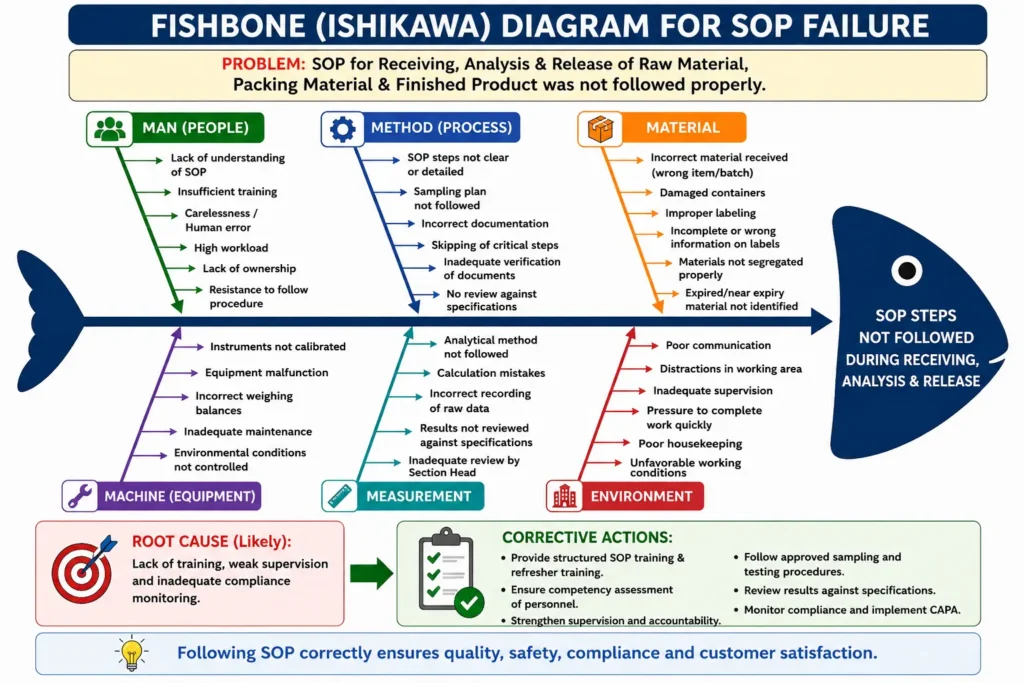
The fishbone diagram groups possible causes into major categories such as Man, Method, Material, Machine, Measurement, and Environment. Possible causes may include inadequate training, human error, incorrect sampling, incomplete documentation, damaged or wrongly labelled material, instrument problems, calculation mistakes, poor supervision, and unsuitable working conditions. By arranging these causes systematically, the team can identify the most probable root cause and implement suitable CAPA, retraining, competency assessment, improved supervision, and compliance monitoring to prevent recurrence.
5. Fault Tree Analysis for SOP Failure:
The Fault Tree Analysis (FTA) is used to identify the possible causes that can lead to failure of the SOP for Receiving, Analysis & Release of Raw Material, Packing Material and Finished Product. The SOP requires proper receipt verification, material inspection, sampling, analysis, documentation, review against specifications, and final release or rejection.
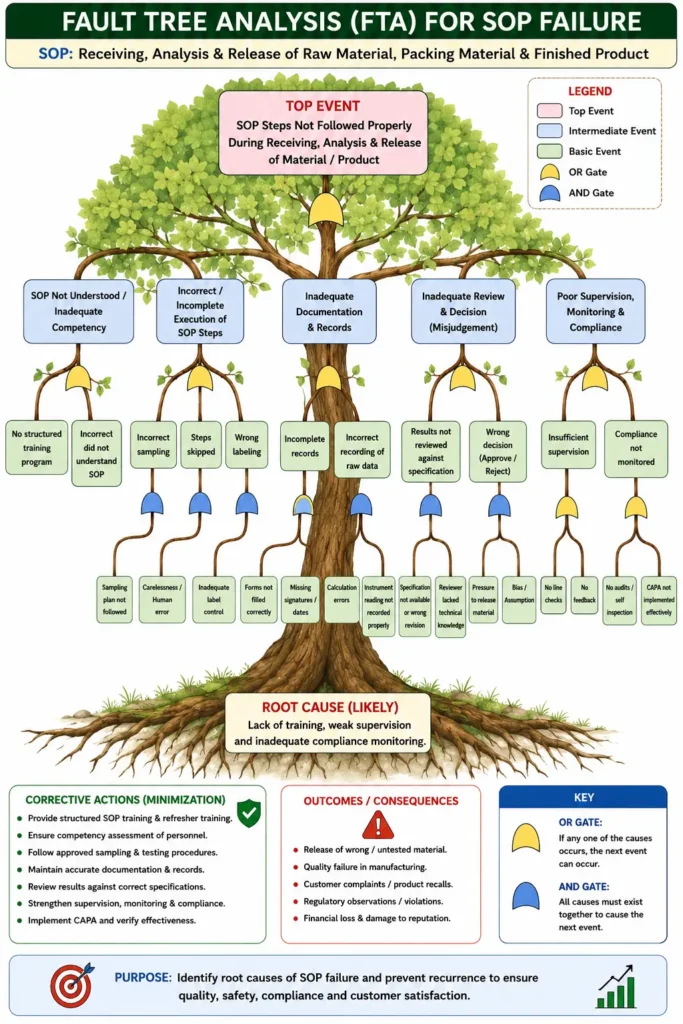
In the tree diagram, the top event is “SOP steps not followed properly.” This is further divided into possible causes such as inadequate SOP understanding, incorrect execution of steps, incomplete documentation, improper review and decision-making, and weak supervision or compliance monitoring. These causes can be further traced to issues like insufficient training, incorrect sampling, skipped steps, wrong labeling, calculation errors, missing records, and lack of monitoring.FTA helps identify the root cause, assess the possible consequences, and establish suitable corrective actions such as retraining, competency assessment, improved supervision, proper documentation, CAPA implementation, and effectiveness verification to prevent recurrence.
Questions & Answers – SOP for Receiving, Analysis & Release of Materials and Finished Product
Q1. What is the objective of this SOP?
Answer: The objective is to define the procedure for receiving, analysis, and release of raw materials, packing materials, and finished products.
Q2. What is the scope of this SOP?
Answer: It applies to receiving, analysis, and release activities for raw materials, packing materials, and finished products.
Q3. Who is responsible for execution of the SOP?
Answer: Executive Quality Control is responsible for execution of the SOP.
Q4. Who is responsible for effective implementation of the SOP?
Answer: The Department Head is responsible for effective implementation.
Q5. What should QC verify before sampling material?
Answer: QC should verify the receiving report for details such as reference number, invoice details, material name, batch number, quantity, packing type, manufacturing and expiry dates, manufacturer, supplier, and required initials.
Q6. What should be checked during inspection of the consignment?
Answer: QC should check material identity, container condition, and proper labeling before arranging sampling according to the approved sampling plan.
Q7. What information should be written on a raw material sample label?
Answer: The label should include material name, batch number, batch size, manufacturing and expiry dates, sample quantity, receipt date, sampled-by details, and sampling date.
Q8. Who performs the analysis of the sample?
Answer: The Analytical Chemist performs the analysis according to the approved procedure and records the findings in the QC raw data sheet.
Q9. What analytical details are recorded in the raw data sheet?
Answer: Details such as weight taken, working standard used, calculations, analytical findings, initials, and date of analysis are recorded.
Q10. Who decides whether material is released or rejected?
Answer: The QC Section Head reviews the receiving report against the specification and releases or rejects the material based on compliance with the specification.
Q11. What is done after raw or packing material is approved or rejected?
Answer: The Sampling Chemist takes the appropriate approved or rejected labels, initials them, and arranges for them to be affixed to individual containers.
Q12. What happens if a material or product sample is rejected?
Answer: The Analytical Chemist immediately reports the rejection to the QC Section Head.
Q13. How is a finished product sample received for analysis?
Answer: In-process QA sends the finished product sample and sample requisition slip to the Quality Control Department.
Q14. What happens after a finished product is released?
Answer: After product release, the Certificate of Analysis is sent to Quality Assurance for dispatch of the product.
Q15. What training is specified in the SOP?
Answer: The Manager–Quality Control acts as trainer, Quality Control personnel are the trainees, and the specified training period is one day.
Q16. Where are controlled and master copies maintained?
Answer: The controlled copy is maintained by the Head of Quality Control, while the master copy is maintained by the Head of Quality Assurance.
Q17. What is the full form of SOP and QC?
Answer: SOP means Standard Operating Procedure, and QC means Quality Control.
Q18. Why is this SOP important?
Answer: It provides a defined system for receiving, sampling, testing, reviewing, and releasing or rejecting materials and finished products so that only compliant materials and products proceed further. This importance follows from the sequence of controls described in the SOP.