







Brief Description
The SOP for Retesting of Raw Materials establishes a controlled procedure for reanalysis of raw materials to confirm their continued suitability for use. The Warehouse informs Quality Control about materials due for retesting, including material name, batch number, quantity, and manufacturing date. Quality Control records the details in the reanalysis register, assigns a reanalysis number, and instructs the chemist to collect representative samples. After sampling, containers are properly closed and identified with appropriate “UNDER TEST” and “SAMPLED” labels. The QC chemist analyzes the samples according to the approved standard method of analysis and, based on the results, applies “APPROVED” or “REJECTED” status labels. The SOP specifies annual retesting for active materials and excipients, while colours and flavours are retested every six months. It also includes training, document distribution, revision history, and an Annexure-I logbook for maintaining complete retesting records.
Skip to PDF content1. Flow Diagram:
The flow diagram illustrates the step-by-step process for retesting of raw materials in a simple Devils Guide format. The process begins when the Warehouse informs Quality Control about the material requiring reanalysis, including its name, batch number, quantity, and manufacturing date. QC records the material in the reanalysis register, assigns a reanalysis number, and instructs the chemist to withdraw a representative sample. The chemist samples the required containers, closes them properly, and applies “UNDER TEST” and “SAMPLED” labels.
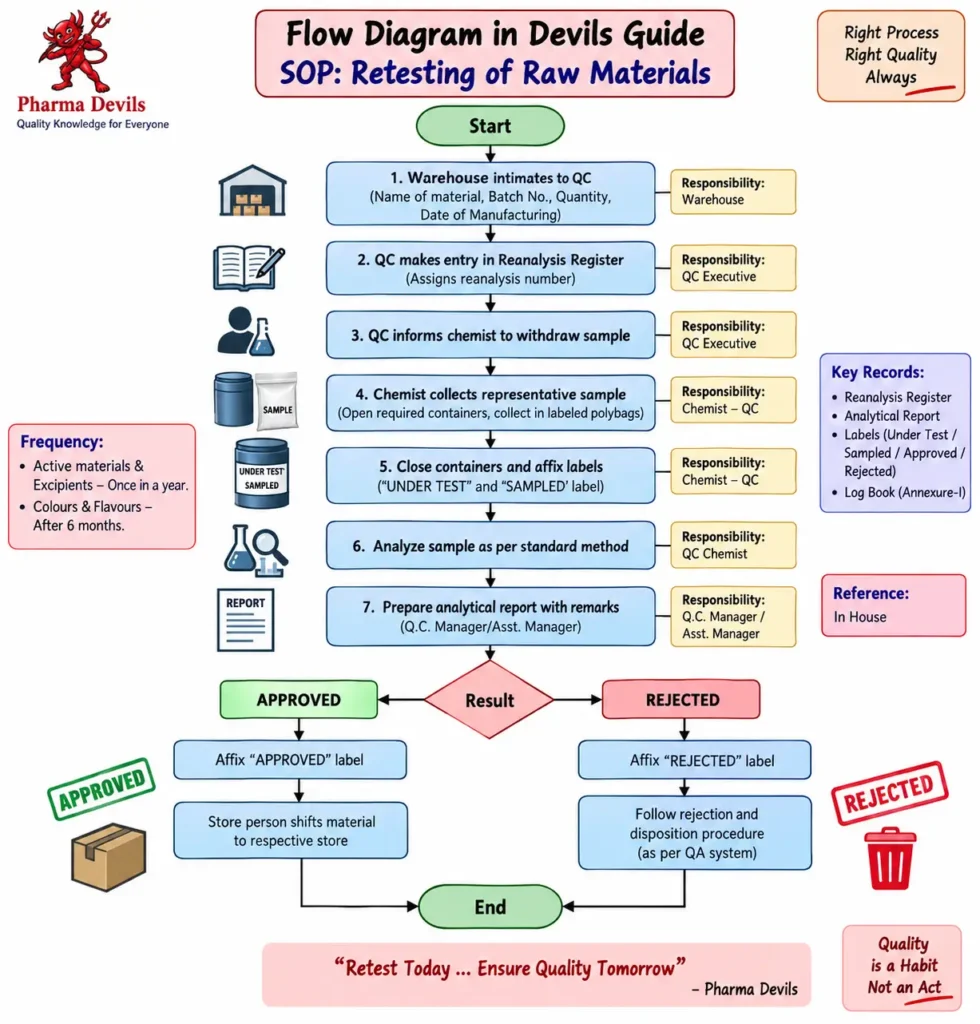
The collected sample is then analyzed according to the approved standard method. After testing, the QC Manager/Assistant Manager reviews the analytical report and remarks. Based on results, the material is classified as Approved or Rejected and labeled accordingly. Approved material is shifted to its respective storage location, while rejected material is handled according to the applicable quality system. The SOP specifies annual retesting for active materials and excipients and six-monthly retesting for colours and flavours.
2. Brainstorming for SOP Failure:
The brainstorming diagram identifies possible reasons why the SOP for Retesting of Raw Materials may not be followed effectively. The central problem is supported by multiple potential failure points covering Warehouse, Quality Control, sampling, testing, labeling, documentation, storage, training, and retesting frequency.
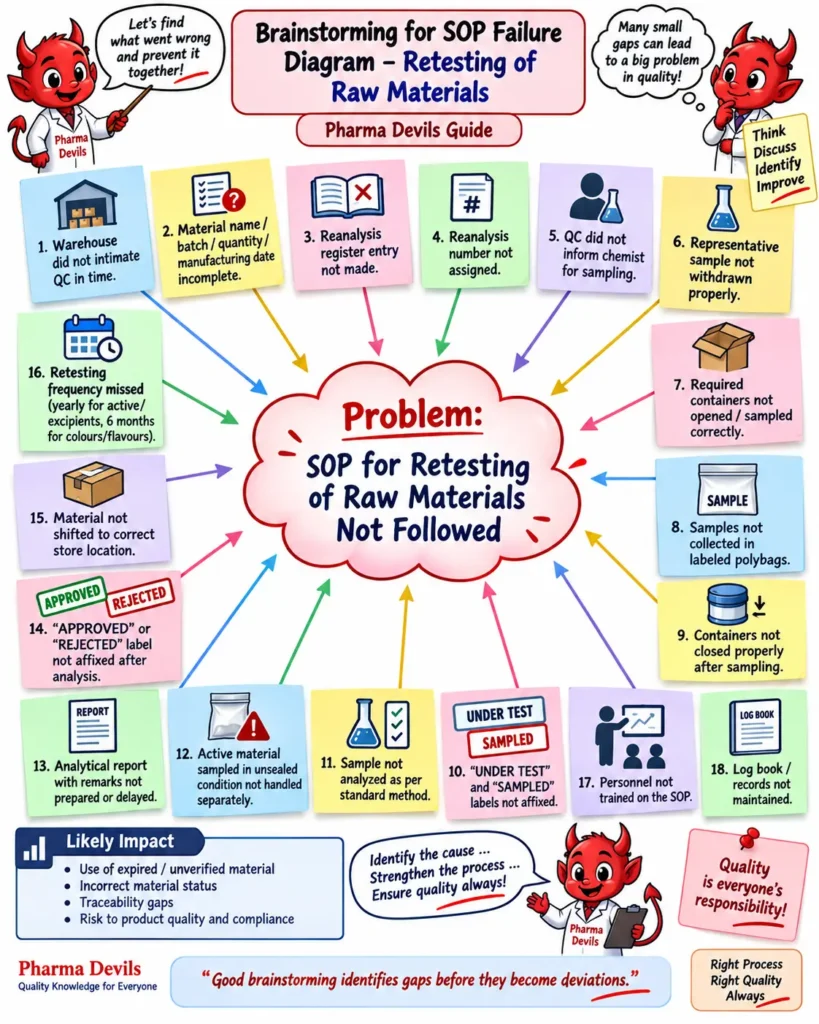
Key issues include delayed Warehouse intimation, incomplete material information, missing reanalysis-register entries, failure to assign a reanalysis number, improper sampling, incorrect container handling, missing “UNDER TEST” and “SAMPLED” labels, testing not performed according to the standard method, delayed analytical reports, and incorrect “APPROVED” or “REJECTED” status labeling. The diagram also highlights missed retesting frequencies, inadequate personnel training, poor logbook maintenance, and incorrect storage after disposition. These failure points can lead to use of unverified material, wrong material status, traceability gaps, and potential quality or compliance concerns. The brainstorming exercise helps identify weaknesses before they develop into deviations or product-quality risks.
3. 5-Why Analysis for SOP Failure:
The 5 Why Analysis identifies the underlying causes for failure to follow the SOP for Retesting of Raw Materials. The analysis begins with the problem that retesting was not performed according to the approved SOP and progressively examines why the failure occurred. Potential reasons include missed Warehouse intimation, failure to identify materials due for reanalysis, improper sample withdrawal, incomplete labeling, analytical testing not being completed, delays in report review, and inadequate monitoring of the reanalysis register. The analysis further highlights insufficient personnel training, poor communication between Warehouse and Quality Control, weak supervision, and lack of management review as contributing factors.
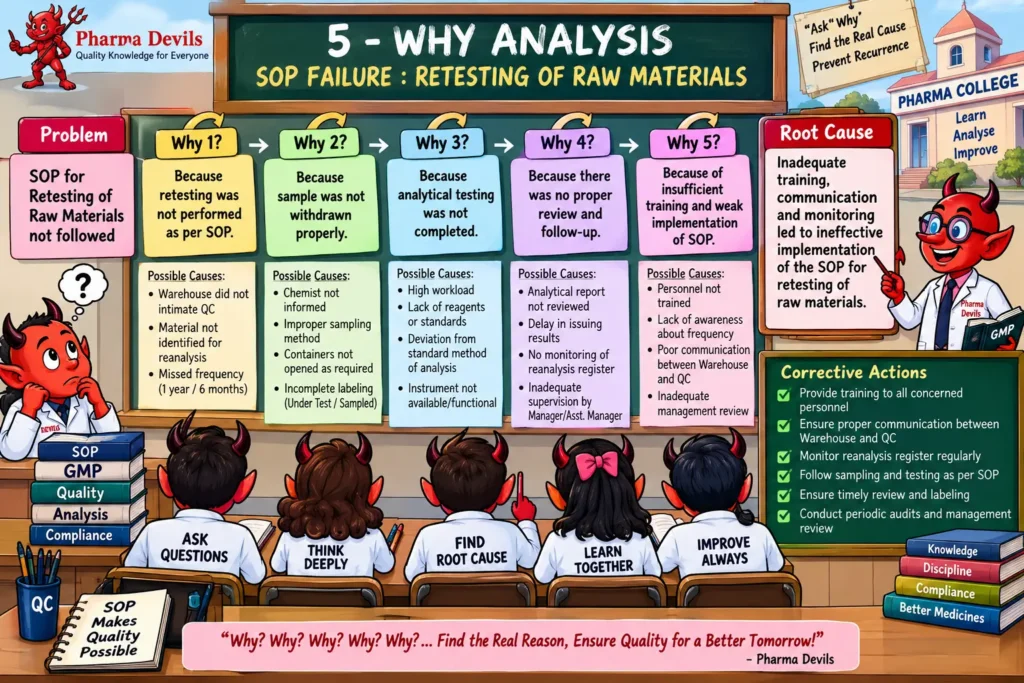
The probable root cause is inadequate training, communication, monitoring, and ineffective implementation of the SOP. Corrective actions include retraining concerned personnel, strengthening Warehouse–QC communication, regularly monitoring the reanalysis register, ensuring sampling and testing are performed as per SOP, completing timely review and labeling, and conducting periodic audits and management review.
4. Fishbone Analysis for SOP Failure:
The Fishbone Analysis identifies the major potential causes for failure to follow the SOP for Retesting of Raw Materials. The central problem is evaluated under key categories such as Man, Method, Machine, Material, Environment, Measurement, Management, and Documentation. Possible causes include inadequate training, lack of awareness of retesting frequency, improper sampling, incomplete status labeling, instrument or reagent issues, incorrect storage conditions, weak monitoring, poor Warehouse–QC communication, incomplete reanalysis records, and delayed review of analytical reports.
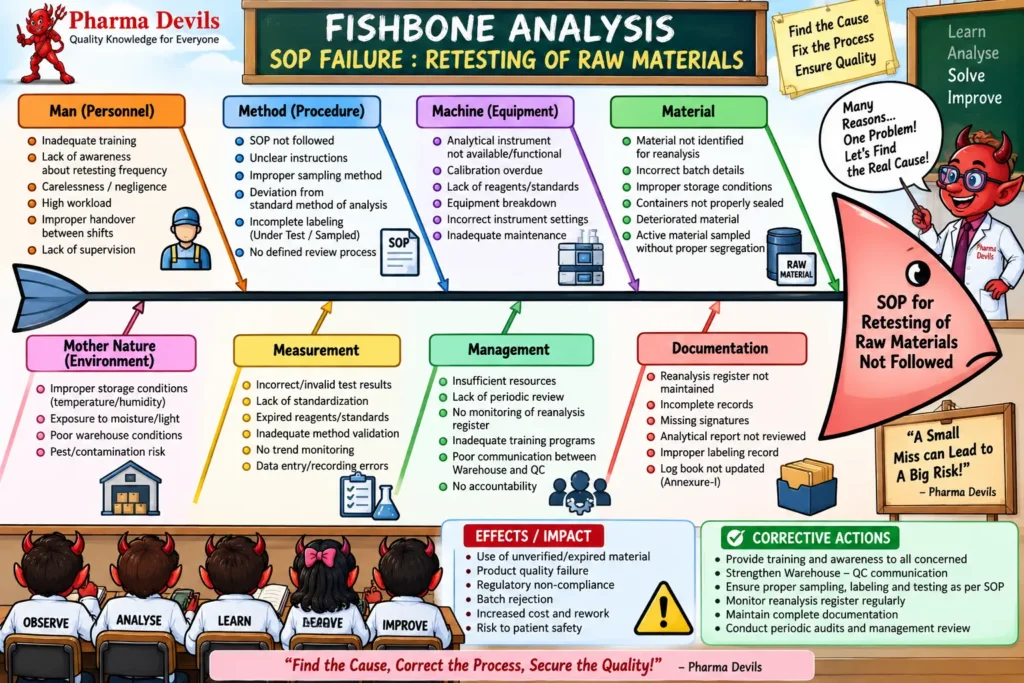
These weaknesses can lead to use of unverified or expired raw materials, incorrect material status, documentation and traceability gaps, regulatory non-compliance, batch rejection, rework, and potential product-quality risks. The analysis supports corrective actions such as personnel training, improved communication, regular monitoring of the reanalysis register, proper sampling and testing, timely labeling and review, and periodic management oversight. The source SOP requires documented reanalysis, representative sampling, testing, status labeling, and defined retesting frequency.
5. Fault Tree Analysis for SOP Failure:
The Fault Tree Analysis (FTA) evaluates how different failures can lead to the top event: “SOP for Retesting of Raw Materials Not Followed.” The diagram groups the causes into major branches such as material not retested, retesting performed incorrectly, incorrect disposition/labeling, and inadequate monitoring or compliance. Supporting causes include failure of Warehouse to inform QC, material not being identified for reanalysis, missed retesting frequency, improper sampling, testing not performed as per the standard method, use of unsuitable instruments or reagents, missing “UNDER TEST,” “SAMPLED,” “APPROVED,” or “REJECTED” labels, incomplete reanalysis records, delayed analytical-report review, inadequate training, and weak management oversight.
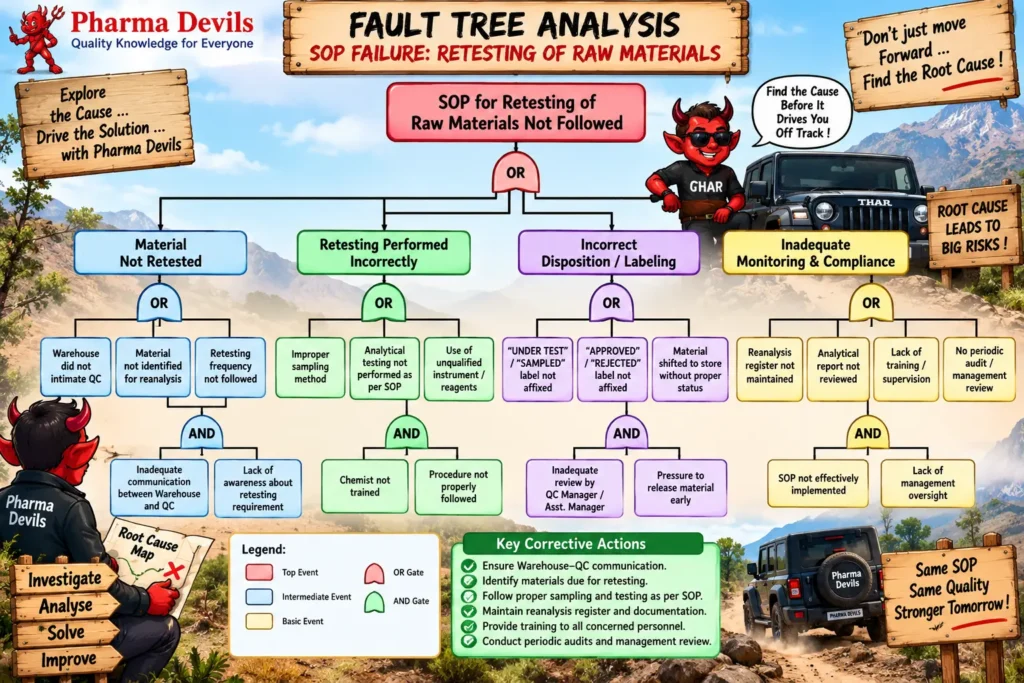
The analysis helps distinguish basic and intermediate events and shows how combinations of failures can result in SOP breakdown. Corrective actions focus on stronger Warehouse–QC communication, timely identification of materials due for retesting, proper sampling and testing, complete documentation, personnel training, periodic audits, and management review. These controls support the requirements described in the source SOP for reanalysis, sampling, testing, labeling, reporting, storage, and defined retesting frequency.
Questions & Answers – SOP for Retesting of Raw Materials
1. What is the objective of the SOP for Retesting of Raw Materials?
The objective is to establish a procedure for retesting raw materials.
2. Who is responsible for execution of this SOP?
The QC Chemist is responsible for execution of the SOP.
3. Who is responsible for effective implementation of the SOP?
The Assistant Manager-QC and Head-QA/QC are responsible for effective implementation.
4. What information should Warehouse provide to Quality Control for reanalysis?
Warehouse should provide the material name, batch number, quantity, and date of manufacturing.
5. What is done after QC receives information about material due for retesting?
The QC Executive makes an entry in the reanalysis register and assigns a reanalysis number.
6. Who withdraws the representative sample?
The QC Chemist withdraws the representative sample after being informed by the QC Executive.
7. How is the sample collected?
The chemist opens the required number of containers and collects samples in labeled polybags.
8. Which labels are applied after sampling?
The containers are properly closed and marked with “UNDER TEST” and “SAMPLED” labels.
9. How is the retest sample analyzed?
The QC Chemist analyzes the sample according to the standard method of analysis.
10. How should active raw material in unsealed condition be handled?
Active raw material in unsealed condition should be sampled and analyzed separately.
11. What status labels are applied after completion of analysis?
The QC Chemist applies either an “APPROVED” or “REJECTED” label based on the analytical result.
12. Who reviews and forwards the analytical report?
The QC Manager/Assistant Manager sends the analytical report with remarks for further processing.
13. What happens to the material after final labeling?
The Store person shifts the material to its respective storage location.
14. What is the retesting frequency for active materials and excipients?
They are retested once in a year.
15. What is the retesting frequency for colours and flavours?
Colours and flavours are retested after six months.
16. Who provides training on this SOP?
The trainer is the Head-QA/QC, and the trainees are Quality Control personnel.
17. What record is maintained for retesting of raw materials?
The SOP includes Annexure-I: Log Book of Retesting of Raw Material for recording retesting activities.
18. What is the reference mentioned in the SOP?
The reference is stated as “In House.”
Reference Guidelines:
- US FDA – 21 CFR 211.87, Retesting of Approved Components, Drug Product Containers and Closures. It requires retesting or re-examination, as appropriate, when materials have been stored for long periods or exposed to conditions such as air, heat, or other factors that may adversely affect quality. (U.S. Food and Drug Administration) FDA – Materials: Basic CGMP Requirements
- ICH Q1A(R2) – Stability Testing of New Drug Substances and Products. It defines the re-test date and re-test period for drug substances and states that the retest period should be supported by stability data. (ICH Database) ICH Q1A(R2) Guideline
- ICH Q7 – GMP Guide for Active Pharmaceutical Ingredients, Section 7.5 Re-evaluation. Materials should be re-evaluated as appropriate to establish continued suitability for use, particularly after prolonged storage or exposure to heat or humidity. (ICH Database) ICH Q7 GMP Guideline
- EU GMP – EudraLex Volume 4, Part II, Section 7.5 Re-evaluation. Section 7.50 similarly requires appropriate re-evaluation of materials after prolonged storage or adverse environmental exposure; the document also addresses re-evaluation/retest dates. EU GMP Volume 4 Part II
- WHO TRS 1010, Annex 10 – Stability Testing of APIs and Finished Pharmaceutical Products. This provides WHO guidance for establishing stability-supported retest periods for APIs. (World Health Organization) WHO TRS 1010 Annex 10
- EU GMP Annex 8 – Sampling of Starting and Packaging Materials. Useful for the sampling portion of your retesting SOP, particularly representative sampling and controls for starting materials. (Public Health) EU GMP Annex 8 – Sampling of Starting and Packaging Materials