






1. Introdction for Risk Assessment for Airborne Particle Counter
Risk Assessment for Airborne Particle Counter evaluates potential hazards associated with equipment operation, calibration, sampling procedures, and environmental monitoring in pharmaceutical cleanrooms. The assessment follows the 6M methodology: Man, Machine, Material, Method, Measurement, and Milieu (Environment), using Failure Mode and Effects Analysis (FMEA). It identifies risks involving inaccurate particle counts, improper sampling locations, equipment malfunction, contamination, and data integrity failures. Risk Priority Numbers (RPN) help evaluate severity, occurrence, and detectability. Recommended controls include personnel training, equipment qualification, calibration, preventive maintenance, validated sampling procedures, and documentation practices to ensure reliable monitoring, regulatory compliance, contamination control, and product quality assurance.
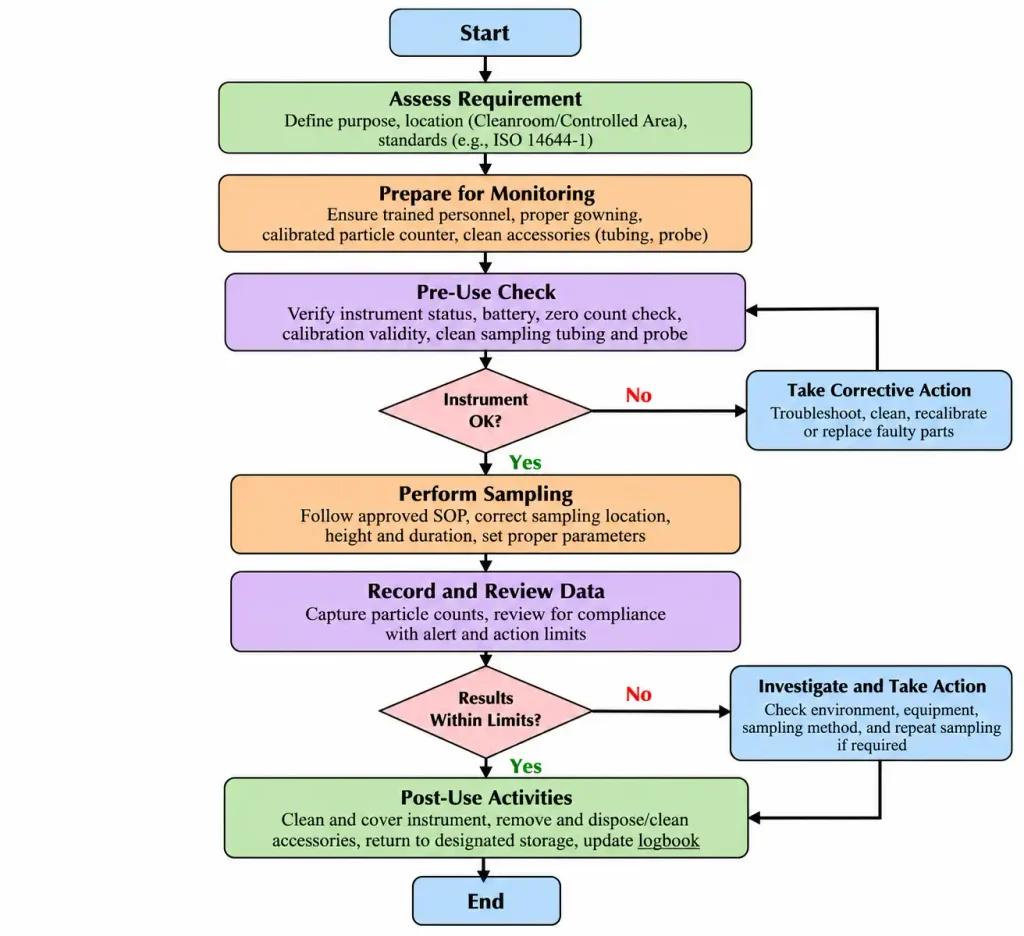
Skip to PDF content2. Flow Diagram – Risk Assessment for Airborne Particle Counter:
The flow diagram illustrates the systematic procedure for assessing and controlling risks associated with airborne particle counter operation in pharmaceutical cleanrooms. It begins with identifying monitoring requirements, followed by personnel preparation, equipment calibration, and pre-use verification. Instrument functionality is checked before conducting particle sampling according to approved SOPs. Collected data are recorded and evaluated against established alert and action limits. Equipment failures or unacceptable results trigger investigations and corrective actions. Following successful monitoring, equipment cleaning, documentation, and proper storage are completed. This structured approach ensures accurate particle counting, reliable environmental monitoring, contamination control, data integrity, and GMP compliance.
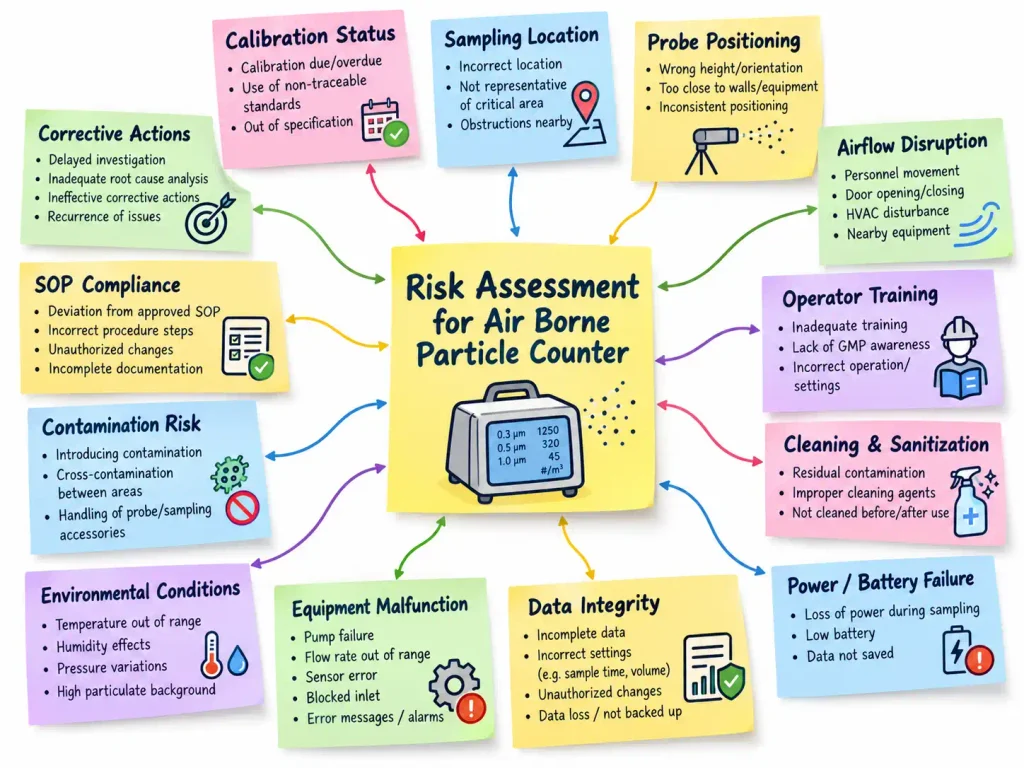
3. Brainstorming Analysis for Risk Assessment of Airborne Particle Counter:
The brainstorming diagram identifies potential risks associated with airborne particle counter operation in pharmaceutical cleanrooms. Key risk areas include calibration failures, incorrect sampling locations, improper probe positioning, airflow disturbances, inadequate operator training, equipment malfunction, and power failures. Additional concerns involve contamination, cleaning deficiencies, environmental variations, SOP noncompliance, and data integrity issues. Brainstorming helps identify possible failure modes and their impact on environmental monitoring accuracy and GMP compliance. Recommended preventive measures include regular calibration, personnel training, equipment maintenance, validated sampling procedures, effective cleaning, and proper documentation. This systematic approach supports risk identification, prioritization, contamination prevention, and continuous improvement in cleanroom monitoring.
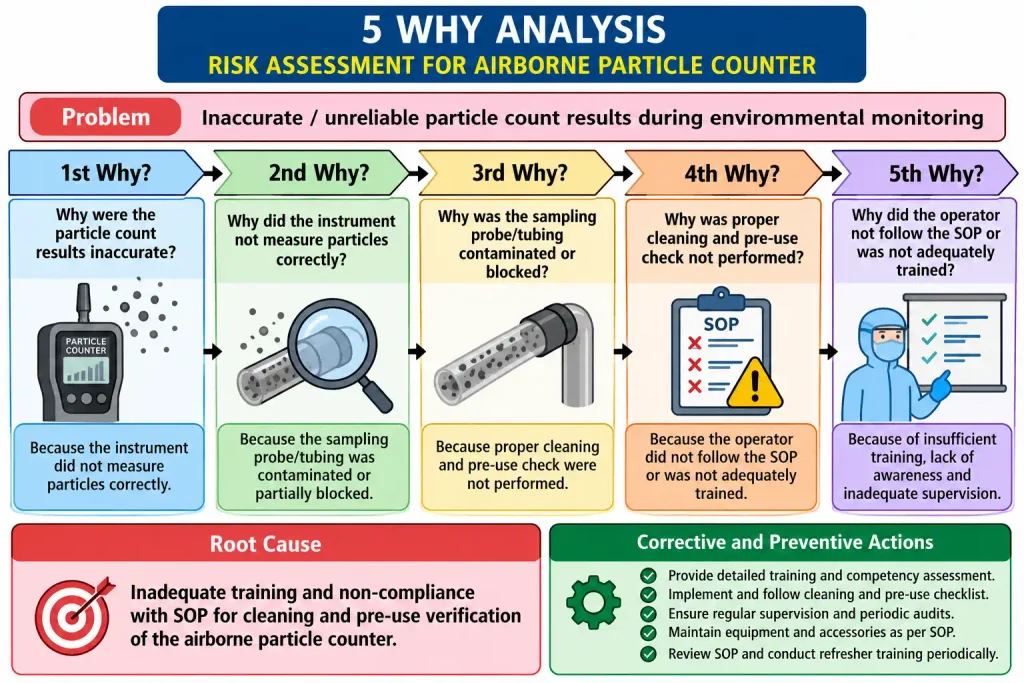
4. 5 Why Analysis for Risk Assessment of Airborne Particle Counter:
The 5 Why Analysis identifies the underlying causes of inaccurate or unreliable airborne particle counter results during pharmaceutical cleanroom environmental monitoring. The investigation begins with incorrect particle measurements and progressively examines contaminated or blocked sampling probes, inadequate cleaning, missed pre-use checks, and noncompliance with approved SOPs. The analysis identifies insufficient operator training, poor awareness, and inadequate supervision as potential root causes. Recommended corrective and preventive actions include competency-based training, standardized cleaning procedures, pre-use verification checklists, periodic equipment maintenance, SOP revisions, and regular compliance audits. These measures improve measurement accuracy, prevent recurring failures, and strengthen GMP compliance and contamination control.
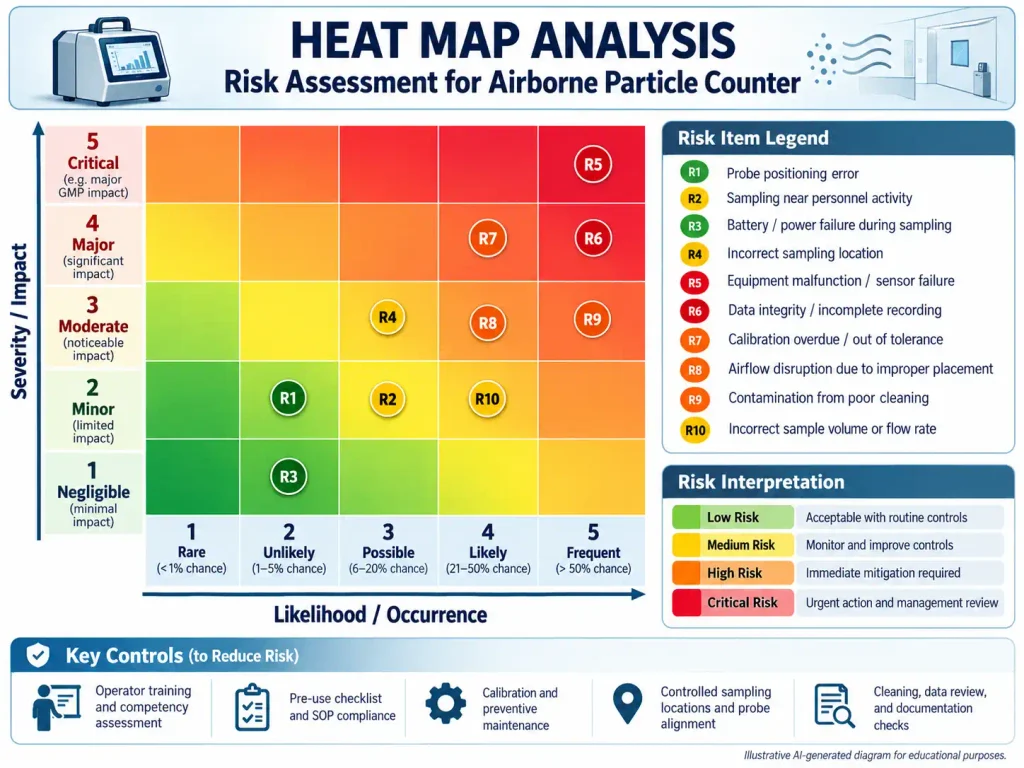
5. Heat Map Analysis for Risk Assessment of Airborne Particle Counter:
The Heat Map Analysis evaluates potential risks associated with airborne particle counter operation in pharmaceutical cleanrooms based on severity and likelihood of occurrence. Risks are classified into low, medium, high, and critical categories using color-coded indicators. Major concerns include equipment malfunction, calibration failures, incorrect sampling locations, airflow disturbances, contamination, power failures, and data integrity issues. Critical risks require immediate corrective actions, while moderate risks need continuous monitoring and preventive controls. Recommended measures include regular calibration, personnel training, equipment maintenance, validated sampling procedures, cleaning verification, and documentation reviews. This approach supports effective risk prioritization, GMP compliance, and reliable environmental monitoring.
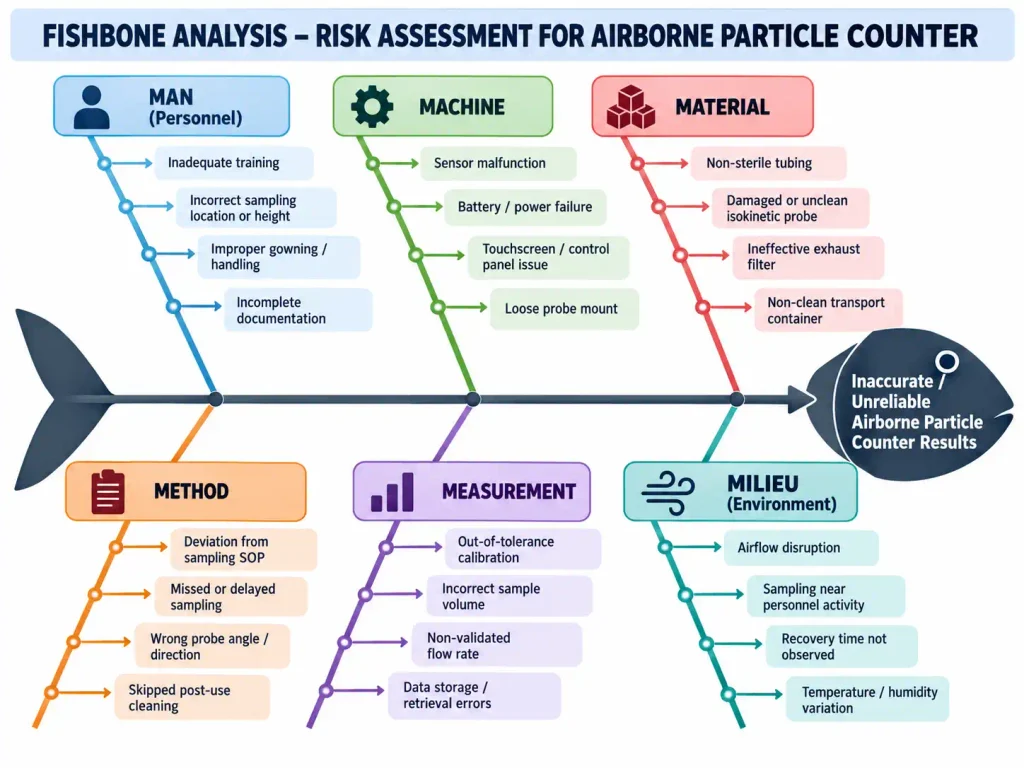
6. Fishbone Analysis for Risk Assessment of Airborne Particle Counter:
The Fishbone Analysis identifies potential causes of inaccurate or unreliable airborne particle counter results in pharmaceutical cleanrooms using the 6M methodology: Man, Machine, Material, Method, Measurement, and Milieu. Key risks include inadequate operator training, equipment malfunction, contaminated sampling probes, incorrect sampling procedures, calibration failures, and environmental disturbances. The diagram systematically categorizes these factors to identify possible root causes affecting particle counting accuracy and GMP compliance. Recommended preventive measures include personnel training, equipment qualification, routine calibration, validated sampling procedures, proper cleaning, and environmental controls. This structured approach supports effective risk mitigation, reliable monitoring, contamination prevention, and continuous quality improvement.
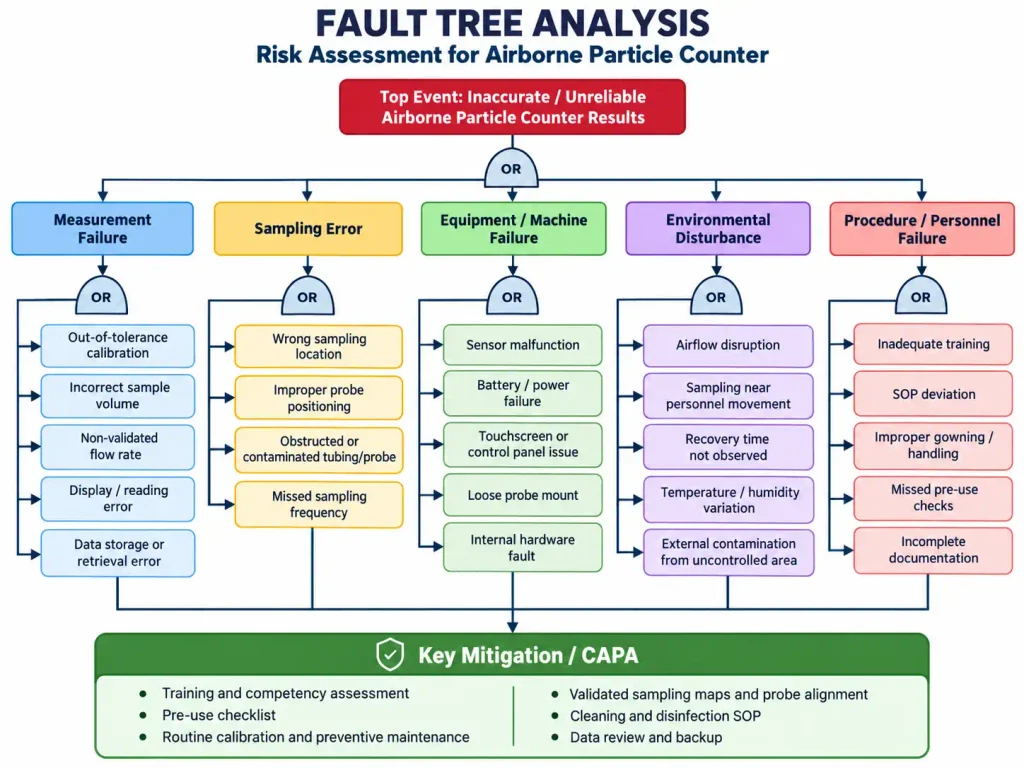
7. Fault Tree Analysis for Risk Assessment of Airborne Particle Counter:
Fault Tree Analysis (FTA) systematically identifies potential causes of inaccurate or unreliable airborne particle counter results during pharmaceutical cleanroom environmental monitoring. The analysis begins with the top failure event and examines five major categories: measurement failure, sampling errors, equipment malfunction, environmental disturbances, and personnel-related failures. Contributing factors include calibration deviations, incorrect sampling locations, contaminated probes, power failures, airflow disturbances, inadequate training, and SOP noncompliance. Logical OR gates illustrate how individual failures may contribute to unreliable results. Recommended preventive measures include routine calibration, equipment maintenance, operator training, validated sampling procedures, cleaning verification, and data integrity controls to strengthen GMP compliance.
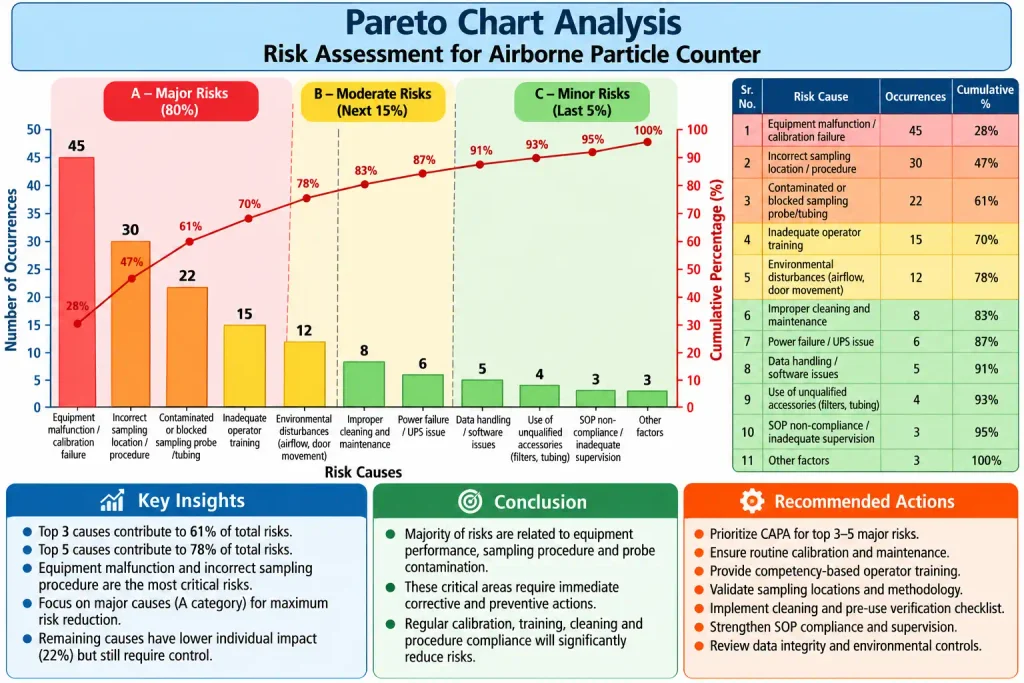
8. Pareto Chart Analysis for Risk Assessment of Airborne Particle Counter:
The Pareto Chart Analysis identifies and prioritizes major risk factors affecting airborne particle counter performance in pharmaceutical cleanrooms. Key concerns include equipment malfunction, calibration failures, incorrect sampling locations, contaminated probes, inadequate operator training, and environmental disturbances. The chart applies the Pareto principle to highlight significant contributors requiring corrective and preventive actions. Cumulative percentages illustrate the relative contribution of identified failure categories. Recommended controls include routine calibration, preventive maintenance, operator training, validated sampling procedures, cleaning verification, and SOP compliance. This systematic approach supports effective risk prioritization, resource allocation, contamination prevention, reliable environmental monitoring, and continuous improvement in GMP compliance.
9. Corrective Action and Preventive Action (CAPA) with Effectiveness Review for Risk Assessment of Airborne Particle Counter:
1. Introduction
Corrective and Preventive Action (CAPA) for the Airborne Particle Counter aims to identify, investigate, correct, and prevent potential failures affecting particle counting accuracy, environmental monitoring reliability, contamination control, and GMP compliance.
Based on the 6M FMEA risk assessment, major concerns include equipment malfunction, improper probe positioning, power failure, incorrect sampling procedures, calibration failures, operator errors, and data integrity issues. CAPA implementation should be documented, verified by Quality Assurance (QA), and evaluated for effectiveness before formal closure.
2. Corrective Action and Preventive Action Plan
| No. | Identified Risk | Corrective Action | Preventive Action |
|---|---|---|---|
| 1 | Incorrect particle counting | Stop affected monitoring, inspect instrument, verify calibration and assess impacted results. | Establish calibration schedules, pre-use checks and periodic performance verification. |
| 2 | Improper sampling location | Review sampling locations and assess validity of collected results. | Implement approved sampling maps with defined location, height and probe orientation. |
| 3 | Damaged or contaminated sampling probe | Clean or replace affected probe and inspect tubing for obstruction. | Introduce probe inspection, cleaning and controlled storage procedures. |
| 4 | Equipment malfunction | Remove defective equipment from service, investigate failure and repair or replace components. | Implement preventive maintenance, functional checks and critical spare-part controls. |
| 5 | Battery or power failure | Restore power, assess incomplete sampling records and repeat sampling where justified. | Establish battery health checks, charging procedures and backup arrangements. |
| 6 | Calibration failure | Quarantine affected equipment and investigate results since the last acceptable calibration. | Maintain calibration alerts, traceable standards and approved calibration procedures. |
| 7 | Inadequate personnel training | Retrain concerned personnel and verify operational competency. | Conduct initial and periodic refresher training with competency assessments. |
| 8 | Airflow disturbance | Investigate equipment positioning and activities affecting representative sampling. | Implement validated positioning maps and controls for personnel movement during sampling. |
| 9 | Incorrect sampling volume or flow rate | Verify instrument settings, flow performance and affected results. | Establish periodic flow verification, approved sampling settings and pre-use checklists. |
| 10 | Data integrity failure | Investigate missing or incorrect records, recover verified data where possible and document impact. | Implement controlled electronic records, access restrictions, audit trail review and secure backups. |
| 11 | Inadequate cleaning | Clean equipment and accessories using approved procedures and assess contamination impact. | Implement cleaning SOPs, cleaning records and periodic compliance inspections. |
| 12 | SOP noncompliance | Investigate deviations, correct practices and evaluate affected environmental monitoring data. | Revise SOPs, improve supervision and conduct periodic procedural compliance audits. |
3. CAPA Implementation and Monitoring Plan
Proposed timelines for implementation; actual dates should be approved based on risk, investigation findings and site procedures.
| CAPA Activity | Responsibility | Target Timeline | Verification |
|---|---|---|---|
| Investigation and root cause analysis | Microbiology / QA | Within 7 days | Approved investigation report |
| Calibration and functional verification | Engineering / Microbiology | Before release for use | Calibration and verification records |
| Sampling procedure revision | Microbiology / QA | Within 15 days | Approved revised SOP |
| Training and competency assessment | Microbiology / QA | Within 30 days | Training and evaluation records |
| Cleaning and probe inspection controls | Microbiology | Within 15 days | Cleaning and inspection logs |
| Preventive maintenance implementation | Engineering | Within 30 days | Approved PM schedule and records |
| Data integrity control verification | Microbiology / QA / IT | Within 30 days | Data review and backup verification |
| CAPA effectiveness verification | QA / Microbiology | 30, 60 and 90 days after implementation | Effectiveness review report |
4. Effectiveness Review of CAPA
Proposed Effectiveness Monitoring Period: 90 Days After CAPA Implementation
The effectiveness of implemented corrective and preventive actions shall be evaluated over a 90-day monitoring period to confirm sustained equipment performance, compliance with approved SOPs, accurate particle counting, and reliable environmental monitoring results.
Day 30
Initial Effectiveness Review
Verify operator training, completion of pre-use checklists, calibration status, equipment performance and implementation of revised sampling procedures.
Day 60
Intermediate Effectiveness Review
Review deviations, equipment failures, probe inspections, sampling practices, maintenance records and completeness of environmental monitoring data.
Day 90
Final Effectiveness Review
Evaluate recurring failures, sampling reliability, procedural compliance, data integrity, residual FMEA risks and CAPA effectiveness before QA approval.
5. CAPA Effectiveness Acceptance Criteria
| Evaluation Parameter | Proposed Acceptance Criteria |
|---|---|
| Calibration compliance | 100% of instruments within valid calibration status during use |
| Personnel qualification | 100% of authorized operators trained and assessed as competent |
| Sampling SOP compliance | 100% compliance for reviewed critical sampling requirements |
| Equipment performance | No recurrence of the targeted equipment failure |
| Sampling accuracy | Required flow rate, sampling volume and applicable performance checks within approved limits |
| Cleaning compliance | 100% completion of required cleaning and inspection records |
| Data integrity | No unresolved critical data integrity deficiencies |
| Repeat deviations | No recurrence of the same root-cause-related deviation during monitoring |
| CAPA documentation | All CAPA actions completed and verified |
| Residual risk | Reduced to an acceptable level according to approved FMEA criteria |
6. Effectiveness Review Report – Proposed Format
CAPA Effectiveness Verification Checklist
Tick each item only after verification against documented evidence.Calibration and functional checks satisfactorySampling SOP compliance verifiedAll operators trained and qualifiedCleaning and probe inspection records completeData integrity controls verifiedNo recurrence of targeted failureResidual risk within approved limits.
7. CAPA Closure and Final Conclusion
The CAPA may be considered effective when documented verification confirms that identified root causes have been adequately addressed, corrective and preventive measures have been implemented, and no related recurring failures have been observed during the approved monitoring period. Reassessment of FMEA severity, occurrence, detection and residual risk shall be performed as applicable.
If the acceptance criteria are not met, the investigation shall be reopened or extended, additional actions shall be implemented, and a new effectiveness monitoring period shall be established based on risk.
Final CAPA closure must be approved by Quality Assurance after satisfactory effectiveness verification. The 90-day period and acceptance criteria above are proposed controls, not evidence that CAPA effectiveness has already been demonstrated.
10. Questions and Answers on Risk Assessment for Airborne Particle Counter:
Q1. What is an Airborne Particle Counter?
Answer: An Airborne Particle Counter is an analytical instrument used to detect, measure, and count airborne particles in controlled environments. It is essential for pharmaceutical cleanroom classification, environmental monitoring, and contamination control.
Q2. What is the purpose of conducting a Risk Assessment for an Airborne Particle Counter?
Answer: The purpose is to identify, evaluate, and control potential risks associated with equipment operation, calibration, sampling accuracy, contamination, data integrity, and environmental monitoring to ensure reliable results and GMP compliance.
Q3. What methodology is used for Risk Assessment of an Airborne Particle Counter?
Answer: Failure Mode and Effects Analysis (FMEA) is used with the 6M methodology: Man, Machine, Material, Method, Measurement, and Milieu (Environment). Potential failures are evaluated based on severity, occurrence, and detectability.
Q4. What are the major risks associated with an Airborne Particle Counter?
Answer: Major risks include incorrect sampling locations, improper probe positioning, equipment malfunction, sensor failure, calibration deviations, contaminated sampling tubing, power interruptions, airflow disturbances, and incomplete data recording.
Q5. What is the working principle of an Airborne Particle Counter?
Answer: Most airborne particle counters operate using laser light scattering technology. Airborne particles passing through a laser beam scatter light, which is detected and processed to determine particle size and concentration.
Q6. What is the importance of calibration?
Answer: Calibration ensures the instrument provides accurate and reliable measurements. Incorrect or overdue calibration may produce misleading results, potentially affecting cleanroom classification, environmental monitoring decisions, and regulatory compliance.
Q7. What are the risks associated with incorrect sampling locations?
Answer: Incorrect sampling locations may produce nonrepresentative particle counts, resulting in inaccurate cleanroom classification or failure to identify contamination in critical areas. Approved sampling maps and defined sampling positions help minimize this risk.
Q8. Why is probe positioning important during particle monitoring?
Answer: Proper probe positioning ensures representative air sampling. Incorrect probe angle, height, orientation, or distance from airflow may cause biased readings and reduce the reliability of environmental monitoring results.
Q9. What is the impact of equipment malfunction?
Answer: Equipment malfunction may cause inaccurate particle counts, sampling interruption, data loss, or unreliable environmental monitoring. Preventive maintenance, functional checks, calibration, and timely replacement of defective components help control these risks.
Q10. What are the risks associated with sampling tubing and accessories?
Answer: Damaged, contaminated, blocked, or unsuitable sampling tubing and probes may introduce contamination or interfere with particle detection. Cleanroom-compatible accessories, proper inspection, cleaning, and controlled storage are necessary.
Q11. How does personnel movement affect airborne particle monitoring?
Answer: Personnel movement may generate airborne particles and disturb airflow, affecting measured particle concentrations. Monitoring conditions should be defined in approved procedures to ensure results are representative of the intended operational state.
Q12. What is the significance of Risk Priority Number (RPN)?
Answer: The Risk Priority Number helps prioritize identified failure modes based on three factors:
\[ RPN = Severity\ (S) \times Occurrence\ (O) \times Detection\ (D) \]
Higher RPN values generally indicate greater priority for risk evaluation and mitigation. Critical severity must also be considered independently.
Q13. What is the role of SOPs in airborne particle monitoring?
Answer: Approved Standard Operating Procedures define equipment operation, sampling locations, sampling volume, probe positioning, calibration verification, cleaning, documentation, and reporting requirements. SOP compliance helps minimize operational errors and maintain consistent monitoring practices.
Q14. What corrective actions should be taken when inaccurate particle counts are observed?
Answer: The affected results should be assessed, and potential causes such as equipment malfunction, calibration failure, incorrect sampling parameters, contaminated tubing, or environmental disturbances should be investigated. Corrective actions must be documented, and repeat sampling performed when scientifically justified.
Q15. What preventive actions reduce airborne particle counter failures?
Answer: Preventive actions include routine calibration, preventive maintenance, operator training, competency assessment, equipment pre-use checks, approved sampling procedures, probe inspection, cleaning verification, and secure data management.
Q16. What are the major data integrity risks?
Answer: Major risks include incomplete records, incorrect data entries, loss of electronic records, improper data retrieval, and unauthorized changes. Controlled access, reliable backups, proper documentation, and periodic data review help protect data integrity.
Q17. How are environmental factors considered during risk assessment?
Answer: Environmental factors include airflow disturbances, personnel activity, temperature and humidity variations, vibrations, and contamination introduced from uncontrolled areas. These conditions can influence equipment performance or the representativeness of collected samples.
Q18. What is the purpose of CAPA in Airborne Particle Counter Risk Assessment?
Answer: Corrective and Preventive Action (CAPA) addresses identified failures and their root causes. It helps prevent recurrence through procedural improvements, equipment maintenance, personnel training, calibration controls, and documented effectiveness verification.
Q19. How is CAPA effectiveness evaluated?
Answer: CAPA effectiveness is evaluated by reviewing equipment performance, calibration status, sampling records, operator competency, deviations, and recurrence of identified failures. A proposed monitoring period of 90 days, with reviews at 30, 60, and 90 days, may be adopted based on risk and approved procedures.
Q20. Which regulatory guidelines are relevant to Airborne Particle Counter Risk Assessment?
Answer: Relevant references include:
- ISO 14644-1 – Classification of air cleanliness by particle concentration.
- ISO 14644-2 – Monitoring to provide evidence of cleanroom performance.
- ISO 21501-4 – Calibration requirements for light scattering airborne particle counters.
- ICH Q9(R1) – Quality Risk Management.
- EU GMP Annex 1 – Manufacture of Sterile Medicinal Products.
- Applicable FDA guidance on aseptic processing and contamination control.
Q21. What actions should be taken if the Airborne Particle Counter fails calibration?
Answer: The instrument should be removed from service, labelled appropriately, and subjected to investigation. Previously generated monitoring results should be evaluated for possible impact, considering the nature of the failure and the last acceptable calibration. Equipment should only return to service after satisfactory corrective actions and verification.
Q22. Why is a pre-use checklist necessary?
Answer: A pre-use checklist confirms calibration validity, battery condition, equipment cleanliness, probe condition, sampling parameters, and instrument functionality. It helps detect potential failures before monitoring begins.
Q23. What is the importance of cleaning the Airborne Particle Counter?
Answer: Cleaning minimizes contamination transfer between controlled areas and prevents residues or particulate contamination from affecting the instrument and its accessories. Cleaning must follow approved procedures using suitable materials.
Q24. What is the overall conclusion of the risk assessment?
Answer: The risk assessment identifies potential failures involving personnel, equipment, materials, methods, measurements, and environmental conditions. Implementation of appropriate risk controls, qualification, calibration, training, preventive maintenance, and SOP compliance helps reduce identified risks to acceptable levels and supports reliable airborne particle monitoring.
Conclusion: A properly implemented risk assessment and CAPA system strengthen contamination control, environmental monitoring reliability, data integrity, and GMP compliance in pharmaceutical cleanrooms.
11. Reference Guidelines for Risk Assessment of Airborne Particle Counter:
The following international regulatory guidelines and standards are relevant to the qualification, calibration, operation, environmental monitoring, contamination control, and risk assessment of airborne particle counters used in pharmaceutical cleanrooms.
| S. No. | Reference Guideline | Relevance to Risk Assessment |
|---|---|---|
| 1 | ICH Q9(R1) – Quality Risk Management | Provides principles for identifying, evaluating, controlling, communicating, and reviewing quality risks using tools such as FMEA and Fault Tree Analysis. |
| 2 | ISO 14644-1:2015 – Cleanrooms and Associated Controlled Environments, Part 1 | Specifies classification of air cleanliness by airborne particle concentration, including sampling requirements. |
| 3 | ISO 14644-2:2015 – Monitoring to Provide Evidence of Cleanroom Performance | Provides requirements for monitoring cleanrooms to demonstrate continued performance with respect to airborne particle cleanliness. |
| 4 | ISO 21501-4:2018 – Light Scattering Airborne Particle Counter | Specifies calibration and verification requirements for light-scattering airborne particle counters. |
| 5 | EU GMP Annex 1 (2022) – Manufacture of Sterile Medicinal Products | Provides requirements for cleanroom classification, environmental monitoring, contamination control strategies, and particle monitoring in sterile manufacturing. |
| 6 | FDA Guidance (2004) – Sterile Drug Products Produced by Aseptic Processing: Current Good Manufacturing Practice | Provides recommendations for cleanroom environmental control, particulate monitoring, and aseptic processing operations. |
| 7 | EU GMP Annex 15 – Qualification and Validation | Provides principles for qualification, validation, and lifecycle control of equipment and systems. |
| 8 | 21 CFR Part 211 – Current Good Manufacturing Practice for Finished Pharmaceuticals | Establishes GMP requirements relating to equipment, laboratory controls, written procedures, records, and quality oversight. |
| 9 | 21 CFR Part 11 – Electronic Records; Electronic Signatures | Relevant where electronic particle monitoring records and electronic signatures fall within its scope. |
| 10 | ICH Q10 – Pharmaceutical Quality System | Provides a framework for CAPA, change management, management review, and continual improvement. |