







1. Brief Description:
This document describes the risk assessment of a vertical autoclave used in the Quality Control microbiology laboratory. The autoclave sterilizes media, glassware, instruments, and biological waste using saturated steam under pressure, usually at 121°C and 15 psi. The assessment follows the 6M approach: Man, Machine, Method, Material, Measurement, and Milieu. It identifies risks such as incorrect loading, wrong cycle selection, insufficient water, faulty sensors, steam leakage, early door opening, unsuitable materials, power failure, poor ventilation, and incomplete records. These failures may result in ineffective sterilization, burns, contamination, equipment damage, explosion, or GMP non-compliance. Important control measures include approved SOPs, trained operators, suitable PPE, proper loading, calibrated sensors, preventive maintenance, safety interlocks, alarms, biological and chemical indicators, good-quality water, and complete cycle records. Regular qualification, validation, audits, and emergency procedures help ensure safe operation, reliable sterilization, product protection, personnel safety, and regulatory compliance.
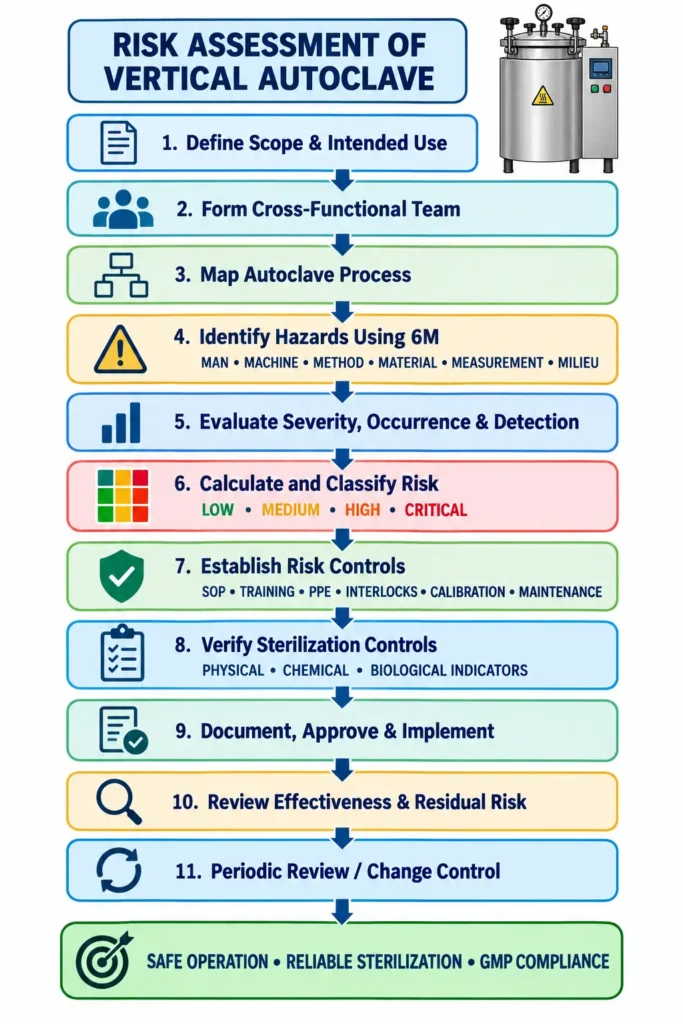
Skip to PDF content2. Flow Diagram:
The flow diagram explains the complete risk assessment process for a vertical autoclave used in the Quality Control microbiology laboratory. The process begins by defining the autoclave’s scope and intended use. A cross-functional team is then formed to study each stage of operation. The complete autoclave process is mapped, and possible hazards are identified using the 6M approach: Man, Machine, Method, Material, Measurement, and Milieu. Each identified hazard is evaluated for severity, occurrence, and detection. Based on this evaluation, the risk is classified as low, medium, high, or critical. Suitable controls are established through SOPs, training, PPE, safety interlocks, calibration, and preventive maintenance. Sterilization controls are verified using physical parameters and chemical and biological indicators. All findings and actions are properly documented, approved, and implemented. Finally, the effectiveness of controls and residual risks are reviewed periodically through audits and change control to ensure safe operation, reliable sterilization, and continuous GMP compliance.
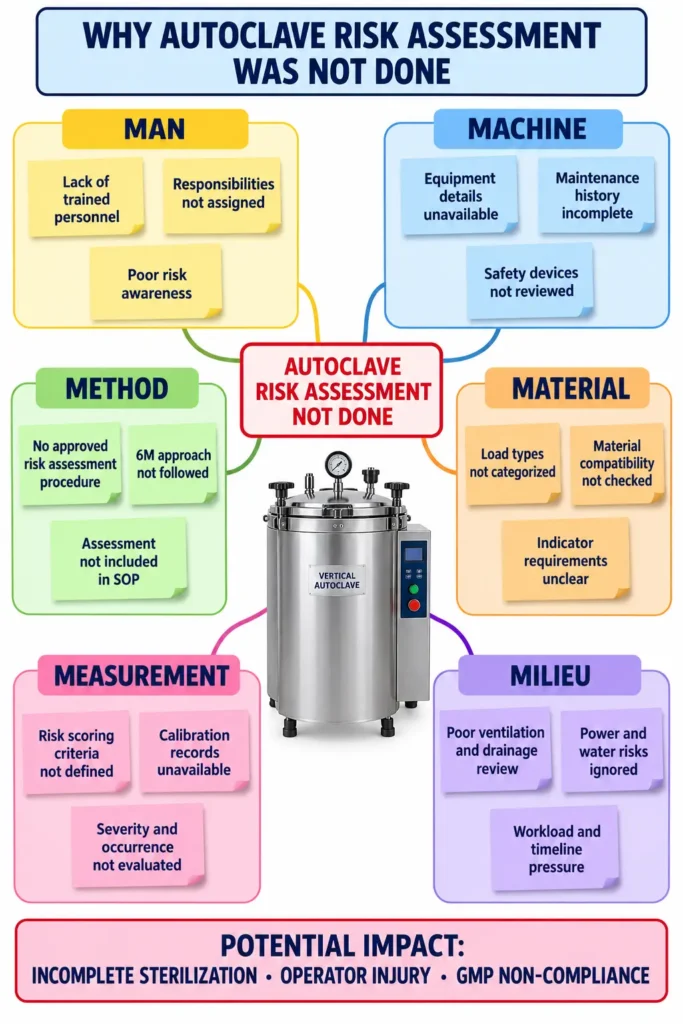
3. Brainstorming:
The brainstorming diagram explains possible reasons why the risk assessment for the vertical autoclave was not completed. It groups the causes under six areas: Man, Machine, Method, Material, Measurement, and Milieu. Under Man, the main concerns are insufficient training, unclear responsibilities, and poor risk awareness. Machine-related causes include unavailable equipment details, incomplete maintenance history, and unreviewed safety devices. Method issues include the absence of an approved risk assessment procedure and failure to use the 6M approach. Material concerns include unknown load categories, compatibility, and indicator requirements. Measurement problems include undefined scoring criteria, missing calibration records, and failure to evaluate severity and occurrence. Milieu factors include poor ventilation, drainage, power, water, workload, and timeline pressure. These combined gaps can cause incomplete sterilization, operator injury, equipment failure, contamination, weak documentation, and GMP non-compliance. The brainstorming helps identify root causes and supports suitable corrective and preventive actions before autoclave operation continues safely.
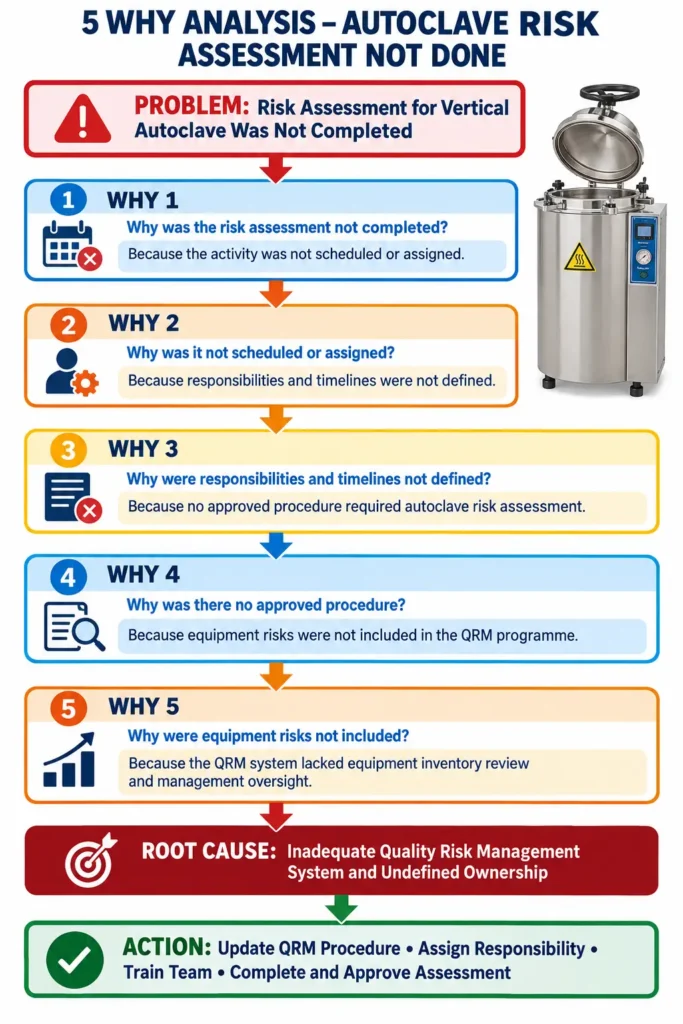
4. 5 Why Analysis:
The 5 Why analysis explains why the risk assessment for the vertical autoclave was not completed. The first reason was that the activity was neither scheduled nor assigned. This happened because responsibilities and completion timelines were not clearly defined. These details were missing because no approved procedure specifically required an autoclave risk assessment. The procedure did not contain this requirement because equipment risks were not included in the Quality Risk Management programme. Finally, equipment risks were overlooked because the QRM system lacked periodic equipment inventory review and effective management oversight. Therefore, the main root cause was an inadequate QRM system combined with undefined ownership. Required actions include updating the QRM procedure, listing all critical equipment, assigning responsible persons, setting timelines, training the assessment team, and obtaining QA approval. Completing these actions will improve hazard identification, operator safety, sterilization reliability, documentation, accountability, and continued GMP compliance in the microbiology laboratory operations.
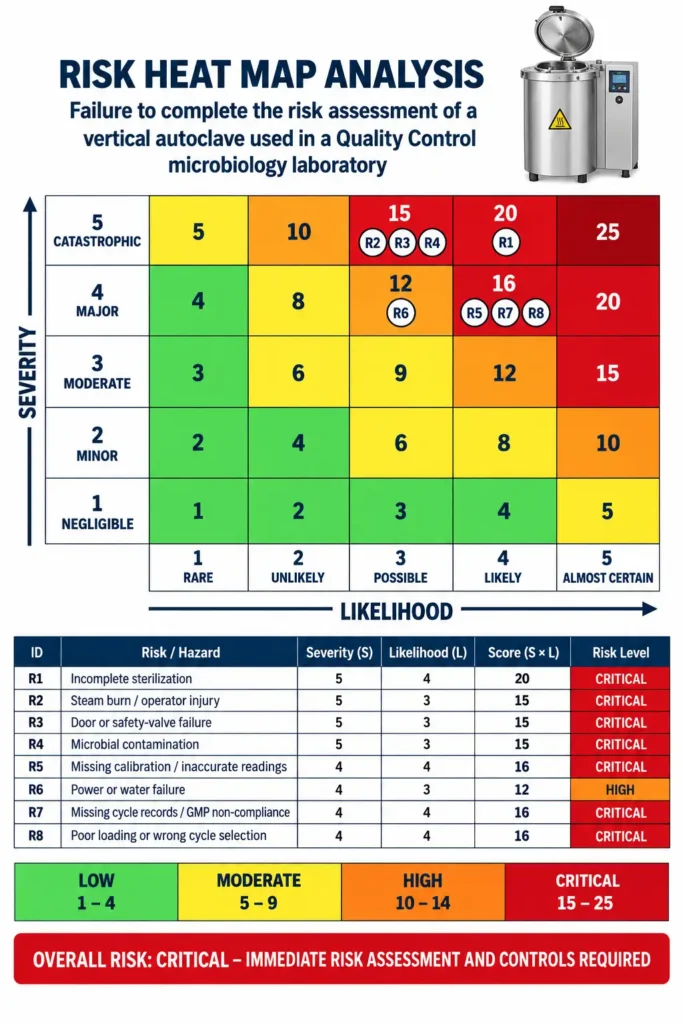
5. Heat Map Analysis:
The heat map analysis shows the risk level created when the vertical autoclave risk assessment is not completed. Each hazard is evaluated using severity and likelihood. The two values are multiplied to calculate the risk score. Green represents low risk, yellow represents moderate risk, orange represents high risk, and red represents critical risk. Incomplete sterilization receives the highest identified score of 20 because it may allow microorganisms to survive. Steam burns, safety-device failure, and microbial contamination receive critical scores of 15. Missing calibration, inaccurate readings, incomplete cycle records, improper loading, and wrong cycle selection receive critical scores of 16. Power or water failure receives a high-risk score of 12. The results show that most identified hazards are critical and require immediate action. The organization should complete the assessment, introduce suitable controls, assign responsibilities, train operators, verify calibration, review safety devices, and maintain proper records before routine autoclave operation continues.
6. Fault Tree Analysis:
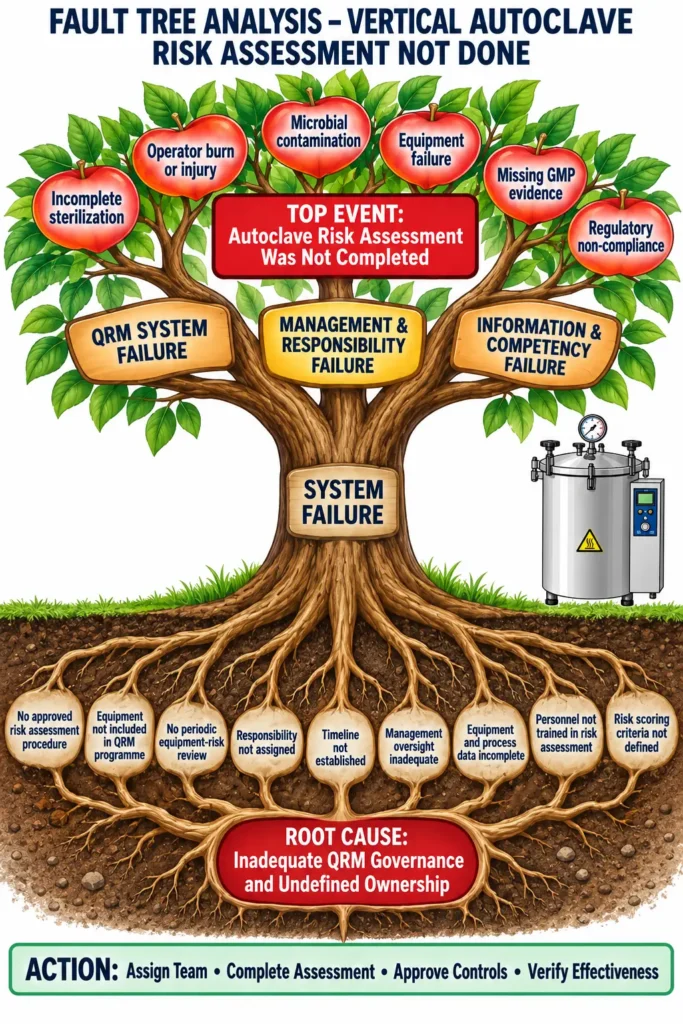
The Fault Tree Analysis diagram explains why the risk assessment for the vertical autoclave was not completed. The tree format makes the relationship between causes, system failures, and consequences easy to understand. The underground roots represent basic causes, including the absence of an approved procedure, undefined responsibility, missing timelines, inadequate management oversight, incomplete equipment information, insufficient training, and undefined risk scoring criteria. These weaknesses combine in the trunk as an overall system failure. The main branches show failures in the QRM system, management and responsibility, and information and competency. The fruits show possible outcomes such as incomplete sterilization, microbial contamination, operator injury, equipment failure, missing GMP evidence, and regulatory non-compliance. The deepest root identifies inadequate QRM governance and undefined ownership as the main root cause. Required actions include assigning a team, completing the assessment, approving risk controls, training personnel, reviewing effectiveness, and maintaining periodic oversight for safe autoclave operation consistently.
7. Pareto Chart Analysis:
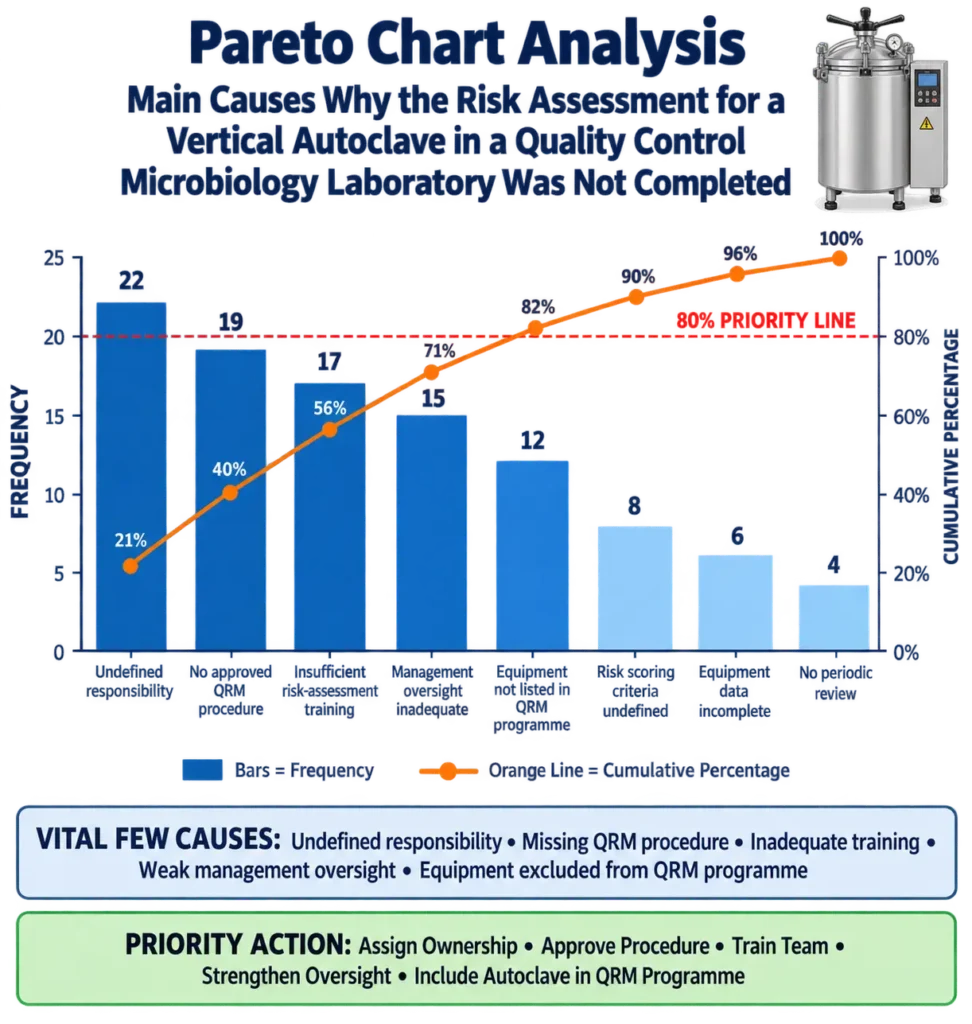
The Pareto chart identifies and ranks the main reasons why the risk assessment for the vertical autoclave was not completed. The blue bars show the frequency of each cause, while the orange line shows the cumulative percentage. Undefined responsibility is the leading cause, followed by the absence of an approved QRM procedure, insufficient risk-assessment training, inadequate management oversight, and failure to include the autoclave in the QRM programme. Together, these five causes account for approximately 82% of the identified problem. Therefore, they are considered the “vital few” causes requiring immediate attention. Other causes include undefined risk-scoring criteria, incomplete equipment data, and the absence of periodic review. The analysis helps management focus resources on the most important weaknesses first. Priority actions should include assigning ownership, approving the risk-assessment procedure, training the team, strengthening management oversight, adding the autoclave to the QRM programme, and monitoring completion through defined timelines and regular effectiveness reviews.
8. Corrective Action, Preventive Action and Effectiveness Review:
Issue: Risk assessment for the vertical autoclave used in the Quality Control microbiology laboratory was not completed.
Immediate Correction
- Suspend any unapproved load type or cycle until its risks are evaluated.
- Review the autoclave’s qualification, calibration, maintenance and cycle records.
- Verify door interlock, safety valve, alarms, temperature sensor and pressure gauge.
- Confirm sterilization effectiveness using physical, chemical and biological indicators.
- Report any failed or doubtful cycle through the deviation system.
- Quarantine materials processed through an unacceptable cycle, where applicable.
Corrective Actions
| No. | Corrective action | Responsibility | Target timeline | Evidence |
|---|---|---|---|---|
| 1 | Open and investigate the deviation for the missing risk assessment | QC and QA | 2 working days | Approved deviation |
| 2 | Form a cross-functional team involving QA, QC Microbiology, Engineering and EHS | QA Head | 3 working days | Team nomination record |
| 3 | Prepare a 6M/FMEA-based autoclave risk assessment | QA and QC Microbiology | 10 working days | Approved assessment |
| 4 | Evaluate risks related to loading, cycle selection, pressure, temperature, door opening and unloading | Assessment team | 10 working days | Risk register |
| 5 | Assess existing qualification, calibration, preventive-maintenance and validation status | Engineering and QA | 7 working days | Review checklist |
| 6 | Define controls and reduce all unacceptable risks | Department heads | 15 working days | Revised risk scores |
| 7 | Train all operators on the assessment and revised controls | QC Microbiology | Before operation | Training records |
Preventive Actions
- Revise the QRM procedure to cover all critical laboratory equipment.
- Maintain a controlled equipment-risk-assessment inventory.
- Assign an owner and due date for every assessment.
- Link risk assessment with equipment qualification, change control and periodic review.
- Introduce automatic reminders and monthly QA tracking.
- Review risk assessments annually and after modifications, breakdowns, deviations or cycle changes.
- Include compliance checks in internal audits and management review meetings.
Effectiveness Review
Effectiveness should be reviewed after 90 days or after three consecutive sterilization cycles, whichever is later.
Acceptance criteria:
- Approved autoclave risk assessment is available.
- All high and critical risks are reduced to acceptable levels or formally justified.
- All relevant personnel are trained, with 100% completion.
- Three consecutive cycles meet approved physical, chemical and biological requirements.
- No unauthorized load or incorrect cycle selection is observed.
- Calibration, maintenance and qualification records remain current.
- No repeat deviation, alarm neglect, premature door opening or incomplete record is identified.
- Internal audit confirms full implementation of revised controls.
Conclusion: CAPA may be closed only when QA verifies objective evidence and confirms that actions are effective, sustainable and free from recurrence.
9. Questions and Answers:
1. What is the purpose of an autoclave risk assessment?
It identifies hazards, evaluates risks and defines controls to ensure safe and effective sterilization.
2. Why is the vertical autoclave considered critical equipment?
It sterilizes microbiological media, glassware, instruments and biological waste using pressurized saturated steam.
3. What may happen if the risk assessment is not performed?
It may lead to incomplete sterilization, microbial contamination, operator injury, equipment failure and GMP non-compliance.
4. Which risk-assessment method can be used?
A 6M-based FMEA may be used to evaluate Man, Machine, Method, Material, Measurement and Milieu.
5. Who should prepare the assessment?
A cross-functional team consisting of QA, QC Microbiology, Engineering, EHS and trained autoclave users.
6. Who should approve the assessment?
The authorized representatives of QC, Engineering, EHS and Quality Assurance should review and approve it.
7. What major hazards should be assessed?
Steam burns, overpressure, door failure, incorrect loading, wrong cycle selection, inadequate sterilization, power failure and contaminated waste exposure.
8. How is each risk evaluated?
Each hazard is scored for severity, occurrence and detection. These scores may be multiplied to calculate the Risk Priority Number.
9. What are the main risks related to personnel?
Poor training, incorrect operation, early door opening, failure to use PPE and inadequate response to alarms.
10. What machine-related risks should be reviewed?
Faulty sensors, damaged gaskets, failed door interlocks, blocked drains, defective safety valves and heater failure.
11. What material-related risks may occur?
Sealed containers, unsuitable plastics, cracked glassware, volatile chemicals and mixed or overloaded materials may create hazards.
12. Why must sealed containers not be autoclaved?
Pressure may build inside the container and cause leakage, rupture or explosion.
13. Why are loading patterns important?
Correct loading allows uniform steam circulation and prevents cold spots and incomplete sterilization.
14. Which sterilization parameters are critical?
Temperature, pressure, exposure time, steam quality and proper air removal are critical.
15. How is sterilization effectiveness verified?
It is verified through physical cycle records, chemical indicators and biological indicators, as applicable.
16. Why is calibration important?
Calibration confirms that temperature, pressure and time measurements are accurate and reliable.
17. What PPE should an operator use?
Heat-resistant gloves, laboratory coat, closed safety shoes and face protection should be used based on the assessed risk.
18. What should be done after a failed sterilization cycle?
Stop release, identify and quarantine the load, initiate a deviation, investigate the failure and repeat processing only after approval.
19. When should the risk assessment be reviewed?
It should be reviewed periodically and after equipment modification, relocation, breakdown, cycle change, deviation or regulatory update.
20. How can CAPA effectiveness be verified?
Verify approved documents, training completion, acceptable risk reduction, current calibration and maintenance, compliant consecutive cycles and absence of recurrence.
21. What is the major root cause when the assessment is not done?
The likely root cause is inadequate QRM governance combined with undefined responsibility and insufficient management oversight.
22. When can the CAPA be closed?
CAPA may be closed only after QA confirms implementation, verifies objective evidence and establishes that the issue has not repeated.
10. Reference Guidelines:
- ICH Q9(R1) – Quality Risk Management
Primary guideline for hazard identification, risk analysis, risk control, communication and periodic review.
ICH Q9(R1) Guideline - ICH Q10 – Pharmaceutical Quality System
Covers management responsibility, CAPA, change management, continual improvement and quality-system effectiveness.
ICH Q10 Guideline - ISO 17665:2024 – Moist Heat Sterilization
Specifies requirements for developing, validating and routinely controlling moist-heat sterilization processes.
ISO 17665:2024 - ISO 11138-1 – Biological Indicators: General Requirements
Provides requirements for biological indicators used to monitor sterilization processes.
ISO 11138-1 - ISO 11138-3 – Biological Indicators for Moist Heat
Provides specific requirements for biological indicators used in steam-sterilization cycles.
ISO 11138-3 - ISO 14971 – Application of Risk Management to Medical Devices
Although intended for medical devices, its structured hazard-analysis principles may support equipment risk assessment.
ISO 14971:2019 - EU GMP Annex 1 – Manufacture of Sterile Medicinal Products
Covers contamination-control strategy, sterilization, equipment qualification, monitoring and risk-based controls.
EU GMP Annex 1 - EU GMP Annex 15 – Qualification and Validation
Applicable to autoclave DQ, IQ, OQ, PQ, requalification and change-control requirements.
EU GMP Annex 15 - WHO GMP – Sterile Pharmaceutical Products
Provides expectations for sterilization processes, validation, monitoring, equipment controls and documentation.
WHO Technical Report Series - FDA – Sterile Drug Products Produced by Aseptic Processing
Provides guidance on sterilization validation, biological indicators, equipment controls and documentation.
FDA Aseptic Processing Guidance - USP General Chapter
<1229>– Sterilization of Compendial Articles
Provides scientific principles for sterilization-process selection, development, validation and control.
USP General Chapters - USP General Chapter
<55>– Biological Indicators
Covers biological-indicator selection, handling, incubation and interpretation for sterilization processes.
USP–NF - CDC – Steam Sterilization Guidance
Explains the principles of steam sterilization, including temperature, pressure, exposure time and monitoring.
CDC Steam Sterilization - Indian Drugs and Cosmetics Rules – Revised Schedule M
Applicable to pharmaceutical quality systems, equipment qualification, validation, risk management, documentation and maintenance in India.
CDSCO