







1. Introduction for Risk Assessment for BOD Incubator:
The Risk Assessment for BOD Incubator evaluates potential risks associated with the installation, operation, monitoring, and routine use of the incubator in a pharmaceutical microbiology laboratory. A BOD incubator provides a controlled low-temperature environment for microbial incubation and BOD-related testing. The assessment applies the 6M approach—Man, Machine, Material, Method, Measurement, and Milieu—along with FMEA and Risk Priority Number (RPN) to identify and prioritize failures. Major risks include power failure, temperature variation, improper operation, inadequate cleaning, data-recording errors, calibration issues, sample contamination, and environmental conditions. Appropriate SOPs, training, UPS backup, calibration, preventive maintenance, qualification, and continuous monitoring help keep identified risks controlled and acceptable.
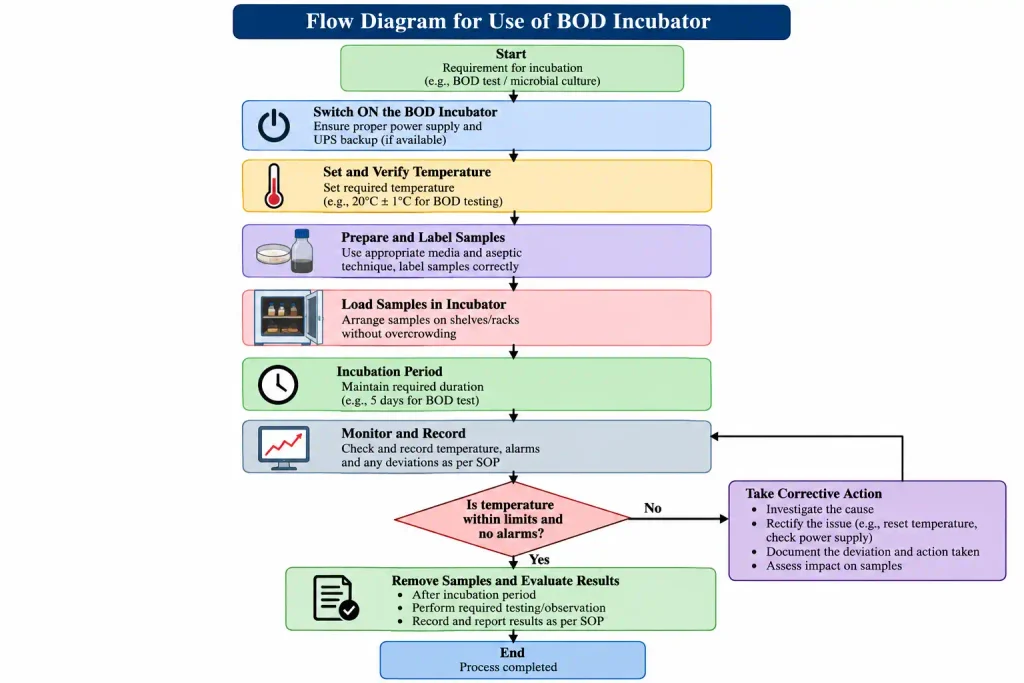
Skip to PDF content2. Flow Diagram – Risk Assessment for BOD Incubator:
The flow diagram describes the controlled sequence for operation and monitoring of a BOD Incubator in a microbiology laboratory. The process starts with identifying the incubation requirement, followed by switching on the incubator and ensuring proper power or UPS backup. The required temperature is then set and verified, after which properly prepared and labeled samples are loaded into the incubator. During incubation, temperature, alarms, and operating conditions are continuously monitored and recorded. Any deviation requires corrective action, investigation, documentation, and impact assessment. After successful completion of incubation, samples are removed, evaluated, and results are documented according to the applicable procedure.
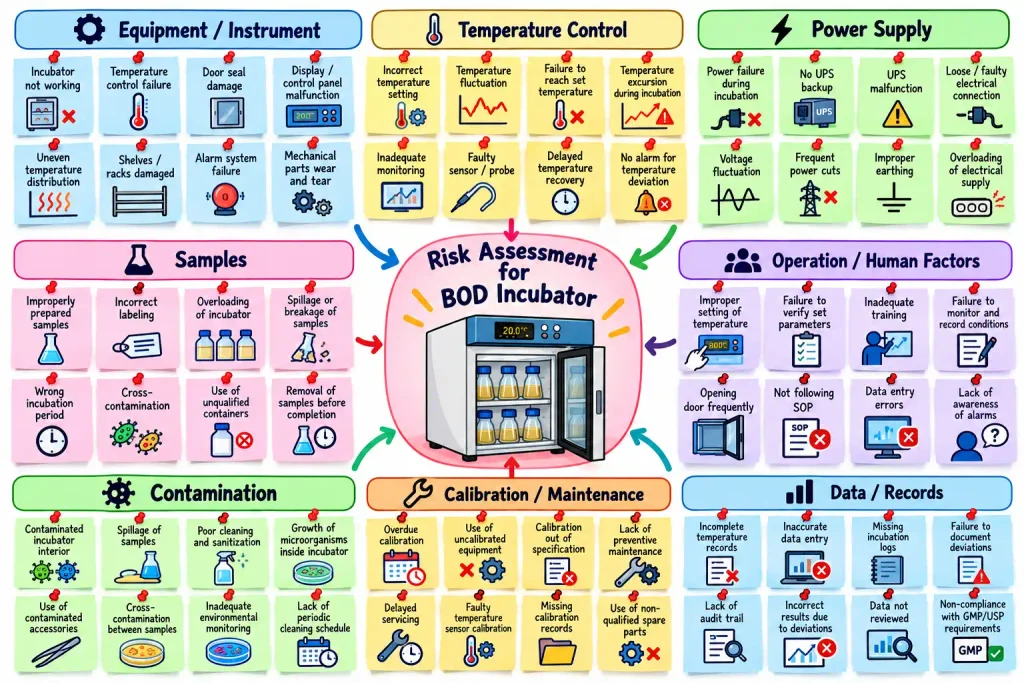
3. Brainstorming for Risk Assessment of BOD Incubator:
The brainstorming diagram identifies potential risks associated with the operation and monitoring of a BOD Incubator in a microbiology laboratory. Key risk areas include equipment malfunction, temperature control failure, power interruption, improper sample handling, operator errors, contamination, calibration deficiencies, maintenance issues, and incomplete documentation. Each category highlights possible failure scenarios such as temperature fluctuation, faulty sensors, UPS failure, incorrect labeling, cross-contamination, overdue calibration, and missing records. This structured brainstorming approach supports comprehensive risk identification, facilitates subsequent FMEA or risk-ranking activities, and helps define appropriate controls, CAPA, monitoring requirements, and preventive measures to ensure reliable incubation conditions and accurate microbiological results.
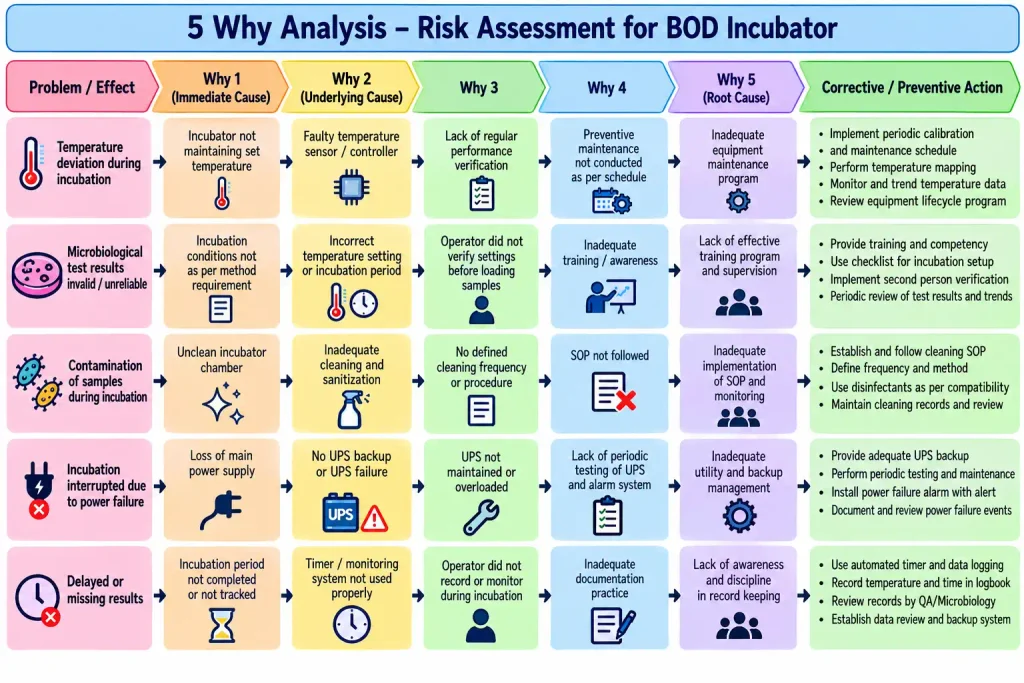
4. 5 Why Analysis for Risk Assessment of BOD Incubator:
The 5 Why Analysis diagram systematically identifies potential root causes of major risks associated with BOD Incubator operation. Key problems evaluated include temperature deviation, unreliable microbiological results, sample contamination, power failure, and delayed or missing results. Each issue is traced through successive causes such as faulty sensors, incorrect settings, inadequate cleaning, insufficient UPS backup, poor documentation, lack of training, and ineffective preventive maintenance. The analysis helps identify underlying system weaknesses rather than only immediate failures. Recommended actions include periodic calibration, temperature mapping, SOP compliance, operator training, preventive maintenance, UPS verification, cleaning controls, data review, and proper documentation to improve reliability and compliance.
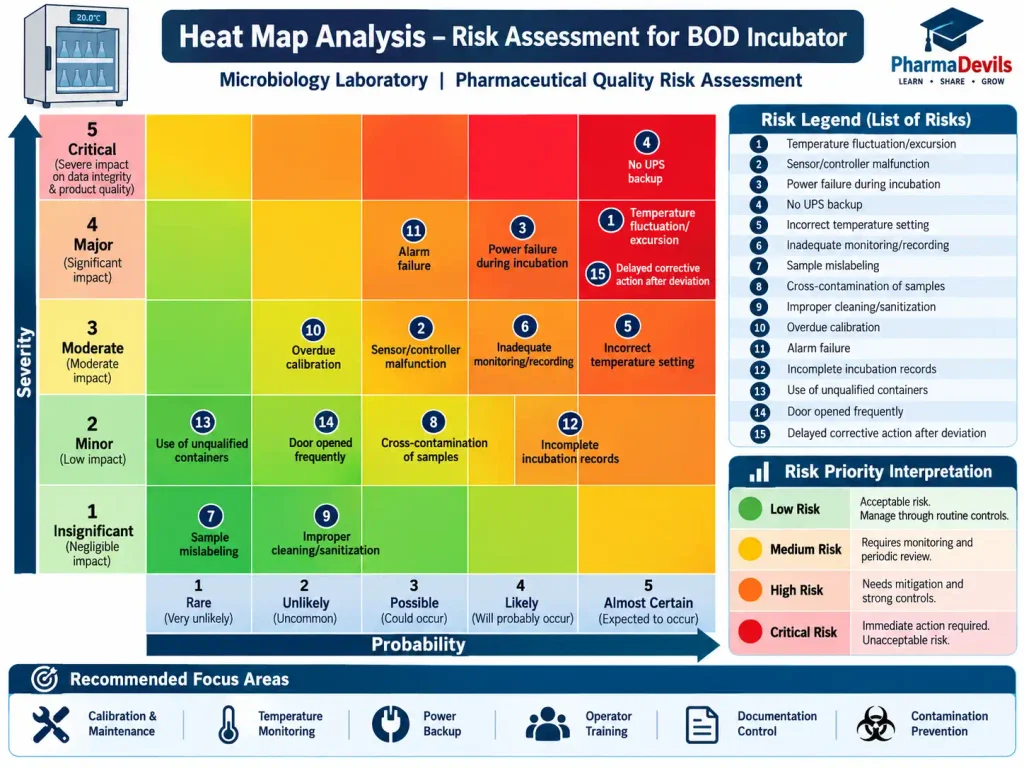
5. Heat Map Analysis for Risk Assessment of BOD Incubator:
The heat map diagram evaluates BOD Incubator risks based on severity and probability, helping prioritize appropriate control measures. Risks such as temperature fluctuation, power failure, lack of UPS backup, incorrect temperature settings, alarm failure, sensor malfunction, inadequate monitoring, and delayed corrective action fall within medium to critical risk zones. Lower-risk issues include sample mislabeling, improper cleaning, unqualified containers, and frequent door opening. The color-coded matrix enables rapid identification of risk priority, supporting effective mitigation planning. Recommended focus areas include calibration, preventive maintenance, temperature monitoring, power backup, operator training, contamination prevention, documentation control, and periodic review of risk-reduction measures.
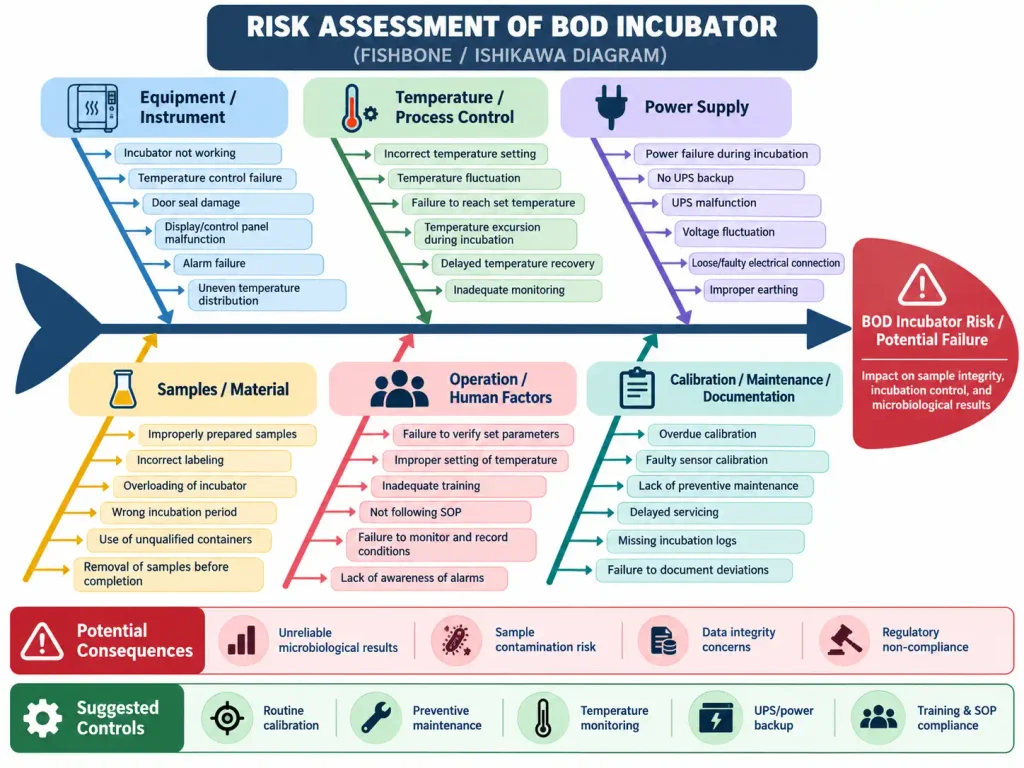
6. Fishbone Analysis for Risk Assessment of BOD Incubator:
The Fishbone or Ishikawa diagram identifies potential causes contributing to BOD Incubator failures and associated microbiological risks. Major categories include equipment and instruments, temperature or process control, power supply, samples and materials, human factors, calibration, maintenance, and documentation. Possible causes include sensor malfunction, temperature fluctuation, alarm failure, UPS issues, improper sample preparation, incorrect labeling, inadequate training, SOP non-compliance, overdue calibration, and incomplete records. These factors may lead to unreliable test results, contamination, data integrity concerns, and regulatory non-compliance. The analysis supports structured root-cause identification and helps establish effective preventive controls, monitoring, maintenance, training, and documentation practices.
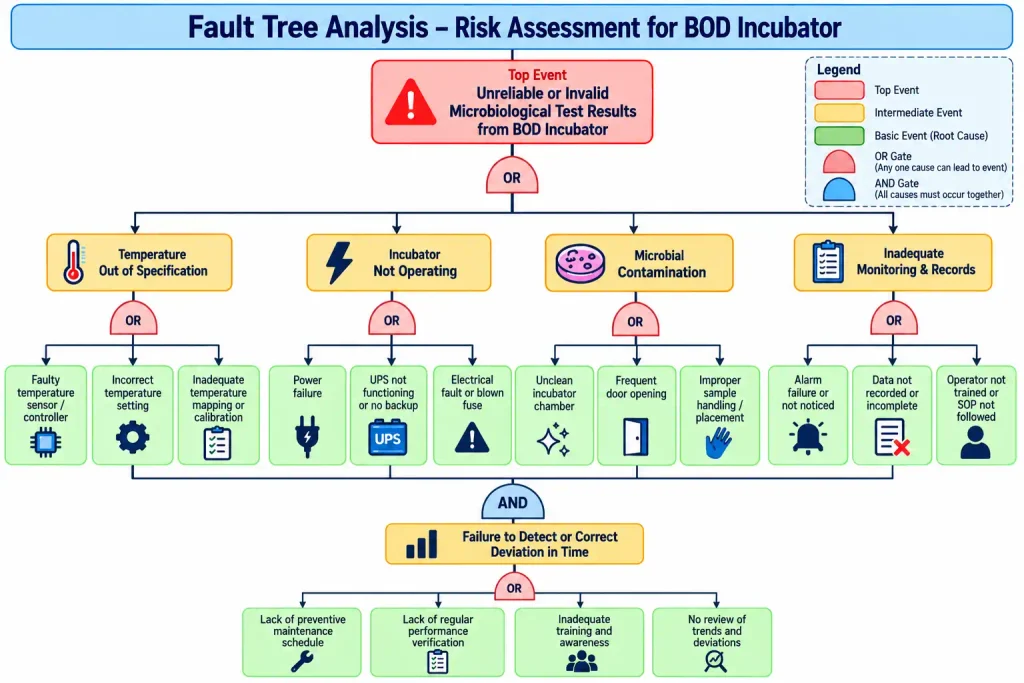
7. Fault Tree Analysis for Risk Assessment of BOD Incubator:
The Fault Tree Analysis diagram evaluates potential causes leading to unreliable or invalid microbiological test results from a BOD Incubator. Major intermediate events include temperature out-of-specification, incubator operational failure, microbial contamination, and inadequate monitoring or documentation. Basic causes may involve faulty sensors, incorrect temperature settings, power or UPS failure, unclean incubator chambers, frequent door opening, improper sample handling, alarm failure, incomplete records, and inadequate operator training. Logical OR and AND gates illustrate how individual or combined failures may contribute to the top event. The analysis supports root-cause identification, preventive maintenance, training, monitoring, calibration, and timely corrective actions.
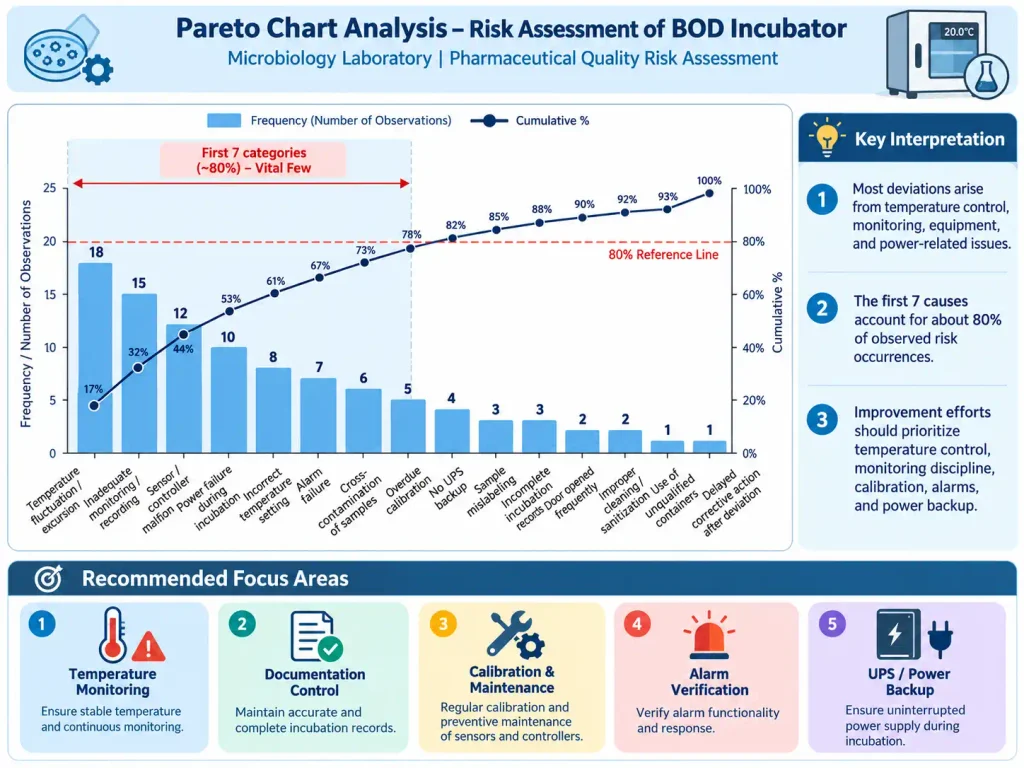
8. Pareto Chart Analysis for Risk Assessment of BOD Incubator:
The Pareto Chart prioritizes major risks associated with BOD Incubator operation based on their frequency of occurrence. High-priority issues include temperature fluctuation, inadequate monitoring, sensor or controller malfunction, power failure, incorrect temperature settings, alarm failure, contamination, and overdue calibration. The cumulative percentage line helps identify the “vital few” causes contributing to approximately 80% of observed risks. This analysis enables focused allocation of resources toward the most significant failure modes. Priority improvement areas include temperature monitoring, documentation control, calibration and preventive maintenance, alarm verification, operator training, and reliable UPS or power backup to enhance incubation reliability and microbiological result accuracy.
9. Corrective Action and Preventive Action (CAPA) – Risk Assessment of BOD Incubator:
| Risk / Failure | Corrective Action | Preventive Action | Effectiveness Check |
|---|---|---|---|
| Temperature excursion | Segregate affected samples, assess impact, verify actual chamber temperature, and investigate the deviation. | Perform periodic temperature mapping, calibration, and continuous temperature monitoring with alarms. | Review temperature trends for 3 consecutive months with no unexplained excursions. |
| Sensor/controller malfunction | Repair or replace the faulty sensor/controller and recalibrate the incubator before reuse. | Establish preventive maintenance and calibration schedules for sensors and controllers. | Verify calibration and temperature accuracy at defined intervals. |
| Power failure / UPS failure | Restore power, evaluate incubation interruption, and determine sample disposition based on impact assessment. | Provide validated UPS or backup power and periodically test backup functionality. | Document successful periodic UPS challenge tests. |
| Alarm failure | Repair and test the alarm system before equipment release. | Include alarm challenge testing in preventive maintenance and qualification activities. | Confirm alarms activate at predefined limits during scheduled verification. |
| Incorrect temperature setting | Correct the set point and assess affected samples for potential impact. | Use approved operating instructions, parameter verification checklists, and second-person verification where required. | Review operating records for recurring setting errors. |
| Inadequate monitoring | Complete missing checks where scientifically possible and initiate deviation investigation. | Define monitoring frequency, recording responsibilities, and escalation requirements in the SOP. | Audit incubation records periodically for completeness. |
| Improper sample handling | Identify affected samples and repeat testing where scientifically justified. | Train personnel on sample preparation, labeling, placement, and incubation requirements. | Conduct competency assessment and periodic observation of operators. |
| Cross-contamination | Remove contaminated materials, clean and disinfect the chamber, and investigate contamination source. | Establish validated cleaning and sanitization procedures and avoid sample overcrowding. | Review environmental and sample contamination trends. |
| Door opened frequently | Minimize further door opening and assess resulting temperature impact. | Define loading/unloading practices and minimize unnecessary access during incubation. | Trend door-opening-related temperature fluctuations. |
| Overdue calibration | Stop use of equipment until calibration is completed and assess results generated since the due date. | Implement calibration due-date tracking with advance alerts. | Verify zero overdue calibration events during periodic QA review. |
| Preventive maintenance not performed | Conduct maintenance, inspect critical components, and document equipment condition. | Maintain an approved preventive maintenance schedule with defined responsibilities. | Monthly review of maintenance compliance. |
| Incomplete records | Correct documentation according to GDP requirements and assess data integrity impact. | Train personnel on GDP/ALCOA+ principles and implement controlled incubation logbooks or electronic records. | Periodic documentation audits with no repeat critical deficiencies. |
| Operator training deficiency | Retrain concerned personnel and assess competence before independent operation. | Maintain role-based training and periodic refresher training. | Successful competency assessment and reduction in operator-related deviations. |
| Cleaning failure | Clean and sanitize the incubator and investigate the reason for missed cleaning. | Establish defined cleaning frequency, approved disinfectants, and cleaning verification records. | Review cleaning logs and contamination trends periodically. |
| Deviation not addressed promptly | Initiate deviation investigation, perform impact assessment, and implement immediate containment. | Establish escalation timelines, deviation tracking, and management review of recurring issues. | Verify deviations are closed within target timelines without recurrence. |
CAPA Effectiveness Review – Risk Assessment of BOD Incubator
The effectiveness of implemented CAPA shall be reviewed after a defined monitoring period to confirm that the identified risks associated with the BOD Incubator have been adequately controlled. Temperature records, alarm performance, calibration status, preventive maintenance compliance, UPS functionality, cleaning records, incubation logs, training records, and related deviations shall be evaluated. Effectiveness will be considered satisfactory when no recurring temperature excursions, equipment failures, documentation gaps, contamination events, or operator-related errors are observed during the review period. Trend analysis should demonstrate stable incubator performance and timely response to abnormalities. Any recurrence or new adverse trend shall require further investigation, reassessment of risk, and additional CAPA. Following successful verification, QA may formally close the CAPA with documented evidence and approval.
10. Questions and Answers – Risk Assessment of BOD Incubator:
- What is a BOD Incubator?
A BOD Incubator is a temperature-controlled chamber used for microbiological incubation and other applications requiring stable low-temperature conditions. - Why is risk assessment required for a BOD Incubator?
Risk assessment identifies potential failures that may affect incubation conditions, test reliability, sample integrity, and regulatory compliance. - What is the most critical parameter of a BOD Incubator?
Temperature control and uniformity are generally the most critical parameters because deviations can directly influence microbial growth and test results. - What are the major risks associated with a BOD Incubator?
Major risks include temperature excursions, sensor failure, power failure, alarm malfunction, contamination, improper sample handling, overdue calibration, and documentation errors. - Why is temperature mapping important?
Temperature mapping demonstrates temperature distribution and helps identify hot or cold spots within the incubator chamber. - How should a temperature excursion be handled?
The affected samples should be identified, the deviation investigated, impact assessed, and sample disposition scientifically justified. - Why is calibration necessary?
Calibration confirms that the displayed and controlled temperature accurately represents the actual chamber temperature. - What is the role of preventive maintenance?
Preventive maintenance reduces the probability of equipment breakdown, sensor malfunction, alarm failure, and unexpected operational interruptions. - Why is UPS or backup power required?
Backup power helps maintain incubation conditions during power interruptions and minimizes the risk of invalid test results. - What should be checked before loading samples?
Cleanliness, calibration status, temperature stabilization, equipment status, sample labeling, and required incubation conditions should be verified. - How can cross-contamination be prevented?
By maintaining proper cleaning, using suitable containers, avoiding spills and overcrowding, and following approved sample-handling procedures. - What is the importance of the incubator alarm system?
The alarm alerts personnel when temperature or other critical operating conditions exceed predefined limits. - How can frequent door opening affect the incubator?
Frequent opening may cause temperature fluctuations and prolonged recovery time, potentially affecting incubation conditions. - What records should be maintained for a BOD Incubator?
Temperature logs, calibration records, maintenance records, cleaning records, alarm checks, usage logs, deviation records, and qualification documents should be maintained. - How is CAPA effectiveness verified?
CAPA effectiveness is verified by reviewing performance trends, deviations, maintenance, calibration, alarm functionality, and recurrence of the original failure. - What monitoring period may be used for CAPA effectiveness?
A three-month monitoring period may be used for routinely operated incubators, with extension where usage is low or the risk is critical. - When should the risk assessment be reviewed?
It should be reviewed periodically and after major breakdowns, recurring deviations, significant modifications, qualification failures, or process changes. - What is the purpose of residual risk assessment?
Residual risk assessment confirms whether the remaining risk after implementation of controls and CAPA is acceptable. - Who should review the BOD Incubator risk assessment?
Typically, representatives from Microbiology/QC, Engineering, and Quality Assurance should review and approve the assessment. - When can a BOD Incubator be released for routine use after a failure?
It should be released only after repair, calibration or qualification as applicable, satisfactory verification of performance, documented impact assessment, and QA approval.
11. Reference Guidelines – Risk Assessment of BOD Incubator:
- WHO TRS No. 961, Annex 2 – Good Practices for Pharmaceutical Microbiology Laboratories. This guidance specifically addresses microbiology laboratory equipment, including incubators, temperature-measuring devices, calibration, qualification, temperature uniformity, monitoring, and record retention. World Health Organization
- WHO TRS No. 1052, Annex 4 – Good Practices for Pharmaceutical Quality Control Laboratories (2024). This provides current WHO expectations for pharmaceutical quality-control laboratory systems, equipment management, calibration, documentation, and reliable laboratory results. World Health Organization
- USP General Chapter <1117> – Microbiological Best Laboratory Practices. This chapter covers microbiological laboratory practices including equipment control, qualification, calibration, maintenance, documentation, training, sample handling, and reliable generation of microbiological data. USP
- ISO/IEC 17025:2017 – General Requirements for the Competence of Testing and Calibration Laboratories. It can be referenced for equipment control, metrological traceability, calibration, monitoring, records, risk-based laboratory controls, and validity of results. WHO’s current QC laboratory guidance is aligned with ISO/IEC 17025:2017. World Health Organization
- ICH Q9(R1) – Quality Risk Management. Applicable for systematic identification, analysis, evaluation, control, communication, and periodic review of risks related to BOD Incubator operation.
- ICH Q10 – Pharmaceutical Quality System. Applicable for CAPA, change management, management review, continual improvement, and lifecycle control of laboratory equipment.