





Introduction:
Risk Assessment for Cleaning validation is a critical aspect of Good Manufacturing Practices (GMP) that ensures equipment used in pharmaceutical manufacturing is free from contaminants such as active pharmaceutical ingredients (APIs), cleaning agents, microbial residues, and particulate matter. The objective is to prevent cross-contamination, ensure product quality, and protect patient safety.
Given the complexity and variability in cleaning processes—ranging from manual cleaning to automated CIP (Clean-In-Place) systems—a risk-based approach is essential to evaluate potential failures in cleaning procedures. Risk assessment helps identify and prioritize areas where cleaning may be inadequate and provides a scientific rationale for establishing worst-case scenarios, cleaning limits, and validation frequency.
This risk assessment employs a systematic 6M methodology (Man, Machine, Material, Method, Milieu, and Measurement) to evaluate all factors that can influence cleaning effectiveness. It aligns with key regulatory guidance, including FDA, EU GMP Annex 15, WHO guidelines, and ICH Q9, ensuring that cleaning processes are robust, reproducible, and fully compliant with global standards.
Flow Diagram:
The flow diagram explains the Risk Assessment process for Cleaning Validation in a simple step-by-step manner. It starts with defining the scope, objectives, responsible team, equipment details, products, cleaning procedures, cleaning agents, and available validation data. The next step is to identify possible hazards and failure modes using tools such as FMEA, Fishbone Analysis, and Poka-Yoke.
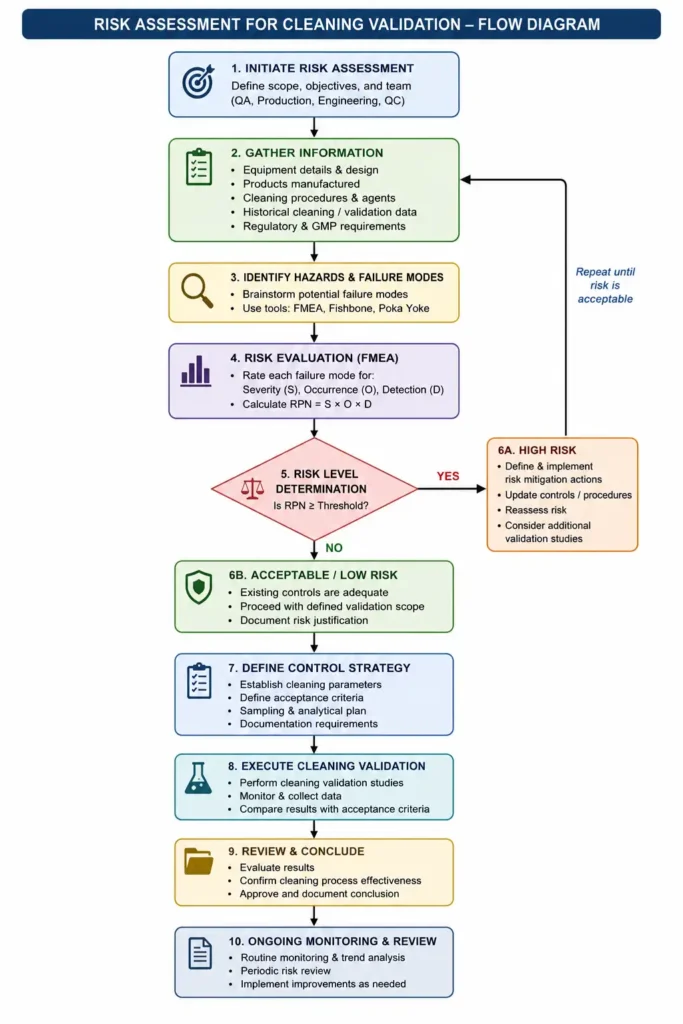
Each identified risk is evaluated by assigning Severity, Occurrence, and Detection scores. The Risk Priority Number is calculated as RPN = S × O × D. High risks require corrective or preventive actions and reassessment, while acceptable risks can proceed to the cleaning validation stage. After defining controls and acceptance criteria, cleaning validation is performed, results are reviewed, and the effectiveness of the cleaning process is confirmed. Finally, ongoing monitoring and periodic risk review help maintain cleaning effectiveness and prevent cross-contamination.
Impact Assessment:
The Risk Assessment for Cleaning Validation has a direct impact on product quality, patient safety, and GMP compliance. If equipment is not cleaned properly, product residues, cleaning agents, or microorganisms may remain on product-contact surfaces and cause cross-contamination or batch rejection.
Manual errors such as using the wrong cleaning chemical, skipping cleaning steps, incorrect swab sampling, or incomplete documentation can reduce the reliability of cleaning validation. Equipment problems such as CIP failure, sensor drift, alarm failure, or insufficient WFI supply may also affect cleaning effectiveness.
The assessment also considers environmental conditions, material compatibility, analytical methods, and measurement errors. Proper controls such as SOPs, training, calibration, validated methods, preventive maintenance, and periodic risk review help reduce these risks. Overall, effective risk assessment improves cleaning reliability, protects data integrity, prevents contamination, and supports regulatory compliance.
Poka-Yoke:
Poka-Yoke means mistake-proofing or error prevention. In Cleaning Validation, it is used to prevent human errors before they affect the cleaning process, sampling, testing, or documentation.
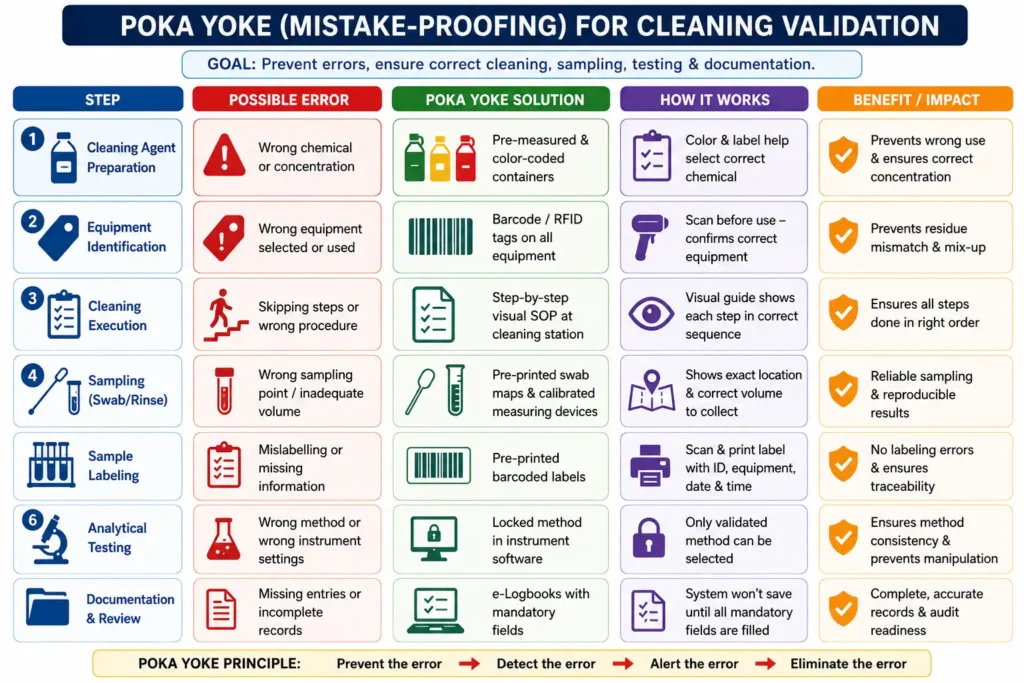
Simple Poka-Yoke controls include pre-measured and color-coded cleaning chemicals, visual SOPs and checklists, barcode labels for samples, pre-marked containers for rinse volume, and validated CIP cycles with interlocks. Digital checklists and QR-coded SOPs can also help operators follow the correct procedure without missing steps. These controls help reduce operator mistakes, prevent equipment or sample mix-ups, avoid cross-contamination, improve repeatability, and increase GMP compliance and audit readiness.
Questions & Answers:
- What is the purpose of risk assessment in Cleaning Validation?
Risk assessment helps identify and control risks that may cause cross-contamination, product carryover, or ineffective cleaning. - Why is Cleaning Validation important?
Cleaning Validation ensures that manufacturing equipment is free from product residues, cleaning agents, and microbial contamination. - Which risk assessment tools are used in the document?
The document uses FMEA, Fishbone Analysis, and Poka-Yoke. - What is FMEA?
FMEA means Failure Modes and Effects Analysis. It is used to identify possible failures, assess their risk, and define suitable controls. - What does Severity mean in FMEA?
Severity shows the impact of a failure on the product or patient and is scored from 1 to 10. - What does Occurrence mean?
Occurrence shows how likely a failure is to happen and is scored from 1 to 10. - What does Detection mean?
Detection shows the likelihood of detecting the failure before it causes a problem and is scored from 1 to 10. - How is RPN calculated?
RPN = Severity × Occurrence × Detection (S × O × D). - What can happen if equipment cleaning is incomplete?
It may cause cross-contamination and batch rejection. - What is the risk of using the wrong cleaning agent?
The wrong cleaning agent may not remove product residues effectively. - Why is correct swab sampling important?
Incorrect swabbing may give false compliance results and may fail to detect remaining residues. - What are important controls for rinse sampling?
SOPs, peer verification, calibrated measuring devices, and checklists should be used to confirm the correct rinse volume. - What are common manual errors during cleaning?
Common errors include incorrect chemical dilution, skipping cleaning steps, improper equipment reassembly, wrong swabbing technique, labeling mistakes, and incomplete records. - What machine-related risks may affect Cleaning Validation?
Risks include incomplete CIP cycles, spray-ball blockage, PLC errors, inaccurate flow readings, sensor drift, alarm failure, and utility failure. - What method-related risks are considered?
Risks include poor swab recovery, insufficient rinse volume, unsuitable analytical detection limits, wrong recovery-factor calculation, incorrect residue selection, and wrong sampling points. - Which environmental factors may affect Cleaning Validation?
Air quality, room classification, surface condition, temperature, humidity, airflow, drainage, personnel movement, lighting, and storage conditions can affect cleaning effectiveness. - Why is worst-case product selection important?
A worst-case product may have residues that strongly adhere to equipment surfaces or have low solubility, making cleaning more difficult. - Why are equipment surface conditions important?
Worn, rough, or pitted surfaces can trap product residues and make cleaning difficult. - Which instruments may be used to verify cleaning effectiveness?
The document includes instruments such as TOC analyzer, HPLC/UV spectrophotometer, balance, conductivity meter, and pH meter. - What is Poka-Yoke in Cleaning Validation?
Poka-Yoke means mistake-proofing or error prevention. It uses systems or tools that help prevent human errors before they occur. - Give one example of Poka-Yoke for cleaning agents.
Pre-measured and color-coded cleaning-agent containers can help prevent the use of the wrong concentration. - How can sample mix-ups be prevented?
Pre-printed barcoded labels can be used for swab samples to prevent incorrect sample identification. - How can errors in CIP systems be prevented?
Pre-set validated cleaning cycles with interlocks can help prevent unauthorized parameter changes. - What are the benefits of Poka-Yoke in Cleaning Validation?
It helps prevent cross-contamination, reduce operator errors, improve audit readiness, and improve cleaning reliability and repeatability. - What should be done after identifying high-risk failures?
Suitable mitigation actions should be implemented, controls should be improved, personnel should be trained, and the risk should be reassessed periodically.