







1. Introduction for Risk Assessment for Colony Counter:
The Risk Assessment for Colony Counter evaluates potential hazards associated with microbial colony enumeration in pharmaceutical microbiology laboratories. It follows the 6M methodology, covering Man, Machine, Material, Method, Measurement, and Milieu (Environment). Major risks include inaccurate colony counting, equipment malfunction, calibration failures, operator errors, improper plate preparation, and data integrity issues. Risks are evaluated using Failure Mode and Effects Analysis (FMEA), considering Severity, Occurrence, and Detection to calculate Risk Priority Numbers (RPN). Recommended controls include equipment qualification, periodic calibration, preventive maintenance, operator training, validated procedures, environmental monitoring, and data integrity safeguards to ensure accurate, reliable, and GMP-compliant microbial results.
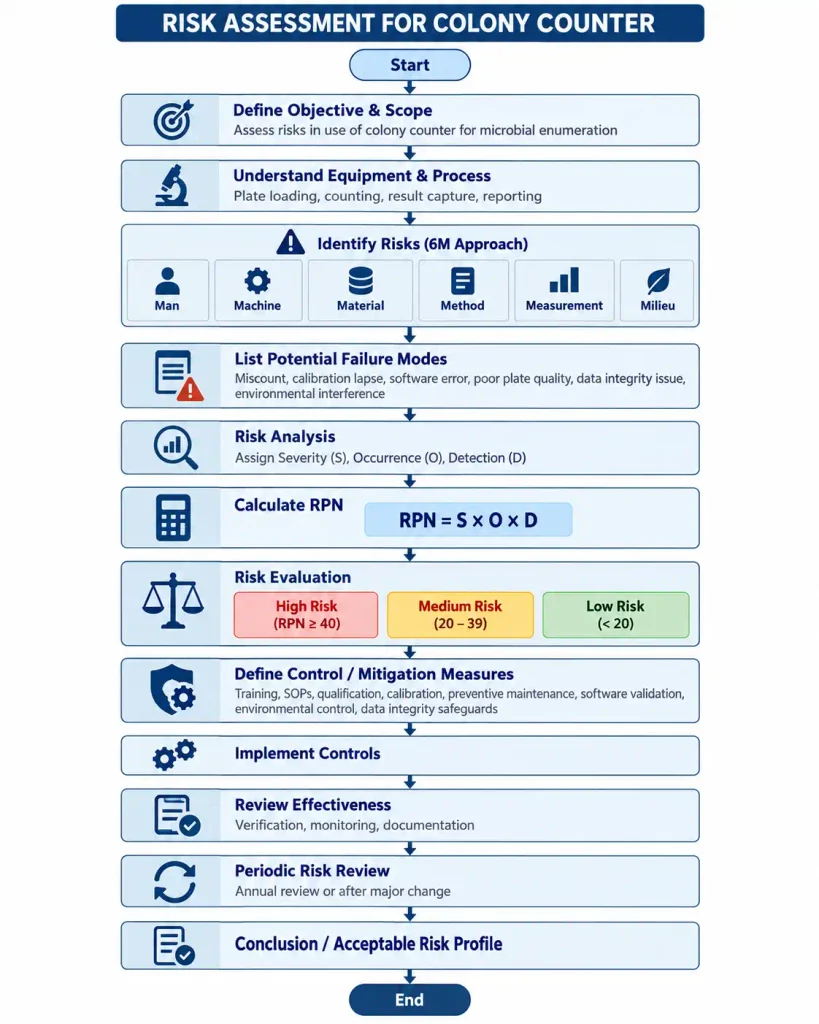
Skip to PDF content2. Flow Diagram – Risk Assessment for Colony Counter:
The flow diagram illustrates the systematic risk assessment process for a Colony Counter used in pharmaceutical microbiology laboratories. It begins with defining objectives, understanding equipment operations, and identifying potential hazards through the 6M approach: Man, Machine, Material, Method, Measurement, and Milieu. Identified failure modes are evaluated using Failure Mode and Effects Analysis (FMEA), considering Severity, Occurrence, and Detection to calculate Risk Priority Numbers (RPN). Risks are classified as high, medium, or low, followed by appropriate mitigation measures. The process includes implementation of controls, effectiveness verification, documentation, and periodic risk reviews to ensure reliable microbial enumeration and GMP compliance.
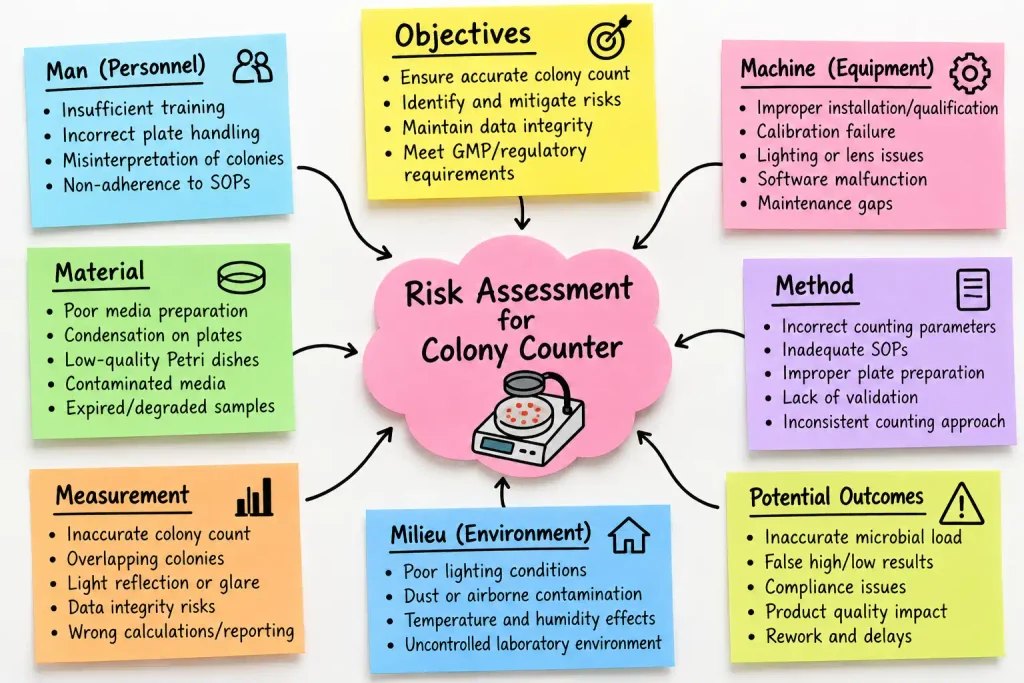
3. Brainstorming – Risk Assessment for Colony Counter:
The brainstorming diagram illustrates the systematic identification of potential risks associated with Colony Counter operations in pharmaceutical microbiology laboratories. It follows the 6M approach, covering Man, Machine, Material, Method, Measurement, and Milieu (Environment). Key concerns include inadequate operator training, calibration failures, software malfunctions, improper media preparation, inaccurate colony counting, and environmental disturbances. Brainstorming helps identify possible causes of microbial enumeration errors, data integrity failures, and regulatory non-compliance. The identified hazards form the basis for FMEA-based risk evaluation and the development of appropriate preventive measures, including equipment qualification, validated procedures, regular calibration, operator training, and environmental monitoring controls.
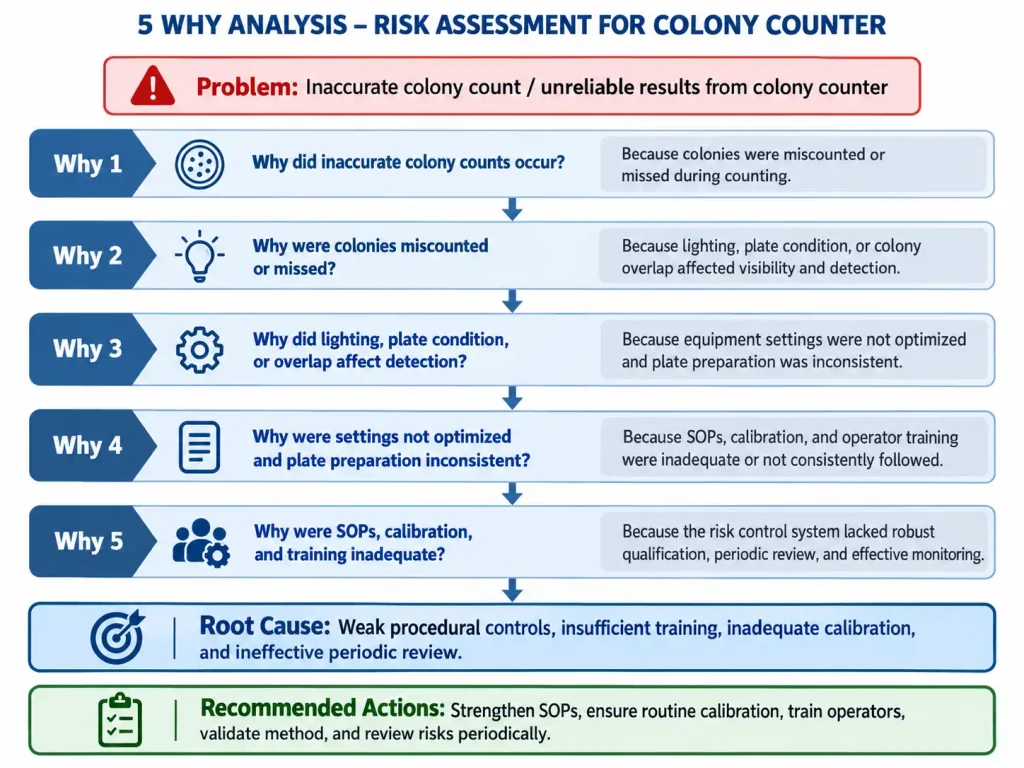
4. 5 Why Analysis – Risk Assessment for Colony Counter:
The 5 Why Analysis systematically investigates the root causes of inaccurate colony counting in pharmaceutical microbiology laboratories. It identifies potential issues such as missed colonies, overlapping microbial growth, inadequate lighting, improper plate preparation, and incorrect equipment settings. Further investigation highlights deficiencies in Standard Operating Procedures (SOPs), operator training, calibration practices, and equipment qualification. The analysis identifies weak procedural controls, insufficient training, and ineffective periodic monitoring as potential root causes. Recommended corrective and preventive actions include strengthening SOPs, conducting regular calibration, validating counting methods, providing competency-based training, and implementing periodic effectiveness reviews to ensure accurate, reliable, and GMP-compliant microbial enumeration.
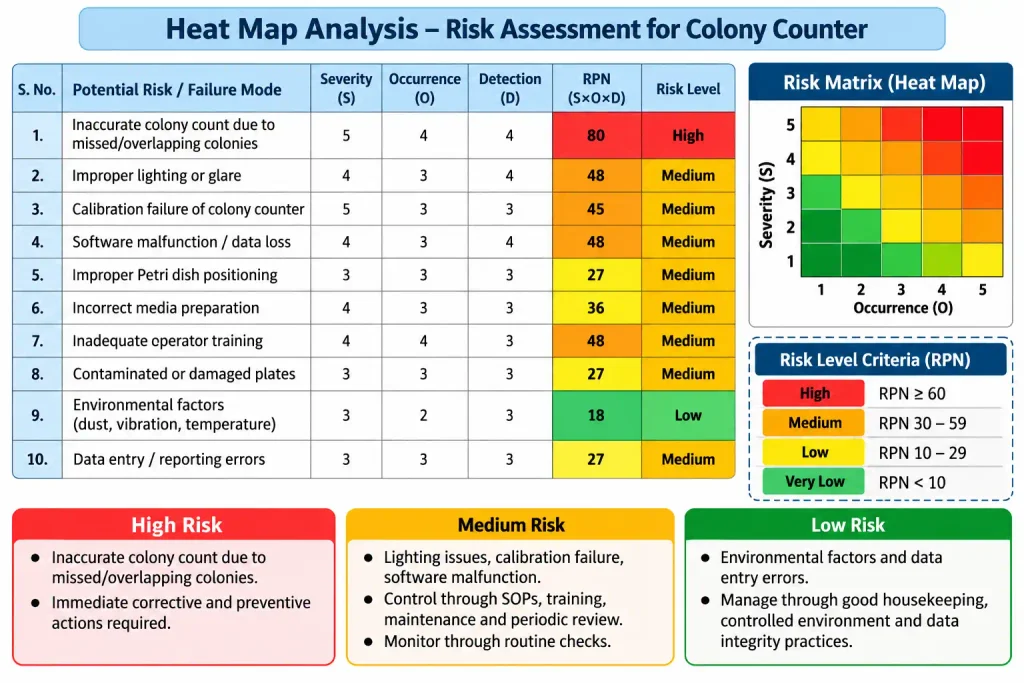
5. Heat Map Analysis – Risk Assessment for Colony Counter:
The Heat Map Analysis visually represents potential risks associated with Colony Counter operations in pharmaceutical microbiology laboratories. Risks are evaluated using Failure Mode and Effects Analysis (FMEA), considering Severity, Occurrence, and Detection to calculate Risk Priority Numbers (RPN). Colour-coded classifications highlight critical hazards, including inaccurate colony counting, calibration failures, software malfunctions, improper lighting, operator errors, and environmental disturbances. High-risk areas require immediate corrective actions, while medium- and low-risk areas require appropriate mitigation and monitoring. Recommended controls include equipment qualification, routine calibration, preventive maintenance, operator training, validated procedures, and periodic reviews to ensure accurate microbial enumeration and GMP compliance.
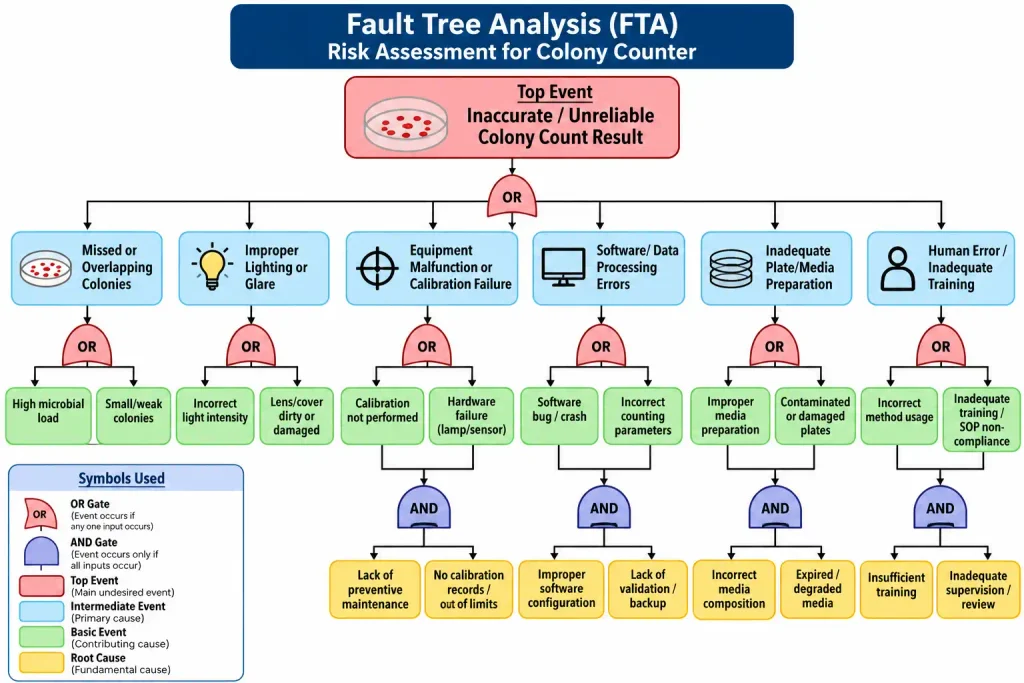
6. Fault Tree Analysis – Risk Assessment for Colony Counter:
Fault Tree Analysis (FTA) systematically identifies potential causes of inaccurate or unreliable colony counting in pharmaceutical microbiology laboratories. The analysis begins with the top event of incorrect microbial enumeration and examines contributing failures through logical AND and OR gates. Major risk factors include overlapping colonies, improper lighting, calibration failures, software malfunctions, inadequate media preparation, and operator errors. Root causes involve insufficient training, poor maintenance, incorrect counting parameters, and inadequate procedural controls. FTA supports the development of corrective and preventive actions, including equipment qualification, routine calibration, validated procedures, operator training, and periodic monitoring to ensure reliable microbial results.
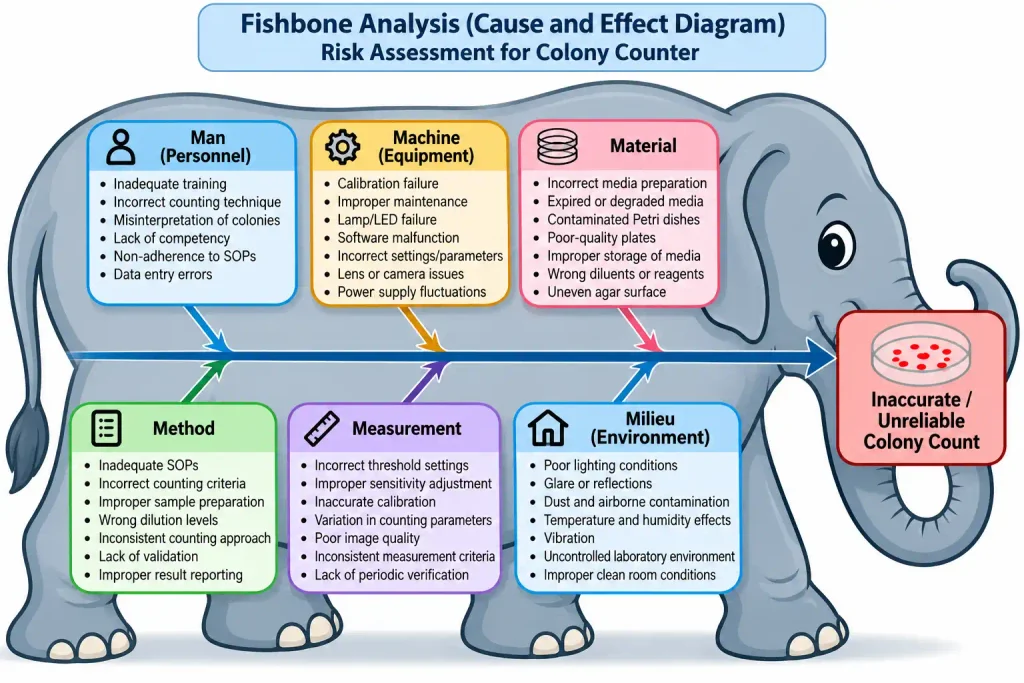
7. Fishbone Analysis – Risk Assessment for Colony Counter:
The Fishbone Analysis systematically identifies potential causes of inaccurate colony counting in pharmaceutical microbiology laboratories using the 6M methodology: Man, Machine, Material, Method, Measurement, and Milieu (Environment). Major contributing factors include inadequate operator training, calibration failures, software malfunctions, improper media preparation, incorrect counting procedures, measurement variations, and environmental disturbances. The diagram illustrates how these factors collectively influence microbial enumeration accuracy, data integrity, and regulatory compliance. Identifying potential root causes supports effective corrective and preventive actions (CAPA), including equipment qualification, routine calibration, validated procedures, operator competency assessments, preventive maintenance, and environmental monitoring to ensure reliable and GMP-compliant results.
8. Pareto Chart Analysis – Risk Assessment for Colony Counter:
The Pareto Chart Analysis illustrates the major risk factors affecting Colony Counter performance in pharmaceutical microbiology laboratories. It prioritizes potential failures based on their frequency and cumulative percentage, following the Pareto principle. Significant risks include inaccurate colony counting, improper lighting, calibration failures, software malfunctions, inadequate media preparation, and operator errors. The chart helps identify critical areas requiring corrective and preventive actions (CAPA). Recommended measures include routine calibration, equipment qualification, optimized lighting, validated counting procedures, preventive maintenance, and operator training. Periodic monitoring and effectiveness reviews support improved microbial enumeration accuracy, data integrity, regulatory compliance, and overall laboratory performance.
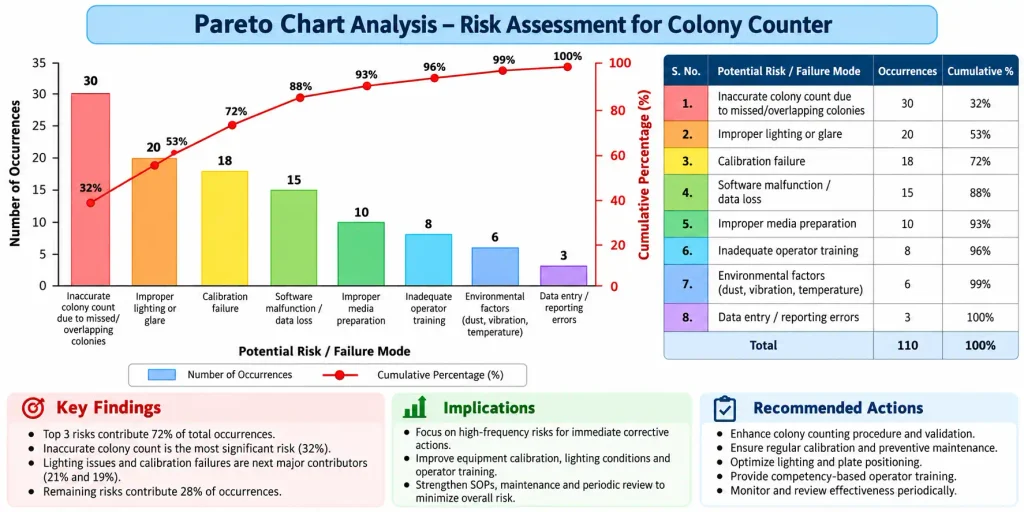
Note: The Pareto chart is illustrative. The occurrence counts shown are example data, not actual recorded deviations from the uploaded risk assessment. For GMP documentation, replace them with verified colony counter failure or deviation data.
9. Corrective Action and Preventive Action (CAPA) with Effectiveness Review – Risk Assessment for Colony Counter:
1. Objective
The objective of CAPA is to identify, investigate, correct, and prevent potential failures associated with the operation of a Colony Counter in pharmaceutical microbiology laboratories. The CAPA process aims to ensure accurate microbial enumeration, reliable analytical results, data integrity, equipment performance, and compliance with Good Manufacturing Practices (GMP).
CAPA shall be implemented based on identified risks, root cause analysis, Failure Mode and Effects Analysis (FMEA), and Risk Priority Number (RPN).
2. Corrective Action and Preventive Action Plan
The following CAPA plan is proposed based on the identified risks in the Risk Assessment for Colony Counter. Actions should be implemented where relevant failures or control gaps are confirmed.
| Identified Risk | Corrective Action (CA) | Preventive Action (PA) |
|---|---|---|
| Inaccurate colony counting | Recount affected plates using a verified method and investigate discrepancies. | Establish periodic counting accuracy and repeatability verification. |
| Calibration failure | Stop equipment use, perform calibration, and assess the impact on previously generated results. | Establish a calibration schedule with reminders and QA review. |
| Improper lighting or glare | Adjust illumination, clean the optical system, and verify counting accuracy. | Define standard lighting conditions and routine pre-use checks. |
| Software malfunction | Investigate system errors, restore verified data where possible, and assess affected results. | Validate applicable software functions, maintain backups, and control system updates. |
| Inadequate operator training | Retrain personnel and reassess their practical counting competency. | Implement initial training, periodic refresher training, and competency assessments. |
| Improper media preparation | Investigate affected media, reject unsuitable plates, and repeat testing where justified. | Strengthen media preparation, growth promotion testing, and storage controls. |
| Incorrect plate positioning | Correct plate alignment and verify the colony count. | Incorporate positioning instructions and illustrations into the operating SOP. |
| Data integrity failure | Investigate data discrepancies, review original records and applicable audit trails. | Implement controlled access, ALCOA+ principles, and periodic data review. |
| Environmental disturbances | Restore appropriate environmental conditions and assess potentially affected counts. | Monitor lighting, temperature, humidity, vibration, and laboratory cleanliness. |
| Inadequate documentation | Correct records through approved GDP procedures and investigate significant omissions. | Review SOPs, establish standardized recording formats, and conduct periodic documentation audits. |
3. CAPA Implementation and Responsibilities
| Activity | Responsibility | Proposed Timeline |
|---|---|---|
| Identify and document failures | QC Microbiology | Immediately upon detection |
| Conduct root cause investigation | QC Microbiology / QA | Within 7 working days |
| Prepare and approve CAPA | QC Head / QA | Within 10 working days |
| Execute corrective actions | QC Microbiology / Engineering / IT | Within 15–30 days, as applicable |
| Implement preventive measures | QC / Engineering / QA | Within 30 days |
| Verify CAPA implementation | QA Department | After completion |
| Review CAPA effectiveness | QC Head / QA | During the defined monitoring period |
| CAPA closure | QA Head / Authorized Designee | After satisfactory effectiveness review |
Timelines are proposed and should be finalized according to the approved CAPA SOP and the severity of the identified risk.
4. CAPA Effectiveness Review
Objective
The effectiveness review shall verify that implemented corrective and preventive actions have adequately addressed the identified root causes, minimized the probability of recurrence, and maintained the reliability of microbial enumeration results.
Proposed Monitoring Period
Recommended effectiveness monitoring period
90 Days
From completion and implementation of the approved CAPA, with assessments at 30, 60, and 90 days.
This monitoring period is a proposed approach, not a period specified in the uploaded risk assessment. It may be extended based on usage frequency, risk severity, and availability of sufficient monitoring data.
Effectiveness Verification Parameters
| Monitoring Parameter | Proposed Acceptance Criteria | Verification Method |
|---|---|---|
| Colony counting accuracy | All verification results comply with approved method-specific acceptance criteria. | Comparison with verified reference/manual counts |
| Calibration compliance | 100% calibration completed within approved due dates. | Calibration records |
| Equipment breakdown | No recurrence of the same identified malfunction attributable to the CAPA root cause. | Breakdown and maintenance logs |
| Operator competency | 100% applicable personnel trained and assessed as competent. | Training records and competency evaluation |
| Software functionality | No unresolved critical software or data processing errors. | Functional verification and error logs |
| Data integrity | No repeat critical data integrity observations related to the identified CAPA. | Record review and audit trail review, where applicable |
| SOP compliance | No repeat critical procedural deviations related to the identified cause. | Operational observation and internal review |
| Environmental controls | Monitoring results comply with established operating limits. | Environmental and area monitoring records |
| Risk reduction | Residual risks are within approved acceptance criteria. | Updated FMEA and RPN assessment |
5. CAPA Effectiveness Monitoring Schedule
- Day 30 – Initial Effectiveness ReviewVerify CAPA implementation, completion of operator training, calibration status, equipment functionality, and initial colony counting accuracy results.
- Day 60 – Intermediate Effectiveness ReviewEvaluate counting performance trends, review deviations, confirm adherence to revised SOPs, and assess calibration and preventive maintenance records.
- Day 90 – Final Effectiveness ReviewReview all monitoring records, assess recurrence, verify results against established criteria, update residual RPN values, and determine CAPA effectiveness.
6. Risk Reassessment Following CAPA
After implementation of the CAPA, reassess identified failure modes using:
RPN = Severity (S) × Occurrence (O) × Detection (D)
The uploaded assessment establishes the following risk categories:
| RPN | Risk Classification | Required Action |
|---|---|---|
| ≥ 40 | High | Immediate mitigation |
| 20–39 | Medium | Mitigation and monitoring |
| < 20 | Low | Routine control and periodic review |
The revised RPN shall reflect documented evidence of improved occurrence or detection controls. Severity should not be reduced unless the consequence of the failure has genuinely changed.
7. CAPA Effectiveness Review Conclusion – Draft
CAPA Effectiveness Review – Risk Assessment for Colony Counter
Following implementation of the approved corrective and preventive actions, the effectiveness of the established risk controls shall be evaluated over a monitoring period of 90 days. The review shall cover colony counting accuracy, calibration compliance, preventive maintenance, operator competency, software functionality, data integrity, environmental conditions, and adherence to approved Standard Operating Procedures.
The effectiveness assessment shall include evaluation of equipment records, training documentation, deviation trends, counting verification results, and updated FMEA risk ratings.
CAPA Effectiveness Acceptance: CAPA shall be considered effective only when the defined acceptance criteria have been achieved, no recurrence of the identified root causes has been observed during the monitoring period, and residual risks are within approved acceptance limits.
Any unsatisfactory results shall require further investigation, CAPA revision or extension, and additional effectiveness monitoring.
Final CAPA Status: Pending effectiveness verification.
Reviewed By: QC Microbiology Head
Verified By: Quality Assurance
Approved By: QA Head / Authorized Designee
8. Reference Guidelines
- ICH Q9(R1) – Quality Risk Management.
- ICH Q10 – Pharmaceutical Quality System.
- EU GMP Chapter 1 – Pharmaceutical Quality System.
- EU GMP Annex 11 – Computerised Systems, where applicable.
- 21 CFR 211.160 – General Requirements for Laboratory Controls.
- 21 CFR Part 11 – Electronic Records and Electronic Signatures, where applicable.
- Approved internal SOPs for CAPA, Risk Management, Colony Counter Operation, Calibration, and Data Integrity.
Important: CAPA closure must be supported by documented effectiveness evidence. Completion of corrective and preventive actions alone does not establish CAPA effectiveness.
10. Questions and Answers – Risk Assessment for Colony Counter:
Q1. What is a Colony Counter?
Answer: A Colony Counter is a microbiological laboratory instrument used to count visible bacterial or fungal colonies grown on agar plates. It supports accurate microbial enumeration during quality control testing, environmental monitoring, and microbial limit testing.
Q2. What is the objective of Risk Assessment for a Colony Counter?
Answer: The objective is to identify, evaluate, control, and monitor potential risks associated with Colony Counter operations to ensure reliable microbial enumeration, data integrity, equipment performance, and GMP compliance.
Q3. What are the major risks associated with Colony Counter operation?
Answer: Major risks include inaccurate colony counting, overlapping colonies, calibration failures, improper lighting, software malfunctions, incorrect plate positioning, inadequate operator training, contaminated media, and data integrity failures.
Q4. What is the 6M approach in Colony Counter Risk Assessment?
Answer: The 6M approach evaluates risks under six categories:
- Man: Personnel training and operating errors.
- Machine: Equipment malfunction and calibration failures.
- Material: Media quality and Petri dish condition.
- Method: SOPs and counting procedures.
- Measurement: Counting accuracy and data integrity.
- Milieu: Environmental conditions such as lighting, temperature, and humidity.
Q5. What is FMEA in Colony Counter Risk Assessment?
Answer: Failure Mode and Effects Analysis (FMEA) is a systematic method used to identify potential equipment and process failures, evaluate their consequences, and prioritize controls based on Severity, Occurrence, and Detection.
Q6. How is the Risk Priority Number (RPN) calculated?
Answer: RPN is calculated using the following formula:
\[ RPN = S \times O \times D \]
Where S represents Severity, O represents Occurrence, and D represents Detection.
According to the uploaded risk assessment, RPN ≥ 40 is high risk, 20–39 is medium risk, and below 20 is low risk.
Q7. What causes inaccurate colony counting?
Answer: Inaccurate counting may result from overlapping colonies, poor illumination, condensation on agar plates, incorrect counting parameters, dirty optical components, improper plate placement, equipment malfunction, or operator errors.
Q8. Why is calibration important for a Colony Counter?
Answer: Calibration or applicable performance verification helps ensure that the Colony Counter operates within established acceptance limits. Failure to maintain equipment accuracy may lead to incorrect microbial enumeration and unreliable laboratory results.
Q9. What are the risks associated with inadequate operator training?
Answer: Inadequate training may result in improper plate handling, incorrect parameter selection, missed colonies, duplicate counting, documentation errors, and failure to recognize equipment abnormalities.
Q10. How can data integrity be maintained during Colony Counter operations?
Answer: Data integrity can be maintained through controlled access, accurate documentation, audit trails where applicable, secure data storage, appropriate backups, independent result verification, and adherence to ALCOA+ principles.
Q11. What is the purpose of 5 Why Analysis?
Answer: The 5 Why Analysis investigates underlying causes of inaccurate colony counting by repeatedly questioning why a failure occurred. It helps identify potential weaknesses in operator training, calibration practices, SOPs, and equipment maintenance.
Q12. What is Fishbone Analysis?
Answer: Fishbone Analysis is a cause-and-effect technique used to identify potential causes of inaccurate microbial enumeration. The analysis categorizes possible failures using the 6M methodology and supports systematic root cause investigation.
Q13. What is Fault Tree Analysis (FTA)?
Answer: Fault Tree Analysis is a structured method used to investigate how combinations of equipment failures, procedural deficiencies, environmental disturbances, and human errors could lead to unreliable Colony Counter results. It uses logical AND and OR gates.
Q14. What is the purpose of Heat Map Analysis?
Answer: Heat Map Analysis provides a visual representation of risk levels, allowing laboratory personnel to identify hazards requiring immediate attention, mitigation, or routine monitoring. The risk classification must follow the approved assessment methodology.
Q15. What is Pareto Chart Analysis?
Answer: Pareto Chart Analysis identifies and prioritizes frequently occurring problems using occurrence counts and cumulative percentages. It helps determine which recurring Colony Counter failures should receive priority attention.
Q16. What corrective actions should be taken when inaccurate colony counts are detected?
Answer: The analyst should stop relying on the questionable result, investigate possible causes, verify instrument performance, and recount the plate using an approved method where feasible. The laboratory should assess affected results, document deviations, and implement appropriate corrective actions.
Q17. What preventive measures can minimize Colony Counter failures?
Answer: Preventive measures include scheduled calibration or performance verification, preventive maintenance, operator competency assessments, approved operating procedures, standardized plate preparation, controlled environmental conditions, and periodic risk reviews.
Q18. What is the recommended CAPA effectiveness monitoring period?
Answer: A proposed monitoring period of 90 days may be adopted, with evaluations at 30, 60, and 90 days. The final duration should be defined through the approved CAPA procedure, considering the severity and frequency of the identified failures.
Q19. How is CAPA effectiveness verified?
Answer: CAPA effectiveness is verified by reviewing colony counting accuracy, equipment calibration records, operator competency, deviation trends, maintenance history, procedural compliance, and recurrence of previously identified failures. Residual risks should also be reassessed through FMEA.
Q20. When should Colony Counter Risk Assessment be reviewed?
Answer: According to the uploaded risk assessment, it should be reviewed annually or following major changes, such as software upgrades. Additional reviews may be necessary after significant equipment modifications, repeated failures, or critical deviations.
Q21. What is the impact of environmental conditions on Colony Counter performance?
Answer: Uncontrolled lighting, high humidity, condensation, temperature variations, dust, vibration, and power fluctuations may affect colony visibility, equipment performance, counting accuracy, and result reliability.
Q22. Why is software validation important for an automated Colony Counter?
Answer: Software validation provides documented evidence that applicable software functions consistently perform as intended. It helps control risks involving colony recognition, counting parameters, electronic records, data processing, and result reporting.
Q23. What is the difference between corrective action and preventive action?
Answer: Corrective action eliminates the cause of an identified nonconformity to prevent recurrence, whereas preventive action addresses potential failures before they occur. Both are important for maintaining reliable Colony Counter performance.
Q24. Who is responsible for Colony Counter Risk Assessment?
Answer: The QC Microbiology Head and QA Validation Team are identified as responsible for risk review in the uploaded assessment. Equipment users, Engineering, and IT personnel may provide support according to assigned responsibilities.
Q25. What is the final conclusion of the Colony Counter Risk Assessment?
Answer: Colony Counter operations can achieve an acceptable risk profile when identified medium- and high-risk conditions are adequately controlled through qualified equipment, effective training, validated procedures, preventive maintenance, calibration, environmental monitoring, and data integrity safeguards.
11. Reference Guidelines – Risk Assessment for Colony Counter:
The following regulatory guidelines and international standards are applicable references for conducting and documenting the Risk Assessment of a Colony Counter used in pharmaceutical microbiology laboratories.
1. Quality Risk Management and GMP Guidelines
| S. No. | Reference Guideline | Relevance to Colony Counter Risk Assessment |
|---|---|---|
| 1 | ICH Q9(R1) – Quality Risk Management | Risk identification, FMEA, risk evaluation, mitigation, and periodic review. |
| 2 | ICH Q10 – Pharmaceutical Quality System | CAPA implementation, change control, equipment performance, and continual improvement. |
| 3 | EU GMP Chapter 1 – Pharmaceutical Quality System | Quality risk management, deviation handling, CAPA, and management review. |
| 4 | EU GMP Chapter 4 – Documentation | Proper recording, review, traceability, and retention of laboratory data. |
| 5 | EU GMP Annex 15 – Qualification and Validation | Risk-based equipment qualification and validation activities. |
| 6 | EU GMP Annex 11 – Computerised Systems | Validation, access controls, audit trails, and data integrity for computerized Colony Counters. |
| 7 | 21 CFR 211.160 – General Requirements for Laboratory Controls | Scientifically sound laboratory controls, instrument calibration, and testing procedures. |
| 8 | 21 CFR 211.194 – Laboratory Records | Complete laboratory records and traceable analytical results. |
| 9 | 21 CFR Part 11 – Electronic Records and Electronic Signatures | Controls for electronic records and signatures when applicable. |