




1. Introduction for Risk Assessment for Fogger:
Risk Assessment for Fogger evaluates potential hazards associated with fogging operations in pharmaceutical cleanrooms, microbiology laboratories, and controlled manufacturing environments. The assessment follows the 6M approach, covering Man, Machine, Material, Method, Measurement, and Environment. Major risks include improper operation, inadequate personnel protection, uneven fog distribution, chemical residues, equipment malfunction, and ineffective disinfection. Failure Mode and Effects Analysis (FMEA) identifies risk severity, occurrence, detection, and Risk Priority Numbers (RPN). Recommended controls include equipment qualification, validated fogging cycles, personnel training, preventive maintenance, environmental monitoring, chemical compatibility assessments, and safe re-entry procedures. Effective implementation ensures personnel safety, contamination control, and GMP compliance.
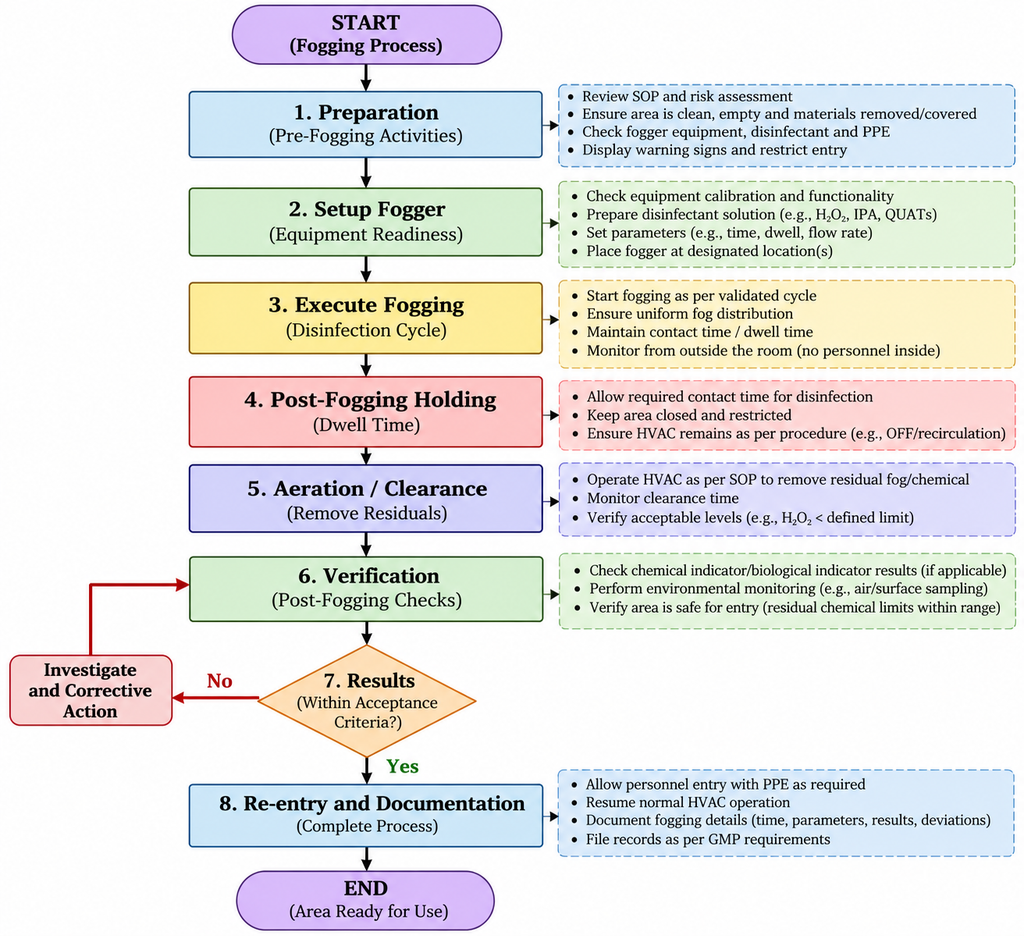
Skip to PDF content2. Flow Diagram for Risk Assessment of Fogger:
The flow diagram illustrates the systematic fogging process in pharmaceutical cleanrooms and controlled environments. It begins with preparation, including SOP review, risk assessment, area clearance, and personnel safety checks. Fogger setup involves equipment verification, disinfectant preparation, and parameter adjustment. The fogging cycle ensures uniform disinfectant distribution and validated contact time. Post-fogging activities include dwell time, aeration, and chemical residue clearance. Verification involves environmental monitoring, indicator evaluation, and confirmation of acceptance criteria. Unsatisfactory results require investigation and corrective actions. Successful verification permits safe personnel re-entry, completion of documentation, and formal release of the area for operational use.
3. Brainstorming Analysis for Risk Assessment of Fogger:
The brainstorming analysis for Risk Assessment of Fogger identifies potential hazards affecting pharmaceutical cleanroom disinfection operations. It evaluates eight critical categories: Personnel Safety, Equipment, Chemicals, Method, Measurement, Environment, Product Protection, and Corrective Actions. Major risks include inadequate training, improper PPE, equipment malfunction, incorrect disinfectant concentration, uneven fog distribution, chemical residues, inadequate dwell time, and HVAC disturbances. The analysis emphasizes equipment qualification, validated fogging cycles, environmental monitoring, proper documentation, and safe re-entry procedures. Recommended preventive measures include personnel training, routine maintenance, chemical compatibility assessments, standardized checklists, and CAPA implementation. This systematic approach strengthens contamination control, operational safety, and GMP compliance.
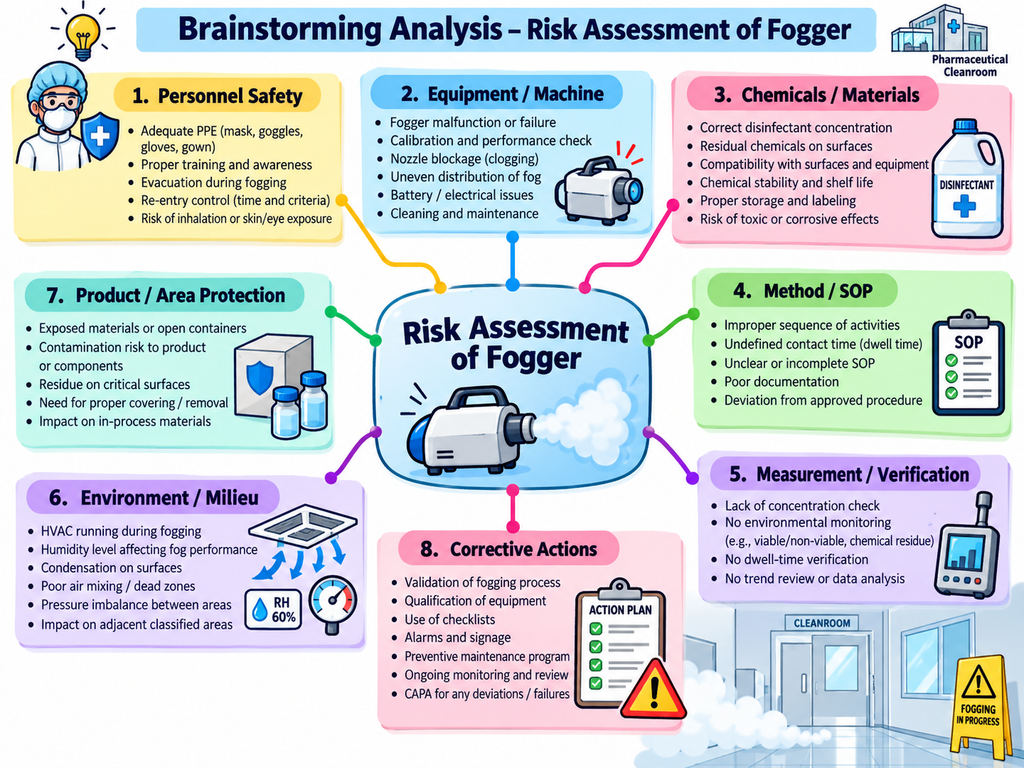
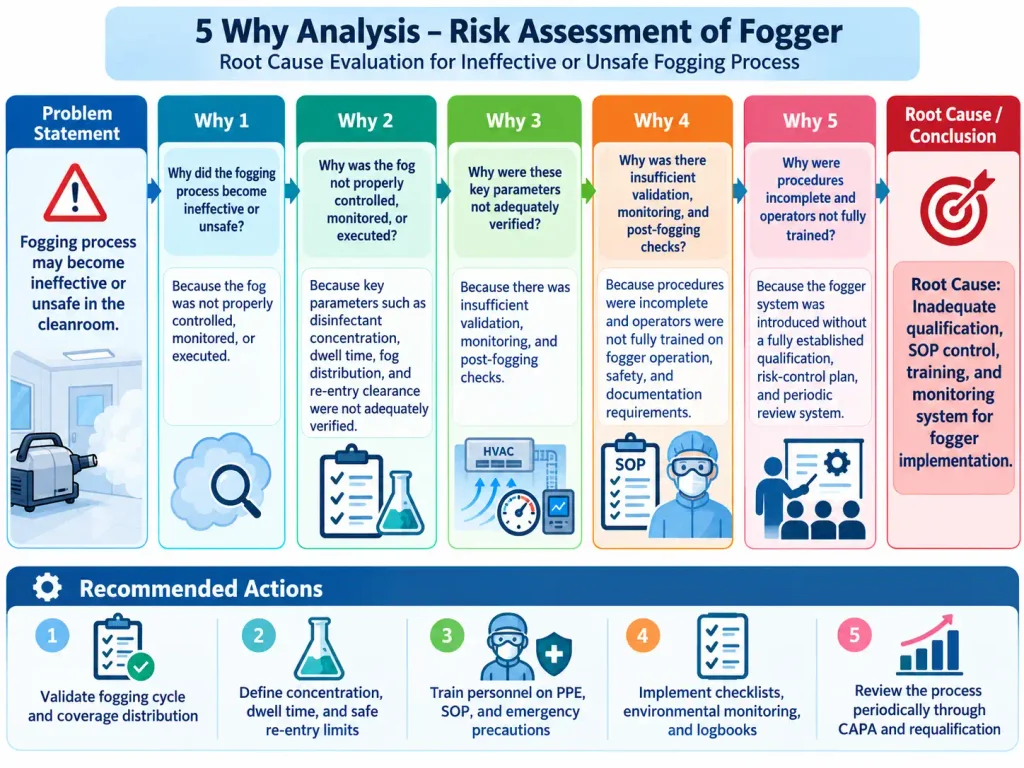
4. 5 Why Analysis for Risk Assessment of Fogger:
The 5 Why Analysis for Risk Assessment of Fogger systematically identifies the root causes of ineffective or unsafe fogging operations in pharmaceutical cleanrooms. The analysis investigates inadequate fog distribution, improper disinfectant concentration, undefined dwell time, insufficient monitoring, and unsafe re-entry conditions. Repeated questioning reveals underlying deficiencies in equipment qualification, process validation, SOP implementation, personnel training, and environmental monitoring. The primary root cause is inadequate establishment of validated procedures and effective operational controls. Recommended corrective and preventive actions include fogging cycle validation, personnel training, standardized checklists, equipment maintenance, environmental monitoring, periodic requalification, and CAPA effectiveness verification to ensure GMP compliance.
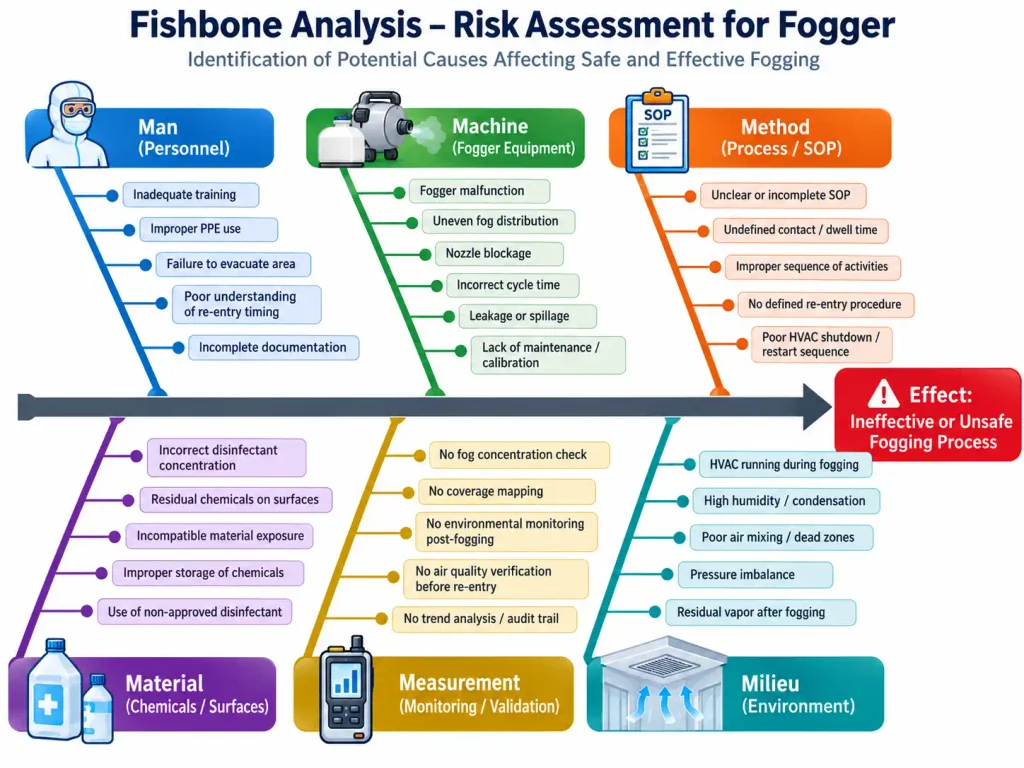
5. Fishbone Analysis for Risk Assessment of Fogger:
The Fishbone Analysis for Risk Assessment of Fogger systematically identifies potential causes of ineffective or unsafe fogging operations in pharmaceutical cleanrooms. It follows the 6M approach, covering Man, Machine, Material, Method, Measurement, and Environment. Major risks include inadequate personnel training, improper PPE usage, equipment malfunction, incorrect disinfectant concentration, undefined dwell time, and inadequate environmental monitoring. Additional concerns include HVAC disturbances, uneven fog distribution, chemical residues, and poor documentation. The analysis supports root cause identification and effective CAPA implementation. Recommended controls include equipment qualification, validated fogging procedures, preventive maintenance, personnel training, and monitoring to ensure GMP compliance and safety.
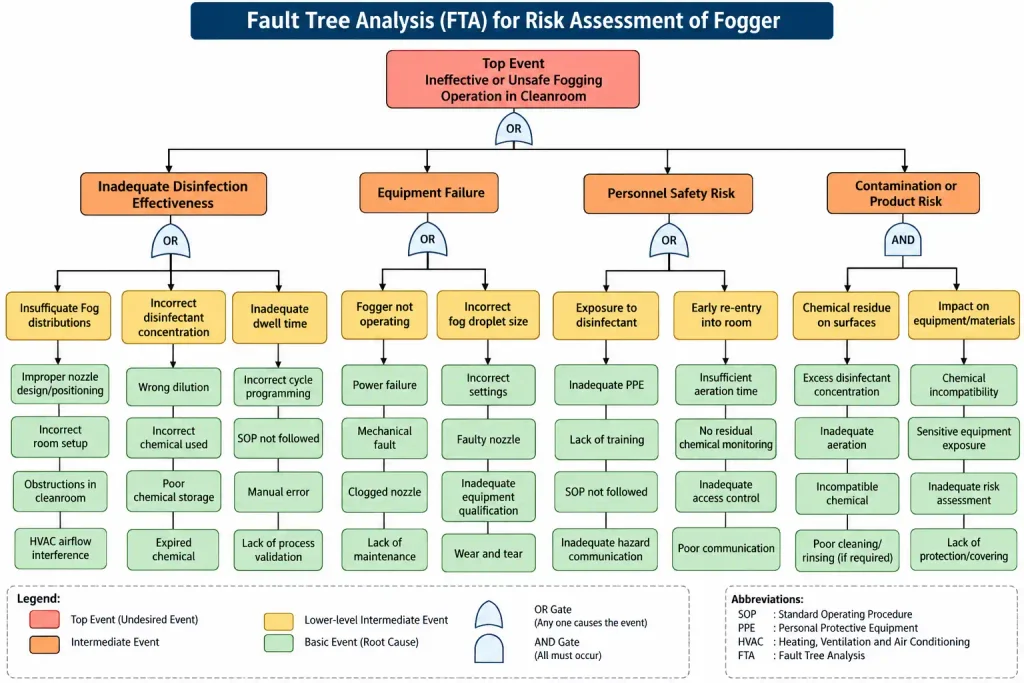
6. Fault Tree Analysis for Risk Assessment of Fogger:
The Fault Tree Analysis (FTA) for Risk Assessment of Fogger systematically evaluates potential causes of ineffective or unsafe fogging operations in pharmaceutical cleanrooms. The analysis identifies four major failure categories: inadequate disinfection effectiveness, equipment failure, personnel safety risks, and product contamination. Contributing factors include uneven fog distribution, incorrect disinfectant concentration, insufficient dwell time, equipment malfunction, inadequate PPE, premature re-entry, and chemical residues. Using AND and OR logic gates, the analysis establishes relationships between failure events and their underlying causes. Recommended preventive measures include process validation, equipment qualification, personnel training, environmental monitoring, maintenance, and effective GMP controls.
7. Pareto Chart Analysis for Risk Assessment of Fogger:
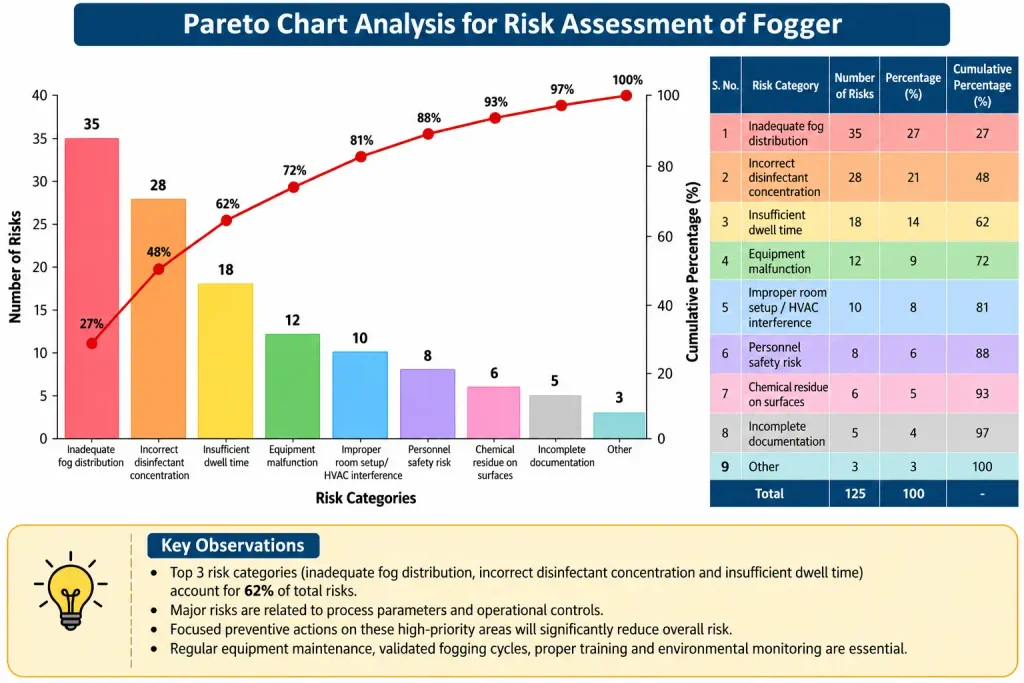
The Pareto Chart Analysis for Risk Assessment of Fogger identifies and prioritizes potential hazards affecting pharmaceutical cleanroom fogging operations. The illustrative analysis highlights inadequate fog distribution, incorrect disinfectant concentration, and insufficient dwell time as major risks, collectively representing approximately 62% of the chart’s total occurrences. Additional concerns include equipment malfunction, HVAC interference, personnel safety, chemical residues, and documentation deficiencies. The analysis supports prioritization of corrective and preventive actions based on risk contribution. Recommended controls include validated fogging cycles, equipment qualification, preventive maintenance, personnel training, environmental monitoring, and periodic effectiveness reviews to strengthen contamination control and GMP compliance.
8. Heat Map Analysis for Risk Assessment of Fogger:
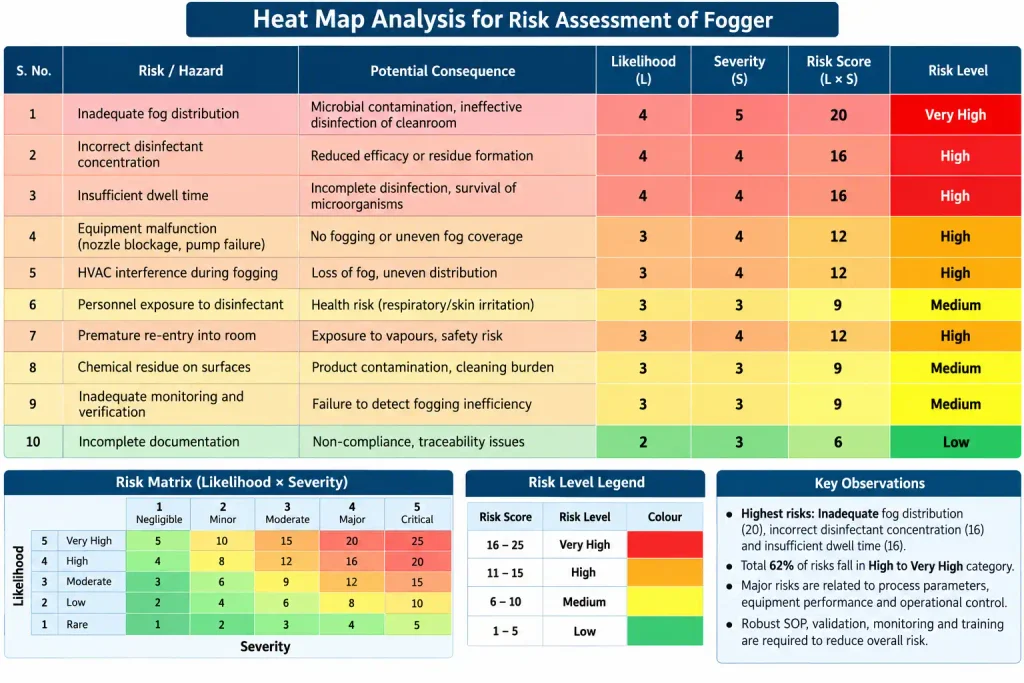
The Heat Map Analysis for Risk Assessment of Fogger systematically evaluates potential hazards based on likelihood, severity, and calculated risk scores. Major risks include inadequate fog distribution, incorrect disinfectant concentration, insufficient dwell time, equipment malfunction, HVAC interference, and premature personnel re-entry. The color-coded matrix classifies risks into Low, Medium, High, and Very High categories, enabling effective prioritization of mitigation measures. Recommended controls include validated fogging cycles, equipment qualification, personnel training, environmental monitoring, preventive maintenance, and standardized operating procedures. The analysis supports risk reduction, contamination prevention, personnel safety, and continuous improvement while strengthening pharmaceutical GMP compliance and operational reliability.
9. Corrective Action and Preventive Action (CAPA) with Effectiveness Review for Risk Assessment of Fogger:
1. Objective
The objective of Corrective Action and Preventive Action (CAPA) for the Risk Assessment of Fogger is to identify, investigate, correct, and prevent failures associated with fogging operations in pharmaceutical cleanrooms, microbiology laboratories, and controlled manufacturing areas.
The CAPA program addresses inadequate fog distribution, incorrect disinfectant concentration, equipment malfunction, insufficient dwell time, personnel exposure, chemical residues, HVAC interference, and incomplete documentation. All actions should be implemented through an approved quality management system to ensure personnel safety, effective contamination control, and GMP compliance.
2. Corrective Action and Preventive Action (CAPA) Plan
The following proposed CAPA plan is based on the potential failure modes identified in the Fogger Risk Assessment. It is not a record of confirmed deviations or completed actions.
| S. No. | Identified Risk / Failure | Corrective Action (CA) | Preventive Action (PA) |
|---|---|---|---|
| 1 | Inadequate fog distribution | Inspect nozzle, correct fogger positioning, and repeat coverage verification. | Conduct fog distribution mapping, periodic qualification, and nozzle inspection. |
| 2 | Incorrect disinfectant concentration | Quarantine incorrectly prepared solution and prepare fresh solution according to the approved procedure. | Introduce standardized dilution instructions, calibrated measuring devices, and preparation verification. |
| 3 | Insufficient contact / dwell time | Investigate cycle parameters and repeat fogging when justified by the approved procedure. | Establish validated dwell times and incorporate controlled timer settings. |
| 4 | Fogger equipment malfunction | Stop operations, investigate the malfunction, and repair or replace defective components. | Implement preventive maintenance, calibration, and pre-operation functionality checks. |
| 5 | Inadequate personnel training | Retrain personnel on equipment operation, chemical handling, PPE, and emergency procedures. | Establish periodic training and competency assessment programs. |
| 6 | Personnel exposure to disinfectant | Restrict access, follow the chemical exposure response procedure, and arrange medical evaluation when needed. | Install warning signs, introduce area clearance checklists, and validate safe re-entry criteria. |
| 7 | Chemical residues on surfaces | Assess affected surfaces and perform approved cleaning or residue removal procedures. | Conduct residue assessments and validate cleaning or clearance procedures where required. |
| 8 | HVAC interference during fogging | Investigate airflow disturbances and verify fogger operation against approved HVAC conditions. | Establish validated HVAC operating, shutdown, and restart sequences. |
| 9 | Inadequate environmental monitoring | Investigate missing monitoring activities and assess the impact on disinfection assurance. | Establish scheduled environmental monitoring and periodic trend analysis. |
| 10 | Incomplete fogging documentation | Investigate missing records and document the deviation according to GDP requirements. | Introduce controlled logbooks, checklists, QA review, and documentation training. |
3. CAPA Effectiveness Review
The effectiveness review evaluates whether the implemented corrective and preventive actions have reduced the identified risks and prevented recurrence of fogging-related failures.
| CAPA Area | Effectiveness Verification Method | Proposed Acceptance Criteria | Monitoring Period |
|---|---|---|---|
| Fog Distribution | Review qualification reports and fog distribution mapping. | All required locations meet approved coverage criteria. | 3 months |
| Disinfectant Concentration | Review preparation records and concentration verification results. | 100% compliance with approved concentration limits. | 3 months |
| Dwell Time | Review fogging cycle records and timer verification. | All reviewed cycles meet validated dwell-time requirements. | 3 months |
| Equipment Performance | Review preventive maintenance, calibration, and breakdown records. | No recurrence of the investigated equipment failure. | 3 months |
| Personnel Training | Review training records and competency assessments. | 100% of authorized operators trained and qualified. | 30 days, followed by 3-month monitoring |
| Personnel Safety | Review area clearance, PPE, and re-entry compliance records. | No unauthorized entry or confirmed disinfectant exposure events. | 3 months |
| Chemical Residues | Review chemical residue and cleaning verification reports, where applicable. | Results comply with established acceptance limits. | 3 months |
| HVAC Control | Review validated HVAC operating conditions and fogging cycle records. | All reviewed fogging cycles comply with approved HVAC requirements. | 3 months |
| Environmental Monitoring | Review microbial monitoring results and environmental trends. | Results meet approved environmental monitoring limits, with adverse trends investigated. | 3 months |
| Documentation Compliance | Review fogging logbooks, checklists, and deviations. | 100% of reviewed fogging activities have complete, traceable records. | 3 months |
The monitoring periods and acceptance criteria above are proposed examples. They must be approved by QA based on site-specific risk, validation data, and applicable procedures.
4. CAPA Effectiveness Review Procedure
CAPA Implementation
Complete approved corrective and preventive actions
Evidence Verification
Review training, validation, maintenance, and monitoring records
Effectiveness Monitoring
Monitor routine fogging operations for the approved period
Are Acceptance Criteria Satisfied?
NO
Reopen investigation, revise CAPA, and reassess risk
YES
QA approval and documented CAPA closure
5. Risk Reassessment After CAPA
The original Fogger Risk Assessment identifies an overall risk level of Moderate to High. Following CAPA implementation, the quality risk management team should reassess each failure mode using the approved FMEA methodology.
\[ RPN = Severity\ (S) \times Occurrence\ (O) \times Detection\ (D) \]
The reassessment should compare initial and residual RPN values, evaluate the effectiveness of implemented controls, and determine whether residual risks meet the site’s approved acceptance criteria.
A reduction in RPN alone is not sufficient if a severe safety or contamination hazard remains inadequately controlled.
6. CAPA Effectiveness Review Conclusion
The effectiveness review of CAPA implemented for the Risk Assessment of Fogger was completed over the approved monitoring period. Verification included review of fogging cycle records, equipment qualification, disinfectant concentration, personnel training, environmental monitoring, HVAC controls, and documentation compliance.
The reviewed records demonstrated that the implemented corrective and preventive measures met the predefined acceptance criteria, with no recurrence of the investigated failures during the monitoring period. Residual risks were reassessed and found acceptable in accordance with the approved quality risk management procedure.
Based on satisfactory effectiveness verification and QA approval, the CAPA was considered effective and recommended for closure.
7. Reference Guidelines
- ICH Q9(R1) – Quality Risk Management.
- ICH Q10 – Pharmaceutical Quality System.
- EU GMP Annex 1 – Manufacture of Sterile Medicinal Products.
- EU GMP Chapter 1 – Pharmaceutical Quality System.
- ISO 14644 series – Cleanrooms and Associated Controlled Environments, as applicable.
- Approved site SOPs for fogging, disinfection, equipment qualification, environmental monitoring, deviation management, and CAPA.
Recommended CAPA effectiveness monitoring period: Three months after implementation, supported by documented results from representative routine fogging cycles, with extension where insufficient evidence is available.
10. Questions and Answers on Risk Assessment of Fogger in Pharmaceutical Cleanrooms:
1. What is a fogger in the pharmaceutical industry?
Answer: A fogger is equipment used to disperse disinfectant solutions into fine droplets or mist for decontamination of cleanrooms, microbiology laboratories, and controlled manufacturing environments. It helps reduce microbial contamination when operated through a validated process.
2. What is the purpose of Risk Assessment for Fogger?
Answer: The purpose is to identify, evaluate, and control potential risks associated with fogging operations, including equipment malfunction, improper disinfectant concentration, inadequate fog distribution, personnel exposure, chemical residues, and ineffective disinfection.
3. Which methodology is used for Risk Assessment of Fogger?
Answer: Failure Mode and Effects Analysis (FMEA) and the 6M approach are used to evaluate potential risks. The six categories include:
- Man (Personnel)
- Machine (Equipment)
- Material (Chemicals)
- Method (Procedures)
- Measurement (Monitoring)
- Mother Nature / Milieu (Environment)
4. What are the major risks associated with fogging operations?
Answer: Major risks include uneven fog distribution, incorrect disinfectant concentration, insufficient dwell time, fogger malfunction, improper PPE usage, chemical residues, inadequate environmental monitoring, and premature personnel re-entry.
5. What is FMEA in Fogger Risk Assessment?
Answer: FMEA is a systematic risk assessment technique used to identify potential failure modes, their causes, consequences, existing controls, and recommended mitigation measures. It evaluates Severity (S), Occurrence (O), and Detection (D).
6. How is the Risk Priority Number (RPN) calculated?
Answer: The Risk Priority Number is calculated using:
\[ RPN = S \times O \times D \]
For example, if Severity = 9, Occurrence = 4, and Detection = 4:
\[ RPN = 9 \times 4 \times 4 = 144 \]
Higher RPN values indicate greater priority for risk reduction, subject to the approved risk acceptance criteria.
7. Why is fog distribution mapping necessary?
Answer: Fog distribution mapping verifies that the disinfectant reaches the required locations throughout the cleanroom, including difficult-to-access areas. Inadequate distribution may result in insufficient disinfection and increased contamination risk.
8. What is the importance of disinfectant concentration?
Answer: Correct disinfectant concentration is essential for effective microbial reduction. Lower concentrations may result in inadequate disinfection, while excessive concentrations may increase chemical residue, personnel exposure, and equipment compatibility risks.
9. What is dwell time during fogging?
Answer: Dwell time is the validated period during which the disinfectant remains in contact with the target environment to achieve the required antimicrobial effect. Insufficient dwell time may compromise disinfection effectiveness.
10. What precautions should be taken before fogging?
Answer: Before fogging, personnel should verify equipment functionality, ensure approved disinfectant preparation, inspect the cleanroom, remove or protect exposed materials, confirm area evacuation, display warning signs, and follow the approved fogging SOP.
11. Why is personnel evacuation necessary during fogging?
Answer: Personnel evacuation prevents exposure to potentially harmful disinfectant mist or vapors. Exposure may cause respiratory irritation, eye irritation, or skin-related health effects, depending on the chemical used.
12. What PPE is required during fogging operations?
Answer: PPE requirements depend on the disinfectant’s safety data sheet, exposure assessment, and approved SOP. Appropriate chemical-resistant gloves, protective clothing, eye protection, and respiratory protection may be required for authorized personnel performing preparation or handling activities.
13. How can HVAC systems affect fogging effectiveness?
Answer: HVAC airflow can influence fog distribution, disinfectant concentration, room pressure, and chemical clearance. The HVAC operating condition during fogging must therefore be established through process validation and documented in the approved SOP.
14. What is the risk of chemical residues after fogging?
Answer: Residual disinfectants may contaminate product-contact surfaces, damage sensitive equipment, cause corrosion, or introduce chemical contamination risks. Appropriate clearance verification, residue assessment, and cleaning procedures should be implemented where applicable.
15. What is the purpose of post-fogging environmental monitoring?
Answer: Post-fogging environmental monitoring helps evaluate microbial contamination control and supports verification of the disinfection program. Results should be assessed against established environmental monitoring limits and historical trends.
16. What is 5 Why Analysis in Fogger Risk Assessment?
Answer: The 5 Why Analysis is a root cause investigation technique that involves repeatedly asking why a failure occurred. It helps identify underlying causes such as inadequate SOP implementation, insufficient validation, equipment qualification deficiencies, and ineffective personnel training.
17. What is Fishbone Analysis for Fogger?
Answer: Fishbone Analysis is a cause-and-effect technique used to identify potential factors contributing to ineffective or unsafe fogging operations. It categorizes possible causes under Man, Machine, Material, Method, Measurement, and Environment.
18. What is Fault Tree Analysis (FTA) for Fogger?
Answer: Fault Tree Analysis evaluates how individual failures or combinations of failures can lead to an undesirable event, such as ineffective or unsafe fogging. It uses logical AND and OR gates to investigate relationships between equipment failures, process deviations, personnel safety hazards, and contamination risks.
19. What is the purpose of Pareto Chart Analysis?
Answer: Pareto Chart Analysis helps identify and prioritize the most frequently occurring risk categories or failure events. It supports focused corrective and preventive actions on the causes contributing most significantly to documented problems.
20. What is Heat Map Analysis in Fogger Risk Assessment?
Answer: Heat Map Analysis visually classifies risks based on their likelihood and severity. Color-coded categories help prioritize mitigation activities. The scoring scale, risk thresholds, and acceptance criteria must be defined in the approved risk assessment procedure.
21. What corrective actions are recommended for fogger malfunction?
Answer: Corrective actions include stopping the fogging process, inspecting equipment, identifying the cause of malfunction, repairing or replacing defective components, verifying equipment performance, and assessing the need to repeat the fogging cycle.
22. What preventive actions should be implemented for fogging operations?
Answer: Preventive actions include periodic equipment qualification, preventive maintenance, personnel training, validated disinfectant concentrations, approved fogging cycles, environmental monitoring, standardized checklists, and periodic SOP review.
23. How is safe re-entry into a fogged cleanroom determined?
Answer: Safe re-entry should be permitted only after the validated aeration or clearance process is completed and applicable chemical exposure limits are satisfied. The procedure should include appropriate monitoring, documented clearance criteria, and authorization.
24. What is CAPA effectiveness verification for Fogger Risk Assessment?
Answer: CAPA effectiveness verification determines whether implemented corrective and preventive actions have successfully controlled identified risks and prevented recurrence. Verification may include review of fogging records, qualification results, environmental monitoring trends, equipment performance, personnel training, and deviation history.
25. What monitoring period is recommended for CAPA effectiveness?
Answer: A proposed monitoring period of three months may be used, depending on the criticality of the failure and frequency of fogging operations. The period should be justified, approved by QA, and supported by sufficient operational evidence.
26. What records should be maintained for fogging operations?
Answer: Important records include fogging logbooks, equipment qualification reports, preventive maintenance records, disinfectant preparation records, cycle parameters, area clearance checklists, environmental monitoring results, deviations, CAPA records, and personnel training records.
27. What is the overall risk level identified in the Fogger Risk Assessment?
Answer: The supplied Fogger Risk Assessment identifies the overall risk level as Moderate to High. The document emphasizes that process validation, equipment qualification, personnel training, environmental monitoring, and procedural controls are necessary to manage risks effectively.
28. Which regulatory guidelines are relevant to Fogger Risk Assessment?
Answer: Relevant guidelines include:
- ICH Q9(R1) – Quality Risk Management.
- ICH Q10 – Pharmaceutical Quality System.
- EU GMP Annex 1 – Manufacture of Sterile Medicinal Products.
- EU GMP Chapter 1 – Pharmaceutical Quality System.
- ISO 14644 series – Cleanrooms and Associated Controlled Environments, where applicable.
The precise applicability of each guideline depends on the manufacturing activity and intended decontamination process.
29. What is the role of Quality Assurance (QA) in fogging operations?
Answer: QA is responsible for reviewing and approving applicable SOPs, risk assessments, qualification and validation documentation, deviations, CAPA activities, and change controls. QA also verifies that established quality and safety requirements are fulfilled before approving relevant process changes or CAPA closure.
30. What is the final conclusion of Risk Assessment for Fogger?
Answer: Risk Assessment for Fogger is essential for ensuring safe and effective disinfection in pharmaceutical cleanrooms. The assessment identifies potential failures related to personnel, equipment, materials, procedures, monitoring, and environmental conditions. Implementation of validated fogging cycles, equipment qualification, personnel training, appropriate chemical controls, environmental monitoring, and CAPA measures helps reduce contamination risks, protect personnel, maintain process integrity, and support GMP compliance.
11. Reference Guidelines for Risk Assessment of Fogger in Pharmaceutical Cleanrooms:
The following regulatory guidelines and international standards are relevant to the risk assessment, qualification, validation, operation, disinfection effectiveness, and safety of foggers used in pharmaceutical cleanrooms and controlled manufacturing environments.
Regulatory Guidelines:
| S. No. | Guideline / Standard | Relevance to Fogger Risk Assessment |
|---|---|---|
| 1 | ICH Q9(R1) – Quality Risk Management | Provides principles for risk identification, analysis, evaluation, control, communication, and review using FMEA and other risk assessment tools. |
| 2 | ICH Q10 – Pharmaceutical Quality System | Supports deviation management, CAPA implementation, change control, monitoring, and continual improvement. |
| 3 | EU GMP Annex 1 – Manufacture of Sterile Medicinal Products (2022) | Provides requirements for contamination control strategies, cleanroom disinfection, cleaning validation, environmental monitoring, and qualification of decontamination processes. |
| 4 | EU GMP Chapter 3 – Premises and Equipment | Addresses equipment suitability, maintenance, cleaning, and prevention of contamination. |
| 5 | EU GMP Chapter 5 – Production | Covers contamination prevention, manufacturing controls, and appropriate cleaning practices. |
| 6 | EU GMP Annex 15 – Qualification and Validation | Provides principles for equipment qualification, process validation, change control, and requalification. |
| 7 | ISO 14644-1 – Classification of Air Cleanliness by Particle Concentration | Establishes cleanroom classification requirements relevant to the controlled environment. |
| 8 | ISO 14644-2 – Monitoring to Provide Evidence of Cleanroom Performance | Supports cleanroom monitoring and verification of environmental performance. |
| 9 | ISO 14644-5 – Cleanroom Operations | Provides guidance on operating procedures, personnel practices, maintenance, and cleanroom management. |
| 10 | ISO 14937 – Sterilization of Health Care Products | Provides general requirements for characterization and validation of sterilizing agents and sterilization processes, where applicable to a substantiated sterilization claim. |