






1. Introduction for Risk Assessment for Laminar Air Flow:
Laminar Air Flow (LAF) is an important equipment used in microbiology laboratories to provide a clean and controlled working area. It supplies a continuous flow of filtered air, usually through a HEPA filter, which helps remove dust, microorganisms, and other airborne particles from the work zone. LAF is commonly used during media preparation, culture transfer, sample handling, sterility testing, and other activities where contamination must be prevented. Risk assessment of LAF helps identify problems that may affect cleanliness, equipment performance, operator safety, or test results. Possible risks include HEPA filter leakage, poor airflow, improper cleaning, power failure, incorrect material placement, operator mistakes, and poor environmental conditions. These risks are evaluated based on their possible impact and likelihood. Suitable controls such as regular maintenance, calibration, cleaning, training, SOP compliance, and environmental monitoring are then applied. This helps maintain reliable LAF performance and reduces contamination risk.
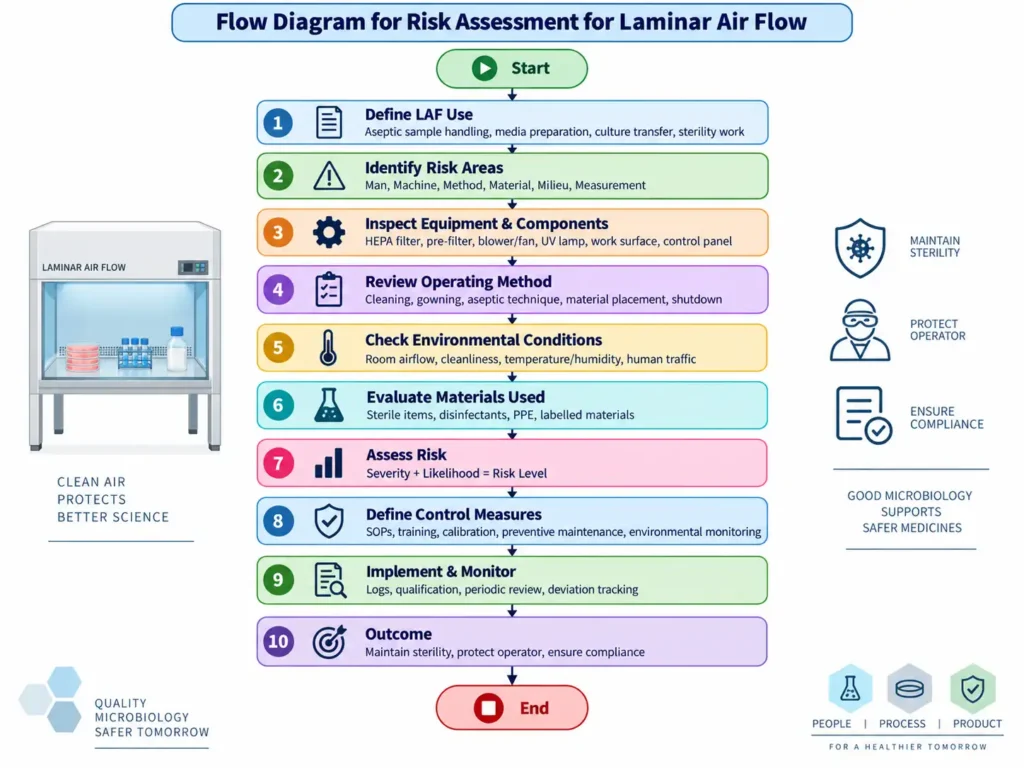
Skip to PDF content2. Flow Diagram for Risk Assessment for Laminar Air Flow::
The flow diagram explains in a simple way how to perform a Risk Assessment for Laminar Air Flow (LAF). The process starts by understanding where and how the LAF is being used, such as for sample handling, media preparation, culture transfer, or sterility-related work. Next, possible risks are identified under areas like Man, Machine, Method, Material, Environment, and Measurement. The LAF equipment and its important parts, such as the HEPA filter, blower, UV lamp, work surface, and control system, are then checked. Operating practices, cleaning, gowning, material placement, environmental conditions, and operator activities are also reviewed. Each risk is assessed according to its severity and likelihood. Suitable control measures such as SOPs, training, calibration, preventive maintenance, and environmental monitoring are applied. Finally, the controls are monitored regularly to maintain cleanliness, reduce contamination, protect the operator, and ensure GMP compliance.
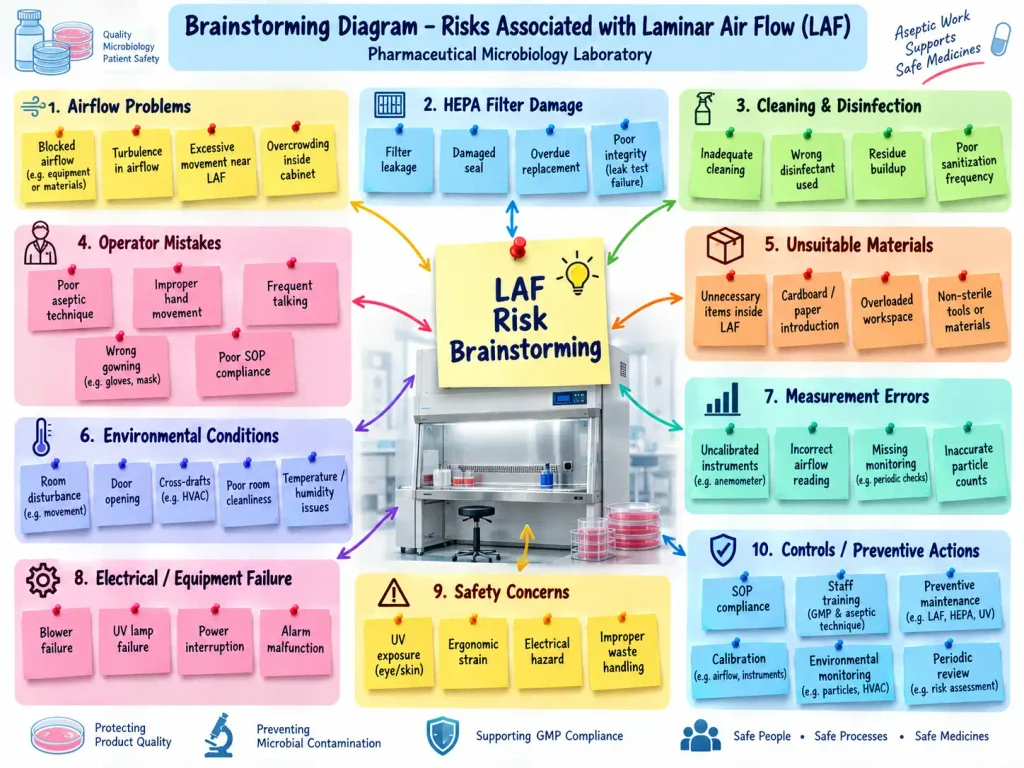
3. Brainstorming for Risk Assessment for Laminar Air Flow:
The brainstorming diagram highlights the main possible risks connected with the use of a Laminar Air Flow (LAF) unit in a pharmaceutical microbiology laboratory. It helps the team think about different problems that may affect clean airflow, sterility, equipment performance, and operator safety. The diagram covers important risk areas such as airflow problems, HEPA filter damage, poor cleaning and disinfection, operator mistakes, unsuitable materials inside the LAF, environmental conditions, measurement errors, electrical or equipment failures, and safety concerns. Examples include blocked airflow, filter leakage, poor aseptic technique, uncalibrated instruments, blower failure, UV exposure, and excessive movement around the LAF. The brainstorming exercise also identifies suitable controls such as SOP compliance, staff training, preventive maintenance, calibration, monitoring, and periodic review. This approach helps identify risks early, reduce contamination, maintain proper LAF performance, and support safe and GMP-compliant laboratory operations.
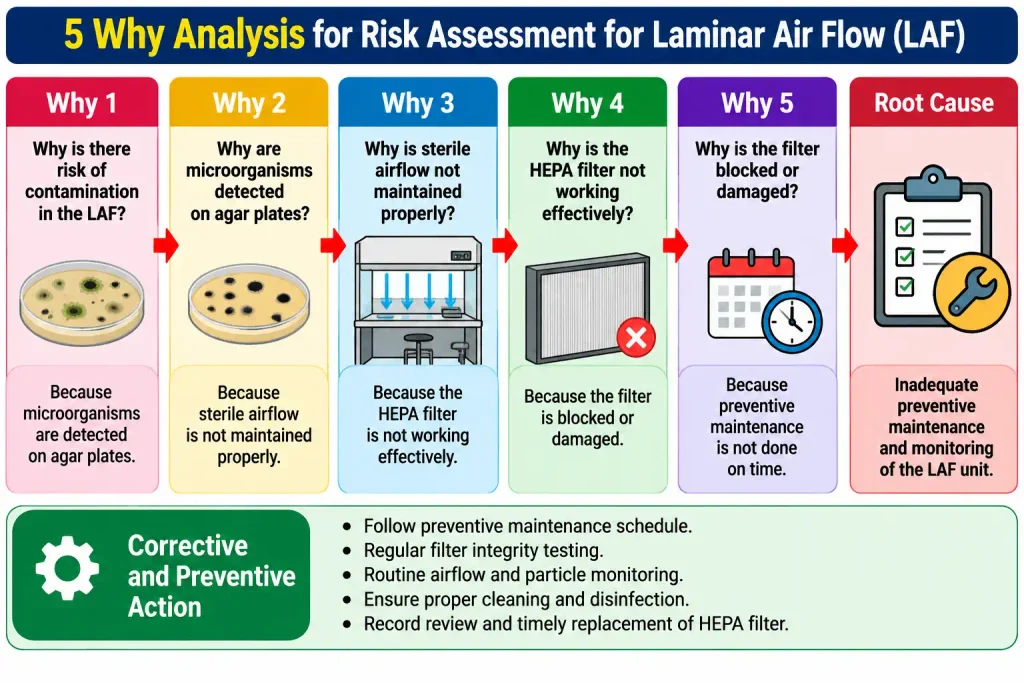
4. 5 Why Analysis for Risk Assessment of Laminar Air Flow (LAF):
The 5 Why Analysis identifies the root cause of contamination risk associated with the Laminar Air Flow (LAF) unit. The analysis begins with microbial contamination and progressively examines possible causes such as improper sterile airflow, ineffective HEPA filtration, blocked or damaged filters, and delayed preventive maintenance. By repeatedly asking “Why?”, the investigation moves from the visible problem to the underlying system weakness. The identified root cause is inadequate preventive maintenance and monitoring of the LAF unit. Appropriate controls include scheduled maintenance, HEPA filter integrity testing, airflow monitoring, cleaning and disinfection, timely filter replacement, and proper documentation to ensure reliable and GMP-compliant LAF performance.
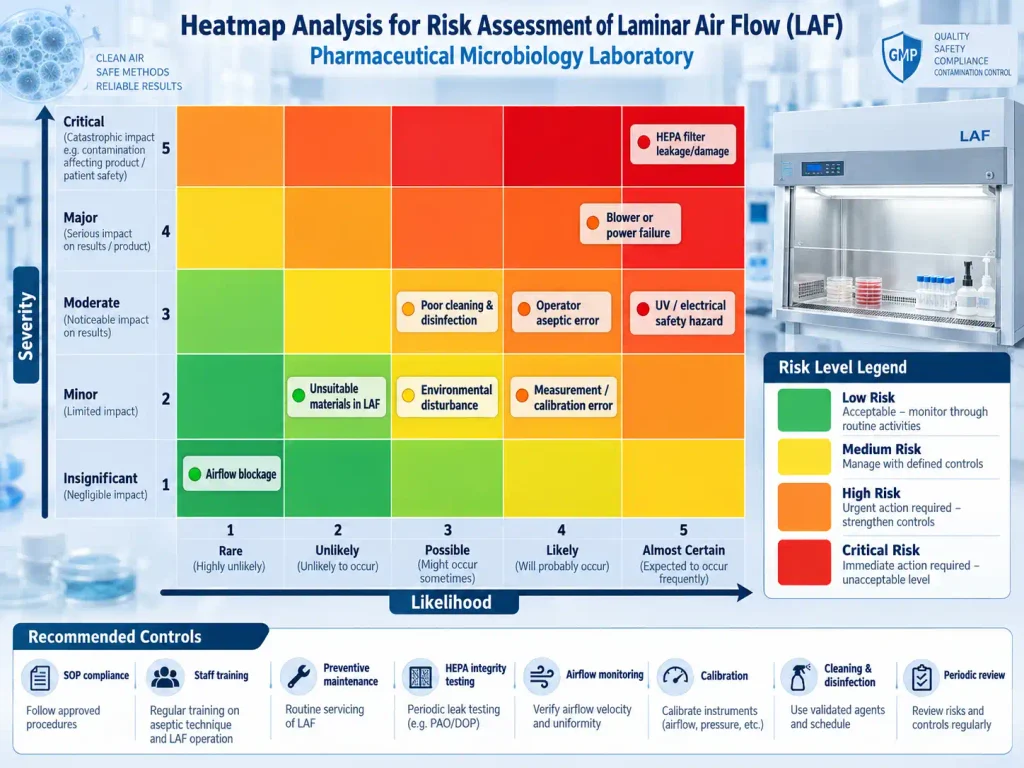
5. Heat Map Analysis for Risk Assessment of Laminar Air Flow (LAF):
The Heat Map Analysis evaluates risks associated with the Laminar Air Flow (LAF) unit by considering severity and likelihood of occurrence. Risks are classified into low, medium, high, and critical levels using a color-coded matrix. Critical risks may include HEPA filter leakage, airflow failure, or blower malfunction because these conditions can directly affect contamination control. Medium and high risks include improper cleaning, operator errors, environmental disturbances, and calibration failures. Low risks are generally manageable through routine controls. The heat map helps prioritize actions such as preventive maintenance, HEPA integrity testing, airflow monitoring, calibration, staff training, cleaning, and periodic risk review.
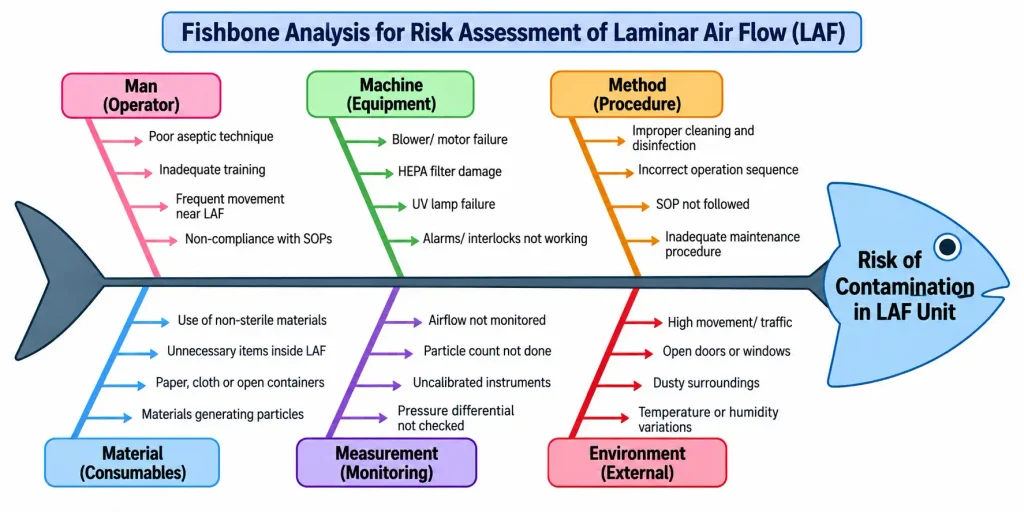
6. Fishbone Analysis for Risk Assessment of Laminar Air Flow (LAF):
The Fishbone Analysis identifies the major causes that may increase contamination risk during operation of a Laminar Air Flow (LAF) unit. The causes are grouped under Man, Machine, Method, Material, Measurement, and Environment. Potential risks include poor aseptic practices, inadequate training, HEPA filter damage, blower failure, improper cleaning, incorrect operating procedures, unsuitable materials, uncalibrated instruments, poor airflow monitoring, high personnel movement, and unfavorable environmental conditions. By organizing possible causes into clear categories, the fishbone diagram supports systematic risk identification and investigation. It helps determine areas requiring control, monitoring, maintenance, training, and procedural improvement to ensure reliable and GMP-compliant LAF operation.
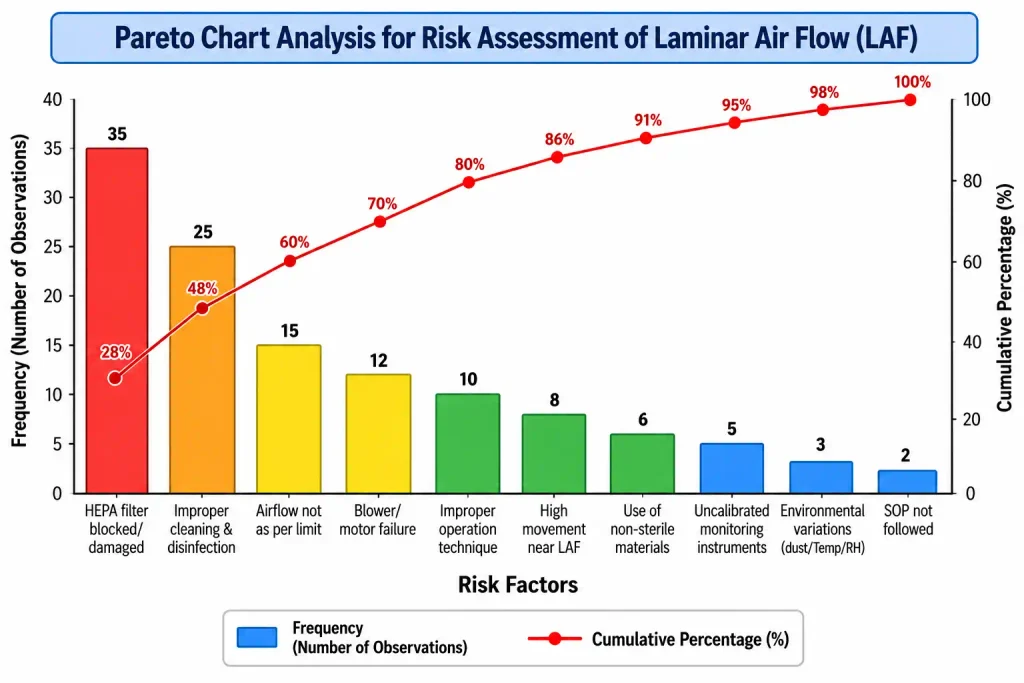
7. Pareto Chart Analysis for Risk Assessment of Laminar Air Flow (LAF):
The Pareto Chart Analysis helps prioritize the major risk factors affecting Laminar Air Flow (LAF) performance by arranging them according to their frequency or contribution. Higher-priority risks include HEPA filter blockage or damage, improper cleaning and disinfection, airflow deviations, blower failure, and incorrect operating practices. The cumulative percentage line shows how a small number of causes may contribute to most LAF-related risks. This supports the 80/20 principle and helps focus corrective actions on the most significant issues first. The analysis assists in improving contamination control, maintenance planning, operator practices, monitoring, and overall GMP compliance of the LAF system.
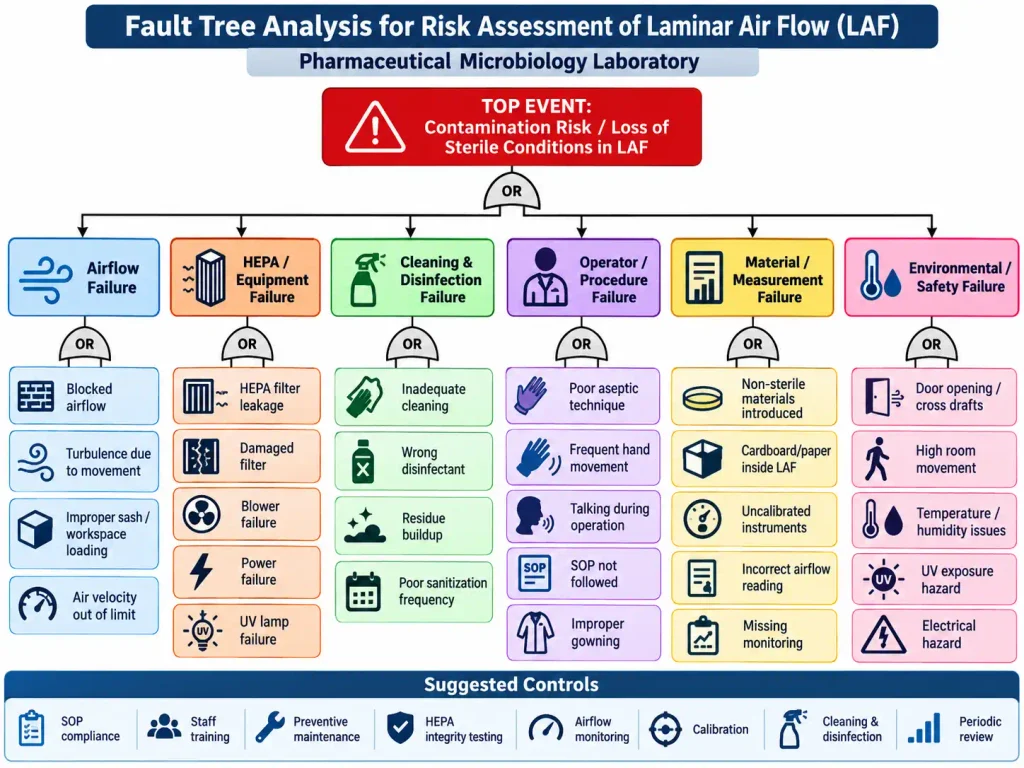
8. Fault Tree Analysis for Risk Assessment of Laminar Air Flow (LAF):
Fault Tree Analysis systematically identifies the possible causes that may lead to contamination or loss of sterile conditions in a Laminar Air Flow (LAF) unit. The top event is linked to major failure categories including airflow failure, HEPA or equipment failure, improper cleaning and disinfection, operator or procedural errors, unsuitable materials, measurement failures, and environmental or safety issues. Each category is further divided into specific causes such as blocked airflow, filter leakage, blower failure, poor aseptic technique, uncalibrated instruments, and environmental disturbances. The analysis supports root-cause identification, risk prioritization, preventive maintenance, monitoring, and effective GMP-compliant contamination-control measures.
9. Corrective Action and Preventive Action (CAPA) for Risk Assessment of Laminar Air Flow (LAF):
| Risk / Issue | Corrective Action | Preventive Action | Effectiveness Check |
|---|---|---|---|
| HEPA filter leakage or damage | Stop LAF use, inspect HEPA filter, repair/replace damaged filter and perform integrity testing. | Establish periodic HEPA integrity testing and replacement criteria. | Verify successful integrity test and acceptable particle counts. |
| Air velocity out of limit | Adjust blower setting, inspect airflow obstruction and requalify airflow velocity. | Perform scheduled airflow velocity monitoring and preventive maintenance. | Confirm velocity remains within established limits during repeated checks. |
| Blower or motor failure | Repair or replace defective blower/motor and verify operation before release. | Include blower and motor inspection in preventive maintenance schedule. | Review equipment performance and breakdown history. |
| Improper cleaning/disinfection | Re-clean and disinfect the LAF using approved disinfectant and procedure. | Train personnel and implement defined cleaning frequency with checklist. | Review cleaning records and environmental monitoring results. |
| Poor aseptic technique | Stop activity, assess affected work and retrain the operator. | Conduct periodic aseptic-practice training and competency assessment. | Observe operator practices and document successful reassessment. |
| SOP not followed | Investigate deviation, correct the activity and retrain concerned personnel. | Periodically review SOP compliance through supervision and internal audits. | Confirm no repeat deviation during the defined review period. |
| Uncalibrated monitoring instruments | Remove instrument from use and calibrate or replace it. | Maintain calibration schedule with due-date tracking and status labels. | Verify calibration status and review subsequent readings. |
| Unsuitable materials inside LAF | Remove unnecessary, particle-generating or non-sterile materials. | Define permitted materials and loading practices in the SOP. | Routine observation of LAF workspace during operations. |
| Excessive movement/cross-drafts | Restrict movement, close nearby doors and stabilize the work area. | Control personnel traffic and define working-zone requirements around LAF. | Confirm stable airflow during smoke study or airflow visualization. |
| UV lamp malfunction | Replace defective UV lamp and verify functional performance. | Maintain lamp usage-hour records and scheduled replacement. | Check UV functionality and replacement records periodically. |
| Environmental conditions out of limit | Correct room temperature, humidity or HVAC condition before LAF use. | Monitor environmental parameters continuously or at defined frequency. | Trend environmental data for compliance. |
| Repeated contamination/monitoring failure | Stop affected activities, perform investigation, sanitize LAF and assess product/sample impact. | Strengthen environmental monitoring, trending and periodic risk review. | Demonstrate satisfactory monitoring results with no recurrence. |
The overall CAPA objective is to ensure that the LAF consistently provides clean, unidirectional HEPA-filtered airflow, minimizes contamination risk, protects laboratory activities, and remains in a qualified state through maintenance, monitoring, calibration, cleaning, training, and periodic review.
10. Questions and Answers – Risk Assessment of Laminar Air Flow (LAF):
- What is the purpose of risk assessment for a Laminar Air Flow unit?
The purpose is to identify, evaluate, and control risks that may affect airflow quality, contamination control, equipment performance, operator safety, and laboratory activities. - What are the major risks associated with LAF operation?
Major risks include HEPA filter leakage, airflow blockage, blower failure, improper cleaning, poor aseptic technique, uncalibrated instruments, environmental disturbances, and power failure. - Why is HEPA filter integrity important in an LAF unit?
HEPA filter integrity is important because any leakage or damage can allow particles and microorganisms to enter the critical work zone. - How can airflow disturbance affect LAF performance?
Airflow disturbance may create turbulence, reduce unidirectional airflow, and increase the possibility of contamination. - What can cause airflow blockage inside the LAF?
Excessive materials, improper equipment placement, overcrowding, and blocked grills can restrict airflow. - Why is proper cleaning and disinfection necessary?
Proper cleaning and disinfection remove residues and microorganisms that could contaminate samples, media, or laboratory materials. - How can operators contribute to contamination risk?
Poor aseptic technique, frequent hand movement, talking, improper gowning, and non-compliance with SOPs can increase contamination risk. - Why should materials inside the LAF be minimized?
Excessive or unsuitable materials may generate particles, obstruct airflow, and interfere with clean working conditions. - Why is preventive maintenance important for LAF?
Preventive maintenance helps detect equipment deterioration before failure and ensures continued reliable operation. - What parameters should be monitored for LAF performance?
Typical parameters include airflow velocity, HEPA filter integrity, particle count, airflow pattern, differential pressure where applicable, and equipment functionality. - Why should monitoring instruments be calibrated?
Calibration ensures that measurements used to assess LAF performance are accurate and reliable. - How can environmental conditions affect LAF performance?
Door opening, cross-drafts, high personnel movement, temperature variation, and surrounding contamination can disturb airflow. - What should be done if the HEPA filter fails an integrity test?
The LAF should be taken out of service, the filter should be repaired or replaced, and requalification should be completed before reuse. - What should be done if airflow velocity is out of limit?
The equipment should be investigated for blower problems, filter blockage, or obstruction, followed by adjustment and requalification. - How is the risk level determined during LAF risk assessment?
Risk is generally evaluated based on severity, likelihood or occurrence, and sometimes detectability, depending on the approved risk-management method. - What is the role of SOPs in controlling LAF risks?
SOPs provide standardized instructions for operation, cleaning, monitoring, maintenance, and handling of abnormal conditions. - Why is staff training important?
Training ensures that personnel understand correct aseptic practices, LAF operation, cleaning procedures, and contamination-control requirements. - What should be done after a contamination event inside the LAF?
The activity should be stopped, the event investigated, affected work assessed, the LAF cleaned and disinfected, and appropriate CAPA implemented. - How is CAPA linked with LAF risk assessment?
CAPA addresses identified weaknesses through corrective actions for existing problems and preventive actions to reduce recurrence. - How often should the LAF risk assessment be reviewed?
It should be reviewed periodically and whenever significant changes, repeated failures, deviations, maintenance issues, qualification failures, or process changes occur.
11. Reference Guidelines – Risk Assessment of Laminar Air Flow (LAF):
- ICH Q9(R1) – Quality Risk Management — applicable for systematic identification, analysis, evaluation, control, communication, and review of risks associated with LAF operation.
- WHO Technical Report Series No. 961, Annex 2 – Good Practices for Pharmaceutical Microbiology Laboratories — provides guidance on microbiology laboratory environment, cleaning and disinfection, equipment maintenance, qualification, calibration, and monitoring. World Health Organization
- EU GMP Annex 1 – Manufacture of Sterile Medicinal Products (2022) — provides requirements and principles for contamination control, unidirectional airflow, HEPA filtration, environmental monitoring, qualification, and sterile operations. Public Health
- WHO TRS No. 1044, Annex 2 – WHO GMP for Sterile Pharmaceutical Products — relevant for clean areas, contamination-control practices, environmental monitoring, and sterile processing requirements. World Health Organization
- ISO 14644-1:2015 – Cleanrooms and Associated Controlled Environments, Part 1 — specifies classification of air cleanliness based on airborne particle concentration. ISO
- ISO 14644-2 – Monitoring to Provide Evidence of Cleanroom Performance Related to Air Cleanliness by Particle Concentration — useful for establishing periodic monitoring and continued clean-area performance verification.
- ISO 14644-3 – Test Methods — applicable to cleanroom/LAF performance testing such as airflow velocity, airflow visualization, filter integrity, and related qualification tests.
- USP General Chapter <797> – Pharmaceutical Compounding—Sterile Preparations — provides principles for maintaining controlled environments and preventing microbial, particulate, and other contamination during sterile preparation activities.