





Brief Description
This document explains the risk assessment for a Sampling and Cleaning Station used for handling and sampling highly potent drug materials. The main purpose is to identify possible problems before the equipment is installed and used. It checks risks related to product quality, operator safety, cleaning, air filtration, containment, equipment design, materials of construction, utilities, maintenance, instruments, and documentation. Each identified risk is rated as low, medium, or high based on its possible impact and likelihood. Suitable control measures are then suggested to reduce the risk to an acceptable level. Important controls include HEPA filtration, leak-proof containment, proper cleaning arrangements, correct drainage, suitable stainless-steel surfaces, calibrated instruments, safe gloves, proper labeling, maintenance procedures, and trained operators. The document also explains how these controls should be verified during installation and operational qualification. Overall, the assessment helps ensure safe, reliable, clean, and GMP-compliant operation of the Sampling and Cleaning Station during use.
Skip to PDF content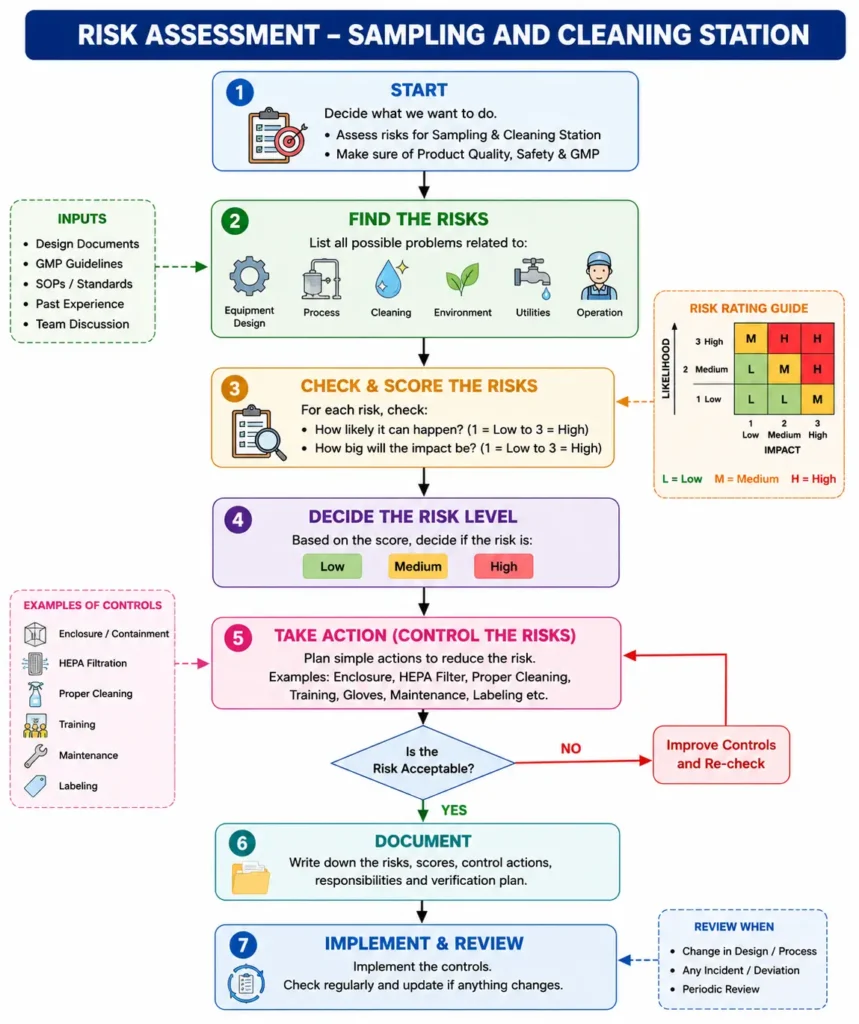
Impact Assessment
The Sampling and Cleaning Station has an important impact on product quality, operator safety, and the working environment. If the station is not properly designed, cleaned, maintained, or operated, highly potent powder may leak, contaminate the area, or expose the operator. Improper air filtration, poor containment, damaged gloves, wrong material of construction, incomplete drainage, or uncalibrated instruments can also create quality and safety problems. The risk assessment helps identify these possible problems before routine use. Suitable controls such as HEPA filters, leak-proof connections, proper cleaning arrangements, stainless-steel contact parts, correct drainage, calibrated instruments, preventive maintenance, SOPs, and operator training help reduce these risks. The document also requires checking these controls during qualification and operation. Overall, this assessment has a positive impact because it helps prevent contamination, protects employees, supports GMP compliance, improves equipment reliability, and ensures that sampling and cleaning activities are performed safely and consistently during normal plant operations.
Critical Process Parameters (CPP) & Critical Quality Attributes (CQA)
The document does not specifically label items as CPPs or CQAs. The following are practical CPP/CQA equivalents inferred from the risks and controls listed for the Sampling and Cleaning Station.
| Critical Process / Operational Parameter | Why Critical | Related Quality Attribute |
|---|---|---|
| Containment / Negative Pressure | Prevents potent powder from escaping into the room | No powder leakage / cross-contamination |
| HEPA Filter Performance | Maintains clean supply and exhaust air | Clean, contamination-free environment |
| Chamber Differential Pressure | Confirms proper containment condition | Controlled sampling environment |
| Sampling Operation | Ensures representative material is collected safely | Correct and uncontaminated sample |
| Cleaning Effectiveness | Prevents residue from previous material | Clean equipment surface |
| Drainage after Cleaning | Prevents standing water and microbial growth | Dry, hygienic equipment |
| Product Contact Surface MOC | Prevents corrosion or product reaction | Product purity and safety |
| Surface Finish | Reduces particle and microbial accumulation | Cleanable, contamination-free surface |
| Gasket / Seal Integrity | Prevents leakage and contamination | Proper containment and product protection |
| Glove Integrity | Prevents exposure and contamination during sampling | Safe and contamination-free handling |
| Instrument Calibration | Ensures pressure and other measurements are reliable | Accurate process monitoring |
| Equipment Dryness | Prevents microbial growth after cleaning | Dry and hygienic sampling area |
The assessment particularly emphasizes HEPA filtration, cleaning, containment, material of construction, drainage, instrument calibration, and operator controls as important factors for safe and GMP-compliant operation.
Questions & Answers
Q1. What is the purpose of this Risk Assessment?
Answer: It is used to identify possible risks related to the Sampling and Cleaning Station and define suitable controls before the equipment is used.
Q2. What is a Sampling and Cleaning Station used for?
Answer: It is used for safe sampling of highly potent drug materials where high containment is required.
Q3. What types of risks are checked?
Answer: GMP, EHS, operational, cleaning, utility, maintenance, contamination, equipment design, and documentation-related risks are checked.
Q4. How are risks classified?
Answer: Risks are classified as Low, Medium, or High based on likelihood and impact.
Q5. Why is containment important?
Answer: Proper containment prevents highly potent powder from leaking into the room and reduces operator exposure and cross-contamination.
Q6. Why are HEPA filters required?
Answer: HEPA filters help provide clean supply and exhaust air and reduce the risk of contamination.
Q7. Why is proper cleaning important?
Answer: Proper cleaning prevents leftover particles from contaminating the cleanroom or the next material being sampled.
Q8. Why should water drain completely after cleaning?
Answer: Standing water can increase microbial growth. Therefore, proper slope and drainage are required.
Q9. What material is recommended for product-contact surfaces?
Answer: Product-contact metallic surfaces should be SS 316 or better with suitable smooth surface finishing.
Q10. Why is negative pressure maintained inside the isolator?
Answer: Negative pressure helps prevent powder from leaking from the isolator into the surrounding room.
Q11. Why are measuring instruments calibrated?
Answer: Calibration ensures that measuring instruments give reliable results and are suitable for use.
Q12. Why are operators required to be trained?
Answer: Trained operators can use the equipment correctly and safely and reduce the chance of operational mistakes or accidents.
Q13. Why are SOPs required?
Answer: SOPs provide clear instructions for operation, cleaning, and maintenance so that activities are performed correctly and consistently.
Q14. When are the risk controls verified?
Answer: Risk controls are checked during activities such as IQ, OQ, facility qualification, SOP verification, and calibration review, depending on the identified risk.
Q15. What is the final conclusion of the Risk Assessment?
Answer: The assessment helps reduce the chance of failure of critical parameters during equipment design, installation, commissioning, operation, and performance.