




1. Introduction for Risk Assessment on Cross Contamination in Existing Manufacturing Facility:
This risk assessment evaluates potential cross-contamination hazards in the existing manufacturing facility using severity, occurrence, detection, and Risk Priority Number (RPN). It reviews risks related to facility design and flow, line clearance and labeling, personnel and material movement, gowning practices, airborne transfer, and cleaning or sampling activities. Existing controls include GMP-compliant surfaces, airlocks, pressure differentials, defined SOPs, personnel training, sanitization, equipment hold-time validation, and cleaning validation sampling. One additional containment action is proposed for common-corridor movement through an interlock system. Overall, the assessment concludes that identified risks are acceptable and should remain controlled through routine monitoring of established control measures.
Skip to PDF content2. Flow Diagram for Risk Assessment on Cross Contamination:
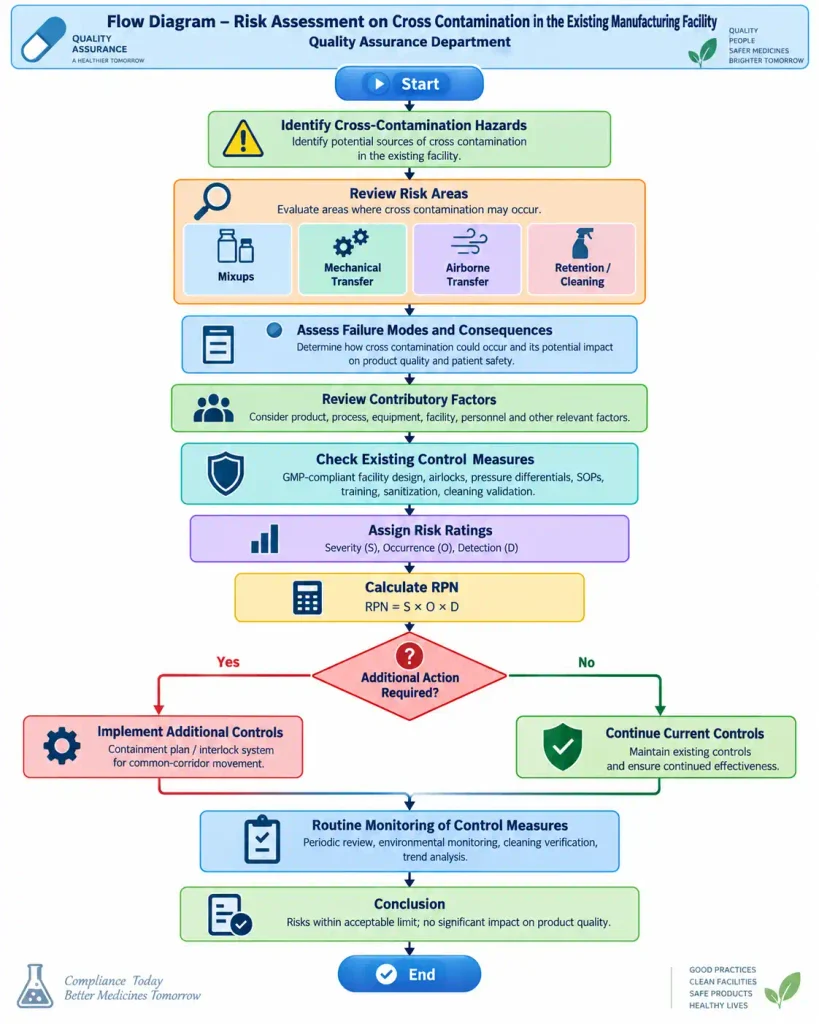
The flow diagram summarizes the systematic assessment of cross-contamination risks within the existing manufacturing facility. It begins with identification of hazards and review of major risk areas, including mixups, mechanical transfer, airborne transfer, and retention or cleaning-related concerns. Potential failure modes, consequences, contributory factors, and existing control measures are then evaluated. Risk ratings for Severity, Occurrence, and Detection are assigned to calculate the Risk Priority Number (RPN). Based on the risk evaluation, additional controls may be implemented where required, while acceptable risks continue under existing controls. Routine monitoring ensures continued effectiveness and maintenance of product quality.
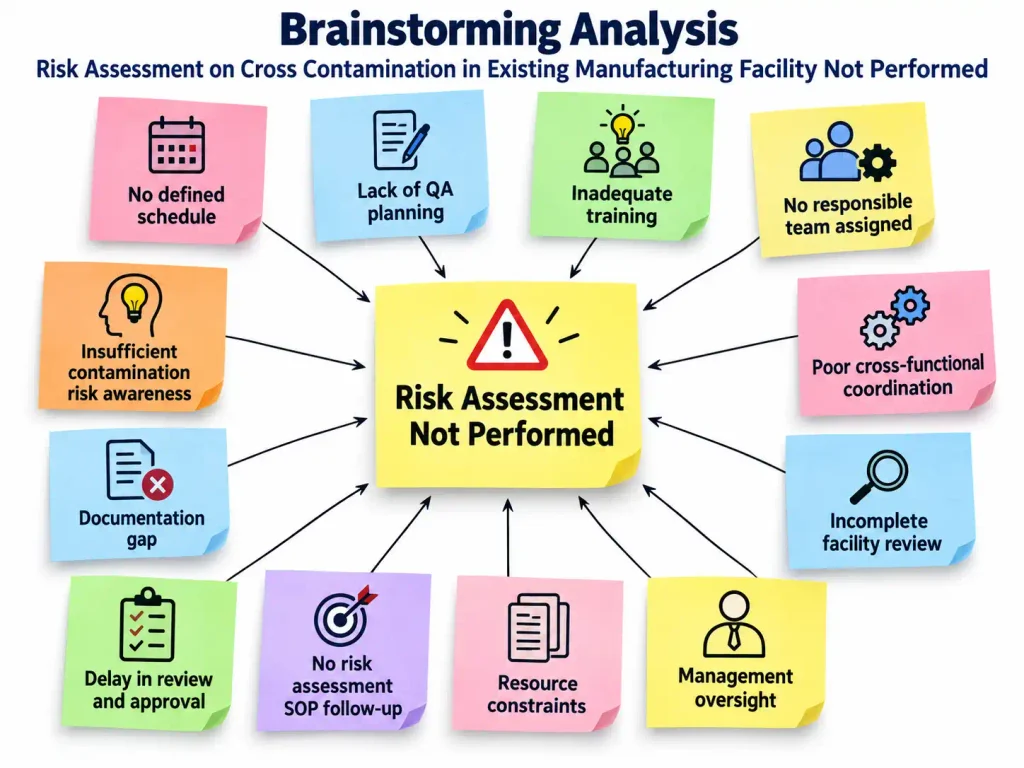
3. Brainstorming Analysis for Risk Assessment for the Cross Contamination in the Common Corridor not performed:
The brainstorming analysis identifies possible reasons why the risk assessment for cross contamination in the existing manufacturing facility was not performed. Major contributing factors include lack of a defined schedule, inadequate QA planning, insufficient training, absence of an assigned responsible team, poor cross-functional coordination, incomplete facility review, and limited awareness of contamination risks. Documentation gaps, resource constraints, management oversight, delayed review and approval, and inadequate follow-up of the risk assessment procedure may also contribute. This analysis helps the Quality Assurance team recognize potential systemic weaknesses and supports development of appropriate corrective and preventive actions to ensure timely risk assessment and GMP compliance.
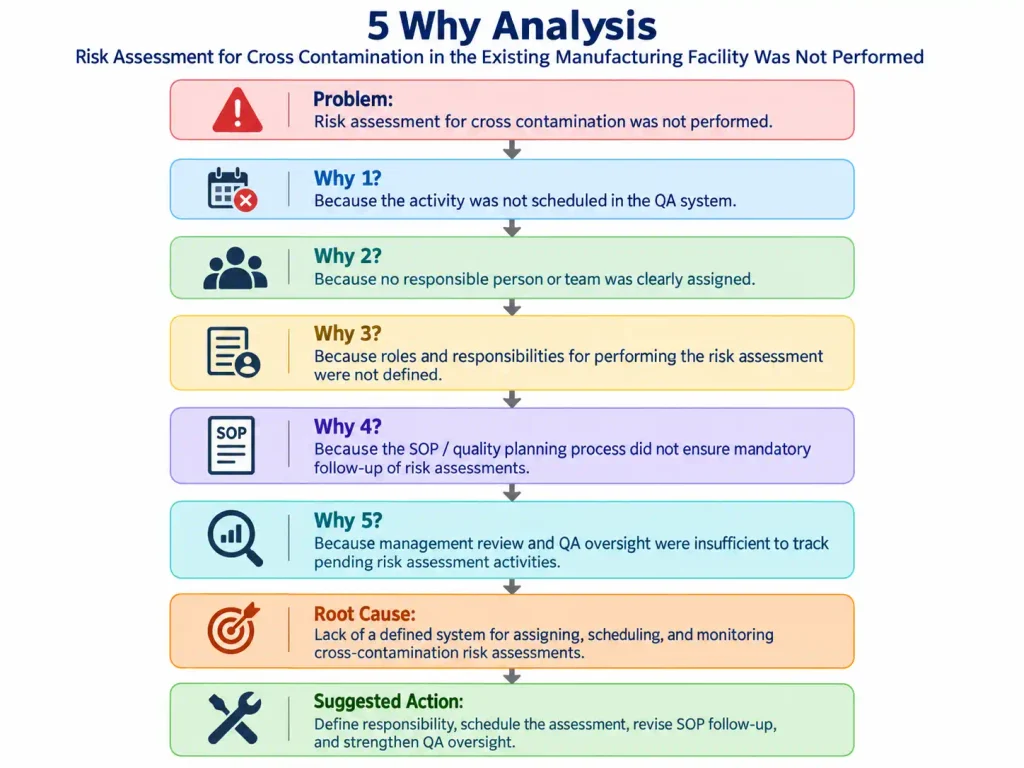
4. 5 Why Analysis for Risk Assessment for the Cross Contamination in the Common Corridor not performed:
The 5 Why Analysis identifies the underlying reasons why the cross-contamination risk assessment for the existing manufacturing facility was not performed. The analysis indicates that the activity was not scheduled, no responsible person or team was clearly assigned, and defined roles and responsibilities were lacking. It further highlights inadequate SOP or quality-planning follow-up and insufficient QA or management oversight for tracking pending risk assessment activities. The identified root cause is the absence of a structured system for assigning, scheduling, and monitoring risk assessments. Corrective action should focus on defining responsibilities, scheduling assessments, strengthening SOP follow-up, and improving QA oversight.
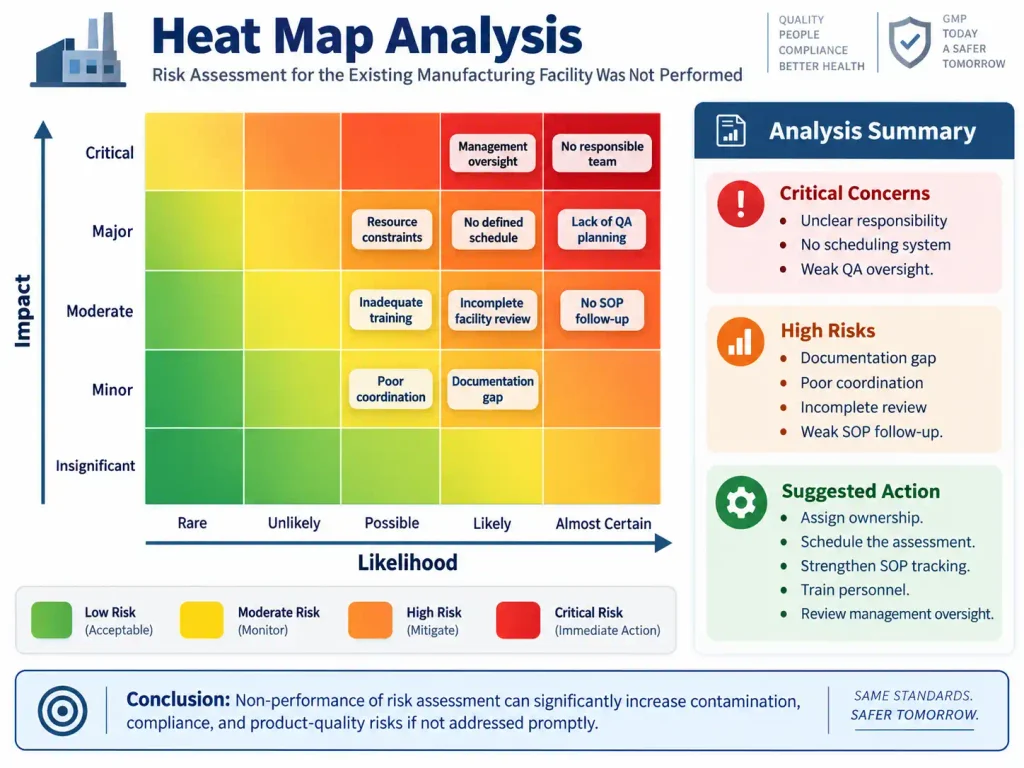
5. Heat Map Analysis for Risk Assessment for the Cross Contamination in the Common Corridor not performed:
The heat map analysis evaluates risks arising from failure to perform the risk assessment for the existing manufacturing facility. Risks are categorized according to their impact and likelihood, ranging from low to critical. Major concerns include unclear responsibility, absence of a defined schedule, weak QA planning, management oversight, inadequate SOP follow-up, and incomplete facility review. Supporting factors such as poor coordination, documentation gaps, insufficient training, and resource constraints also increase overall risk. The analysis helps prioritize corrective actions, including assigning ownership, scheduling the assessment, strengthening SOP tracking, improving training, and enhancing management oversight to maintain GMP compliance and product quality.
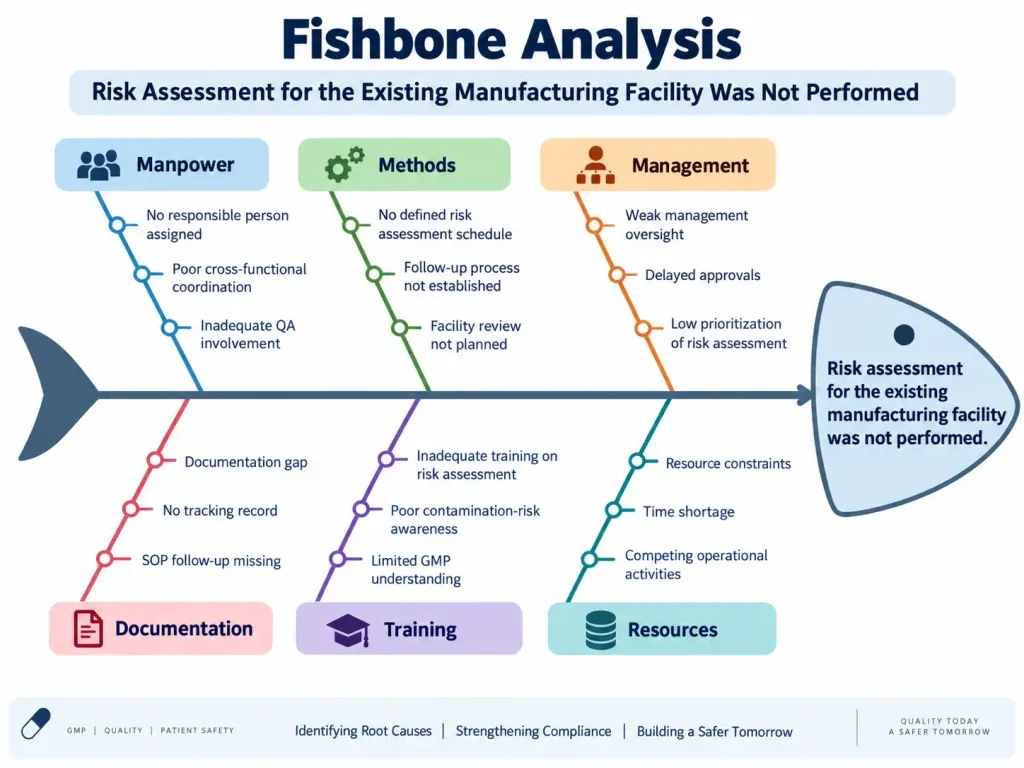
6. Fishbone Analysis for Risk Assessment for the Cross Contamination in the Common Corridor not performed:
The Fishbone Analysis identifies potential causes for failure to perform the risk assessment for the existing manufacturing facility. The causes are grouped under six major categories: Manpower, Methods, Management, Documentation, Training, and Resources. Key issues include unclear responsibility, poor cross-functional coordination, absence of a defined assessment schedule, inadequate follow-up, weak management oversight, delayed approvals, documentation gaps, insufficient training, limited GMP awareness, resource constraints, and time shortages. This structured analysis helps identify possible root causes and supports development of appropriate corrective and preventive actions to ensure timely completion of risk assessments, improved QA oversight, GMP compliance, and effective contamination-risk control.
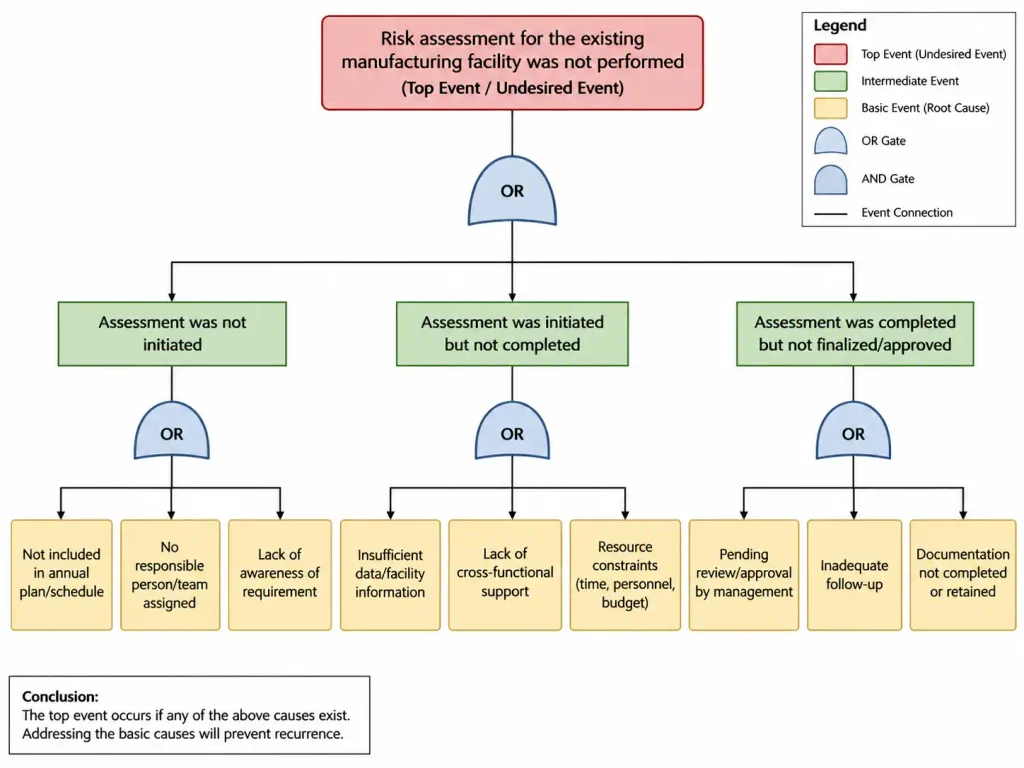
7. Fault Tree Analysis for Risk Assessment for the Cross Contamination in the Common Corridor not performed:
The Fault Tree Analysis identifies possible pathways leading to failure to perform the risk assessment for the existing manufacturing facility. The top undesired event is linked through OR gates to three major conditions: the assessment was not initiated, it was initiated but not completed, or it was completed but not finalized and approved. Basic causes include absence from the annual schedule, unclear responsibility, insufficient awareness, inadequate facility information, poor cross-functional support, resource constraints, pending management approval, weak follow-up, and incomplete documentation. Addressing these underlying causes helps prevent recurrence and strengthens risk-management, QA oversight, and GMP compliance.
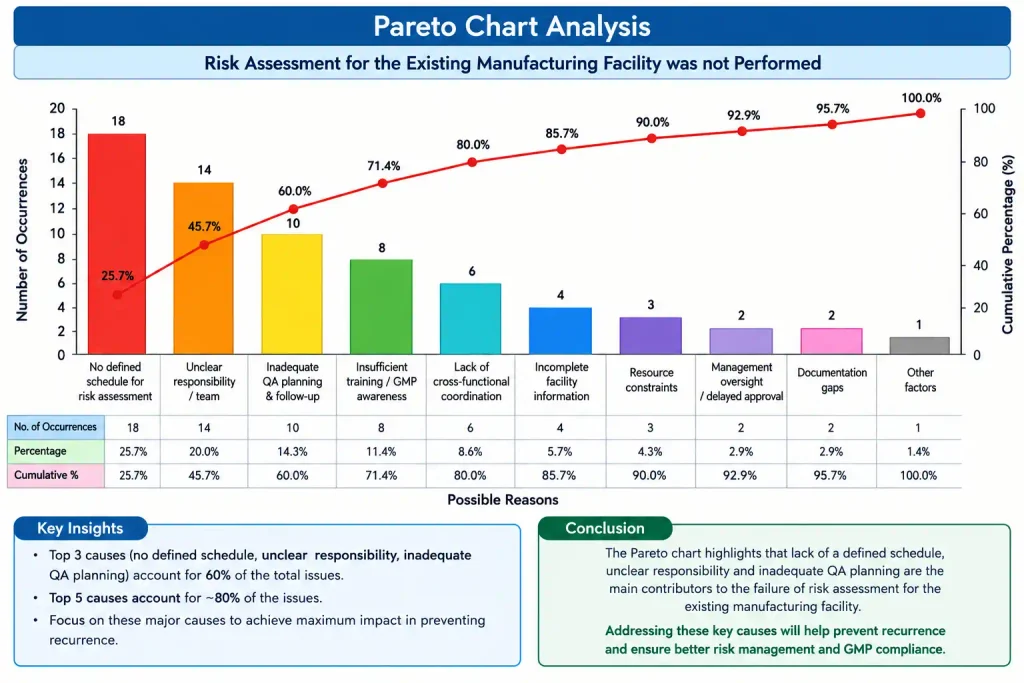
8. Pareto Chart Analysis for Risk Assessment for the Cross Contamination in the Common Corridor not performed:
The Pareto Chart Analysis identifies and prioritizes the main causes responsible for failure to perform the risk assessment for the existing manufacturing facility. The chart shows that the most significant contributors are absence of a defined assessment schedule, unclear responsibility, inadequate QA planning and follow-up, insufficient training, and weak cross-functional coordination. The cumulative percentage line helps distinguish the few major causes contributing to most of the problem. Focusing corrective actions on these priority areas can provide maximum improvement. Establishing clear scheduling, defined ownership, effective QA monitoring, adequate training, and timely follow-up will strengthen risk-management practices and support GMP compliance.
9. Corrective Action & Preventive Action (CAPA):
Risk Assessment for the Existing Manufacturing Facility Was Not Performed
The original document is a QA risk assessment addressing cross-contamination risks in the existing manufacturing facility, including facility design, personnel/material movement, airborne transfer, and cleaning controls. The following CAPA is proposed for the scenario where this assessment was not performed.
| No. | Type | Action |
|---|---|---|
| 1 | Correction | Immediately initiate and complete the cross-contamination risk assessment for the existing manufacturing facility. |
| 2 | Corrective Action | Form a cross-functional team comprising QA, Production, Engineering, QC/Microbiology, and EHS, as applicable. |
| 3 | Corrective Action | Review facility design, personnel/material flow, airlocks, pressure differentials, gowning, cleaning, labeling, and contamination-control practices. |
| 4 | Corrective Action | Identify failure modes, consequences, contributory factors, existing controls, and calculate RPN using Severity × Occurrence × Detection. |
| 5 | Corrective Action | Define responsible persons and target dates for all additional risk-control measures identified during assessment. |
| 6 | Corrective Action | Investigate why the assessment was missed and document the root cause through an approved RCA process. |
| 7 | Preventive Action | Revise the Risk Management SOP to clearly define responsibility, initiation criteria, approval, periodic review, and follow-up requirements. |
| 8 | Preventive Action | Introduce an annual Risk Assessment Master Schedule/Tracker with due dates, owners, status, and escalation requirements. |
| 9 | Preventive Action | Train QA and concerned departmental personnel on risk assessment methodology, cross-contamination risks, and RPN calculation. |
| 10 | Preventive Action | Include pending and overdue risk assessments in periodic QA review and Management Review Meetings. |
| 11 | Preventive Action | Establish an escalation mechanism for assessments approaching or exceeding their due dates. |
| 12 | Preventive Action | Periodically review risk assessments following facility, equipment, HVAC, process, product, or regulatory changes. |
Effectiveness Review
CAPA effectiveness should be verified after 3–6 months by confirming that the cross-contamination risk assessment has been completed and approved, all identified actions are closed within their target dates, responsible personnel are trained, and the risk-assessment tracker contains no unjustified overdue activities. QA should also review subsequent risk assessments for compliance with the revised procedure. Effectiveness criterion: 100% completion of scheduled risk assessments within the defined timeline, with documented follow-up of all identified risk-control actions.
10. Questions & Answers – Risk Assessment on Cross Contamination in Existing Manufacturing Facility:
Q1. What is the purpose of this risk assessment?
Answer: The purpose is to identify, evaluate, and control potential cross-contamination risks within the existing manufacturing facility and assess whether existing control measures are adequate.
Q2. What major cross-contamination risks are evaluated?
Answer: The assessment considers mix-ups, facility design and flow, labeling and line clearance, mechanical transfer, personnel and material movement, gowning, airborne transfer, and cleaning-related risks.
Q3. How is risk evaluated in this assessment?
Answer: Risk is evaluated using Severity (S), Occurrence (O), and Detection (D), with the Risk Priority Number calculated as RPN = S × O × D.
Q4. What can improper facility design cause?
Answer: Improper building or facility design may contribute to cross contamination and product failure.
Q5. What controls are used for facility design and flow?
Answer: Controls include GMP-compliant surfaces, suitable pipework and utilities, controlled entry and exit procedures, airlocks, pressure differentials, air supply, and extraction systems.
Q6. Why are line clearance and labeling important?
Answer: Proper line clearance and labeling help prevent mix-ups and product failure by ensuring materials and in-process items are correctly identified before activities begin.
Q7. What risk is associated with personnel and material movement?
Answer: Improper movement through common corridors may lead to product contamination, market complaints, product failure, and regulatory observations.
Q8. What additional action was identified for personnel and material movement?
Answer: The assessment recommends introducing a containment plan, including an interlock system, to reduce cross-contamination risk associated with common-corridor movement.
Q9. Why is gowning important for cross-contamination control?
Answer: Proper gowning, protective clothing, controlled movement, hygiene training, and health checks help prevent personnel-related contamination and cross contamination.
Q10. How is airborne contamination controlled?
Answer: Airborne contamination is controlled through defined sanitization procedures, validated equipment hold times, and established cleaning requirements.
Q11. What controls are used during cleaning validation sampling?
Answer: Controls include defined rinse and swab methods, sampling of hard-to-clean locations, suitable swabbing solvents, calculated acceptance limits, trained personnel, and testing of final rinse samples.
Q12. What is the overall conclusion of the risk assessment?
Answer: The document concludes that the identified potential failure modes fall within the accepted risk range and that cross-contamination controls should continue to be maintained through routine monitoring of established control measures.
11.0 Reference Guidelines:
- ICH Q9(R1) – Quality Risk Management
Provides the overall framework for risk identification, assessment, control, communication, and review. It also recognizes tools such as FMEA and Fault Tree Analysis. - EU GMP – EudraLex Volume 4, Part I, Chapter 3: Premises and Equipment
Covers facility layout, personnel/material flow, ventilation, prevention of mix-ups, dust control, cleaning, and measures to minimize cross-contamination. - EU GMP – EudraLex Volume 4, Part I, Chapter 5: Production
Includes GMP requirements for prevention and control of cross-contamination during pharmaceutical manufacturing. - WHO GMP for Pharmaceutical Products – Main Principles, TRS 986, Annex 2
Provides GMP principles applicable to pharmaceutical manufacturing facilities, production, personnel, premises, equipment, sanitation, and quality systems. - WHO GMP / Cleaning Validation Guidance
Emphasizes prevention of contamination and cross-contamination through appropriate cleaning procedures and validation. - WHO – Points to Consider when Including Health-Based Exposure Limits in Cleaning Validation, TRS 1033
Addresses cross-contamination in multi-product facilities and recommends technical and organizational controls, suitable HVAC systems, cleaning procedures, cleaning validation, and periodic review. - PIC/S Guide to GMP for Medicinal Products – PE 009-17
Provides GMP expectations relating to pharmaceutical quality systems, premises, equipment, production, contamination control, and risk management. - US FDA – 21 CFR Part 211, §211.42: Design and Construction Features
Requires adequate facility design, space, material flow, and defined areas to prevent contamination and mix-ups. - US FDA – 21 CFR Part 211, §211.67: Equipment Cleaning and Maintenance
Requires written cleaning procedures, defined responsibilities, cleaning schedules, equipment protection, inspection, and documentation to prevent contamination. - US FDA – 21 CFR Part 211, §211.113: Control of Microbiological Contamination
Requires written procedures for preventing objectionable microorganisms and microbiological contamination of pharmaceutical products. - India – Drugs Rules, 1945, Revised Schedule M: Good Manufacturing Practices
Covers GMP requirements for pharmaceutical premises, plant, equipment, material movement, prevention of mix-ups and contamination, documentation, and quality systems. CDSCO published the revised Schedule M notification as G.S.R. 922(E), dated 28 December 2023.