






Brief Description
The SOP for Safety Measures in Quality Control provides essential precautions to ensure safe working practices within the Quality Control laboratory. Its objective is to establish standardized safety requirements for QC personnel, with responsibility assigned to the QC Chemist, Assistant Manager-QC, and Head-QA/QC. The SOP emphasizes careful handling of hazardous chemicals, acids, alkalis, solvents, ammonia solution, and poisonous materials. It requires the use of suitable protective gloves, proper labeling and warning of hazardous chemicals, safe storage and disposal practices, and the use of a rubber bulb for pipetting acids and alkalis. It also prohibits storing food or drinking water in laboratory refrigerators. The procedure further requires laboratory equipment such as ovens, hot plates, water baths, and furnaces to be switched off after use, maintenance of clean working areas, operation of instruments according to approved SOPs, and proper labeling of reagents and volumetric solutions. Training is provided to Quality Control personnel by QC/QA management.
Skip to PDF content1. Flow Diagram:
The Flow Diagram presents the Safety Measures in Quality Control SOP in a simple three-stage approach: Verify, Implement, and Post-Use Actions. Before starting laboratory work, QC personnel should verify chemical and reagent labels, safe storage conditions, cleanliness of the workplace, availability of appropriate PPE, and readiness of laboratory instruments. During the Implement stage, personnel follow safe working practices such as handling ammonia and ether inside a fume cupboard, protecting the skin and eyes from acids, solvents, and toxic chemicals, using gloves where required, using a rubber bulb for pipetting acids and alkalis, and maintaining proper labeling and controlled storage of hazardous substances.
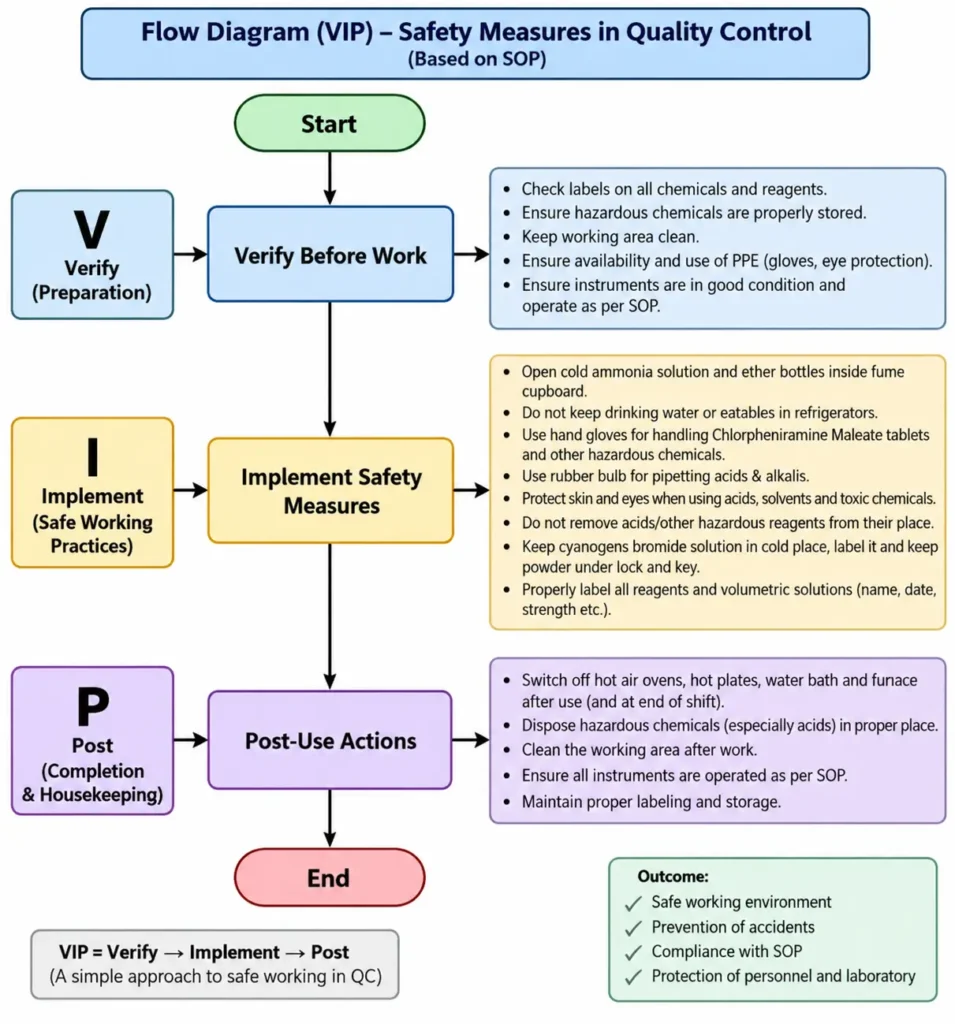
The Post-Use stage includes switching off heating equipment, safely disposing of hazardous chemicals, cleaning the work area, maintaining appropriate storage, and ensuring instruments are operated according to approved SOPs.Overall, the VIP approach supports accident prevention, personnel protection, laboratory safety, and consistent SOP compliance.
2. Brainstorming for SOP Failure:
The Brainstorming for SOP Failure – Chai ki Tapri Discussion presents a simple and engaging way to identify possible reasons for failure of the Safety Measures in Quality Control SOP. The discussion highlights key causes such as lack of training, poor awareness of the SOP, inadequate supervision, improper chemical labeling, non-use or unavailability of PPE, human error, poor housekeeping, inadequate storage and disposal practices, insufficient risk assessment, and lack of periodic review.
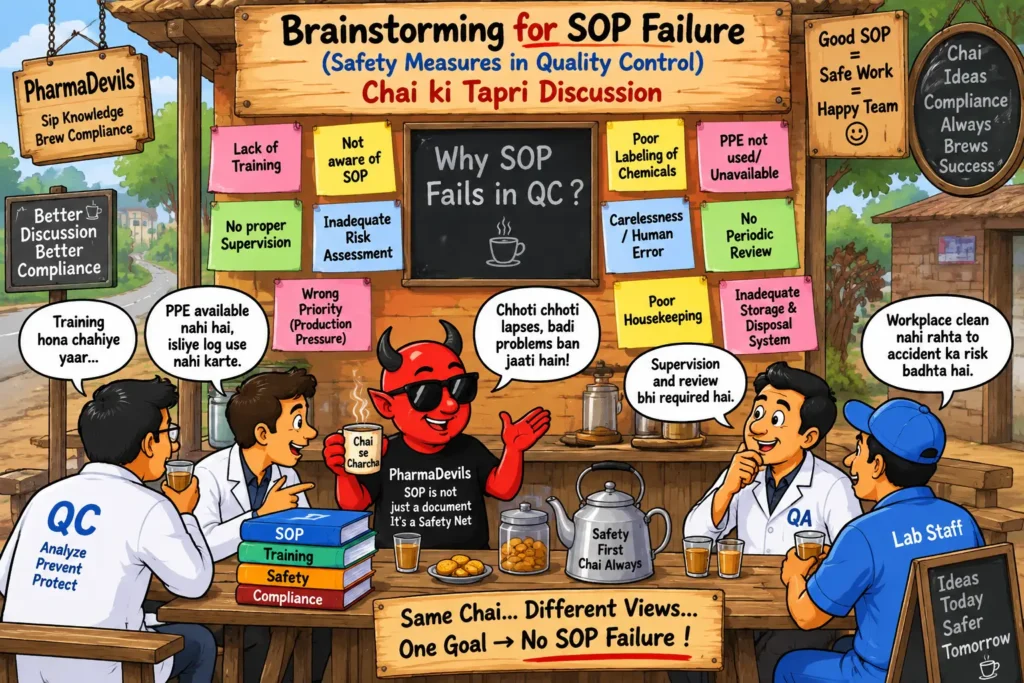
The concept encourages QC, QA, and laboratory personnel to openly discuss practical problems that may lead to non-compliance. It reinforces that even small lapses in laboratory safety can result in accidents, chemical exposure, contamination, or procedural failures. The brainstorming approach helps teams identify weaknesses early and develop corrective actions such as improved training, stronger supervision, proper PPE availability, better labeling, housekeeping, and routine SOP review. Overall, it promotes team participation, safety awareness, and prevention of SOP failures in the QC laboratory.
3. 5-Why Analysis for SOP Failure:
The 5-Why Analysis diagram presents a hypothetical SOP failure scenario during a Hotel Meeting Devils activity, using the SOP “Safety Measures in Quality Control” as the compliance basis. The SOP requires QC personnel to follow defined safety precautions, including proper handling of hazardous chemicals, use of protective gloves, correct pipetting practices, proper labeling, safe equipment operation, and maintaining a clean workplace.
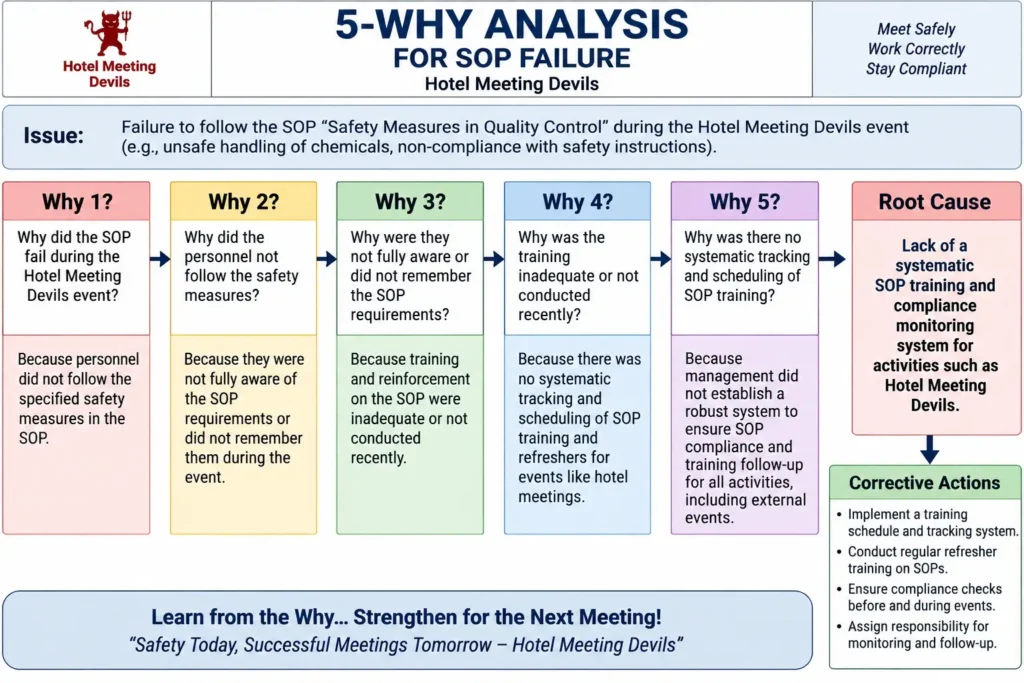
The analysis progressively identifies why the SOP was not followed: personnel did not comply with required safety measures, awareness or recall of SOP requirements was inadequate, refresher training was insufficient, training was not systematically scheduled or tracked, and management controls for compliance follow-up were weak. The root cause is identified as the absence of a robust SOP training and compliance-monitoring system. Recommended actions include scheduled refresher training, documented training tracking, periodic compliance checks, and assigning clear responsibility for follow-up to prevent recurrence.
4. Fishbone Analysis for SOP Failure:
The Fishbone Analysis for SOP Failure provides a practical way to identify possible causes behind failure to follow the SOP “Safety Measures in Quality Control.” The diagram groups potential causes into major categories such as People, Equipment, Method, Material, Measurement, Environment, and Management. These may include inadequate training, lack of SOP awareness, improper use of PPE, incorrect chemical labeling or storage, equipment not operated as per SOP, weak supervision, poor compliance monitoring, and inadequate housekeeping.
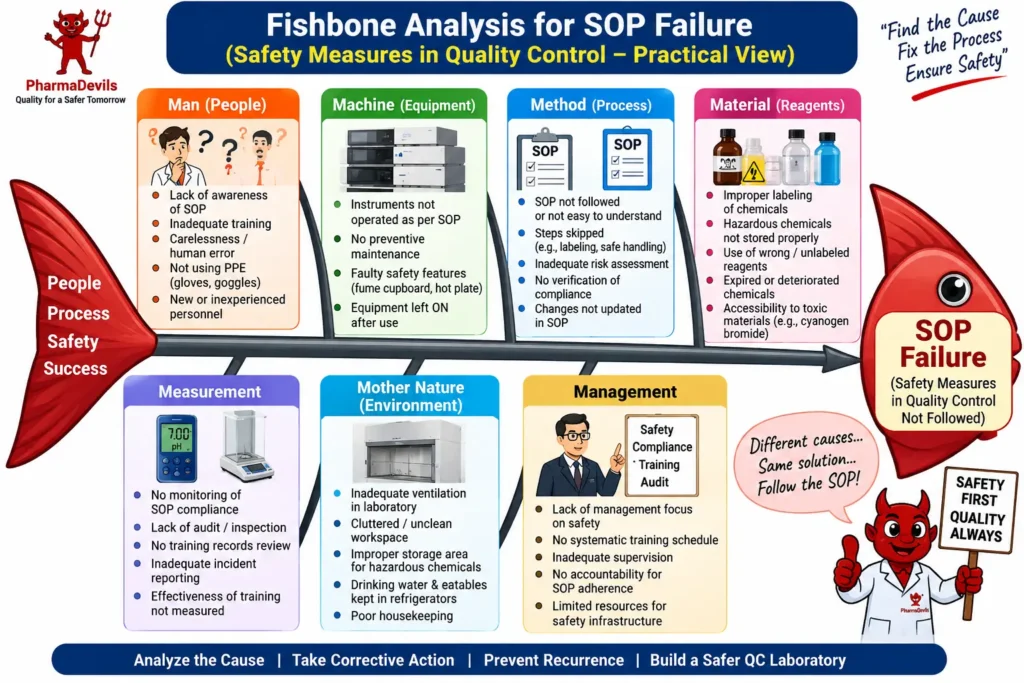
The source SOP specifically requires safe handling of hazardous chemicals, use of gloves, correct pipetting practices, proper labeling of reagents, switching off equipment after use, maintaining cleanliness, and operating instruments according to approved SOPs.The fishbone approach helps the investigation team systematically explore people-, process-, equipment-, material-, and management-related contributors, identify the most probable root causes, and establish appropriate corrective and preventive actions to strengthen laboratory safety and SOP compliance.
5. Fault Tree Analysis for SOP Failure:
The Fault Tree Analysis (FTA) diagram evaluates possible causes that can lead to failure of the SOP “Safety Measures in Quality Control.” The top event is defined as SOP Failure, which may result from several contributing events such as inadequate training, procedural deficiencies, improper handling of chemicals, equipment or instrument issues, weak monitoring, human error, and poor housekeeping.
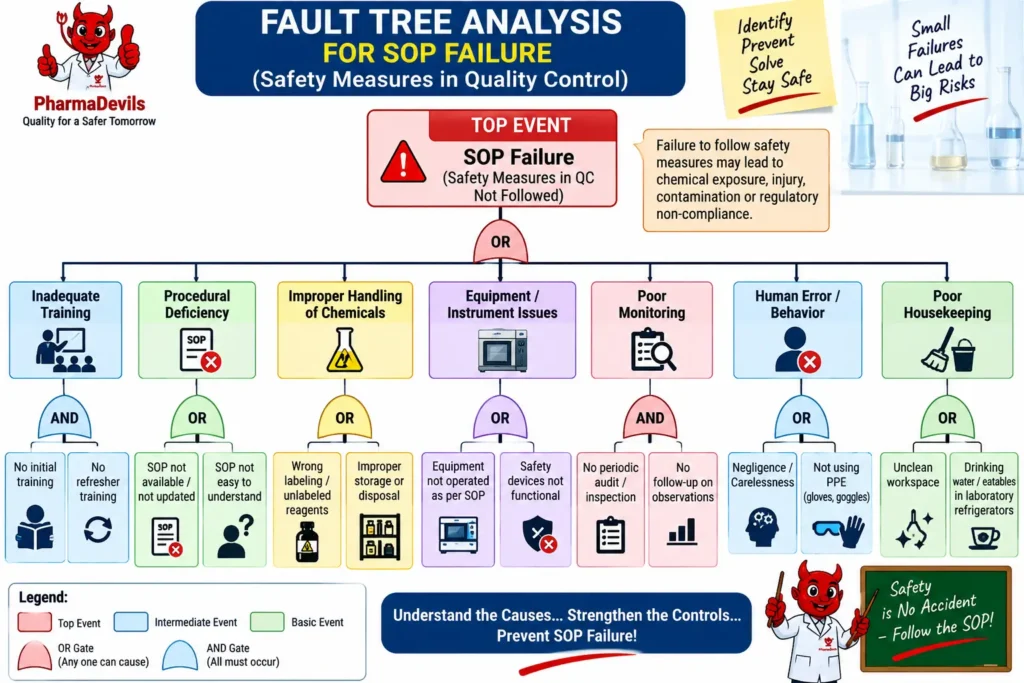
The SOP requires QC personnel to follow specific safety practices, including careful handling of ammonia, ether, acids, alkalis and hazardous chemicals, use of gloves and rubber bulbs, proper labeling and storage of reagents, switching off equipment after use, keeping the workplace clean, and operating instruments according to approved SOPs.The FTA diagram uses AND/OR logic gates to connect basic and intermediate causes with the top event. This structured approach helps identify critical failure pathways, determine root causes, strengthen preventive controls, improve training and monitoring, and reduce the possibility of recurrence of safety-related SOP failures.
Questions & Answers – SOP for Safety Measures in Quality Control
- What is the objective of this SOP?
The objective is to lay down the procedure for safety measures to be followed in the Quality Control department. - Who is responsible for following this SOP?
QC Chemists, Assistant Manager-QC, and Head-QA/QC are responsible for implementation of the SOP. - Where should cold ammonia solution and solvent ether bottles be opened?
They should be opened carefully inside the fume cupboard. - Can drinking water or eatables be stored in laboratory refrigerators?
No. Drinking water and eatables should not be kept inside laboratory refrigerators. - What PPE is specified during analysis of Chlorpheniramine Maleate tablets?
Hand gloves should be used during the analysis. - What precaution should be taken while handling acids, solvents, and toxic chemicals?
Skin and eyes should be protected, and exposed body parts should be washed thoroughly after handling such chemicals. - How should poisonous chemicals be identified?
They should be properly labeled with appropriate warning information. - How should hazardous chemicals and acids be stored and disposed of?
They should be stored and disposed of carefully in the proper designated place to avoid risk to inexperienced personnel. - What should be used for pipetting acids and alkalis?
A rubber bulb should always be used for pipetting acid and alkali solutions. - What precaution is required while washing glassware containing hazardous chemicals?
Hand gloves should be used while washing glassware containing poisonous or hazardous chemicals. - How should cyanogen bromide be stored?
Cyanogen bromide solution should be kept in a cold place with proper labeling, while the powder should be kept under lock and key. - What should be done with heating equipment after use?
Hot air ovens, hot plates, water baths, and furnaces should be switched off after use, particularly at the end of the shift. - What is the requirement for workplace cleanliness?
The working place should be kept clean, particularly after working hours. - How should laboratory instruments be operated?
All instruments should be operated according to the applicable SOP. - What information should appear on reagent and volumetric solution labels?
Labels should include information such as name, date, and strength. - Who provides training for this SOP and what is the training period?
The trainer is the Manager-QC/QA, trainees are Quality Control personnel, and the training period is one hour. - Who receives the controlled and master copies of the SOP?
The controlled copy is maintained by the Head of Department–Quality Control, while the master copy is maintained by the Head of Department–Quality Assurance. - Does the SOP specify any reference guideline?
No. The SOP states “Reference: Nil.”
Reference Guidelines:
- WHO – Good Practices for Pharmaceutical Quality Control Laboratories, TRS 1052, Annex 4 (2024)
Covers pharmaceutical QC laboratory management, personnel, premises, equipment, reagents, testing activities, documentation, and laboratory safety. (World Health Organization)
WHO QC Laboratory Guideline – Official Link - Drugs Rules, 1945 – Schedule L-I: Good Laboratory Practices and Requirements of Premises and Equipment, India
Relevant to laboratory management, documented quality systems, premises, ventilation, equipment, storage, SOPs, technical audits, and GLP compliance. (CDSCO)
CDSCO Drugs Rules – Official Link - WHO – Quality Assurance of Pharmaceuticals, Volume 2: GMP and Inspection, 10th Edition (2024)
Provides GMP guidance covering quality management, personnel hygiene, equipment, quality control, and pharmaceutical manufacturing controls. (World Health Organization)
WHO GMP Compendium – Official Link - OSHA 29 CFR 1910.1450 – Occupational Exposure to Hazardous Chemicals in Laboratories
Covers chemical-hygiene procedures, PPE, fume hoods, hazardous-chemical handling, employee information, training, and laboratory exposure controls. (OSHA)
OSHA Laboratory Chemical Safety Standard