





Brief Description
The SOP for Sampling of Water describes the standardized procedure for collecting water samples for microbiological and chemical analysis to ensure consistent and controlled sampling practices. The procedure is executed by the Microbiologist and Executive QC, with implementation oversight by QA/QC management. For microbiological testing, samples are collected in pre-sterilized screw-cap glass bottles. Sampling points are disinfected with 70% IPA, water is allowed to drain for approximately 30 seconds, and about 200 mL is collected while preventing contact between the bottle and sampling valve.For chemical analysis, clean and dry bottles are used, rinsed at least three times with sample water, and approximately 1000 mL is collected without entrapping air bubbles. Samples not analyzed immediately are stored at 2–8°C, with analysis initiated within 24 hours. The SOP also includes an Annexure specifying the scheduled water sampling and microbiological testing plan.
Skip to PDF content1. Flow Diagram:
The comic-style flow diagram for Sampling of Water presents the SOP in a simple, easy-to-understand sequence. It begins with preparation of the sampling kit and verification of scheduled sampling points. The sampling point is then disinfected with 70% IPA, the valve is opened, and water is drained for approximately 30 seconds before sample collection.
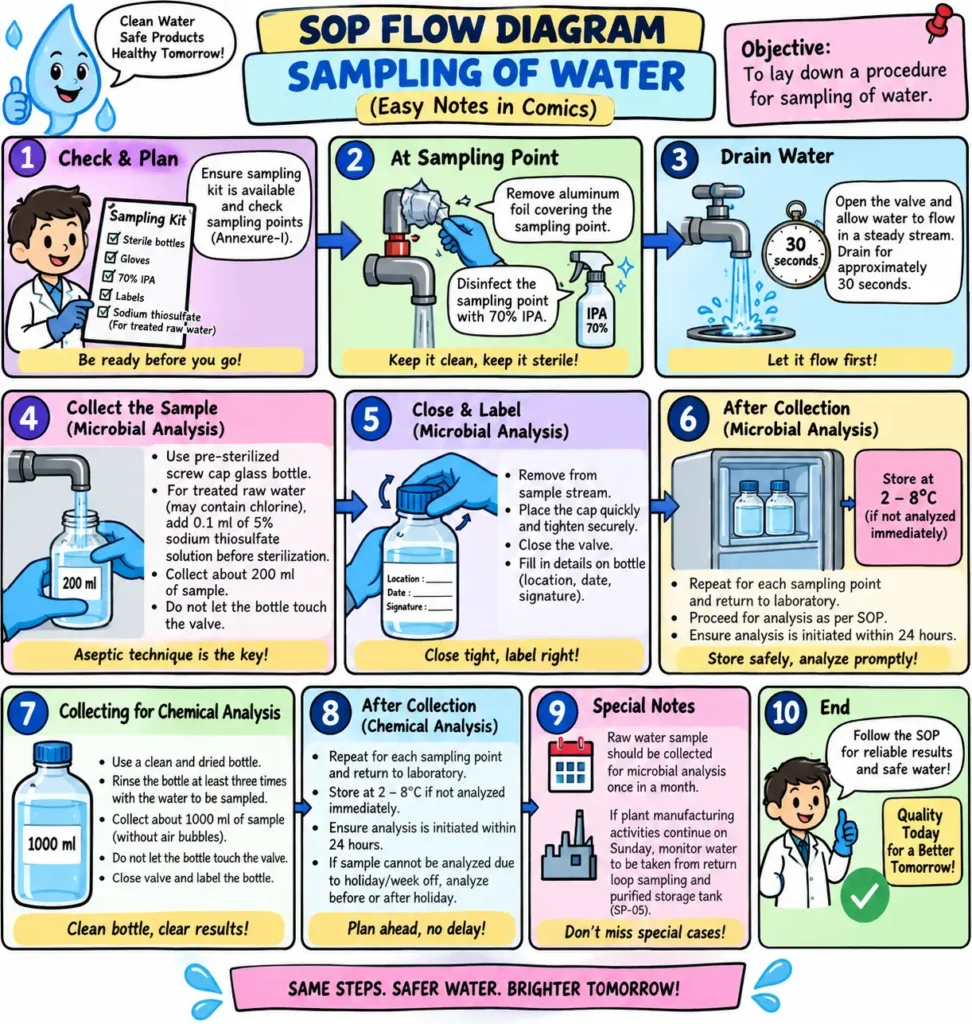
For microbiological analysis, the diagram shows collection of approximately 200 mL water in a pre-sterilized screw-cap glass bottle while preventing contact between the bottle and sampling valve. The sample is immediately capped, labeled, and transferred for analysis.For chemical analysis, a clean, dry bottle is rinsed three times with sample water and approximately 1000 mL is collected. Samples not analyzed immediately are stored at 2–8°C, and analysis is initiated within 24 hours. The comic format makes the sampling process visually clear, memorable, and suitable for GMP training.
2. Brainstorming for SOP Failure:
The brainstorming diagram for failure of the SOP for Sampling of Water uses a highway bridge and sticky-note concept to show the potential “roadblocks” that can lead to improper water sampling. Major causes identified include an unavailable or incomplete sampling kit, selection of the wrong sampling point, failure to disinfect the sampling point with 70% IPA, inadequate draining time, use of an unsuitable or non-sterile sampling bottle, incorrect sample quantity, and accidental contact of the bottle or cap with the sampling valve or other surfaces. These directly relate to the critical sampling controls described in the SOP.
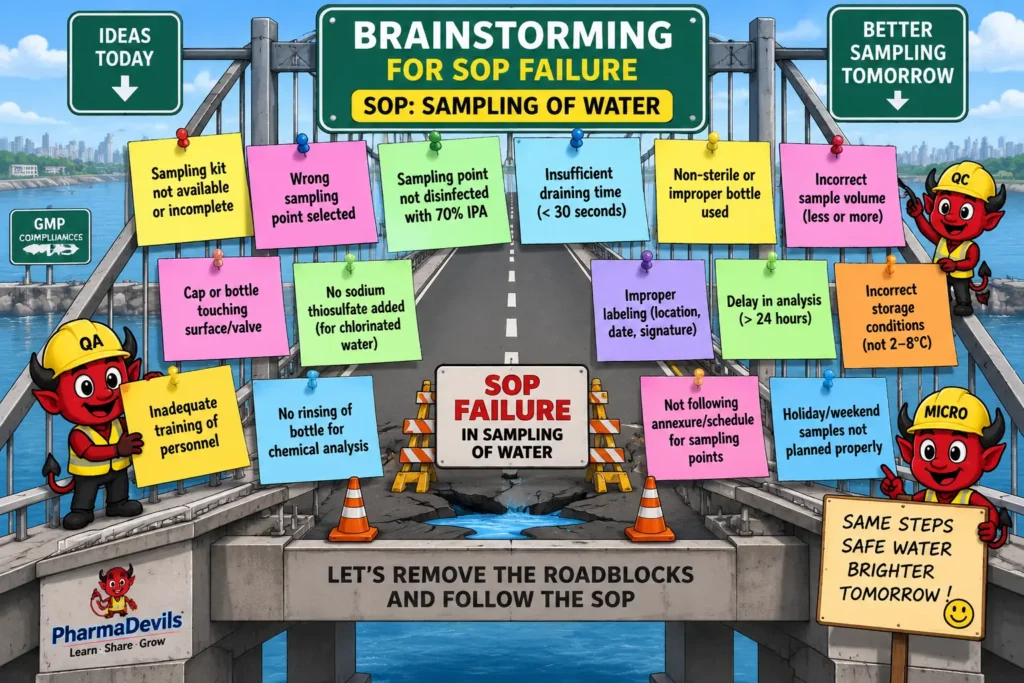
Additional possible failures include omission of sodium thiosulfate for chlorinated water, inadequate bottle rinsing for chemical analysis, improper labeling, incorrect storage conditions, delayed analysis beyond 24 hours, failure to follow the approved sampling schedule, and inadequate personnel training. The highway-bridge theme visually represents how each failure can obstruct reliable water-quality monitoring and emphasizes removing these “roadblocks” through proper SOP compliance.
3. 5-Why Analysis for SOP Failure:
The 5-Why Analysis diagram for failure of the SOP “Sampling of Water” presents the problem in a clear 5-step pillar format using comic-style devils to make the root cause analysis simple and engaging. The diagram starts with the problem statement that the Sampling of Water SOP was not followed and then moves step by step through five “Why” questions to identify the deeper cause of failure.
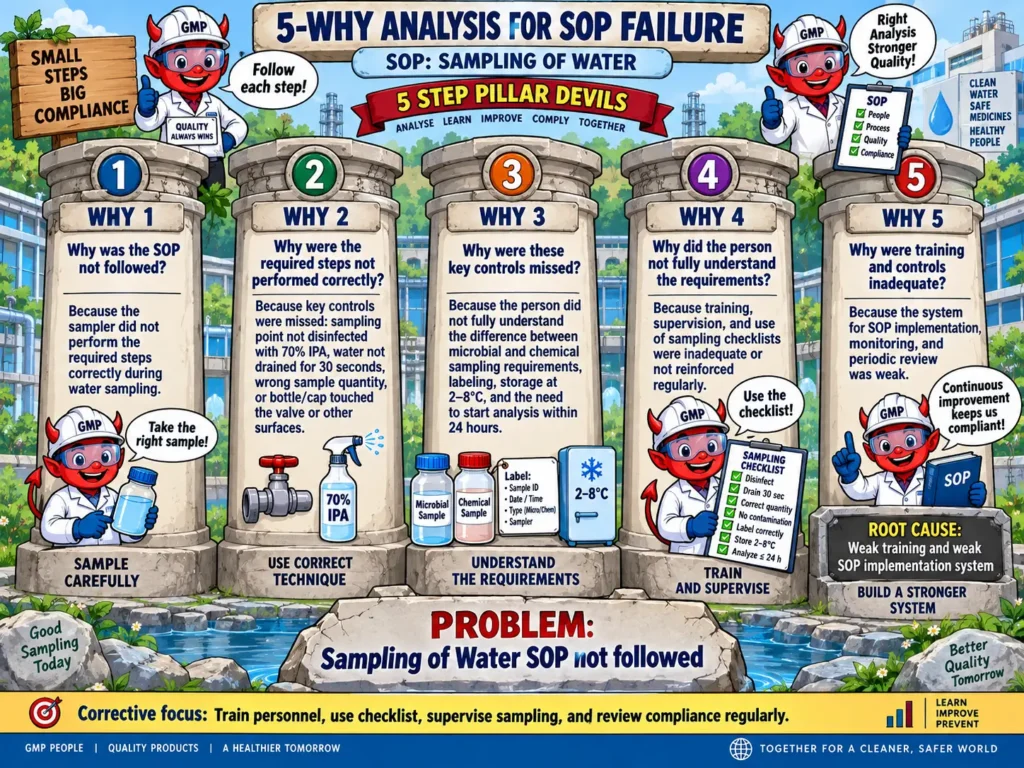
The first pillars explain that the SOP failure happened because the sampler did not follow the required steps correctly during water sampling. The next levels show likely reasons such as failure to disinfect the sampling point with 70% IPA, inadequate draining time, wrong sample quantity, contamination due to contact with the bottle or cap, incorrect labeling, improper storage at 2–8°C, and delay in analysis beyond 24 hours. These points are directly linked to the required water sampling procedure in the SOP.The final pillars highlight that the deeper root cause is inadequate training, supervision, checklist use, and weak SOP implementation/monitoring. The diagram concludes with a corrective focus on training personnel, improving supervision, using sampling checklists, and regularly reviewing compliance so that water sampling is performed correctly and consistently. This matches the SOP’s emphasis on training and controlled implementation.
4. Fishbone Analysis for SOP Failure:
The Fishbone Analysis diagram for SOP failure of “Sampling of Water” presents the possible causes of failure in a clear cause-and-effect format with a fun “devils running mode” theme. The head of the fish represents the main effect: SOP Failure in Sampling of Water, while the bones show major cause categories such as People, Method, Material, Measurement/Sample Control, Environment/Storage, and Management/System.
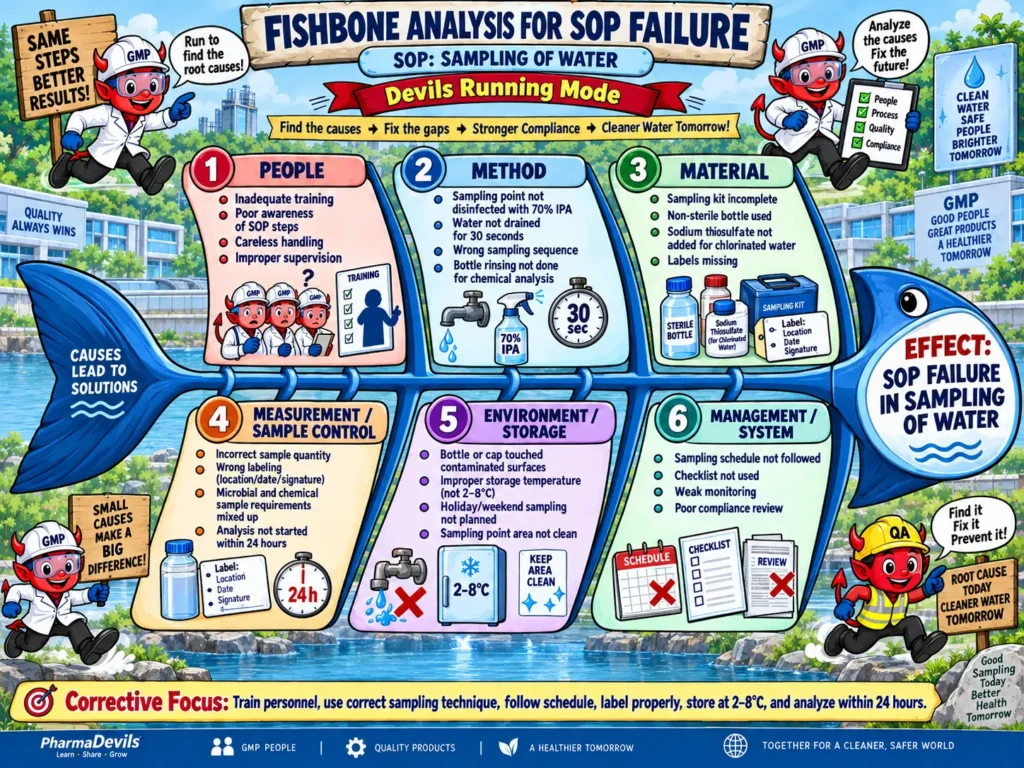
Under People, the diagram highlights inadequate training, poor awareness, careless handling, and weak supervision. Under Method, it focuses on failures such as not disinfecting the sampling point with 70% IPA, not draining water for about 30 seconds, using the wrong sequence, or not following correct sampling technique. Under Material, it includes incomplete sampling kits, use of non-sterile bottles, missing labels, and failure to add sodium thiosulfate for chlorinated raw water. These are directly linked to the SOP instructions for microbial and chemical sampling.The remaining branches explain errors in sample quantity, labeling, storage, and timing of analysis, such as collecting the wrong volume, improper bottle handling, storing samples outside 2–8°C, and not starting analysis within 24 hours. The management side points to failure to follow the sampling schedule, poor checklist usage, and weak compliance review. Overall, the fishbone diagram helps identify root causes systematically and supports corrective action through training, proper technique, correct storage, timely analysis, and stronger SOP implementation.
Brief Description – Fault Tree Analysis for SOP Failure
The Fault Tree Analysis (FTA) diagram identifies potential causes that may lead to failure in following the SOP for Sampling of Water. The SOP requires correct sampling points, suitable sampling containers, proper disinfection, specified sample quantities, correct labeling, appropriate storage, and timely analysis. For example, the procedure requires use of pre-sterilized bottles for microbial sampling, disinfection of the sampling point with 70% IPA, approximately 30 seconds of draining, and collection of about 200 mL for microbial analysis.
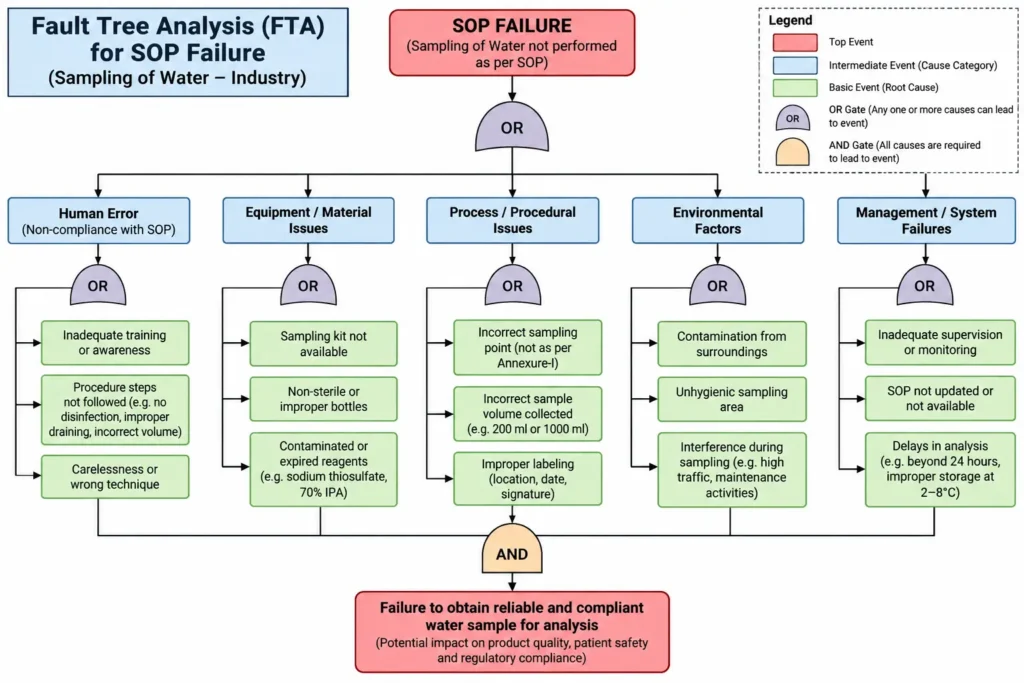
The fault tree groups possible failures into Human Error, Equipment/Material Issues, Process/Procedural Issues, Environmental Factors, and Management/System Failures. Root causes may include inadequate training, incorrect sampling technique, unavailable sampling kits, unsuitable bottles, wrong sampling points, incorrect sample volume, improper labeling, contamination, inadequate supervision, and delays in analysis. The SOP also specifies refrigerated storage at 2–8°C when analysis is delayed and initiation of analysis within 24 hours, making these important control points.FTA helps systematically identify these failure pathways so that appropriate CAPA, training, supervision, procedural controls, and monitoring can be implemented to ensure reliable and compliant water sampling.
Questions & Answers – Fault Tree Analysis for SOP Failure
- What is the top event in the Fault Tree Analysis?
The top event is failure to perform water sampling according to the approved SOP. - What are the major categories that can contribute to SOP failure?
Major categories include human error, equipment/material issues, procedural issues, environmental factors, and management/system failures. - How can human error cause water-sampling SOP failure?
Inadequate training, carelessness, incorrect technique, or failure to follow specified sampling steps can lead to non-compliance. - What preparation is required before microbial water sampling?
The sampling kit should be available, the correct sampling point should be selected according to Annexure-I, and microbial samples should be collected in pre-sterilized screw-cap glass bottles. - Why is 70% IPA used during sampling?
The SOP requires the sampling/user point to be disinfected with 70% IPA before opening the valve and allowing a steady stream of water. - What can happen if the sampling point is not drained properly?
Failure to drain the sampling point for approximately 30 seconds may result in an unrepresentative or potentially contaminated sample. The 30-second draining requirement is specified in the SOP. - What sample quantity is specified for microbial analysis?
Approximately 200 mL is to be collected according to the analysis requirement. - What quantity is specified for chemical analysis?
The SOP specifies approximately 1000 mL for chemical analysis and requires that no air bubble be entrapped. - Why is correct labeling important?
The sample bottle should contain information such as the sampling location, date of sampling, and signature. Incorrect or missing labeling may cause sample identification and traceability failures. - What should be done if the sample cannot be analyzed immediately?
The SOP states that the sample should be stored in a refrigerator at 2–8°C if analysis is not performed immediately. - Within what period should analysis be initiated?
Analysis should be initiated within 24 hours after sampling. - What is the purpose of Fault Tree Analysis for SOP failure?
FTA helps identify the possible failure pathways and root causes that can result in incorrect or non-compliant water sampling, allowing targeted CAPA, training, supervision, and procedural controls to be established.
Reference Guidelines:
For the SOP for Sampling of Water and the related Fault Tree Analysis, the uploaded SOP itself lists the reference as “In House.” For external regulatory/technical support, the following references are appropriate:
- WHO Technical Report Series No. 1033, Annex 3 – Good Manufacturing Practices: Water for Pharmaceutical Use (2021). This is a key WHO reference for pharmaceutical water-system design, operation, monitoring, sampling, and control. (World Health Organization)
- USP General Chapter <1231> – Water for Pharmaceutical Purposes. It includes guidance on pharmaceutical water systems and specifically addresses representative sampling and water-quality monitoring. (USP)
- FDA – Guide to Inspections of High Purity Water Systems. Useful for understanding microbiological control, system evaluation, sampling practices, and inspection expectations for pharmaceutical water systems. (U.S. Food and Drug Administration)
- WHO Technical Report Series No. 929, Annex 4 – Guidelines for Sampling of Pharmaceutical Products and Related Materials may also be used as a general sampling-practice reference. (WHO Extranet)
- WHO GMP Compendium, 10th Edition (2024) can be used as an additional current GMP reference framework for pharmaceutical quality systems and manufacturing controls. (World Health Organization)
For your document, a concise Reference section can be written as:
References:
- WHO TRS 1033, Annex 3 – Good Manufacturing Practices: Water for Pharmaceutical Use.
- USP <1231> – Water for Pharmaceutical Purposes.
- FDA – Guide to Inspections of High Purity Water Systems.
- WHO TRS 929, Annex 4 – Guidelines for Sampling of Pharmaceutical Products and Related Materials.
- Approved In-house SOP – Sampling of Water.