






1. Introduction – SOP for Sedimentation Study of Oral Suspension:
The SOP for Sedimentation Study of Oral Suspension describes the standardized procedure for evaluating the physical stability and settling characteristics of an oral suspension. The purpose of the study is to determine the extent of sediment formation during a defined holding period and to ensure that the suspension remains within the established acceptance criteria. The SOP applies to oral suspension products and is executed by Production personnel under the responsibility of Production and QA/QC management. SEDIMENTATION STUDY OF ORAL SUS… As per the procedure, 100 mL of the suspension is transferred into a calibrated measuring cylinder, and the volume is observed after 24, 48, and 72 hours. The observations are recorded in the designated sedimentation study record. The specified acceptance criterion is NMT 2 mL; if the observed volume exceeds the limit, the batch is required to be placed on hold and an investigation initiated. SEDIMENTATION STUDY OF ORAL SUS… This study helps provide documented evidence of the suspension’s physical stability during the defined observation period and supports consistent product quality and controlled batch disposition.
Skip to PDF content2. SOP for Sedimentation Study of Oral Suspension:
The SOP for Sedimentation Study of Oral Suspension defines the standardized method for monitoring the settling behavior of an oral suspension over a specified time period. As shown in the flow diagram, 100 mL of the suspension is transferred into a calibrated measuring cylinder and kept undisturbed for observation. The volume is then checked at 24, 48, and 72 hours to evaluate sedimentation. SEDIMENTATION STUDY OF ORAL SUS…
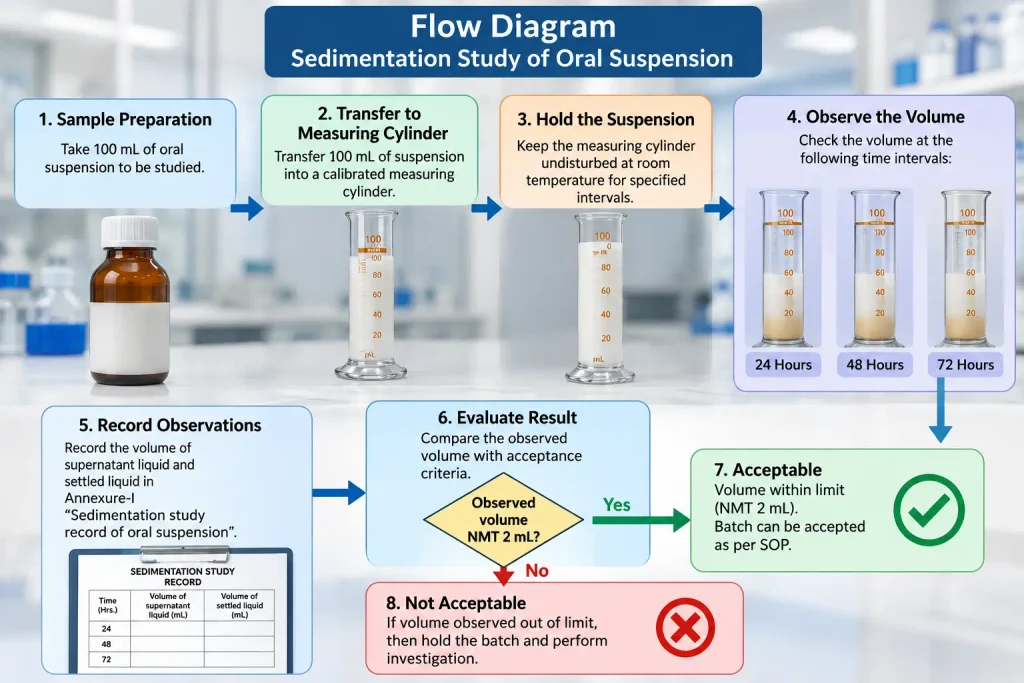
The observed volume of supernatant and settled liquid is documented in the designated sedimentation study record. Results are compared against the specified acceptance criterion of NMT 2 mL. If the observed volume remains within the limit, the result is considered acceptable. If the value exceeds the specified limit, the batch is required to be placed on hold and investigated before further disposition. SEDIMENTATION STUDY OF ORAL SUS… Following this SOP ensures consistent evaluation, proper documentation, and controlled assessment of the physical stability of oral suspension products.
3. Benefits of Following SOP for Sedimentation Study of Oral Suspension:
Following the SOP for Sedimentation Study of Oral Suspension ensures that the settling behavior of the suspension is evaluated in a consistent and controlled manner. The SOP requires a defined sample volume, specified observation intervals, proper recording of results, and comparison against the stated acceptance criterion. SEDIMENTATION STUDY OF ORAL SUS…
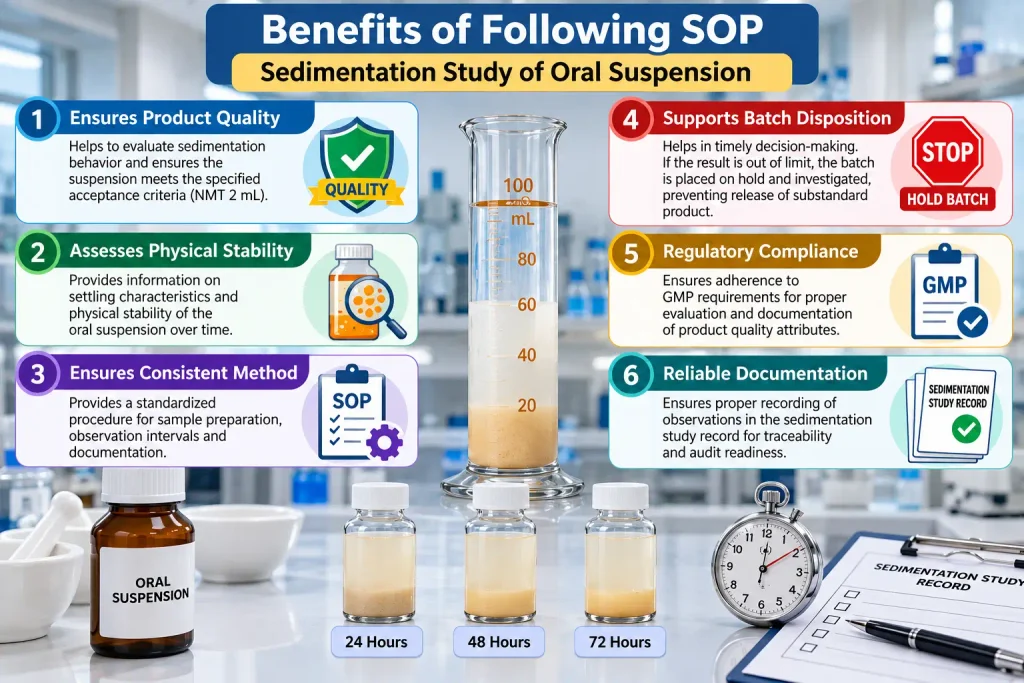
The major benefits of following this SOP include consistent testing methodology, reliable documentation, assessment of physical stability, controlled batch disposition, and improved traceability. Observations at 24, 48, and 72 hours help identify changes in sedimentation over time and provide a structured basis for evaluating the suspension. SEDIMENTATION STUDY OF ORAL SUS… If the observed volume is outside the specified limit, the SOP requires the batch to be held and investigated, helping prevent further processing or release without proper evaluation. SEDIMENTATION STUDY OF ORAL SUS… Overall, compliance with this SOP supports uniform execution of the sedimentation study and maintains documented control over oral suspension quality evaluation.
4. CPP and CQA for SOP for Sedimentation Study of Oral Suspension:
The SOP for Sedimentation Study of Oral Suspension identifies key operating conditions that should be controlled during the study and quality attributes that should be evaluated to assess sedimentation behavior. Important process-related parameters include using 100 mL of suspension, a calibrated measuring cylinder, keeping the sample undisturbed, and recording observations at 24, 48, and 72 hours. SEDIMENTATION STUDY OF ORAL SUS…
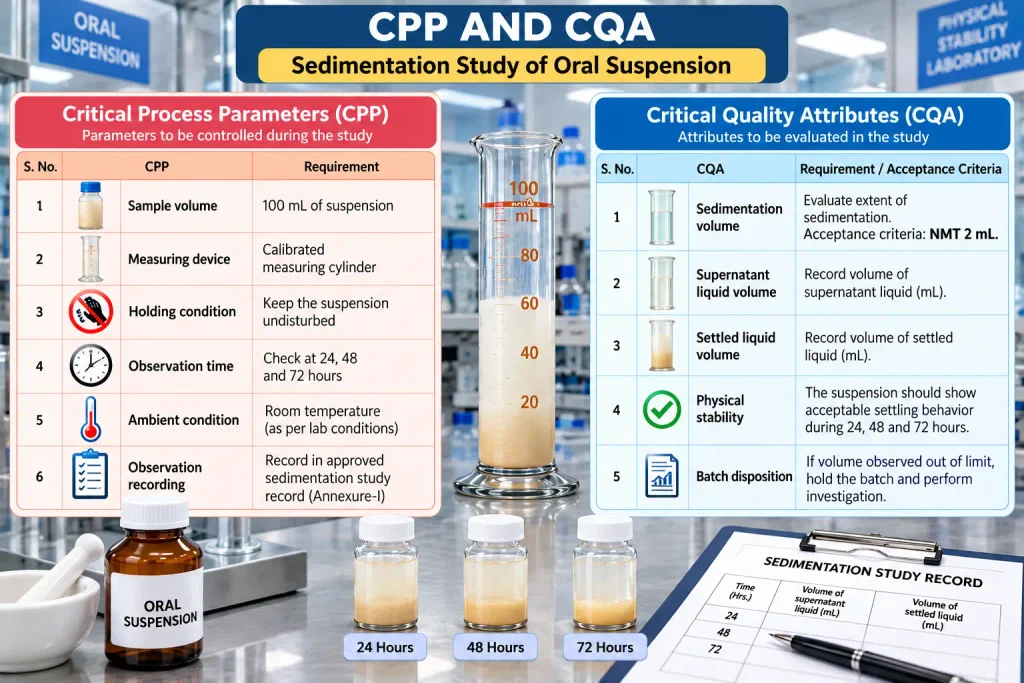
The critical quality attributes evaluated during the study include the sedimentation volume, volume of supernatant liquid, volume of settled liquid, and overall physical settling behavior of the suspension. The SOP specifies an acceptance criterion of NMT 2 mL. If the observed result is outside the defined limit, the batch must be held and investigated before further disposition. SEDIMENTATION STUDY OF ORAL SUS… The approved sedimentation study record also provides fields for documenting the supernatant and settled liquid volumes at the defined time intervals, supporting traceability and consistent evaluation of the oral suspension. SEDIMENTATION STUDY OF ORAL SUS…
5. Brainstorming for SOP Failure: Sedimentation Study of Oral Suspension:
The Brainstorming for SOP Failure – Sedimentation Study of Oral Suspension identifies possible causes that may lead to unreliable, inaccurate, or non-compliant study results. Key potential failures include incorrect sample volume, use of a non-calibrated measuring cylinder, disturbance of the sample during the observation period, incorrect observation timing, improper sample handling, incomplete documentation, inadequate personnel training, and failure to verify the acceptance criterion. The SOP requires 100 mL of suspension to be placed in a calibrated measuring cylinder and checked after 24, 48, and 72 hours, with observations recorded in the designated annexure. SEDIMENTATION STUDY OF ORAL SUS…

Brainstorming also highlights risks such as poor sample uniformity, unclear separation between supernatant and settled liquid, use of unsuitable equipment, and failure to initiate an investigation when results exceed the specified NMT 2 mL limit. These potential causes should be evaluated through training, equipment control, procedural compliance, documentation review, and appropriate investigation to prevent recurrence and ensure reliable sedimentation study results.
6. 5-Why Analysis for SOP Failure: Sedimentation Study of Oral Suspension:
The 5-Why Analysis for SOP Failure – Sedimentation Study of Oral Suspension is used to systematically identify the underlying cause of an unacceptable sedimentation study result. The analysis begins with the problem of sedimentation exceeding the specified NMT 2 mL limit and progressively examines possible causes such as improper sample preparation, incorrect use or calibration of the measuring cylinder, deviation from the approved procedure, and inadequate personnel training or supervision. The SOP requires 100 mL of suspension to be observed in a calibrated measuring cylinder at 24, 48, and 72 hours, with the findings properly recorded. SEDIMENTATION STUDY OF ORAL SUS…
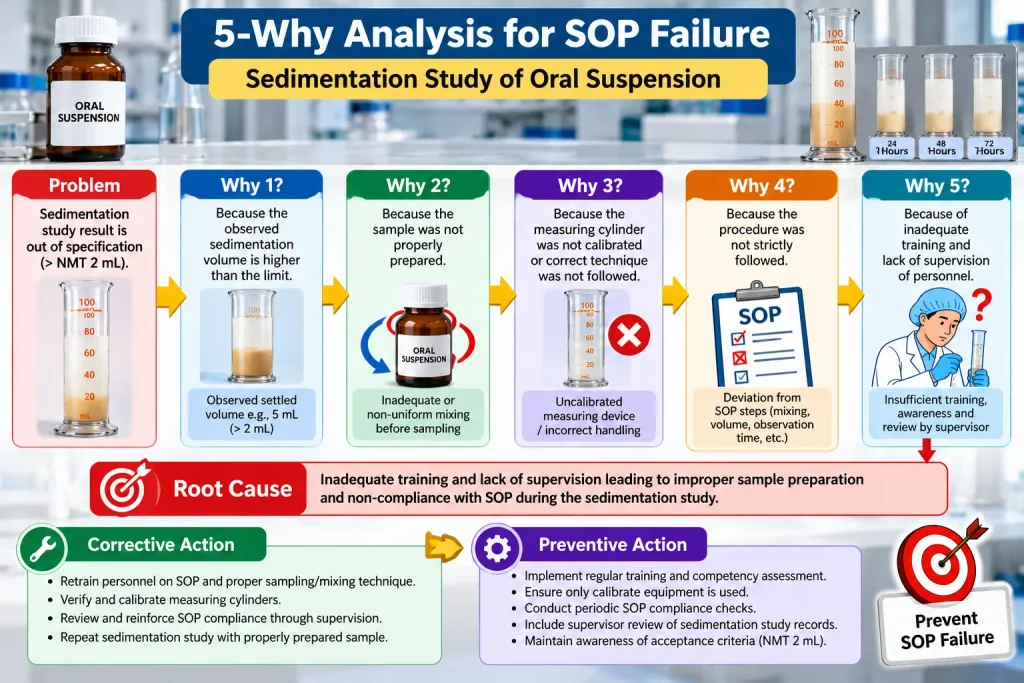
The 5-Why approach helps distinguish immediate causes from the actual root cause and supports selection of appropriate corrective and preventive actions. These may include retraining personnel, ensuring calibrated equipment, strengthening supervisory review, verifying compliance with the approved observation intervals, and improving documentation practices. When the observed volume is outside the defined limit, the SOP requires the batch to be held and investigated, making root-cause analysis essential before further disposition. SEDIMENTATION STUDY OF ORAL SUS…
7. Fishbone Analysis for SOP Failure – Sedimentation Study of Oral Suspension:
The Fishbone Analysis for SOP Failure – Sedimentation Study of Oral Suspension is used to identify and organize the possible causes that may lead to an unacceptable or unreliable sedimentation study result. The analysis considers major cause categories such as Man (Personnel), Method (Procedure), Machine (Equipment), Material (Sample), Measurement, Environment, and sample-related characteristics. Potential causes include inadequate training, deviation from SOP steps, incorrect sample volume, use of a non-calibrated or unsuitable measuring cylinder, improper mixing, inaccurate meniscus reading, disturbance of the sample during the observation period, incomplete documentation, and failure to investigate an out-of-limit result. The approved SOP requires 100 mL of suspension to be placed in a calibrated measuring cylinder and checked after 24, 48, and 72 hours. SEDIMENTATION STUDY OF ORAL SUS…
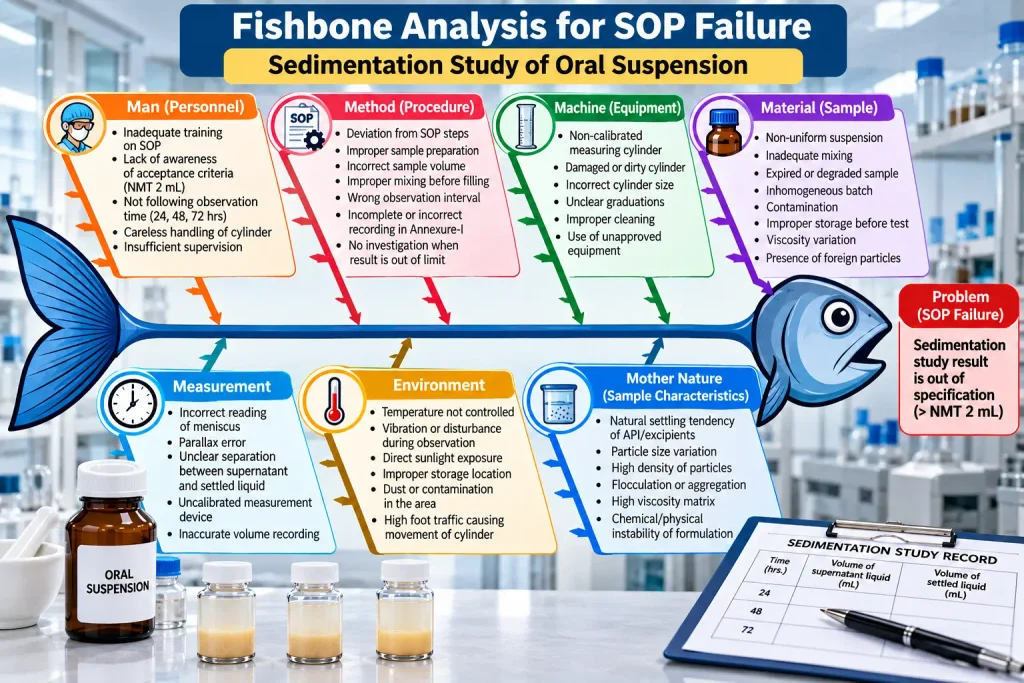
The fishbone approach helps the investigation team systematically evaluate contributing factors and focus on the most probable root causes. It supports selection of appropriate CAPA to improve procedural compliance, equipment control, training, measurement accuracy, and documentation. The SOP specifies an acceptance criterion of NMT 2 mL and requires the batch to be held and investigated when the observed result is outside the limit. SEDIMENTATION STUDY OF ORAL SUS…
8. Fault Tree Analysis for SOP Failure – Sedimentation Study of Oral Suspension:
The Fault Tree Analysis for SOP Failure – Sedimentation Study of Oral Suspension is used to identify the combination of failures that may lead to an out-of-limit sedimentation study result. The top event is an unacceptable sedimentation result exceeding the specified NMT 2 mL limit, and the analysis traces this event to possible contributing causes such as incorrect sample preparation, unsuitable or non-calibrated measuring equipment, deviation from the approved procedure, and inadequate personnel competency or supervision. The SOP requires 100 mL of suspension to be taken in a calibrated measuring cylinder and observed after 24, 48, and 72 hours. SEDIMENTATION STUDY OF ORAL SUS…
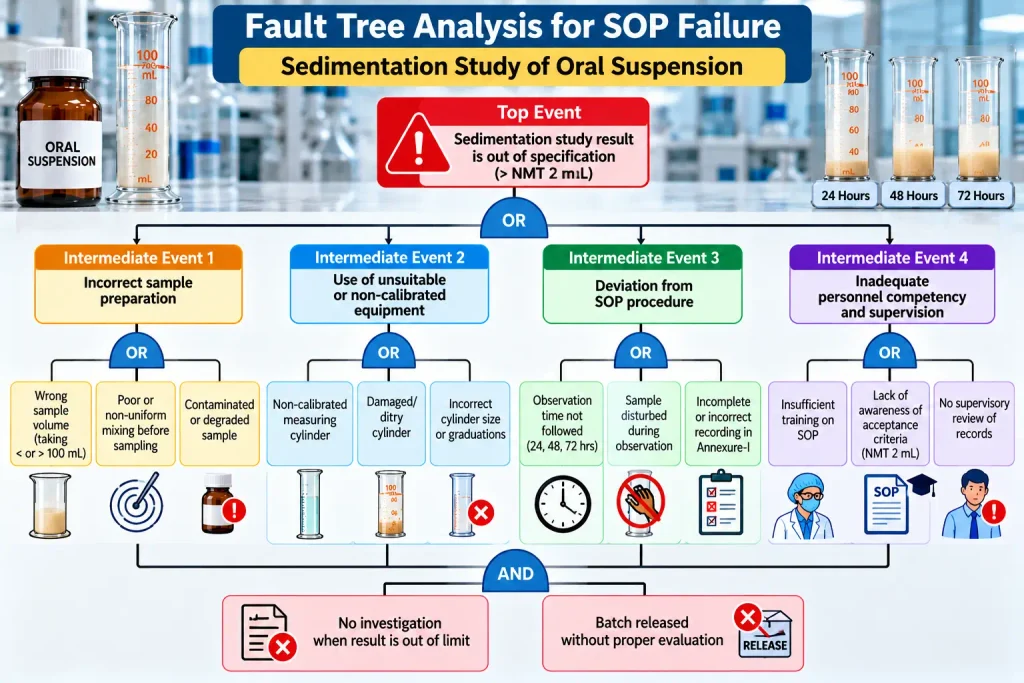
The fault tree further highlights basic failures such as wrong sample volume, non-uniform mixing, contaminated sample, damaged or dirty measuring cylinder, missed observation intervals, disturbance of the cylinder during the study, incomplete recording, and lack of awareness of the acceptance criteria. The approved SOP also states that when the observed volume is outside the limit, the batch must be held and an investigation performed. SEDIMENTATION STUDY OF ORAL SUS… This analysis helps the investigation team understand how individual failures can combine to produce the final SOP failure and supports focused corrective and preventive actions to strengthen training, equipment control, procedural compliance, documentation, and supervisory review.
9. Impact Assessment for SOP Failure – Sedimentation Study of Oral Suspension:
The Impact Assessment for SOP Failure – Sedimentation Study of Oral Suspension evaluates the consequences that may arise when the approved procedure is not followed or when an out-of-limit sedimentation result is not properly controlled. The SOP requires 100 mL of suspension to be evaluated in a calibrated measuring cylinder at 24, 48, and 72 hours, with results recorded in the designated study record and compared against the specified NMT 2 mL acceptance criterion. SEDIMENTATION STUDY OF ORAL SUS…
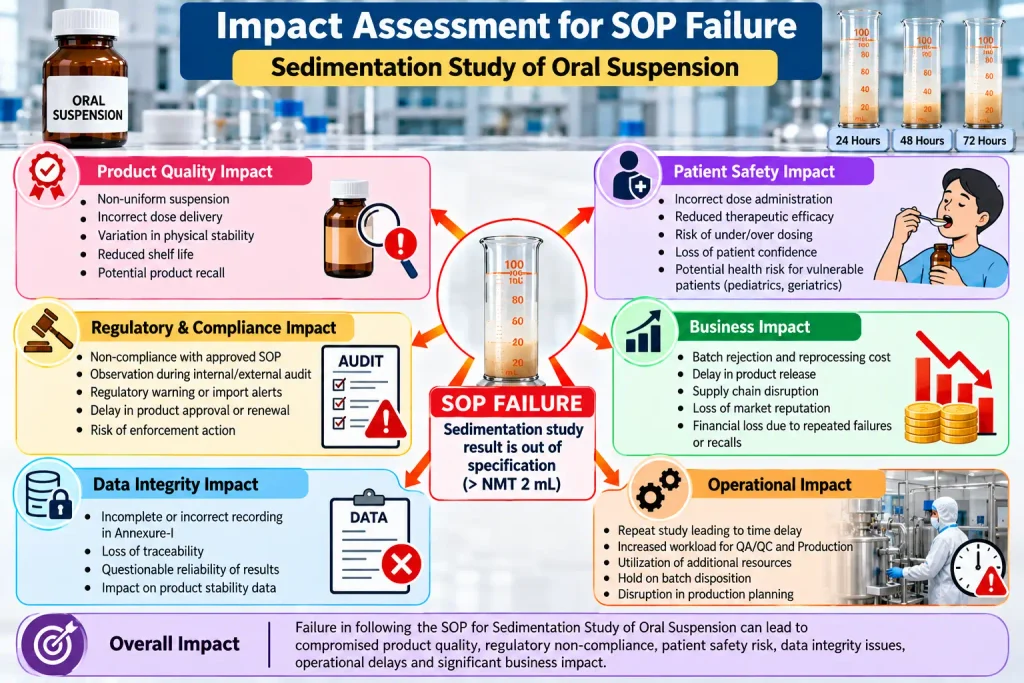
Failure to follow these requirements can affect product quality, reliability of the study result, documentation, batch disposition, and overall compliance. For example, incorrect sample preparation, inaccurate observation, incomplete recording, or use of unsuitable equipment may produce unreliable data and delay appropriate batch decisions. The SOP specifically requires the batch to be held and investigated when the observed volume is outside the defined limit. SEDIMENTATION STUDY OF ORAL SUS… The impact assessment therefore helps identify the seriousness of the failure, determine whether additional investigation or corrective action is needed, and ensure that the sedimentation study remains properly controlled and documented.
10. CAPA for SOP Failure – Sedimentation Study of Oral Suspension:
The CAPA for SOP Failure – Sedimentation Study of Oral Suspension is designed to correct the immediate causes of non-compliance and prevent recurrence of failures during the sedimentation study. The SOP requires 100 mL of oral suspension to be evaluated in a calibrated measuring cylinder with observations at 24, 48, and 72 hours, and the results must be recorded in the approved annexure. SEDIMENTATION STUDY OF ORAL SUS…
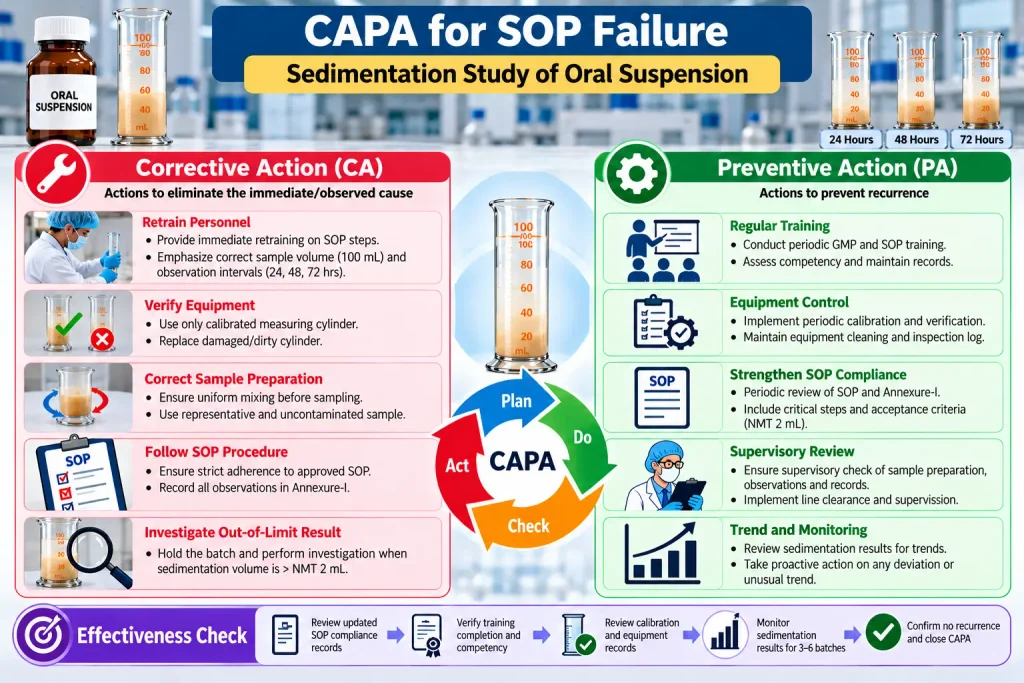
Corrective actions may include retraining personnel, verifying calibration and cleanliness of the measuring cylinder, ensuring correct sample preparation, repeating the study where justified, and investigating any result exceeding the specified NMT 2 mL acceptance criterion. Preventive actions can include periodic SOP training, competency assessment, routine equipment verification, supervisory review, improved documentation checks, and trend monitoring of sedimentation results. The SOP specifically states that if the observed volume is out of limit, the batch must be held and an investigation performed. SEDIMENTATION STUDY OF ORAL SUS… An effectiveness check should confirm that training is completed, calibrated equipment is used, records are properly maintained, and no similar failure recurs during subsequent sedimentation studies before CAPA closure.
Question & Answer – SOP for Sedimentation Study of Oral Suspension:
Q1. What is the objective of this SOP?
To lay down the procedure for performing the sedimentation study of oral suspension. SEDIMENTATION STUDY OF ORAL SUS…
Q2. What is the scope of this SOP?
This SOP is applicable to oral suspension. SEDIMENTATION STUDY OF ORAL SUS…
Q3. Who is responsible for execution of this SOP?
The Officer/Chemist-Production and concerned Production personnel are responsible for execution of the SOP. SEDIMENTATION STUDY OF ORAL SUS…
Q4. Who is responsible for effective implementation of this SOP?
The Sr. Manager-Production and Head-QA/QC are responsible for effective implementation. SEDIMENTATION STUDY OF ORAL SUS…
Q5. How much oral suspension is taken for the sedimentation study?
100 mL of suspension is taken for the study. SEDIMENTATION STUDY OF ORAL SUS…
Q6. Which equipment is used for the study?
A calibrated measuring cylinder is used. SEDIMENTATION STUDY OF ORAL SUS…
Q7. At what time intervals is the suspension observed?
The volume is checked after 24 hours, 48 hours, and 72 hours. SEDIMENTATION STUDY OF ORAL SUS…
Q8. Where are the observations recorded?
The observations are recorded in Annexure-I, “Sedimentation Study Record of Oral Suspension.” SEDIMENTATION STUDY OF ORAL SUS…
Q9. What is the acceptance criterion for the sedimentation study?
The specified acceptance criterion is NMT 2 mL. SEDIMENTATION STUDY OF ORAL SUS…
Q10. What action is required if the observed volume is out of limit?
The batch must be held and an investigation performed. SEDIMENTATION STUDY OF ORAL SUS…
Q11. What information is recorded in the sedimentation study record?
The annexure includes product name, batch number, sampling date/time, sample volume, observation date, volume of supernatant liquid, volume of settled liquid, checking details, and remarks. SEDIMENTATION STUDY OF ORAL SUS…
Q12. Why are observations taken at 24, 48, and 72 hours?
According to the SOP, these are the specified observation intervals for checking sedimentation behavior. The SOP does not provide a separate scientific justification for why these particular intervals were selected. SEDIMENTATION STUDY OF ORAL SUS…
Q13. What should be done if the measuring cylinder is not calibrated?
The SOP specifies use of a calibrated measuring cylinder. Therefore, an uncalibrated cylinder would not meet the stated procedure requirements. SEDIMENTATION STUDY OF ORAL SUS…
Q14. Which departments are involved in the SOP?
The SOP assigns responsibilities to Production and QA/QC, with Production responsible for execution and QA/QC involved in implementation and approval. SEDIMENTATION STUDY OF ORAL SUS…
Q15. What is the purpose of documenting sedimentation observations?
The SOP requires the readings to be entered in the approved annexure, providing a documented record of the study results for review and batch evaluation. SEDIMENTATION STUDY OF ORAL SUS…
Reference Guidelines – SOP for Sedimentation Study of Oral Suspension:
- WHO Good Manufacturing Practices for Pharmaceutical Products – for controlled procedures, documentation, training, deviation handling, and quality-system requirements.
- PIC/S Guide to Good Manufacturing Practice for Medicinal Products (PE 009) – for SOP control, equipment suitability, documentation, training, and investigation of deviations.
- ICH Q8(R2) – Pharmaceutical Development – for understanding critical quality attributes and physical characteristics of dosage forms.
- ICH Q9(R1) – Quality Risk Management – for risk assessment of sedimentation failures and evaluation of product-quality impact.
- ICH Q10 – Pharmaceutical Quality System – for CAPA, investigation, change management, and continual improvement.
- USP General Chapter <1151> Pharmaceutical Dosage Forms – general considerations for pharmaceutical dosage forms, including suspensions.
- USP General Chapter <905> Uniformity of Dosage Units, where applicable to the product and dosage presentation.
- Indian Pharmacopoeia / British Pharmacopoeia / USP–NF – applicable monograph and general requirements for the specific oral suspension product.
- 21 CFR Parts 210 and 211 – current GMP requirements for manufacturing, processing, packing, holding, laboratory controls, records, and investigations.