






Brief Description
This SOP explains the action to be taken when an in-process check fails during the manufacture and packing of tablets and capsules. The purpose is to control the affected material, find the cause, correct the problem, and prevent further production of non-conforming product. If any test result is outside the specified limit, the machine or activity should be stopped immediately and Production, Department Head, and Quality Assurance should be informed. The material produced since the previous acceptable check should be isolated and kept under quarantine. The failed test is repeated, equipment or instruments are checked where required, and the issue is investigated by Production and QA. Depending on the stage, corrective actions may include machine adjustment, reprocessing, visual inspection, retesting, sorting, or rejection. Production can restart only after the required checks are satisfactory and QA gives approval. The SOP covers blending, compression, capsule filling, coating, metal detection, and packing failures.
Skip to PDF content1. Process Mapping Flow Diagram:
The process mapping flow diagram explains the simple steps to follow when an in-process check fails during pharmaceutical production or packing. The process starts with routine production and in-process testing. If the result is within the specified limit, production continues and the result is recorded. If the result is not acceptable, the machine or activity is stopped immediately and Production, Department Head, and Quality Assurance are informed.
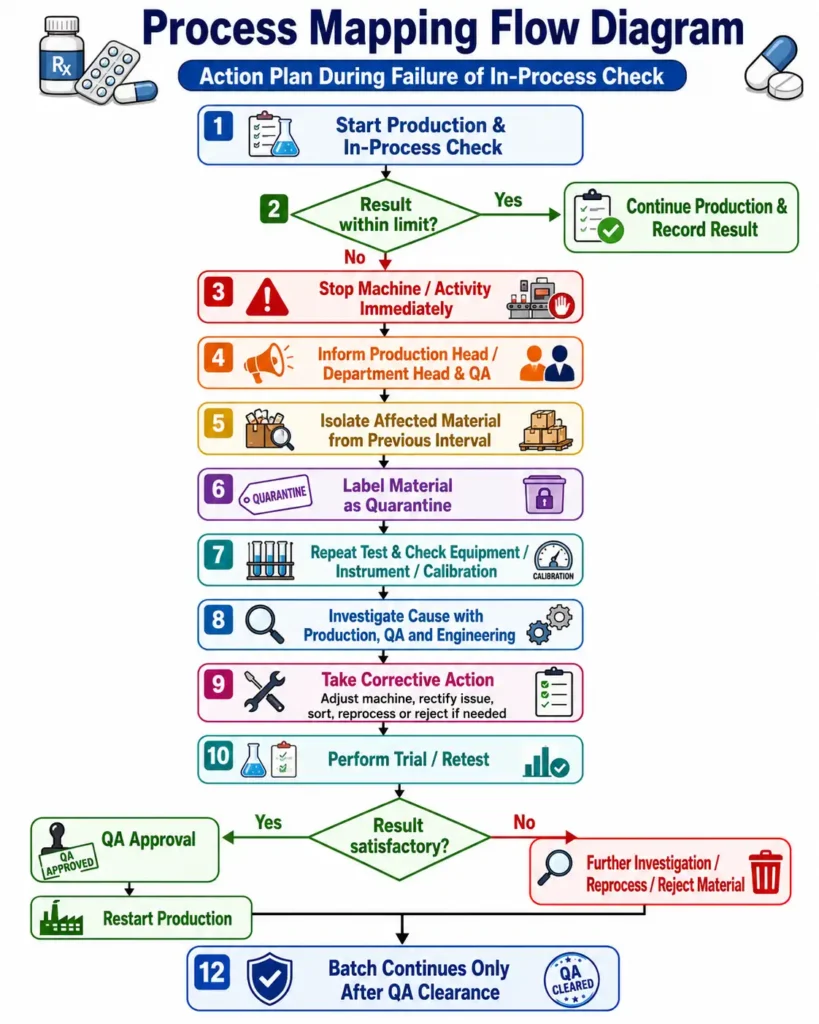
The affected material from the previous acceptable checking interval is isolated and kept under quarantine. The test is repeated, equipment and calibration status are checked, and the cause is investigated with Production, QA, and Engineering. Necessary corrective action is taken, followed by a trial or retest. If the result is satisfactory, QA gives approval and production is restarted. If the result still fails, further investigation, reprocessing, segregation, or rejection is carried out as required.
2. Brainstorming:
Brainstorming is a simple team-based method used to collect possible causes and solutions when an in-process check fails during manufacturing or packing. In this activity, team members from Production, Quality Assurance, and Engineering share their ideas freely without immediately judging them. Each idea can be written on a separate sticky note so that all possible causes are clearly visible and easy to group.
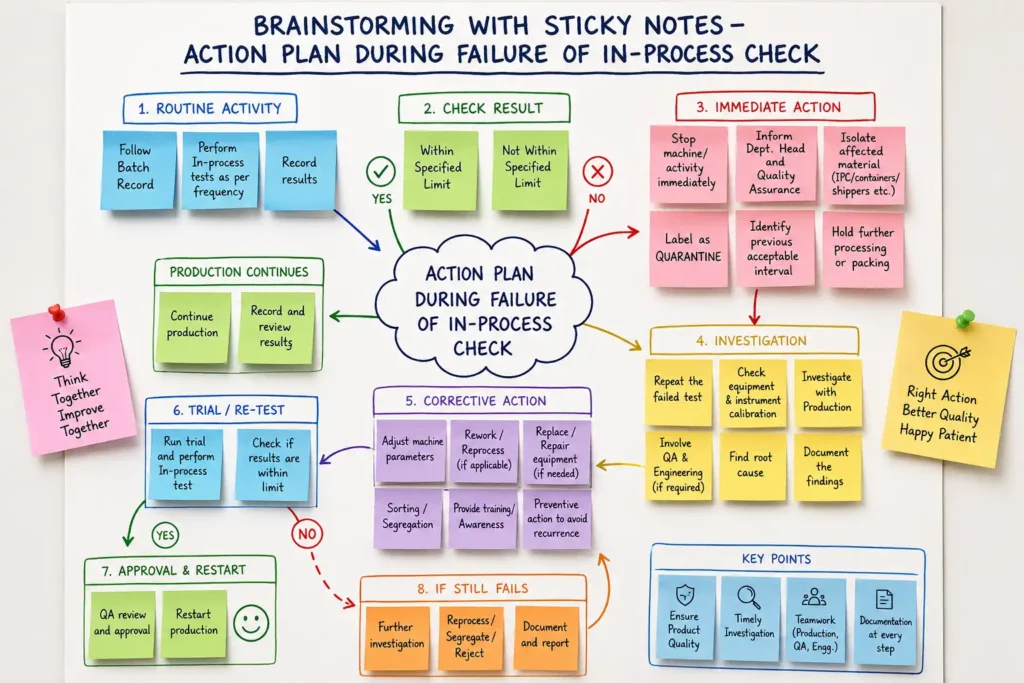
For an in-process failure, brainstorming may cover points such as machine settings, equipment condition, operator practices, material quality, test method, calibration status, environmental conditions, and process parameters. The team then reviews the ideas, identifies the most likely causes, and decides what should be investigated first. This method helps the team think together, avoid missing possible reasons, and find practical corrective actions. It also supports better root cause investigation, proper documentation, prevention of repeated failures, and improved product quality.
3. 5-Why Analysis:
The 5-Why Analysis is a simple root cause analysis tool used to find the actual reason behind a problem by repeatedly asking “Why?”. In the case of an in-process check failure, the investigation starts with the observed problem, such as tablet weight being outside the specified limit.
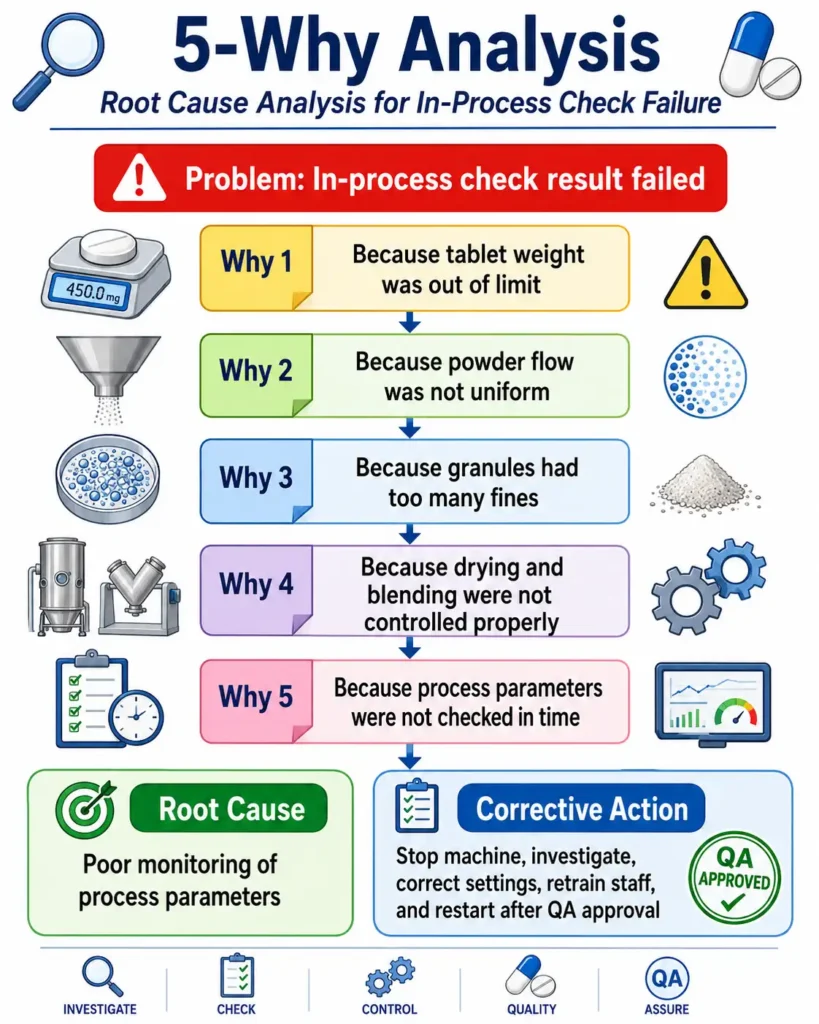
The first “Why” identifies the immediate cause. Each next “Why” goes deeper until the team reaches the root cause of the failure. For example, weight variation may be linked to poor powder flow, excessive fines, improper drying or blending, and finally inadequate monitoring of process parameters. Once the root cause is identified, suitable corrective and preventive actions can be taken. These may include adjusting machine settings, checking process parameters, improving monitoring, retraining personnel, and verifying results before restarting production. The 5-Why method is easy to use and helps prevent the same problem from happening again.
4. Fishbone Diagram (Ishikawa):
The Fishbone Diagram, also called the Ishikawa Diagram, is a simple root cause analysis tool used to identify possible reasons for an in-process check failure. It arranges potential causes into major categories so that the investigation team can review the problem in a systematic way.
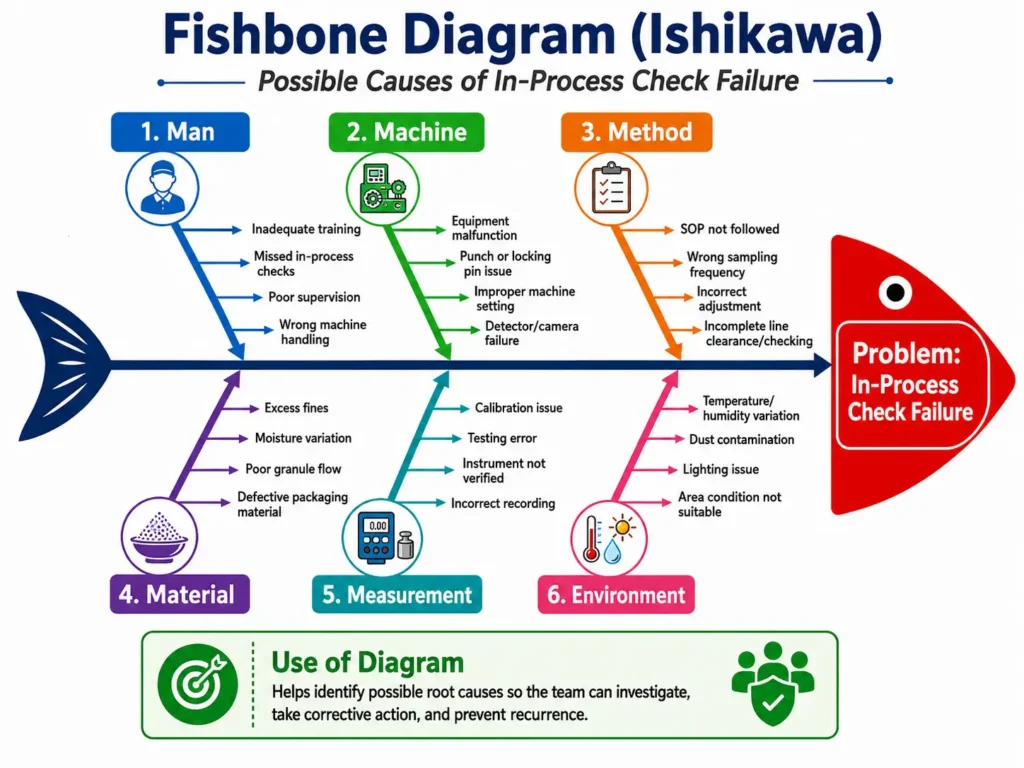
For an in-process failure, causes can be grouped under Man, Machine, Method, Material, Measurement, and Environment. Examples include inadequate training, incorrect machine settings, SOP not followed, poor granule flow, calibration problems, and unsuitable temperature or humidity conditions. The main problem is written at the head of the fish, while possible causes are shown on the branches. Production, Quality Assurance, and Engineering can review each branch and identify the most likely cause. This method helps the team avoid missing important factors, supports proper investigation, and assists in selecting suitable corrective and preventive actions to prevent recurrence.
5. Fault Tree Analysis (FTA):
Fault Tree Analysis (FTA) is a simple root cause analysis tool used to understand how different problems can lead to an in-process check failure. The analysis starts with the main problem, called the Top Event, and then breaks it down into possible causes and sub-causes.
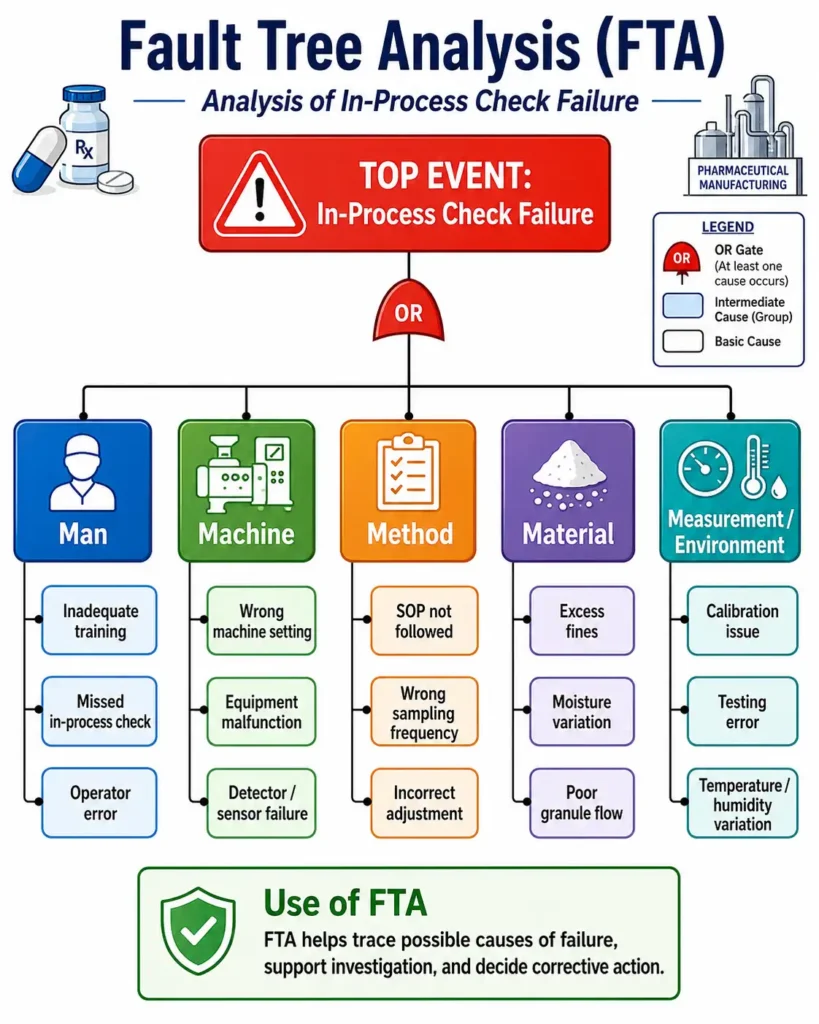
For an in-process failure, possible causes may be grouped under Man, Machine, Method, Material, Measurement, and Environment. These can include operator error, incorrect machine settings, equipment malfunction, wrong sampling, material variation, calibration problems, testing errors, or unsuitable environmental conditions. The SOP also requires checking equipment or instrument calibration and investigating failures jointly with Production and Quality Assurance. FTA helps the investigation team trace the problem step by step, identify the most probable root cause, and select suitable corrective actions. It supports systematic investigation, better decision-making, prevention of repeated failures, and improved product quality.
6. FMEA:
Failure Mode and Effects Analysis (FMEA) is a systematic risk assessment tool used to identify possible failures in a process before they cause serious problems. It evaluates each potential failure based on three factors: Severity (S), Occurrence (O), and Detection (D).
These values are multiplied to calculate the Risk Priority Number (RPN): RPN = Severity × Occurrence × Detection
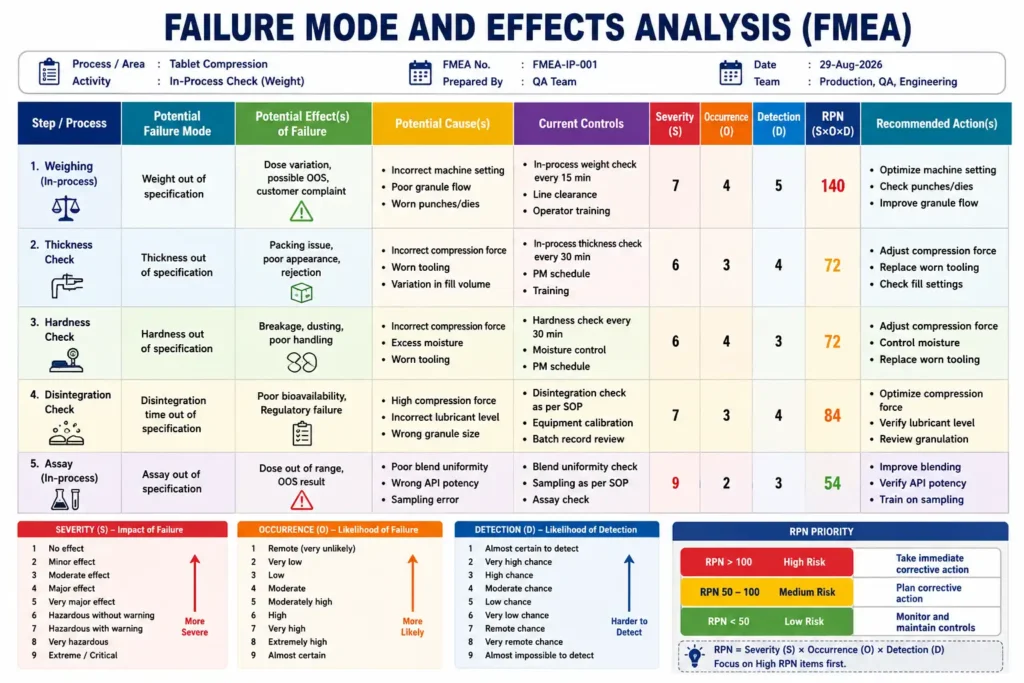
For an in-process check failure, FMEA can assess problems such as tablet weight variation, incorrect thickness, hardness failure, disintegration failure, machine setting problems, or material flow issues. Higher RPN values indicate higher-risk problems that require priority action. Based on the risk level, suitable actions such as machine adjustment, equipment checking, process improvement, additional monitoring, or personnel training are taken. FMEA helps reduce failures, improve product quality, strengthen process controls, and prevent recurrence.
7. Is / Is-Not Analysis:
Is / Is-Not Analysis is a simple root cause analysis tool used to understand a problem by comparing what is happening (IS) with what is not happening (IS-NOT).
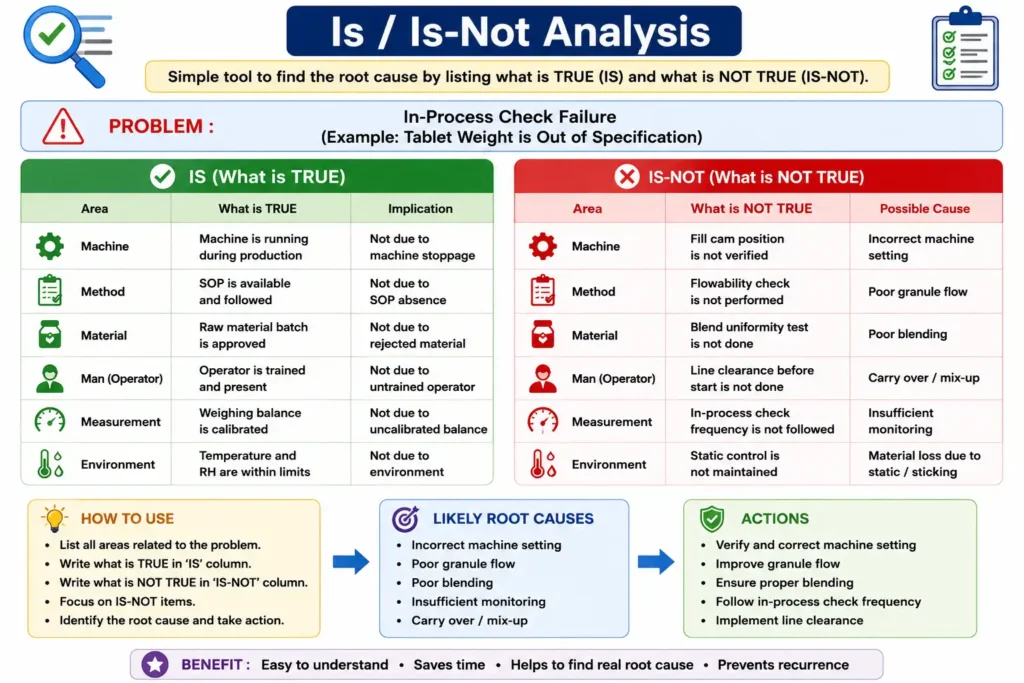
During an in-process check failure, the team reviews different areas such as Man, Machine, Method, Material, Measurement, and Environment. Facts that are confirmed are written under the IS column, while conditions that are absent, incorrect, or different are written under the IS-NOT column. This comparison helps narrow down the possible causes of the failure. For example, if the machine is running properly but the machine setting was not verified, the setting may become a likely cause. The method is easy to understand, saves investigation time, and helps the team focus on the most probable root cause. After identifying the cause, suitable corrective and preventive actions can be taken to avoid recurrence.
8. Pareto Chart:
A Pareto Chart is a simple graphical tool used to identify the most frequent or important causes of a problem. It combines bars and a cumulative percentage line. The bars show how often each type of failure occurs, arranged from highest to lowest frequency, while the line shows the cumulative contribution of these failures.
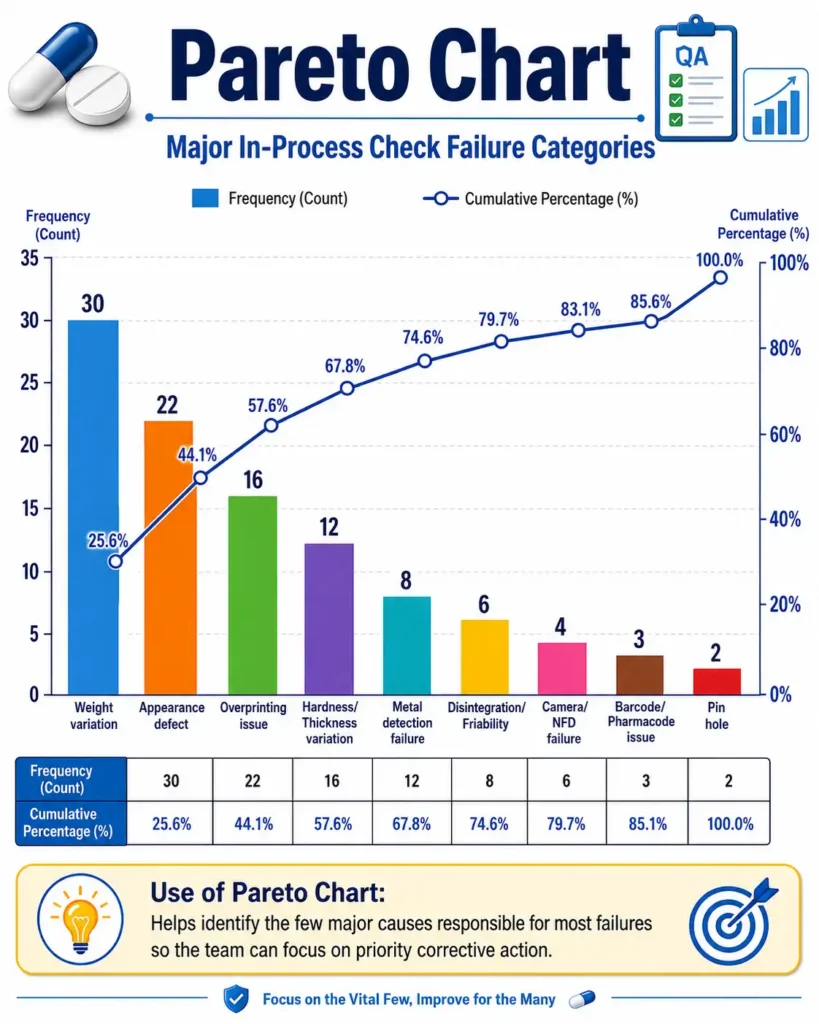
For in-process check failures, categories may include weight variation, appearance defects, overprinting problems, hardness or thickness variation, metal detector failure, disintegration failure, camera/NFD failure, barcode issues, and pinholes. The Pareto Chart follows the 80/20 principle, which suggests that a small number of causes may be responsible for a large portion of problems. By focusing first on the major causes, the investigation team can prioritize corrective actions, use resources effectively, reduce repeated failures, and improve overall product quality.
9. Timeline Analysis:
Timeline Analysis is a simple investigation tool used to understand what happened, when it happened, and what action was taken during an in-process check failure.
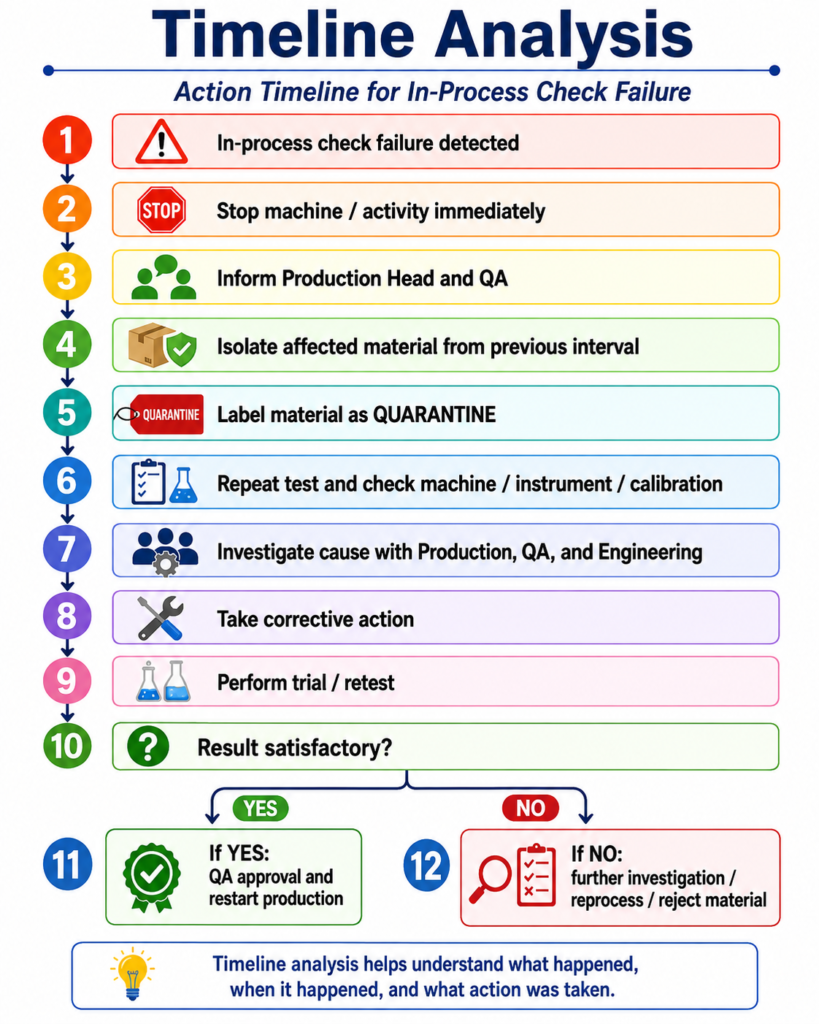
The timeline begins when the failure is detected. The machine or activity is stopped, Production Head and Quality Assurance are informed, and the affected material from the previous interval is isolated and kept under quarantine. After this, the failed test is repeated, equipment or instrument status is checked, and the cause is investigated. Corrective action is then taken, followed by a trial or retest. If the result is satisfactory, QA approval is obtained and production can restart. If the result is still not acceptable, further investigation, reprocessing, segregation, or rejection may be required. Timeline Analysis helps the team review events in the correct sequence, identify delays or gaps, and improve future response to similar failures.
10. Barrier Analysis:
Barrier Analysis is used to identify which controls should prevent an SOP failure during in-process checks and whether those controls are working properly. Possible causes may include unclear SOP instructions, lack of training, missed checking frequency, workload, poor supervision, checklist not used, or recording errors.
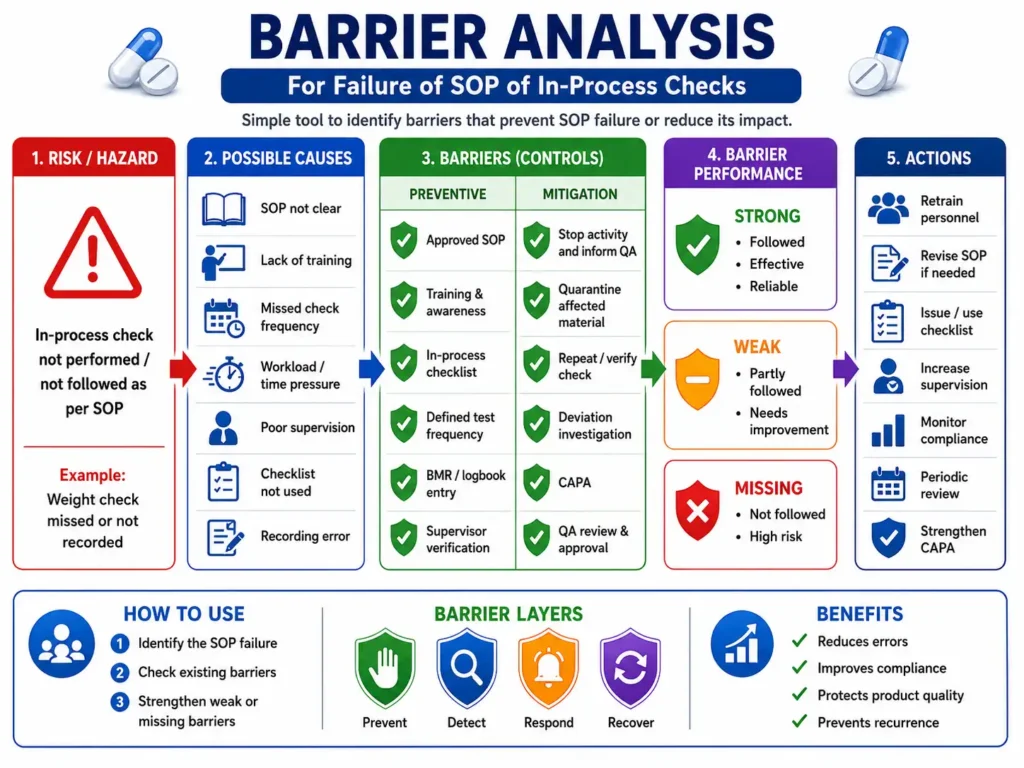
Preventive barriers include an approved SOP, trained personnel, defined in-process check frequency, checklists, BMR/logbook entries, and supervisor verification. If a failure occurs, mitigation barriers such as stopping the activity, informing QA, quarantining affected material, repeating the check, investigation, CAPA, and QA approval are used. The SOP specifically requires stopping the activity, informing the Department Head and QA, and isolating affected material when results are not acceptable.
Barrier Analysis helps identify weak or missing controls so they can be strengthened to improve compliance, protect product quality, and prevent recurrence.
11. Human Error Analysis:
Failure of the SOP for in-process checks means that the required checks are not performed, recorded, or followed as specified during manufacturing or packing. This may include missed testing frequency, incorrect testing, failure to stop the process after an unacceptable result, or failure to inform the Department Head and Quality Assurance. The SOP requires in-process tests to be performed at the defined frequency and immediate action to be taken when results are outside the specified acceptance criteria.
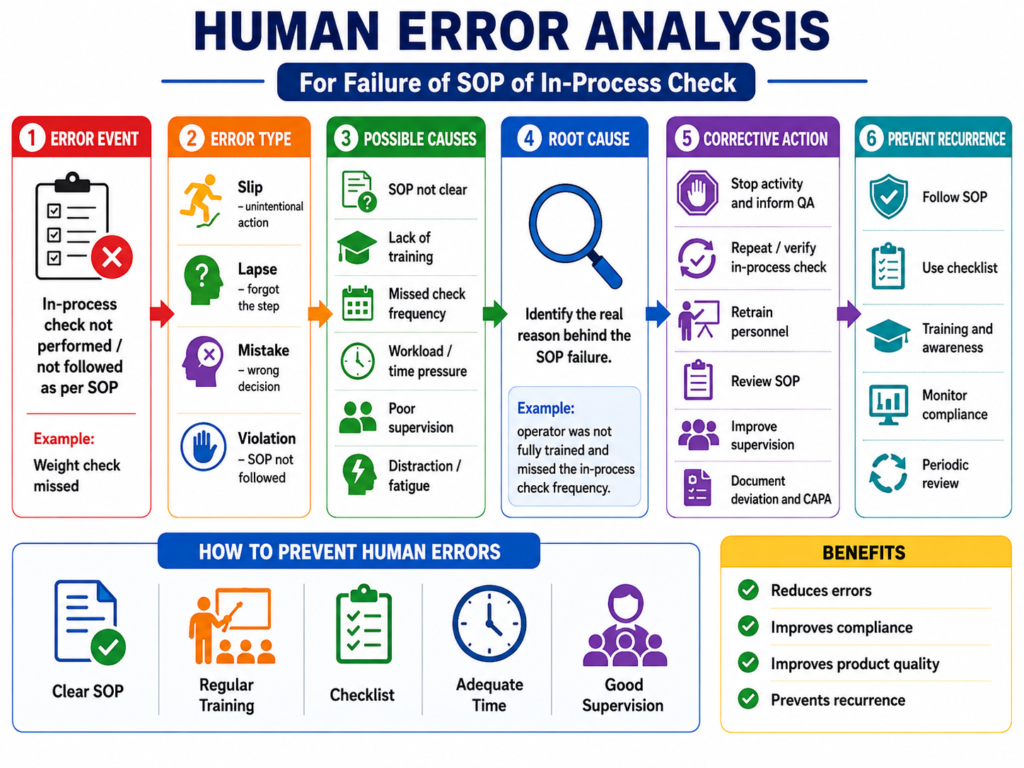
Such failures may occur because of inadequate training, unclear instructions, workload, poor supervision, human error, or lack of awareness. The affected material should be identified and quarantined, the failure investigated, and equipment or calibration status checked where applicable. Corrective actions may include retraining, SOP review, improved supervision, checklists, and stronger monitoring to prevent recurrence and protect product quality.
12. Kepner–Tregoe Analysis:
Tregoe Analysis for In-Process Check Failure
Kepner–Tregoe Analysis can be used to systematically investigate an in-process check failure covered by the SOP. The process starts by clearly identifying and describing the failure. As required by the SOP, the machine or activity is stopped, Production and Quality Assurance are informed, and the affected material from the previous checking interval is isolated and kept under quarantine.
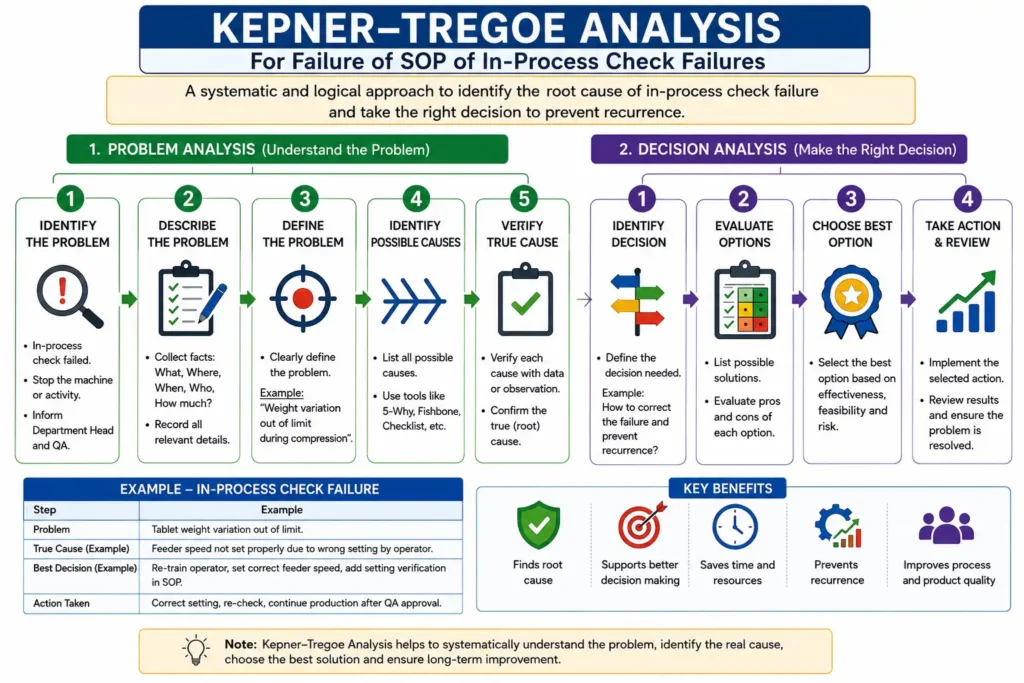
The investigation team then collects facts, lists possible causes, and verifies the most likely root cause using available evidence. After the true cause is identified, different corrective options are evaluated and the most suitable action is selected. This may include machine adjustment, equipment correction, reprocessing, segregation, or additional checking as applicable. The selected action is implemented and results are reviewed before normal production continues.
This method helps ensure logical investigation, correct decision-making, prevention of recurrence, and better product quality.
13. PDCA Cycle:
The PDCA Cycle is a simple continuous improvement method used to manage and prevent in-process check failures. It follows four steps: Plan, Do, Check, and Act.
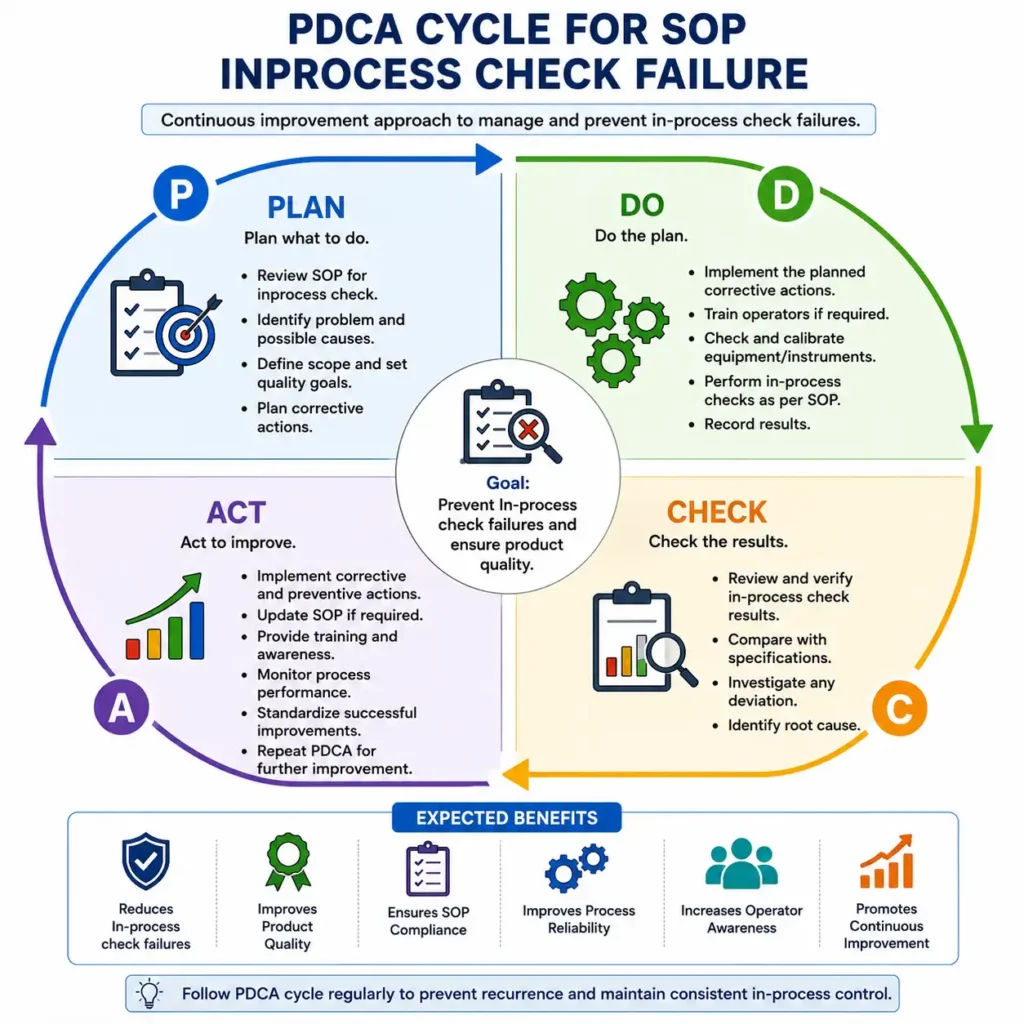
Plan: Identify the problem, review the SOP, find possible causes, and plan corrective actions.
Do: Implement the planned actions, check equipment or instruments, train personnel if required, and perform in-process checks as per the SOP.
Check: Review the results, compare them with specifications, investigate any deviation, and confirm the root cause.
Act: Implement corrective and preventive actions, update the SOP if needed, provide training, and standardize successful improvements.
The PDCA cycle helps reduce repeated failures, improve product quality, strengthen SOP compliance, and maintain consistent in-process control.
14. DMAIC Method Analysis
The DMAIC Method can be used to investigate and control an in-process check failure in a simple and systematic way.
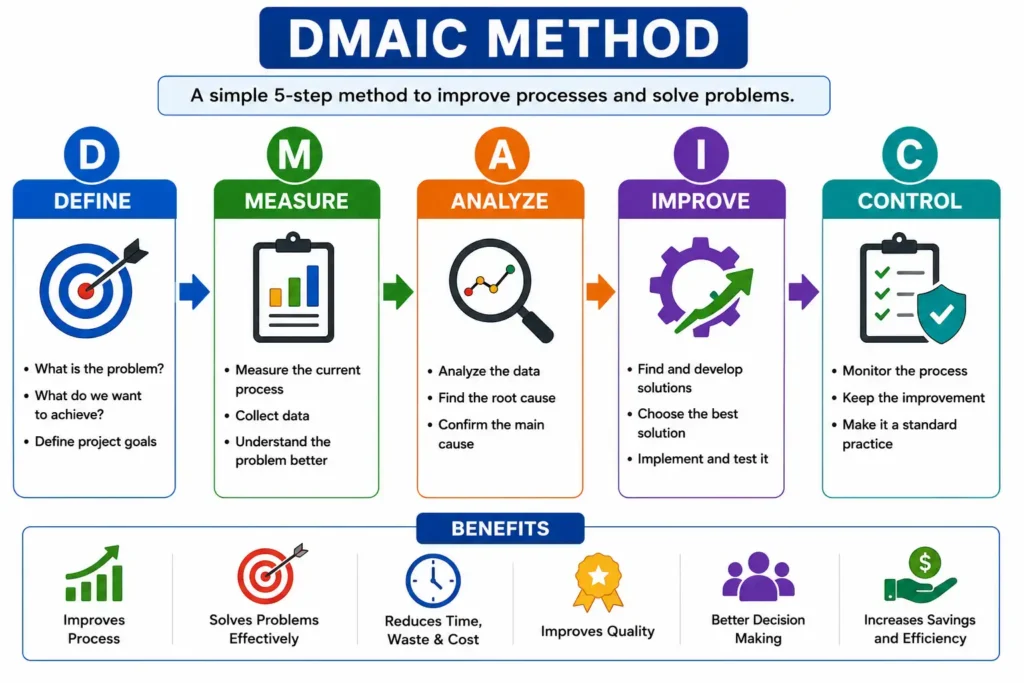
Define: Clearly identify the failed in-process parameter and stop the machine or activity immediately. Inform the Department Head and Quality Assurance.
Measure: Isolate the affected material from the previous acceptable checking interval, keep it under quarantine, and repeat the required test.
Analyze: Investigate the reason for failure with Production and QA. Check equipment, instrument calibration, machine settings, material, and process conditions.
Improve: Take suitable corrective action such as machine adjustment, reprocessing, sorting, equipment repair, or other required correction.
Control: Perform a trial or retest after correction. Production should continue only after results meet the specified requirements and necessary QA approval is obtained.
DMAIC helps find the root cause, correct the failure, and prevent recurrence.
15. Design of Experiment:
Design of Experiments (DoE) can be used to systematically study factors that may contribute to failure of an SOP for in-process checks. The SOP requires in-process tests to be performed at the defined frequency and immediate action to be taken when results are outside acceptance criteria.
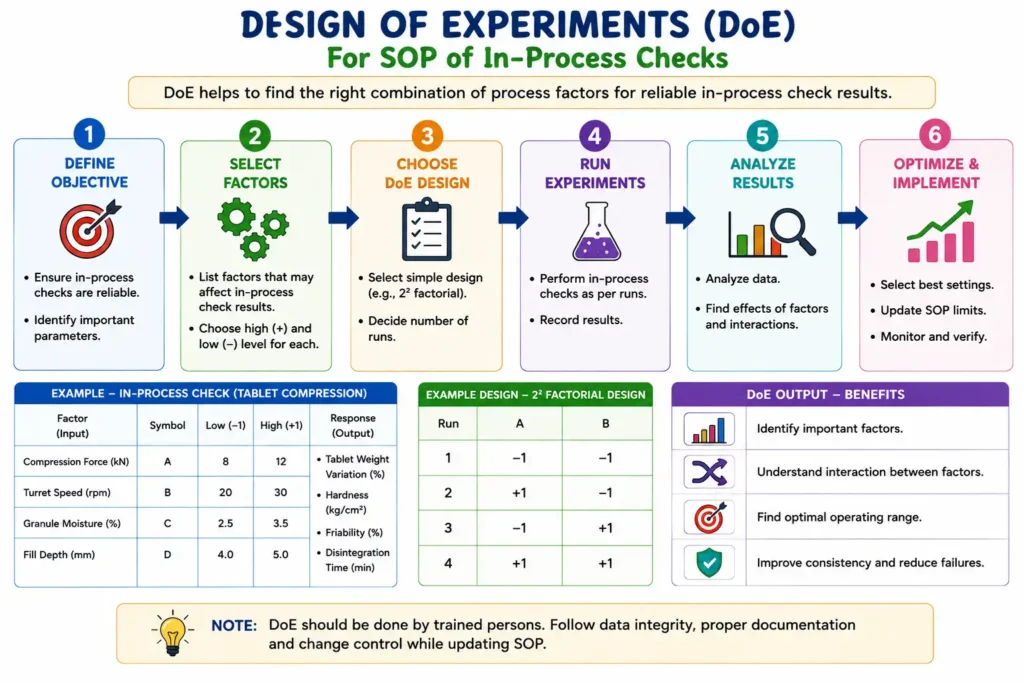
Possible factors such as training level, workload, SOP clarity, supervision, and compliance with checking frequency can be evaluated in a planned manner. Different combinations of these factors are studied to understand which ones have the greatest effect on SOP compliance.
The results help identify important contributing factors and support selection of suitable improvements, such as better training, clearer instructions, stronger supervision, or improved monitoring. Any SOP change should be properly documented and controlled.
DoE supports a data-based approach to improving SOP compliance and reducing repeated in-process check failures.
16. Bow-Tie Analysis:
Bow-Tie Analysis is a simple risk analysis tool used to understand the causes, controls, failure event, and consequences of an SOP failure during in-process checks.
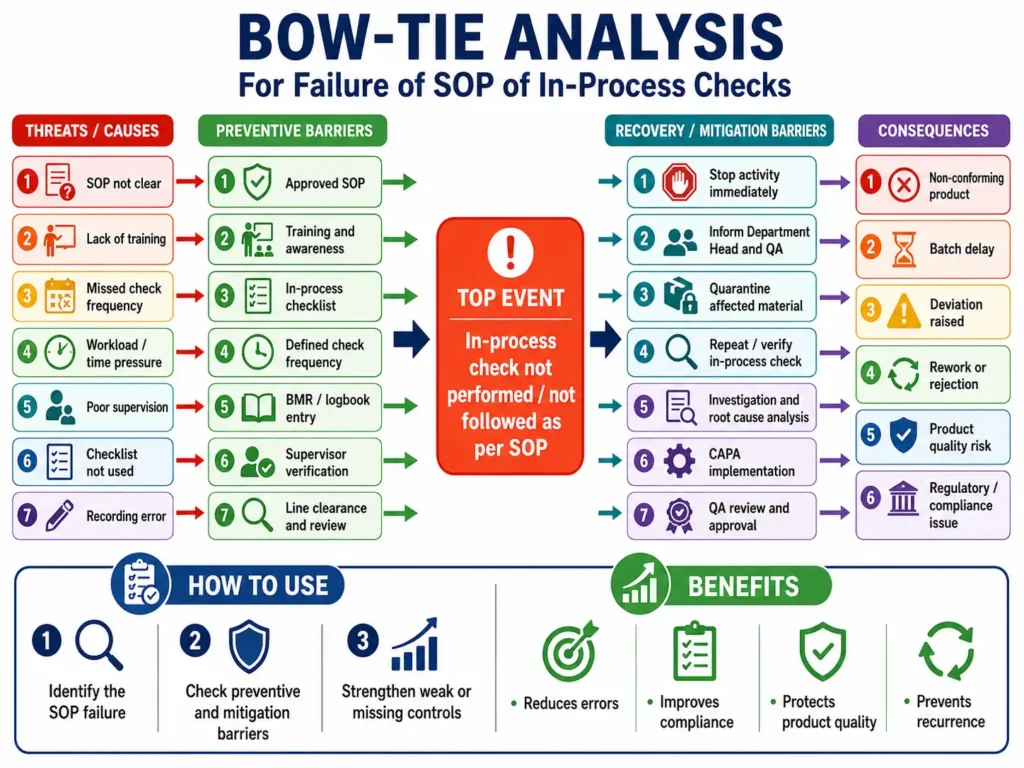
On the left side, possible threats such as unclear SOP, lack of training, missed check frequency, workload, poor supervision, checklist not used, and recording errors are identified. Preventive barriers such as approved SOPs, training, checklists, defined checking frequency, proper recording, and supervisor verification are used to stop the failure from occurring. The centre represents the top event, where the in-process check is not performed or not followed as per SOP. On the right side, mitigation actions such as stopping the activity, informing QA, quarantining affected material, repeating the check, investigation, CAPA, and QA approval help reduce the impact. Bow-Tie Analysis helps strengthen controls, reduce errors, protect product quality, improve compliance, and prevent recurrence.
17. HAZOP Analysis:
HAZOP (Hazard and Operability Study) is a systematic method used to identify possible deviations in an SOP and understand their causes, consequences, existing controls, and required actions.
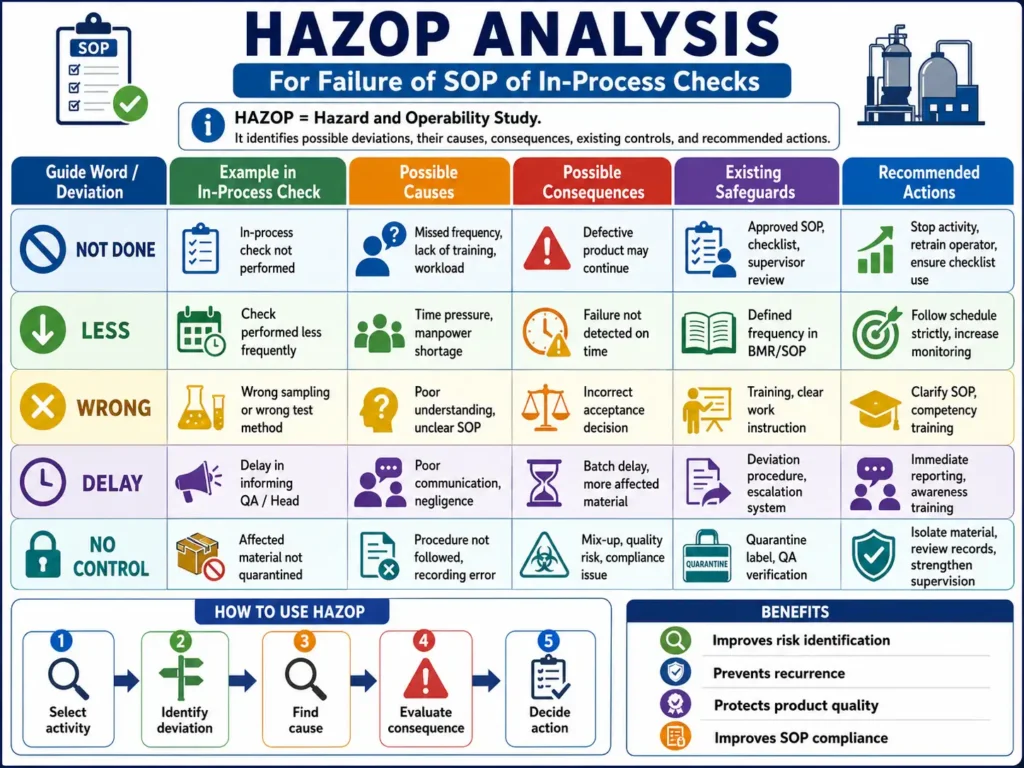
For in-process checks, deviations may include check not performed, check performed less frequently, wrong test method, delayed reporting, or affected material not quarantined. Possible causes can include lack of training, unclear SOP instructions, workload, poor communication, or recording errors.
The SOP requires in-process checks at the specified frequency and, when results are outside limits, the activity must be stopped and Production/QA informed. Affected material should also be isolated and quarantined, with equipment/calibration status checked where applicable.
HAZOP helps strengthen controls, improve SOP compliance, reduce risk, and prevent recurrence.
18. HACCP Analysis:
HACCP (Hazard Analysis and Critical Control Points) can be used to identify and control risks related to failure of SOP during in-process checks. The main hazards may include missed checks, incorrect testing, delayed reporting, or failure to quarantine affected material.
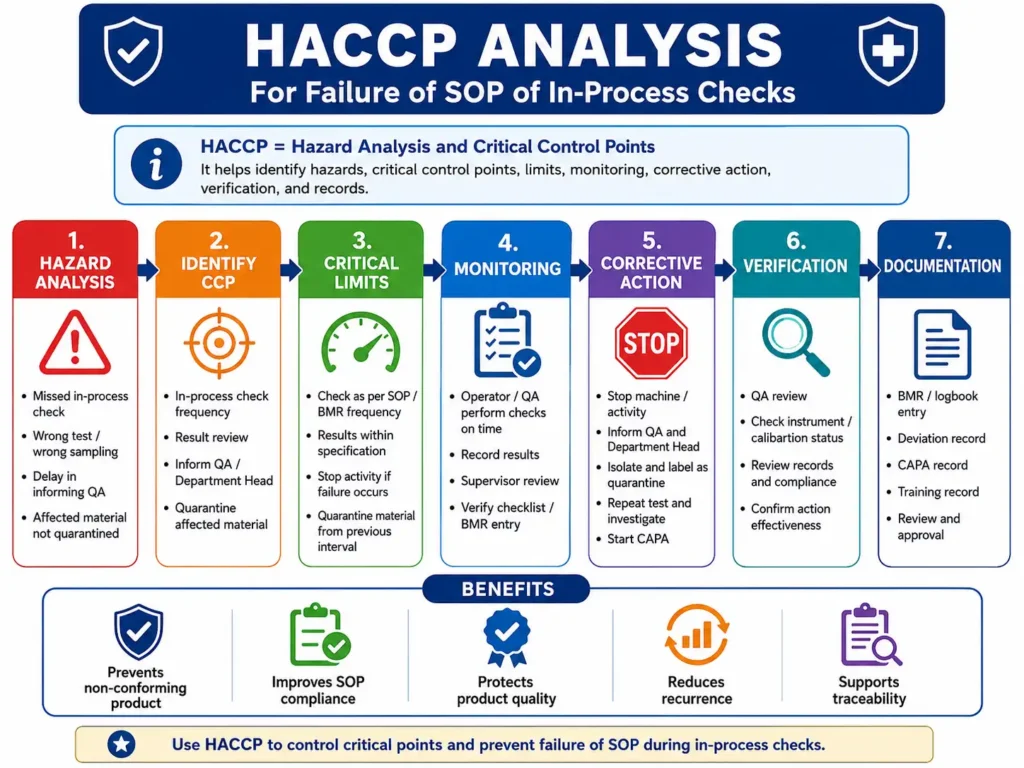
Critical control points include performing checks at the required frequency, reviewing results, informing Production and QA, and isolating affected material when a result is outside the specified limit. The SOP requires the activity to be stopped immediately when acceptance criteria are not met. Corrective actions may include repeating the test, checking equipment or calibration status, investigating the cause, and taking suitable action before restarting production.HACCP helps improve SOP compliance, product quality, traceability, timely action, and prevention of repeated in-process check failures.
19. Gemba Walk:
A Gemba Walk is a simple method where the investigation team goes to the actual work area to observe how in-process checks are being performed and to understand why the SOP was not followed.
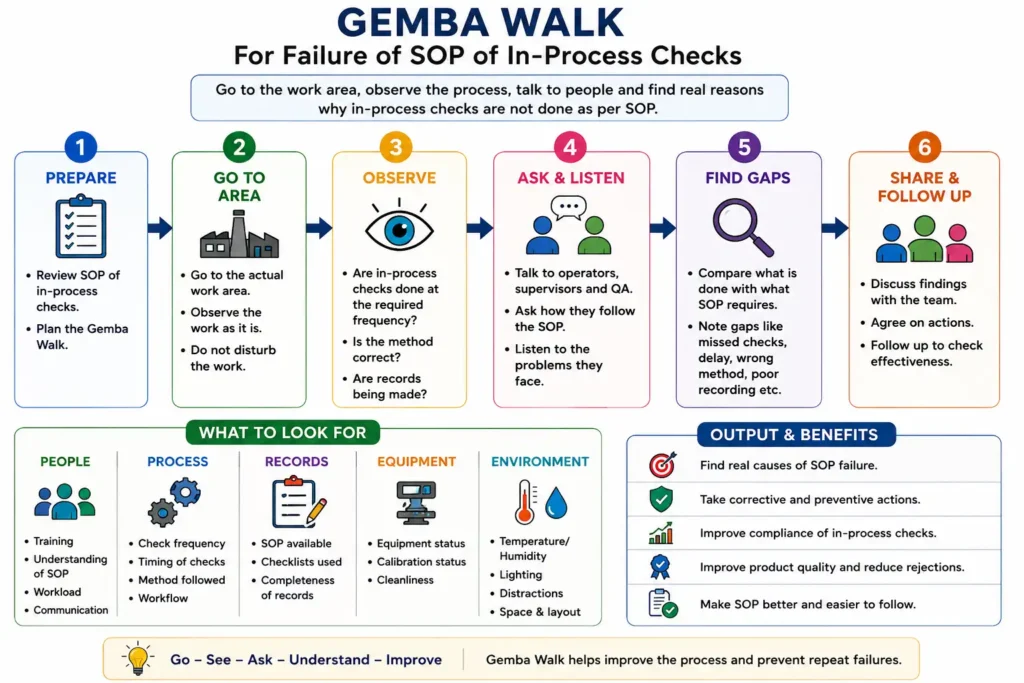
During the walk, the team checks whether in-process tests are performed at the required frequency, whether records are completed correctly, and whether operators follow the defined procedure. The SOP requires in-process checks to be performed at the specified frequency and immediate action to be taken when results are outside acceptance criteria. The team also talks with operators, supervisors, and QA to identify gaps such as lack of training, missed checks, workload, unclear instructions, equipment issues, or poor documentation. Findings are reviewed, corrective and preventive actions are implemented, and effectiveness is followed up. Gemba Walk helps find the real problem at the workplace, improve SOP compliance, reduce repeated failures, and strengthen product quality.