







1. Introduction – SOP for Addition of Recovery in the Batch:
The SOP for Addition of Recovery in the Batch describes the controlled procedure for adding recoverable product material from a previous batch into a subsequent batch. The purpose of this SOP is to ensure that recovery material is handled, examined, approved, and incorporated in a manner that maintains the required quality of the finished product. SOP for As defined in the SOP, recovery refers to the balance remaining from products. Its addition is carried out in the presence of the Manufacturing Chemist and QA Chemist. Recovery should not be stored for an unnecessarily long period and should normally be added to the next batch only after appropriate examination for quality. Where required, a QC report must be available, particularly when the recovery quantity exceeds 5% of the batch. SOP for Following this SOP provides documented control over recovery handling, supports GMP compliance, minimizes the risk of using unsuitable recovered material, and ensures appropriate Production and Quality oversight before recovery is incorporated into a batch.
Skip to PDF content2. Flow Diagram – SOP for Addition of Recovery in the Batch:
The Flow Diagram for SOP for Addition of Recovery in the Batch illustrates the controlled sequence for handling and incorporating recovery material into a subsequent batch. The process starts with identification and collection of recovery remaining from the previous batch. The recovered material is examined for quality in the presence of the Manufacturing Chemist and QA Chemist before further use.
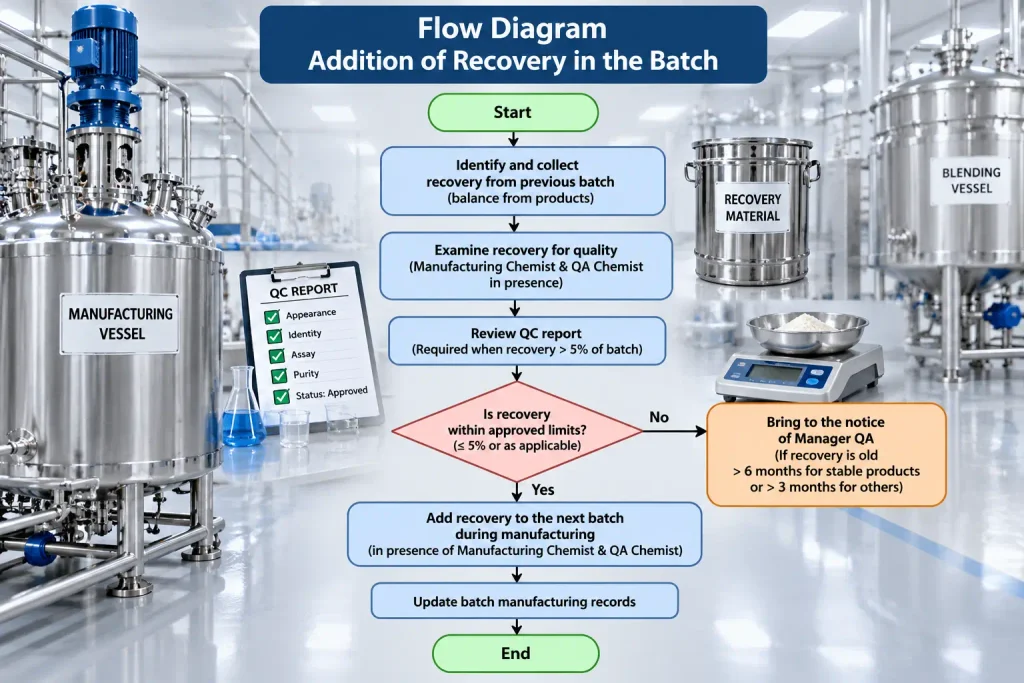
When the quantity of recovery is more than 5% of the batch, a QC report is required before addition. The SOP also requires older recovery material to be brought to the attention of the Manager QA under the conditions specified in the procedure. After satisfactory examination and approval, the recovery is added to the next batch under Production and QA supervision. The activity should be appropriately documented to provide traceability, accountability, and GMP control throughout the recovery-addition process.
3. Benefits of Following SOP – Addition of Recovery in the Batch:
Following the SOP for Addition of Recovery in the Batch ensures that recovered product material is handled in a controlled and documented manner before being added to a subsequent batch. The SOP requires recovery material to be examined for quality and added in the presence of the Manufacturing Chemist and QA Chemist, helping maintain appropriate Production and Quality oversight.
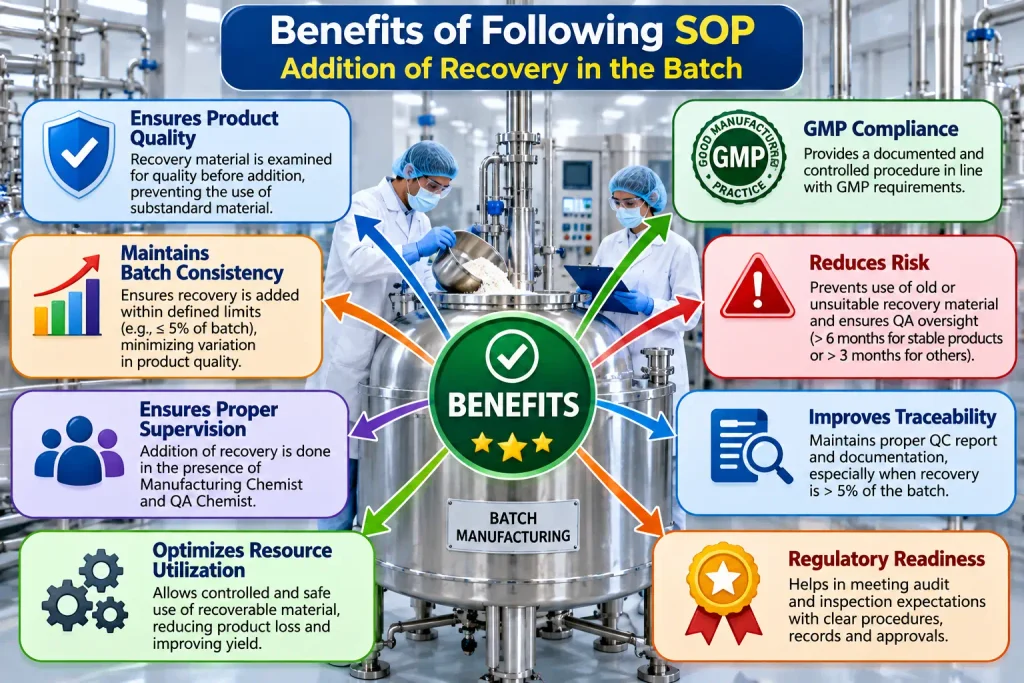
The procedure also strengthens batch consistency and traceability by defining when a QC report is required, particularly when recovery exceeds 5% of the batch. It further requires older recovery material to be brought to the attention of the Manager QA under the specified conditions. Overall, following this SOP supports controlled recovery utilization, reduces the risk of using unsuitable material, improves documentation and accountability, and promotes consistent GMP-compliant batch manufacturing practices.
4. Brainstorming Analysis – SOP for Addition of Recovery in the Batch:
The Brainstorming Analysis for SOP Failure – Addition of Recovery in the Batch identifies potential causes that may lead to improper handling or addition of recovery material during manufacturing. The SOP requires recovery to be examined for quality and added in the presence of the Manufacturing Chemist and QA Chemist. It also specifies that recovery should not be stored for long periods without appropriate consideration and that a QC report is required when recovery exceeds 5% of the batch.The brainstorming diagram therefore highlights possible failure areas such as incorrect identification of recovery material, mix-up with another product or batch, inadequate quality examination, absence of Production or QA supervision, improper storage, missing QC documentation, incorrect weighing, use of old recovery, inadequate labeling, poor record updating, and insufficient personnel awareness.
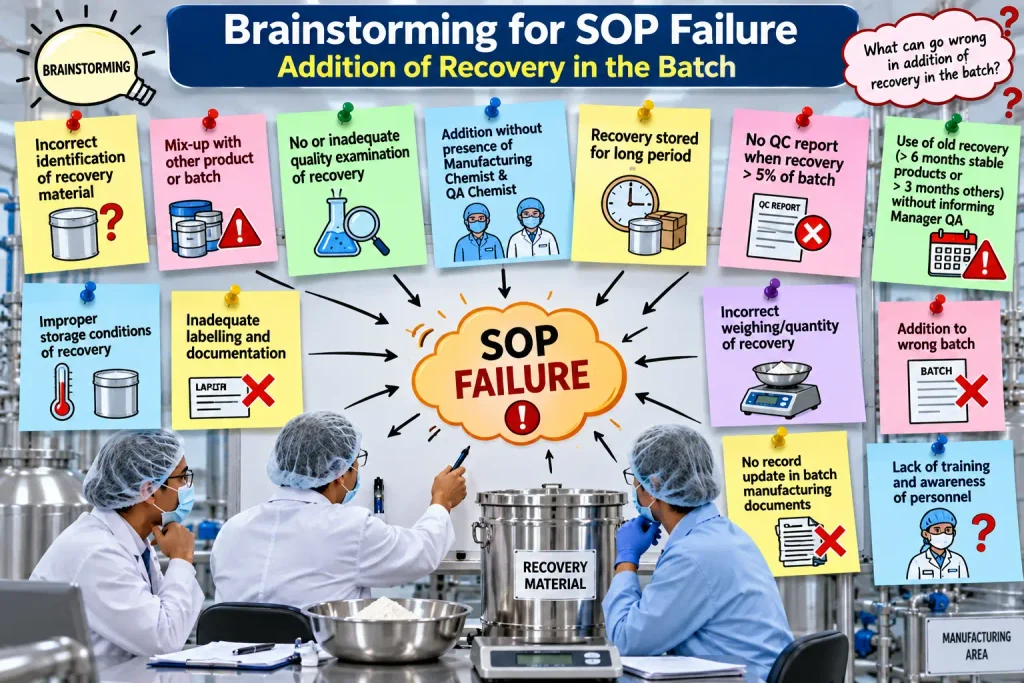
This analysis helps the manufacturing and quality teams recognize likely failure points in advance so that suitable controls, verification, documentation, training, and QA oversight can be strengthened to prevent incorrect recovery addition and maintain batch quality.
5. 5-Why Analysis – SOP for Addition of Recovery in the Batch:
The 5-Why Analysis for SOP Failure – Addition of Recovery in the Batch is used to trace the underlying causes that could result in incorrect or uncontrolled addition of recovery material during manufacturing. The SOP requires recovery to be properly examined for quality and added in the presence of the Manufacturing Chemist and QA Chemist. It also states that recovery should not be stored for long periods without proper consideration and that a QC report is required when recovery exceeds 5% of the batch. The analysis begins with the problem of improper recovery addition and progressively examines why the failure occurred. Possible contributing factors include inadequate quality examination, prolonged storage of recovery, absence of required QC documentation, lack of Production and QA supervision, insufficient awareness of SOP requirements, poor labeling or identification, and weak documentation practices.
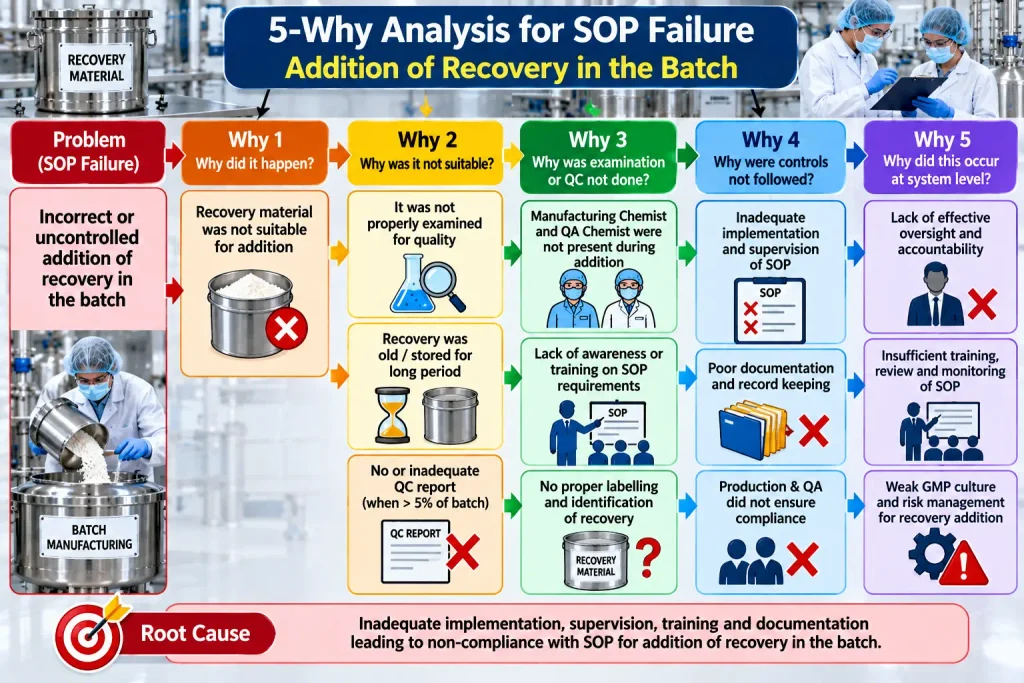
The final root cause may be linked to inadequate SOP implementation, supervision, training, and documentation, which can lead to non-compliance with the approved recovery-addition procedure. This analysis helps identify system-level weaknesses so that appropriate corrective and preventive actions can be established.
6. Fishbone Analysis – SOP for Addition of Recovery in the Batch:
The Fishbone Analysis for SOP Failure – Addition of Recovery in the Batch is used to identify the possible causes that can result in incorrect or uncontrolled addition of recovery material during manufacturing. The SOP requires recovery material to be properly examined for quality and added in the presence of the Manufacturing Chemist and QA Chemist. It also specifies that recovery should not be stored for a long period without appropriate evaluation and that a QC report is required when recovery exceeds 5% of the batch.
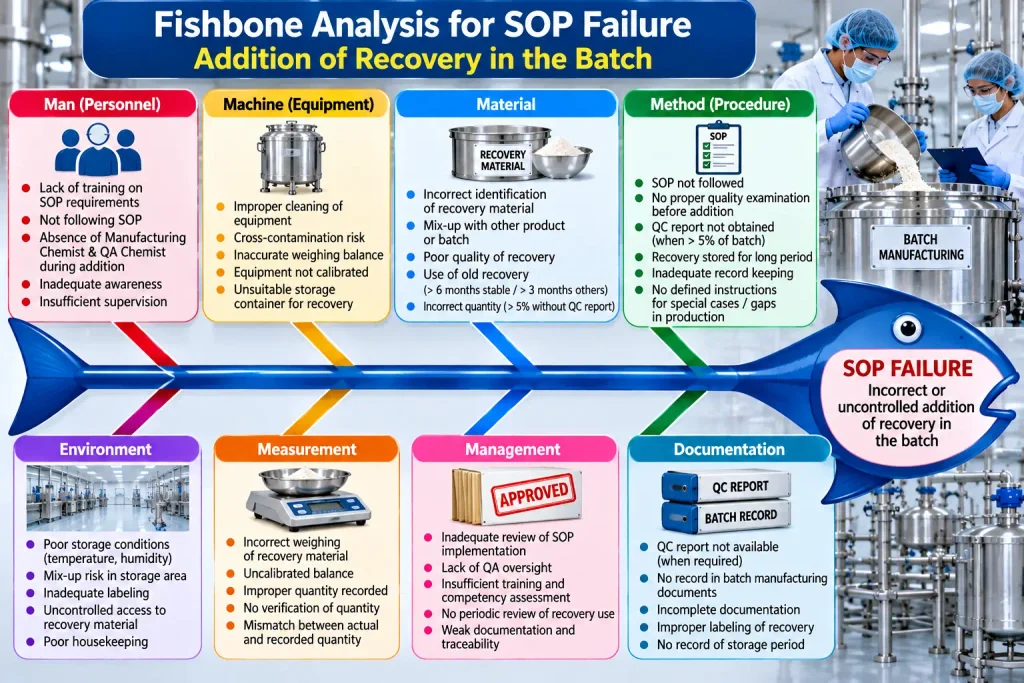
The fishbone diagram groups potential causes under categories such as Man, Machine, Material, Method, Environment, Measurement, Management, and Documentation. Typical failure causes include inadequate training, absence of QA or Production supervision, incorrect identification of recovery material, mix-up with another batch, inaccurate weighing, unsuitable storage, missing QC reports, incomplete batch records, poor labeling, and weak implementation of the SOP. This analysis helps the Production and Quality teams systematically identify contributing factors and establish suitable controls to prevent recovery-related errors and strengthen GMP compliance.
7. Fault Tree Analysis – SOP for Addition of Recovery in the Batch:
The Fault Tree Analysis for SOP Failure – Addition of Recovery in the Batch evaluates how different individual failures can combine and lead to the top event of incorrect or uncontrolled addition of recovery material into a batch. The SOP requires the recovery to be properly examined for quality, added in the presence of the Manufacturing Chemist and QA Chemist, and supported by a QC report when recovery exceeds 5% of the batch. It also specifies that recovery should not be stored for an unnecessarily long period.
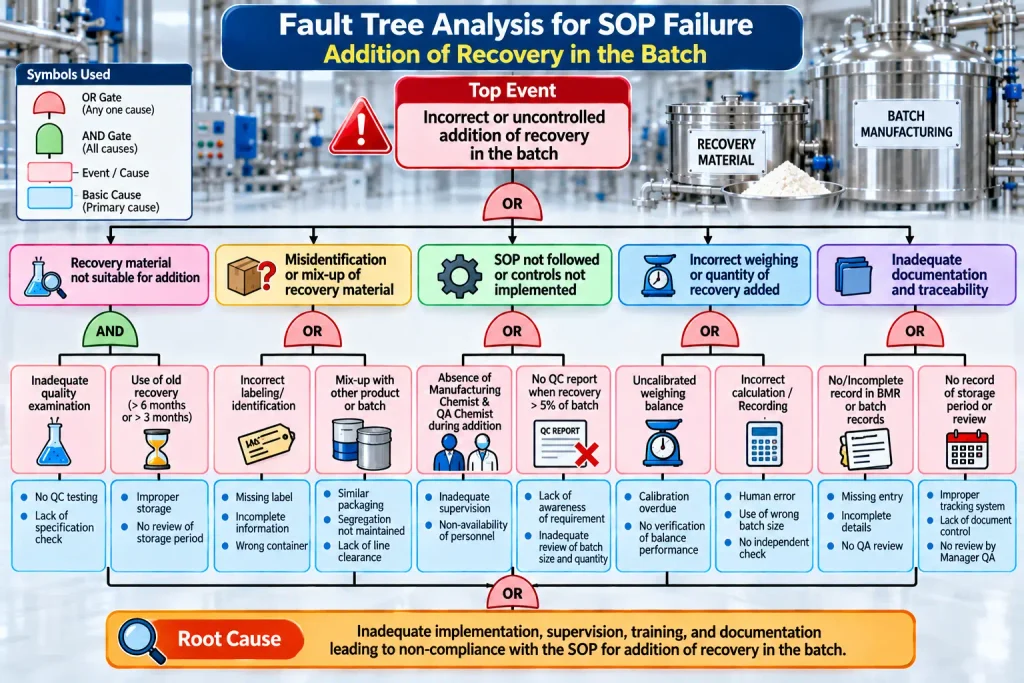
The fault tree considers major branches such as unsuitable recovery material, misidentification or mix-up, failure to follow SOP controls, incorrect weighing or quantity, and inadequate documentation or traceability. These branches can arise from basic causes including insufficient quality examination, use of old recovery, missing labels, absence of required personnel, lack of QC reporting, inaccurate weighing, incomplete batch records, or poor review practices. The analysis helps identify critical failure pathways and supports the establishment of effective controls, supervision, training, documentation, and QA oversight to prevent SOP non-compliance and protect batch quality.
8. Impact Assessment – SOP for Addition of Recovery in the Batch:
The Impact Assessment for SOP Failure – Addition of Recovery in the Batch evaluates the possible consequences of incorrect or uncontrolled use of recovery material during manufacturing. Since the SOP requires quality examination of recovery, presence of the Manufacturing Chemist and QA Chemist, and a QC report when recovery exceeds 5% of the batch, failure to follow these controls may affect batch quality and compliance.
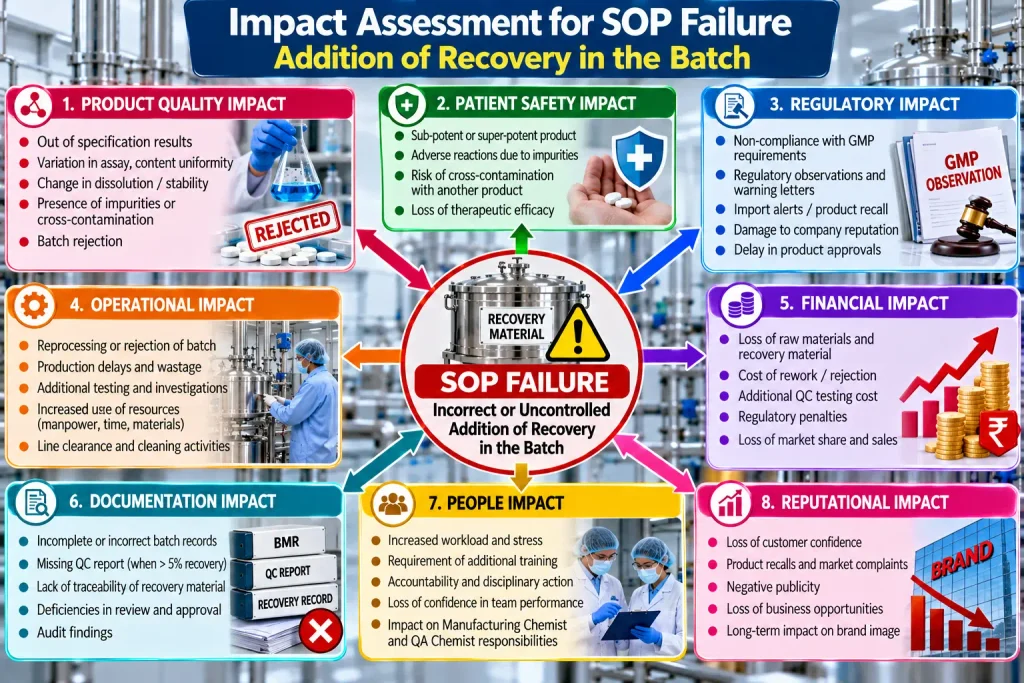
Potential impacts include variation in product quality, batch rejection, additional testing or investigation, production delays, incomplete documentation, and loss of traceability. Significant SOP failure may also increase regulatory risk and create additional operational and financial burden. The assessment therefore helps Production and Quality teams understand the seriousness of non-compliance and supports timely corrective and preventive actions to maintain GMP control and consistent batch manufacturing.
9. CAPA – SOP for Addition of Recovery in the Batch:
The CAPA for SOP Failure – Addition of Recovery in the Batch is intended to address failures associated with improper or uncontrolled use of recovery material during manufacturing. The SOP requires recovery to be examined for quality, added in the presence of the Manufacturing Chemist and QA Chemist, and supported by a QC report when recovery exceeds 5% of the batch. It also states that recovery should not be stored for long periods without appropriate consideration.
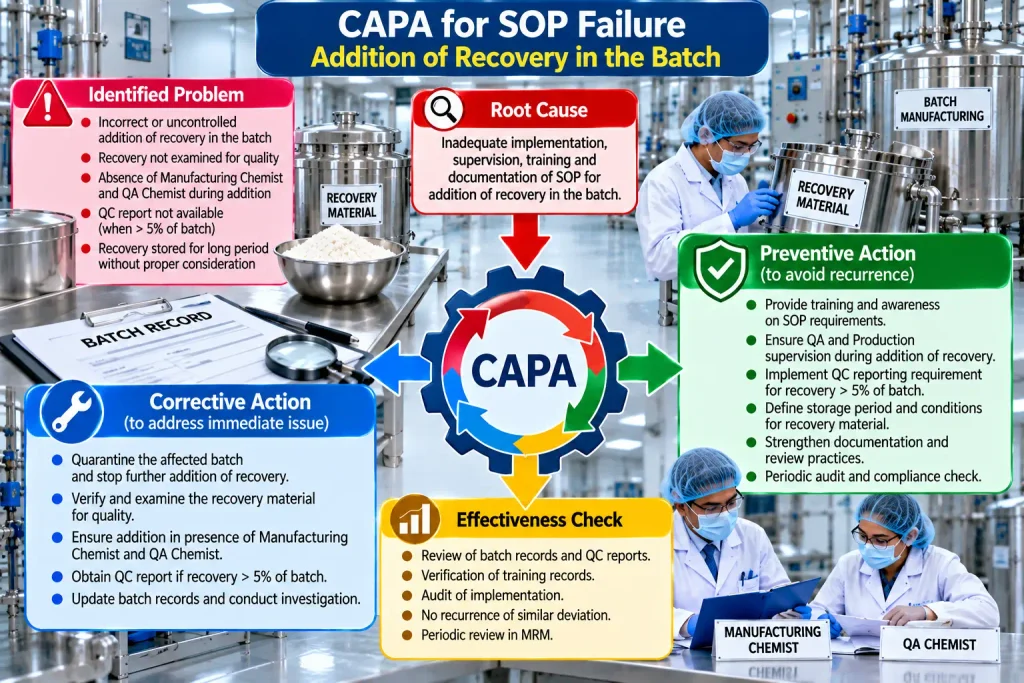
Corrective actions may include stopping further recovery addition, examining the recovery material, reviewing the affected batch, obtaining the required QC report, and ensuring proper documentation. Preventive actions should focus on personnel training, Production and QA supervision, controlled storage of recovery, defined review requirements, and stronger batch-record practices. Effectiveness should be verified through review of batch records, QC reports, training records, and periodic compliance checks to confirm that similar SOP failures do not recur.
Questions & Answers – SOP for Addition of Recovery in the Batch:
- What is the objective of this SOP?
The objective is to describe the procedure for addition of recovery in the batch. - What is the scope of this SOP?
The SOP covers the addition of recovery in the batch. - Who is responsible for execution of this SOP?
The concerned Production Chemist is responsible for execution of the SOP. - Who is responsible for effective implementation of the SOP?
The Sr. Manager Production and Head – QA/QC are responsible for effective implementation. - What does recovery mean according to the SOP?
Recovery means the balance remaining from products. - In whose presence should recovery be added?
Recovery should be added in the presence of the Manufacturing Chemist and QA Chemist. - Can recovery material be stored for a long period?
The SOP states that recovery should not be stored for long and should preferably be added to the next batch after proper quality examination. - What should be done if the next batch is planned after a gap?
The recovery should be properly examined for quality or specially processed as specified in the SOP. - When is a QC report required for recovery addition?
A QC report is required when the recovery is more than 5% of the batch. - What should be done if recovery is old?
The SOP states that recovery more than 6 months old for stable products should be brought to the notice of the Manager QA. The next part of the sentence in the uploaded SOP is unclear/incomplete, so it should be verified from the approved controlled copy before implementation. - Why is quality examination of recovery important?
It helps ensure that only suitable recovery material is considered for addition to the next batch, consistent with the SOP requirement for proper examination. - Why is QA involvement important during recovery addition?
QA presence provides oversight during the recovery-addition activity and supports compliance with the approved procedure. - What is the reference given in the SOP?
The SOP lists “As per GMP” as the reference. - Does this SOP have any annexure?
No. The SOP states Annexure: Nil. - Which departments receive controlled and master copies?
The controlled copy is distributed to the Head of Department – Production, while the master copy is maintained by the Head of Department – Quality Assurance.
Reference Guideline – SOP for Addition of Recovery in the Batch:
The SOP does not identify any specific GMP guideline, regulatory authority, chapter, clause, or document number. If you want, I can separately provide an expanded regulatory reference list for recovery/rework/reprocessing using current GMP guidance.