







1. Brief Description:
This SOP describes the systematic procedure for transferring an analytical method from a Transferring Laboratory (TL) to a Receiving Laboratory (RL). It applies to analytical tests for drug substances and drug products, including assay, dissolution, related substances, content uniformity, residual solvents, preservative or antioxidant content, identification, and microbiological testing. The procedure defines the responsibilities of Quality Assurance, Quality Control, the transferring laboratory, and the receiving laboratory. Before transfer, required instruments, columns, reagents, standards, samples, documents, and analyst training must be ensured. Both laboratories perform testing according to an approved transfer protocol and predefined acceptance criteria. Results are compared, reviewed, and documented in the analytical method transfer report. Any discrepancy or failure is investigated and corrective actions are implemented. After successful completion, the transfer report, certificate, and training documentation are approved, demonstrating that the receiving laboratory can reliably perform the transferred analytical method.
Skip to PDF content2. Flow Diagram:
The flow diagram presents the step-by-step process for Analytical Method Transfer from the Transferring Laboratory to the Receiving Laboratory. The process starts after successful analytical method development and verification. Product information is shared, followed by preparation and review of the prerequisite checklist to ensure availability of required instruments, reagents, standards, columns, documents, and other resources. An Analytical Method Transfer Protocol is then prepared, reviewed, and approved by both laboratories. The receiving laboratory analysts are trained and familiarized with the method before execution. Both laboratories perform the required analysis according to the approved protocol and standard test procedure.
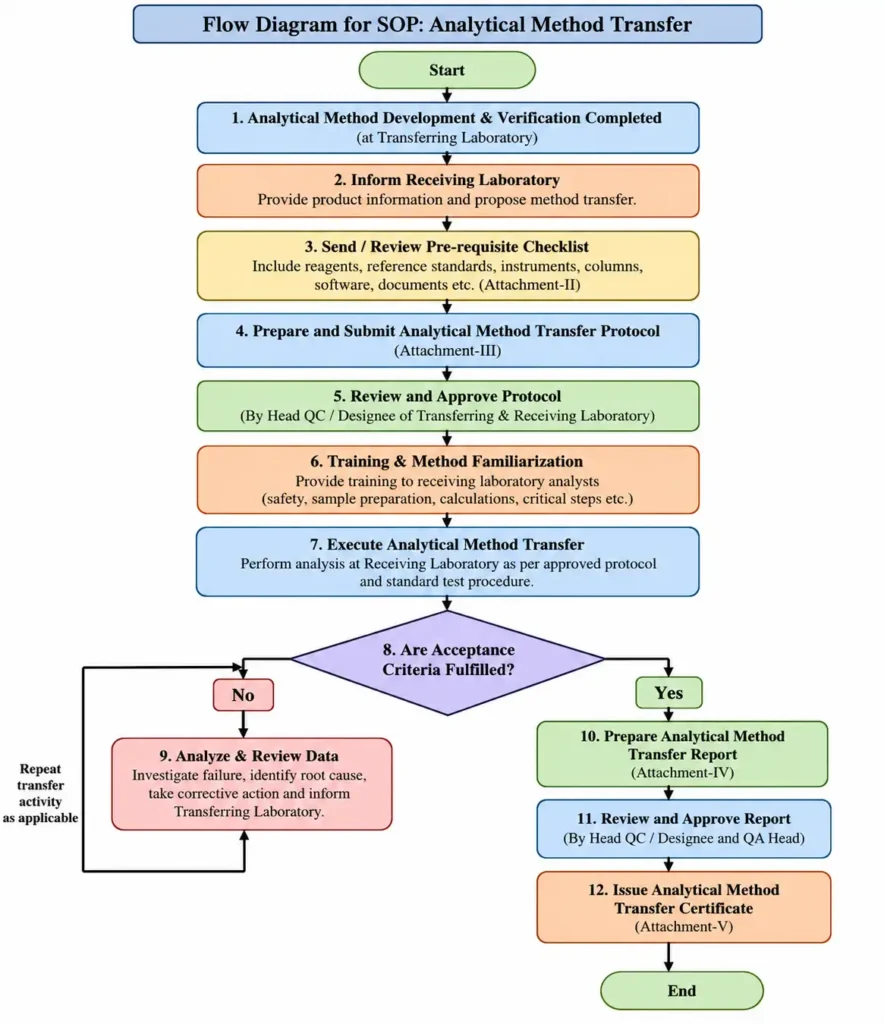
Results are evaluated against predefined acceptance criteria. If the criteria are not met, the data are investigated, root causes are identified, corrective actions are taken, and the transfer activity may be repeated. If results comply, the transfer report is prepared and approved, followed by issuance of the Analytical Method Transfer Certificate, completing the process.
3. Brainstorming:
Analytical Method Transfer SOP failure occurs when the transferring and receiving laboratories cannot complete the transfer successfully according to the approved protocol and predefined acceptance criteria. Common causes include incomplete prerequisite checks, unavailable instruments, columns, reagents or reference standards, inadequate analyst training, poor method familiarization, sample preparation errors, calculation mistakes, system suitability failure, documentation gaps, and ineffective communication between laboratories.
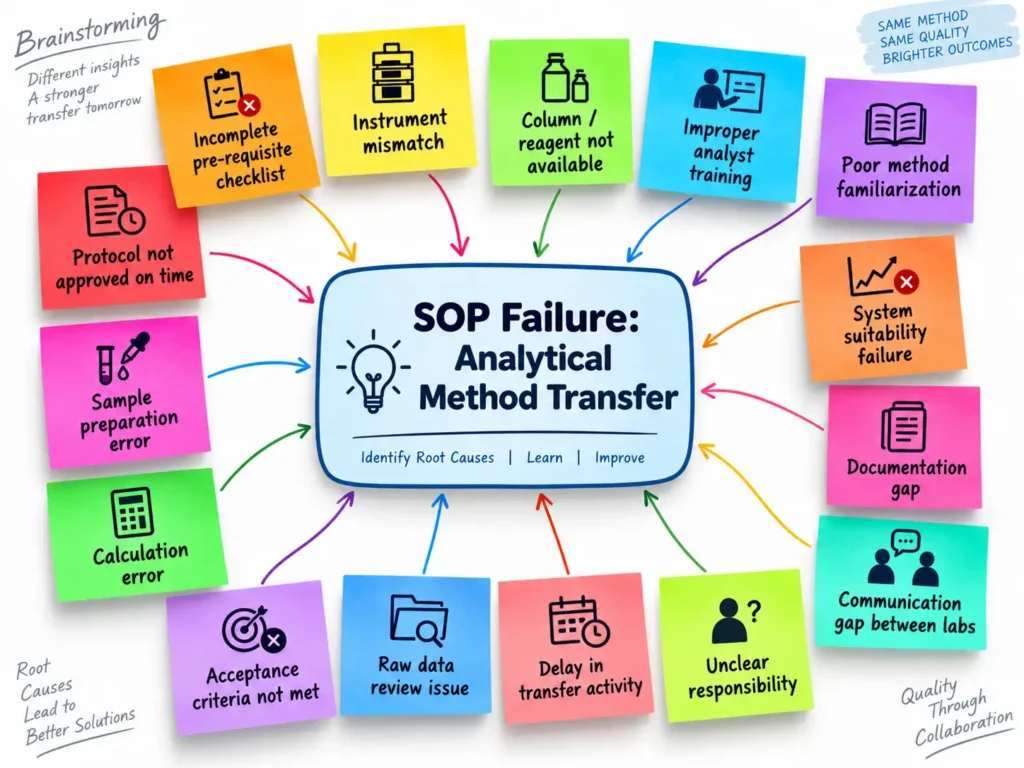
The SOP requires both laboratories to review generated data for accuracy, investigate questionable or non-compliant results, identify assignable causes, and document the investigation. When acceptance criteria are not achieved, the impact must be evaluated and appropriate corrective actions or contingency testing should be decided before repeating the activity where necessary. Effective prevention depends on proper planning, approved documentation, equivalent instrumentation, trained analysts, timely communication, complete raw-data review, and QA/QC oversight to ensure a reliable, reproducible, and compliant analytical method transfer.
4. 5 Why – Analytical Method Transfer SOP Failure:
The 5 Why analysis is used to identify the underlying root cause of failure during Analytical Method Transfer. The problem begins when the transfer does not meet the predefined acceptance criteria. The first “Why” identifies non-compliant results, while the second explores differences between results generated by the Transferring Laboratory and Receiving Laboratory. Further analysis may reveal inconsistent sample preparation, system suitability problems, instrument differences, or variations in analytical conditions. The investigation then examines why these inconsistencies occurred, such as inadequate analyst training, incomplete method familiarization, or failure to verify prerequisite resources.
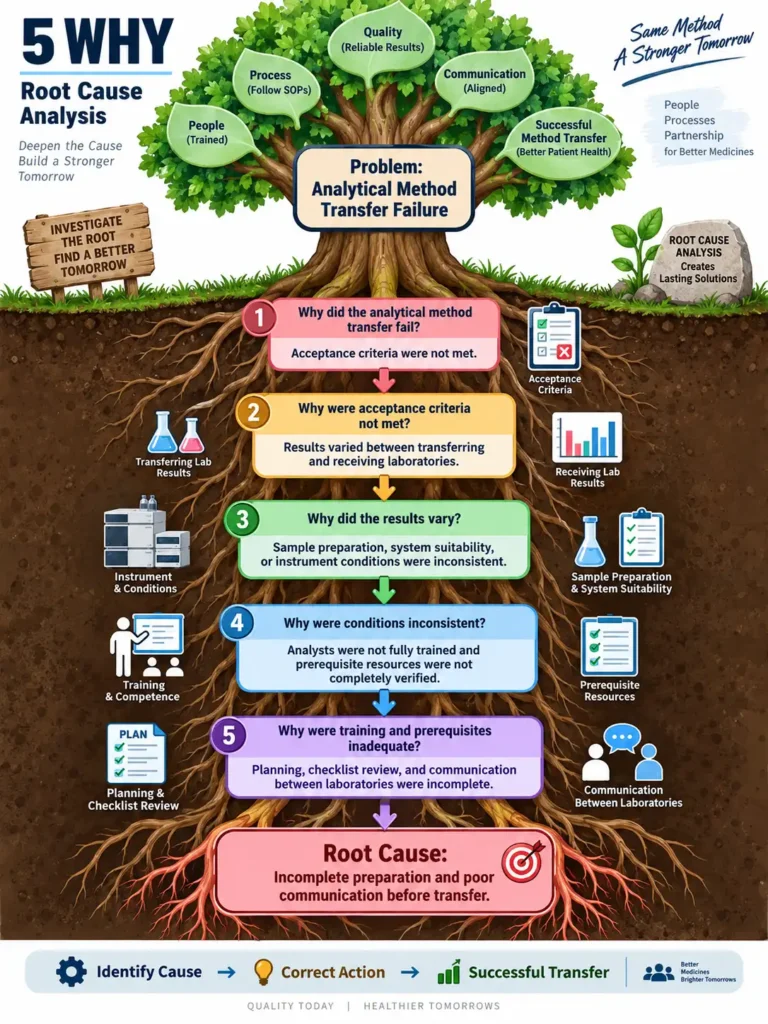
The final “Why” may identify weaknesses in planning, checklist review, responsibility, or communication between laboratories as the fundamental cause. The SOP requires non-compliant transfer results to be investigated, appropriate actions to be implemented, and the transfer report to document conclusions and recommendations. The 5 Why approach supports effective CAPA and prevents recurrence of transfer failures.
5. Heat Map (FMEA):
The Heat Map for Analytical Method Transfer SOP Failure is a risk-assessment tool used to identify, evaluate, and prioritize potential causes that may affect successful method transfer. The diagram ranks each failure mode according to its Likelihood and Impact, generating a risk score that classifies the issue as low, medium, high, or very high risk. Major risks include incomplete prerequisite checks, inadequate analyst training, instrument or software differences, reagent or reference-standard issues, sample preparation errors, system suitability failure, incorrect data review, communication gaps, documentation deficiencies, and insufficient QA/QC oversight.
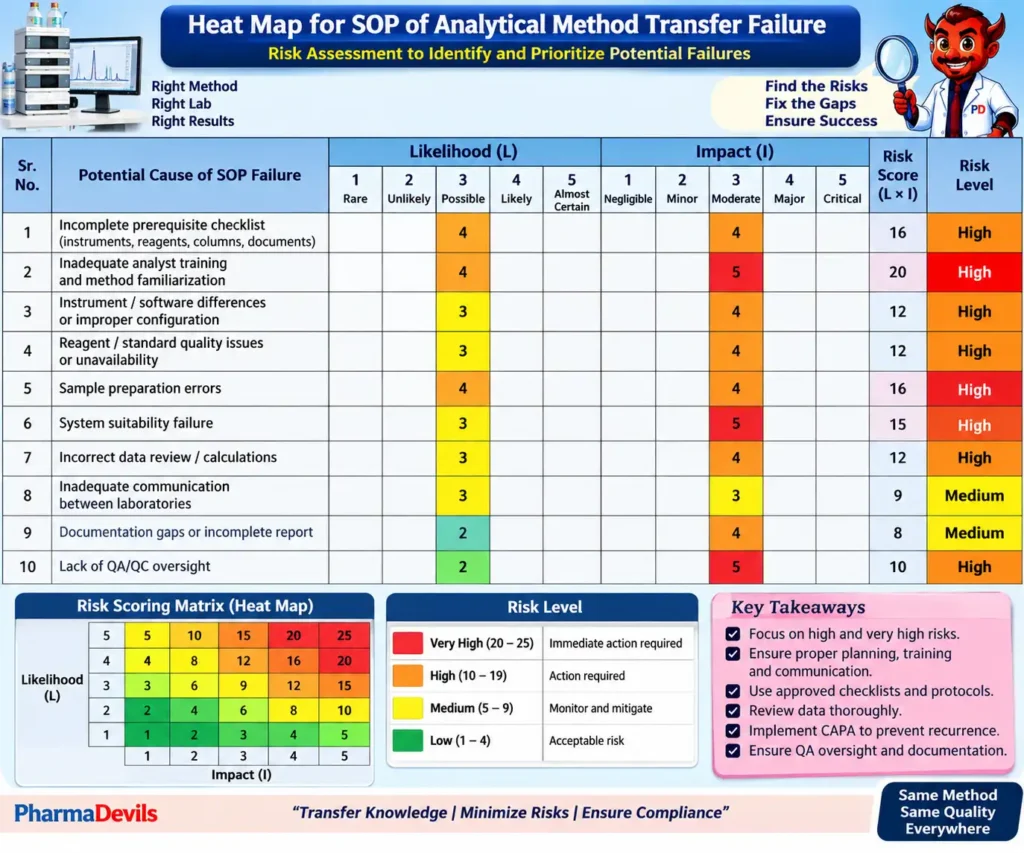
The heat map helps the organization focus first on high-risk areas that require immediate corrective or preventive action. It supports better planning, training, communication, data verification, and documentation before and during method transfer. By addressing the highest-priority risks, laboratories can reduce transfer failures, improve reproducibility of analytical results, strengthen compliance, and ensure reliable implementation of the transferred analytical method.
Questions & Answers
Q1. What is the purpose of the Analytical Method Transfer SOP?
Answer: The purpose is to define a controlled procedure for transferring analytical methods from one laboratory to another laboratory.
Q2. Which tests may be covered under Analytical Method Transfer?
Answer: The SOP covers critical tests such as assay, related substances, dissolution, preservative/antioxidant content, content uniformity, residual solvents, microbiological testing, and other critical tests for drug substances or drug products.
Q3. What is a Transferring Laboratory?
Answer: It is the laboratory that developed, evaluated, verified, or previously successfully received the analytical method and is responsible for transferring it to another laboratory.
Q4. What is a Receiving Laboratory?
Answer: It is the laboratory to which the analytical method is transferred for routine execution.
Q5. What are the responsibilities of the Transferring Laboratory?
Answer: It demonstrates the method, provides the transfer package, prerequisites and protocol, trains the receiving laboratory analysts, communicates issues, and supports resolution of transfer-related problems.
Q6. What are the responsibilities of the Receiving Laboratory?
Answer: It performs analysis according to the provided standard test procedure, prepares required specifications and procedures, reports results and critical observations, and communicates them to the Transferring Laboratory.
Q7. What should be checked before Analytical Method Transfer begins?
Answer: The Receiving Laboratory should verify availability of required instruments, reagents, chemicals, reference standards, columns, samples, documentation, and other prerequisites before starting the transfer.
Q8. Is transfer required for compendial analytical methods?
Answer: According to this SOP, compendial methods normally require method verification rather than transfer. Method transfer is required when the compendial method has been modified.
Q9. Is analyst training required before method transfer execution?
Answer: Yes. Laboratory training and method familiarization must be organized before execution of the analytical method transfer activity.
Q10. Who performs the Analytical Method Transfer testing?
Answer: The transfer activity is performed by two analysts—one from the Transferring Laboratory and one from the Receiving Laboratory—using the same batch/sample as applicable.
Q11. What is the assay acceptance criterion mentioned in the SOP?
Answer: For assay, six sample preparations are analyzed by each analyst. Individual analyst %RSD should be NMT 2.0%, and the overall RSD for both analysts should be NMT 3.0%.
Q12. What should happen if acceptance criteria are not met?
Answer: The results must be investigated, the impact of the failure evaluated, appropriate corrective actions or recommendations implemented, and the conclusions documented in the method transfer report.
Q13. When is the Analytical Method Transfer considered complete?
Answer: The transfer is considered complete when the results comply with the specified acceptance criteria.
Q14. Who reviews and approves the transfer data?
Answer: Head QC and Head QA review the reported data, and the results are approved by the concerned laboratories.
Q15. What document is issued after successful Analytical Method Transfer?
Answer: After successful completion and compliance with acceptance criteria, an Analytical Method Transfer Certificate is prepared and approved.
Q16. Is a training certificate required after successful transfer?
Answer: Yes. An Analytical Method Transfer Training Certificate is prepared by the Transferring Laboratory analyst and approved by the Receiving Laboratory Head QA and QC.