







1. Brief Description:
This SOP defines the procedure for conducting the Annual Product Review (APR) of every drug product manufactured during a calendar year. It assigns responsibilities to Production, Stores, Quality Control and Quality Assurance for collecting and evaluating product and process data. The review covers batch details, critical quality attributes, manufacturing yields, rejected or reprocessed batches, stability studies, deviations, change controls, OOS results, recalls, market complaints and returned products. QA compiles the information in tabular or graphical form to identify trends, variability and recurring quality issues. The APR report evaluates the continued consistency of the manufacturing process, the effectiveness of existing controls and the overall quality status of each product. Any identified concern must be supported by appropriate recommendations, action plans, CAPA or further investigation. The completed review provides documented evidence of continued process control and opportunities for continual improvement.
Skip to PDF content2. Flow Diagram:
The flow diagram presents the systematic process for conducting the Annual Product Quality Review (APQR). The process begins with preparation of the annual APQR schedule, identification of applicable products and batches, and collection of data from concerned departments. The collected information is reviewed for manufacturing performance, yields, quality-control results, stability data, deviations, OOS results, change controls, CAPA, complaints, returned products and recalls. Statistical trending is then performed to evaluate process consistency and overall product quality.
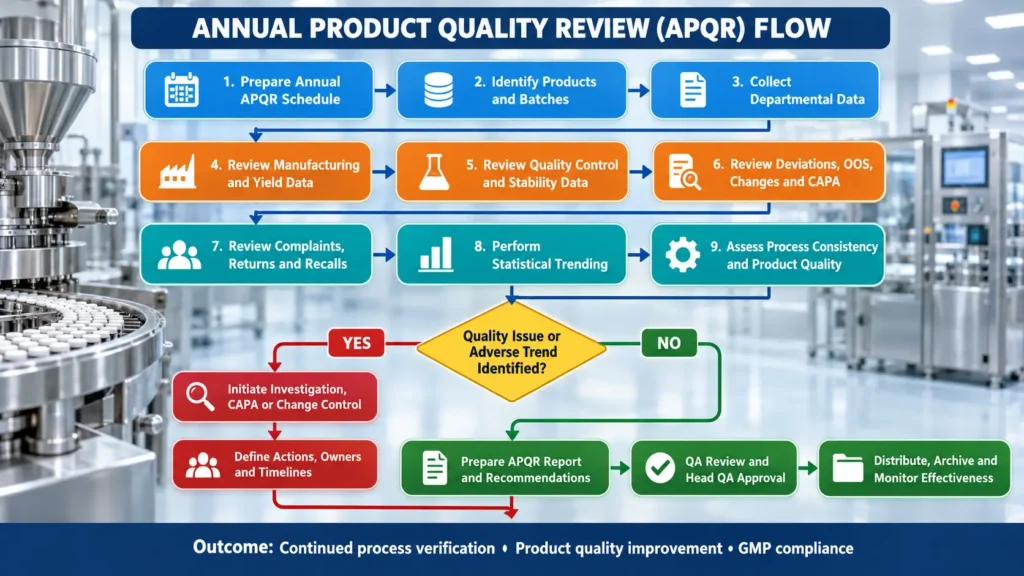
If an adverse trend or quality issue is identified, an investigation, CAPA or change control is initiated with defined responsibilities and timelines. QA prepares the final APQR report with conclusions and recommendations for approval by the Head of Quality Assurance. The approved report is distributed and archived, while identified actions are monitored for completion and effectiveness.
3. Brainstorming Analysis:
The brainstorming analysis identifies potential reasons for the non-implementation of the Annual Product Review (APR) SOP. Major contributing factors include inadequate management oversight, undefined departmental responsibilities, insufficient personnel training, absence of an approved APR format and failure to establish an annual review schedule. Delayed data collection, poor coordination between QA, QC, Production, Stores and Engineering, and ineffective QA follow-up may further prevent timely APR completion.
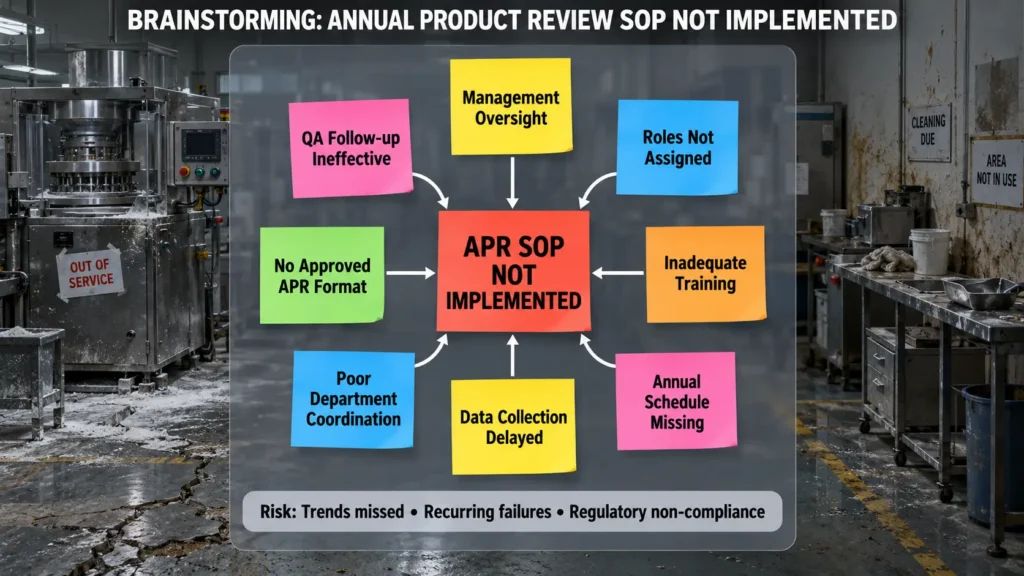
Failure to implement the APR procedure can result in missed product and process trends, unidentified recurring deviations, delayed CAPA, inadequate assessment of process consistency and regulatory non-compliance. The brainstorming outcome supports structured root-cause investigation and the development of corrective actions such as assigning responsibilities, approving standardized templates, establishing timelines, training personnel and monitoring APR completion through the pharmaceutical quality system.
4. 5-Why Analysis:
The 5-Why analysis identifies the underlying reasons for the failure to implement the Annual Product Review (APR) SOP. The APR was not completed because annual review activities were not initiated. Activities were not initiated due to the absence of an approved annual APR schedule. The schedule was not issued because responsibilities and completion timelines were not clearly assigned to QA, QC, Production, Stores and other concerned departments. Further analysis indicates that these responsibilities remained unclear because the APR SOP was not effectively implemented, communicated or monitored. The root cause was determined to be inadequate management oversight, insufficient employee training and ineffective QA follow-up.
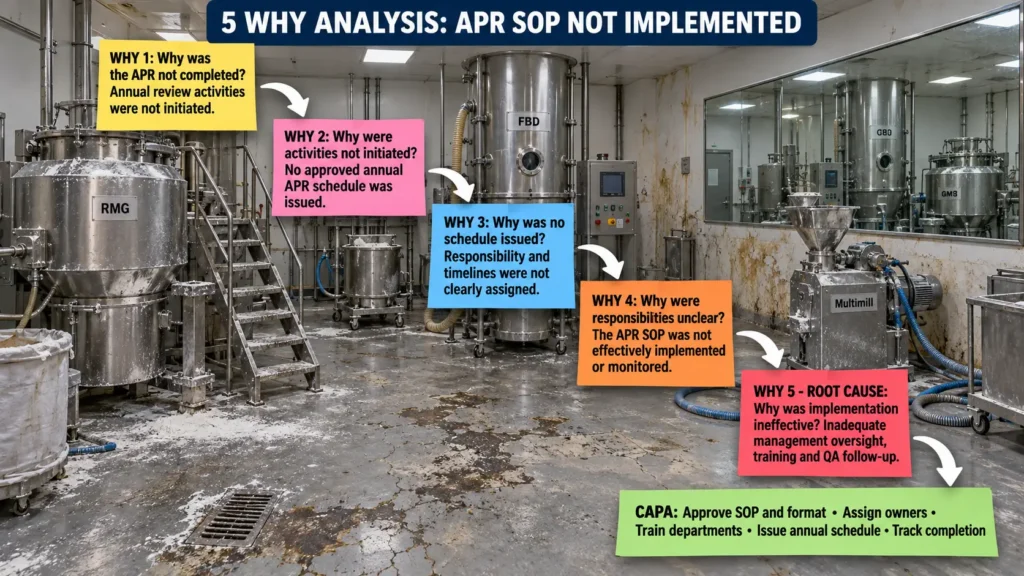
Corrective actions should include approving the APR SOP and reporting format, assigning departmental responsibilities, training concerned personnel, issuing a yearly APR schedule and periodically tracking completion through the pharmaceutical quality system.
5. Heat Map:
The heat map evaluates risks arising from the non-implementation of the Annual Product Quality Review (APQR) SOP according to their severity and likelihood. The risks are categorized as low, medium, high or critical. Product or patient risk being overlooked receives the highest risk score. Regulatory non-compliance and recurring quality failures are also classified as critical risks. Failure to detect adverse trends, ineffective CAPA and uncontrolled process variability fall within the high-risk category. Delayed departmental data and incomplete APQR reports represent medium-level risks.
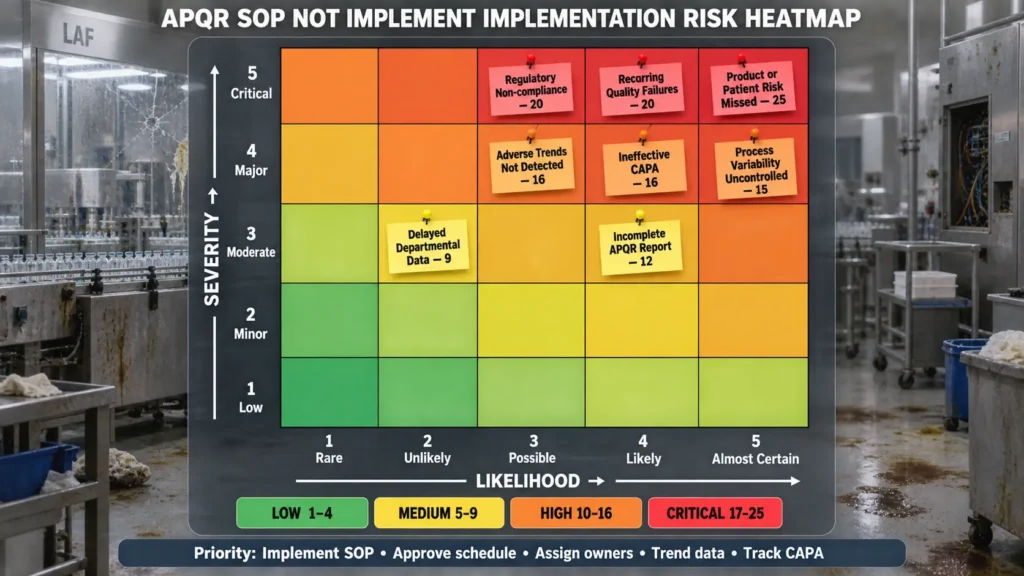
The assessment demonstrates that failure to implement the APQR SOP can prevent timely detection of product, process and quality-system weaknesses. Immediate controls should include SOP approval, issuance of an annual APQR schedule, assignment of departmental responsibilities, systematic data trending, management review and effectiveness monitoring of resulting CAPAs.
Impact Assessment:
Failure to implement the Annual Product Quality Review (APQR) SOP has a major impact on the pharmaceutical quality system. Without a systematic annual review, adverse trends, recurring deviations and gradual deterioration in process or product performance may remain unidentified.
| Impact Area | Potential Impact | Risk |
|---|---|---|
| Product quality | Variability in assay, dissolution, impurities, sterility or other CQAs may remain undetected | High |
| Patient safety | Emerging quality defects may not be assessed promptly | Critical |
| Process control | Loss of evidence demonstrating a continued state of control | High |
| Deviations and OOS | Recurring events may not be identified or investigated collectively | High |
| CAPA | Ineffective or repeated CAPAs may remain undetected | High |
| Stability | Adverse stability trends or reduced shelf-life assurance may be missed | Critical |
| Complaints and recalls | Repeated complaint patterns and recall signals may not be evaluated | High |
| Change management | Cumulative effects of changes may not be assessed | High |
| Validation | Need for revalidation or process improvement may not be identified | High |
| Regulatory compliance | Non-compliance with applicable GMP requirements and potential audit observations | Critical |
| Documentation | Incomplete product-quality history and weak management oversight | High |
| Business continuity | Increased rejection, recall, supply disruption and financial loss | High |
Overall Assessment:
Overall risk: High to Critical
The absence of APQR does not automatically confirm that released batches are defective; however, it significantly weakens assurance of continued process consistency and product quality. Immediate remediation should include retrospective APQR completion, risk-based product prioritization, approval of the SOP and templates, assignment of responsibilities, data trending, management review, CAPA initiation and effectiveness verification.
Questions & Answers: Annual Product Quality Review
1. What is an Annual Product Quality Review (APQR)?
APQR is a documented periodic review of product, process and quality-system data to confirm consistent manufacturing performance and product quality.
2. What is the main objective of APQR?
To verify process consistency, identify adverse trends, evaluate existing controls and determine opportunities for product and process improvement.
3. Which batches should be included in APQR?
All batches manufactured during the defined review period, including released, rejected, reprocessed, reworked, returned and recalled batches, as applicable.
4. Who is responsible for preparing the APQR?
Quality Assurance coordinates and prepares the APQR with data provided by Production, Quality Control, Stores, Engineering, Regulatory Affairs and other concerned departments.
5. How frequently should APQR be performed?
It should normally be performed annually according to an approved schedule and completed within the timeline defined in the SOP.
6. What manufacturing data should be reviewed?
Batch size, yields, reconciliation, in-process results, critical process parameters, process deviations, rejected batches and reprocessing or reworking details.
7. Which quality-control data should be evaluated?
Assay, dissolution, impurities, uniformity, sterility where applicable, OOS/OOT results, stability data and other relevant critical quality attributes.
8. Should complaints, returns and recalls be included?
Yes. Their number, nature, investigation, root cause, product impact and resulting CAPA should be reviewed and trended.
9. Why is statistical trending important?
It helps detect shifts, variability, recurring failures and adverse trends that may not be evident from individual batch results.
10. What should be done when an adverse trend is identified?
The company should initiate a documented investigation and, where necessary, CAPA, change control, additional monitoring or revalidation.
11. Should deviations, OOS and CAPA be reviewed collectively?
Yes. Collective review helps identify recurrence, common causes and weaknesses in the pharmaceutical quality system.
12. Does APQR replace batch release review?
No. Batch release confirms compliance of an individual batch, whereas APQR evaluates cumulative product and process performance.
13. Can different strengths be covered in one APQR?
Yes, when scientifically justified by common formulation, manufacturing process, equipment and quality characteristics. Strength-specific data must remain identifiable.
14. What should the final APQR report contain?
The report should include reviewed data, statistical trends, conclusions, identified risks, recommendations, CAPA, responsibilities and target completion dates.
15. Who should approve the APQR report?
The report should be reviewed by relevant department heads and approved by the Head of Quality Assurance or an authorized quality representative.
16. What is the impact if the APQR SOP is not implemented?
Adverse trends may be missed, process control may weaken, CAPA may become ineffective and regulatory non-compliance may occur.
17. Is retrospective APQR required when reviews are overdue?
Yes. Overdue products should be prioritized through risk assessment, and retrospective reviews should be completed under an approved remediation plan.
18. How should APQR actions be monitored?
Actions should be entered into a controlled tracker or CAPA system with assigned owners, deadlines, status reviews and effectiveness checks.
19. When may revalidation be recommended?
Revalidation may be required when APQR identifies significant process variability, repeated failures, major changes or evidence that the validated state may not be maintained.
20. How should APQR records be retained?
Protocols, source data, trend reports, approvals and action records should be retained according to the company’s document-retention SOP and regulatory requirements.
Reference Guidelines for Annual Product Quality Review
- EU GMP – EudraLex Volume 4, Part I, Chapter 1 Sections 1.10 and 1.11 establish detailed requirements for regular Product Quality Reviews, including batch data, deviations, changes, stability, complaints, recalls, CAPA and assessment of revalidation needs.
EU GMP Chapter 1 – Pharmaceutical Quality System - US FDA – 21 CFR 211.180(e) Requires a written evaluation of each drug product’s quality standards at least annually to determine whether specifications, manufacturing procedures or controls require changes.
21 CFR 211.180 – General Requirements - FDA Guidance: Quality Systems Approach to Pharmaceutical CGMP Regulations Connects annual product review with quality-system management, continual improvement and product/process performance trending.
FDA Quality Systems Approach Guidance - PIC/S GMP Guide PE 009, Part I, Chapter 1 Provides Product Quality Review expectations broadly aligned with EU GMP, including review of critical data, deviations, changes, complaints, stability and CAPA.
PIC/S Publications – GMP Guide PE 009 - WHO GMP – TRS 986, Annex 2 Includes Product Quality Review requirements within the pharmaceutical quality system and expects periodic review of authorized products to verify consistency and identify improvements.
WHO TRS 986, Annex 2 - ICH Q10 – Pharmaceutical Quality System Supports process-performance and product-quality monitoring, management review, CAPA, change management and continual improvement throughout the product lifecycle.
ICH Q10 Guideline - ICH Q9(R1) – Quality Risk Management Provides the risk-based framework for prioritizing adverse APQR trends, investigations, CAPA and continual review of product-quality risks.
ICH Q9(R1) Guideline - India – Revised Schedule M Indian manufacturers should follow the applicable Pharmaceutical Quality System and Product Quality Review requirements under the revised Schedule M of the Drugs Rules, 1945.
CDSCO Gazette Notifications