







1. Brief Description:
This Standard Operating Procedure describes the requirements for effective charge handover between production shifts to ensure continuity, proper communication, and smooth execution of manufacturing activities. The SOP applies to the Production Department and assigns responsibility to Production Officers, Executives, and Assistant Managers, while the Head of Production ensures execution and compliance.
During handover, the outgoing shift officer must communicate the product or lot details, workmen assigned to each machine, machine status, job allocation, production planning, special precautions, changes in plan, anticipated problems, proposed remedies, and actual physical status to the incoming shift officer. If the next shift officer, operator, or workman does not report for duty, the current person must continue into the next shift. The revision card identifies this document as Revision 00 – New SOP.
Skip to PDF content2. Flow Diagram:
The flow diagram illustrates the systematic charge handover process between production shifts to maintain continuity and effective communication. The process begins with the current shift officer preparing the necessary handover information. Key details—including product or lot status, manpower deployment, machine condition, job allocation, next-shift production planning, special precautions, changes in plan, anticipated problems, proposed remedies, and actual physical status—are communicated to the incoming shift officer.
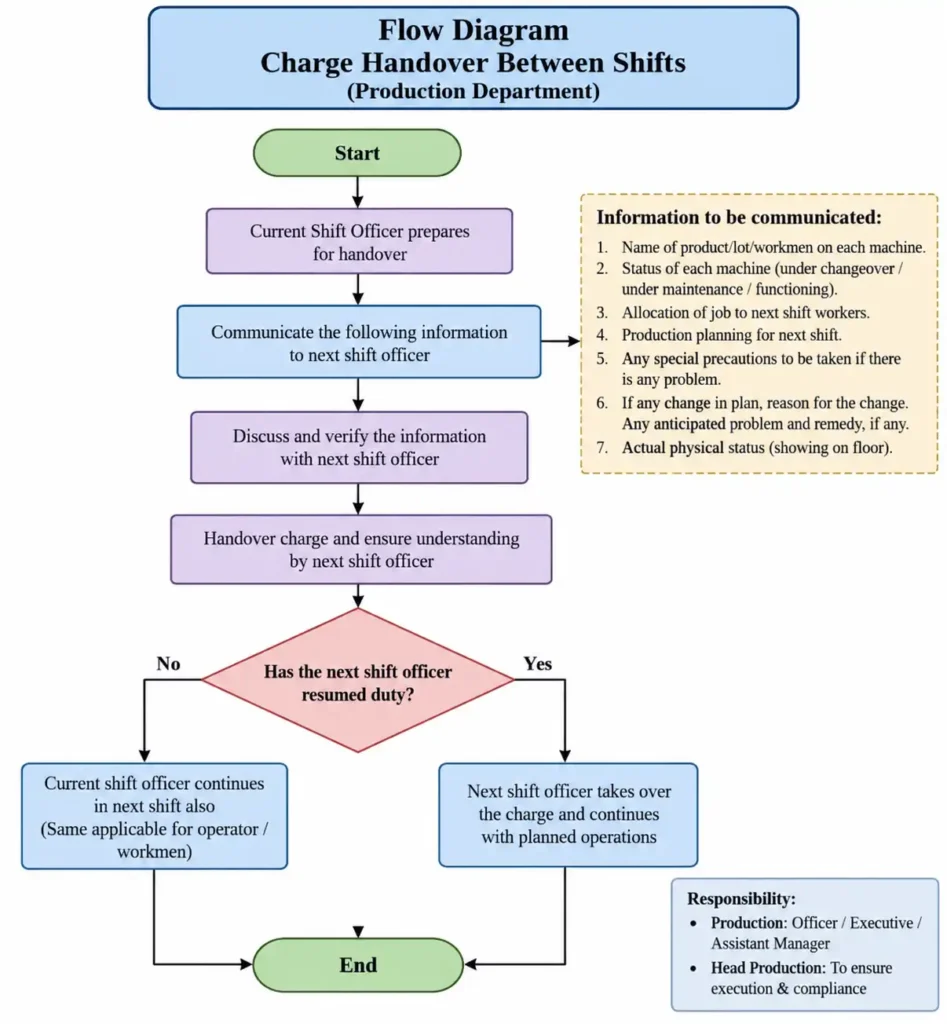
The information is discussed and verified to ensure the incoming officer clearly understands ongoing production activities and pending actions. A decision point confirms whether the next shift officer has reported for duty. If yes, the incoming officer takes over the charge and continues planned operations. If no, the current shift officer continues into the next shift; the same requirement applies to operators and workmen. This process supports smooth production continuity, accountability, and proper shift-to-shift coordination.
3. Brainstorming:
Failure to perform the charge handover process between production shifts can create serious communication gaps and disrupt continuity of manufacturing activities. The SOP requires the outgoing shift officer to communicate essential information such as product/lot details, manpower deployment, machine status, job allocation, production planning, special precautions, changes in plan, anticipated problems, remedies, and actual physical status to the incoming shift officer.
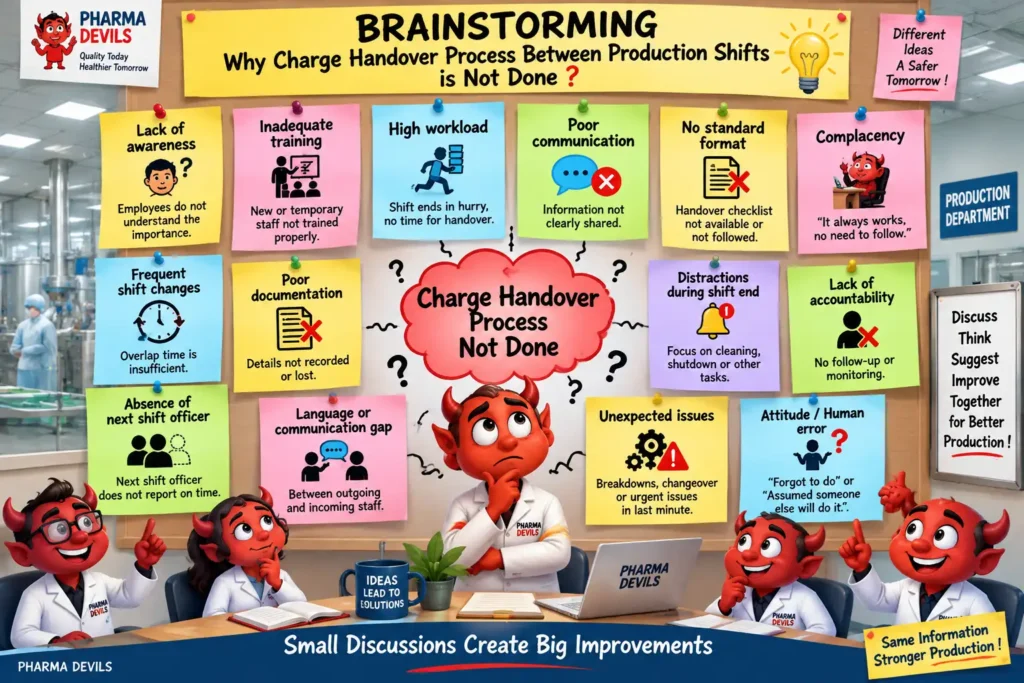
If this handover is not completed, the incoming team may be unaware of ongoing activities, pending tasks, equipment conditions, or production issues. This can lead to delays, incorrect decisions, repeated work, missed precautions, and weak accountability. Possible contributing factors include inadequate training, workload pressure, poor communication, lack of a standard handover checklist, poor documentation, shift-end distractions, complacency, and absence of the incoming officer. The SOP also requires the current officer to continue duty when the next shift officer does not report.
4. 5 Why Analysis:
The 5 Why Analysis identifies the underlying reasons why the charge handover process between production shifts was not followed. The first cause is failure of the outgoing shift officer to communicate required information to the incoming shift. This may occur when a standardized handover checklist or format is not consistently used, leading to missed details. High workload and time pressure at the end of the shift can further reduce attention to handover activities. Inadequate manpower, production targets, pending tasks, and poor shift planning may also contribute to rushed or incomplete communication.
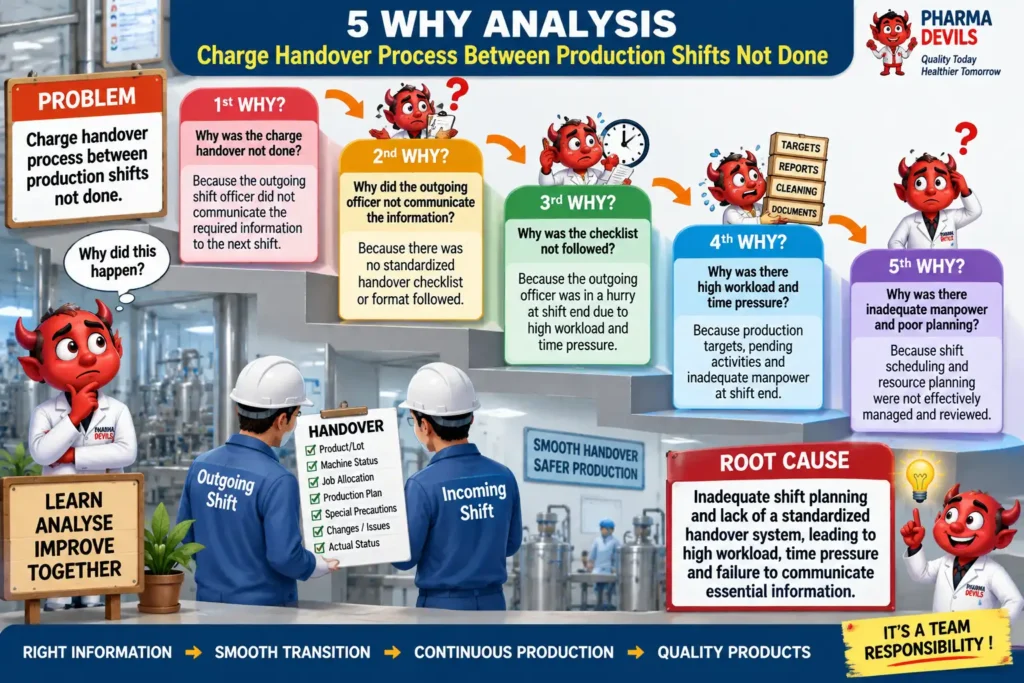
The analysis ultimately points toward a root cause involving weak shift planning and an insufficiently controlled handover system, resulting in inconsistent communication of product/lot details, machine status, job allocation, production plans, special precautions, and actual physical status required by the SOP. Strengthening planning, accountability, checklist use, and monitoring can help prevent recurrence.
5. FMEA for Charge Handover Process Between Production Shifts Not Followed
The Failure Mode and Effects Analysis (FMEA) evaluates potential risks arising when the charge handover process between production shifts is not properly followed. The assessment considers critical handover activities such as communication of product/lot details, machine status, job allocation, next-shift production planning, special precautions, changes in plan, anticipated problems, remedies, and actual physical status, all of which are required by the SOP.
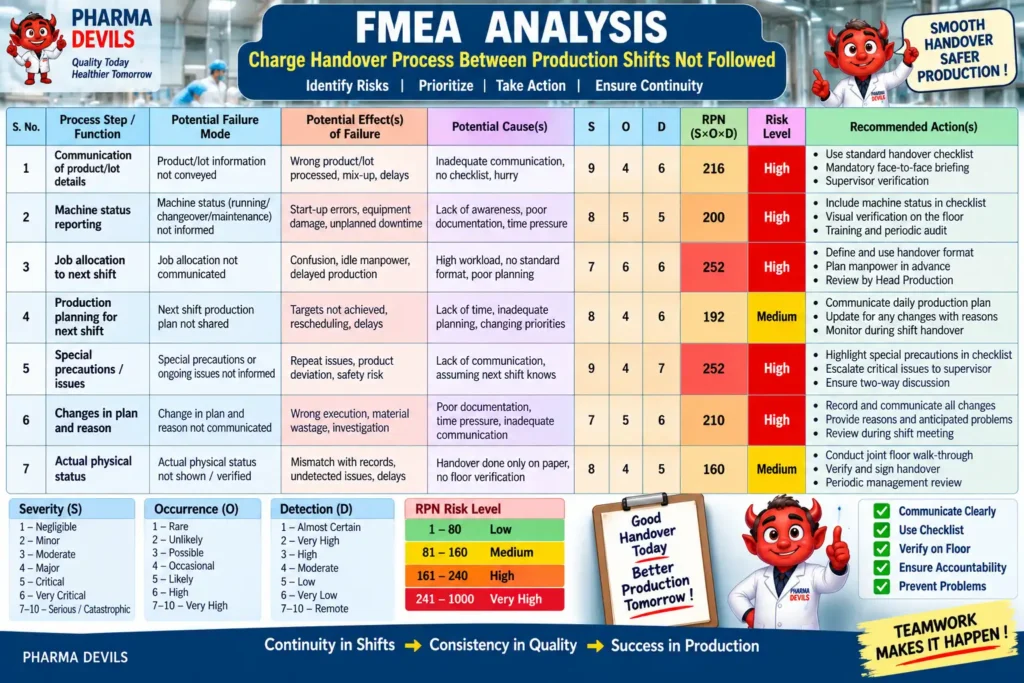
Each potential failure is assessed using Severity (S), Occurrence (O), and Detection (D) ratings to calculate the Risk Priority Number (RPN = S × O × D). Higher-risk failures may result in production delays, mix-ups, equipment problems, incorrect execution, missed precautions, or inadequate communication. Recommended controls include a standardized handover checklist, face-to-face communication, floor verification, proper documentation, manpower planning, supervisory review, training, and periodic compliance monitoring. The FMEA helps prioritize corrective actions and strengthens production continuity, accountability, and consistent shift-to-shift communication.
Questions & Answers:
- Q: What is the objective of the SOP?
A: To lay down the procedure for charge handover between production shifts. - Q: Where is this SOP applicable?
A: It is applicable to charge handover between shifts in the Production Department. - Q: Who is responsible for carrying out the charge handover?
A: Production Officers, Executives, and Assistant Managers are responsible for the process. - Q: What is the responsibility of the Head of Production?
A: The Head of Production is responsible for ensuring execution and compliance with the SOP. - Q: What product-related information must be handed over?
A: The name of the product, lot, and workmen working on each machine must be communicated. - Q: What machine information should be communicated to the next shift?
A: The status of each machine, including whether it is functioning, under changeover, or under maintenance. - Q: Should job allocation be discussed during handover?
A: Yes. Jobs for the workers of the next shift should be allocated and communicated. - Q: Is production planning part of the shift handover?
A: Yes. The production plan for the next shift must be communicated. - Q: How should special problems or precautions be handled?
A: Any special precautions required due to an existing problem should be clearly communicated to the next shift. - Q: What should be communicated if there is a change in the production plan?
A: The reason for the change, any anticipated problems, and the available remedy should be communicated. - Q: Is physical verification required during handover?
A: Yes. The actual physical status of the production activities should be shown to the incoming shift. - Q: What should happen if the next shift officer does not report for duty?
A: The current shift officer must continue in the next shift. - Q: Does the same rule apply to operators and workmen?
A: Yes. If the next-shift operator or workman does not resume duty, the current operator or workman should continue. - Q: Does the SOP specify any annexures or references?
A: No. The SOP lists both annexures and references as Nil. - Q: What is the revision status of this SOP?
A: The revision card identifies it as Revision No. 00 – New SOP.