







1. Brief Description:
This SOP describes the cleaning and challenge testing of the Solid Flow Monitor (SFM) installed on a Fluidized Bed Dryer (FBD) in the granulation area. Its objective is to ensure that the SFM remains clean, correctly assembled, and capable of detecting abnormal material flow through the exhaust. Before operation, personnel verify Dutch mesh integrity, proper earthing, and incoming air pressure of at least 6 kg/cm². The sensor is removed carefully, cleaned with a dry lint-free cloth, reassembled without twisting the cable, and checked for correct positioning.
For the challenge test, about 250 g of starch, talc, or microcrystalline cellulose is introduced so material contacts the SFM sensor. The sensor should trip the FBD within 5–10 seconds. Failed tests are repeated and escalated to Engineering if unsuccessful. Testing is performed every 14 ± 2 days, with records and monthly material reconciliation maintained.
Skip to PDF content2. Flow Diagram:
The SOP for Cleaning and Challenge Test of Solid Flow Monitor (SFM) for Fluidized Bed Dryer (FBD) defines the procedure to ensure proper cleanliness, installation, and functional performance of the SFM used in the granulation area. Before operation, the integrity of the Dutch mesh, proper earthing connection, and minimum incoming air pressure of 6 kg/cm² are verified. The SFM sensor is carefully removed, cleaned with a dry lint-free cloth, and reassembled in the correct position without twisting the cable.
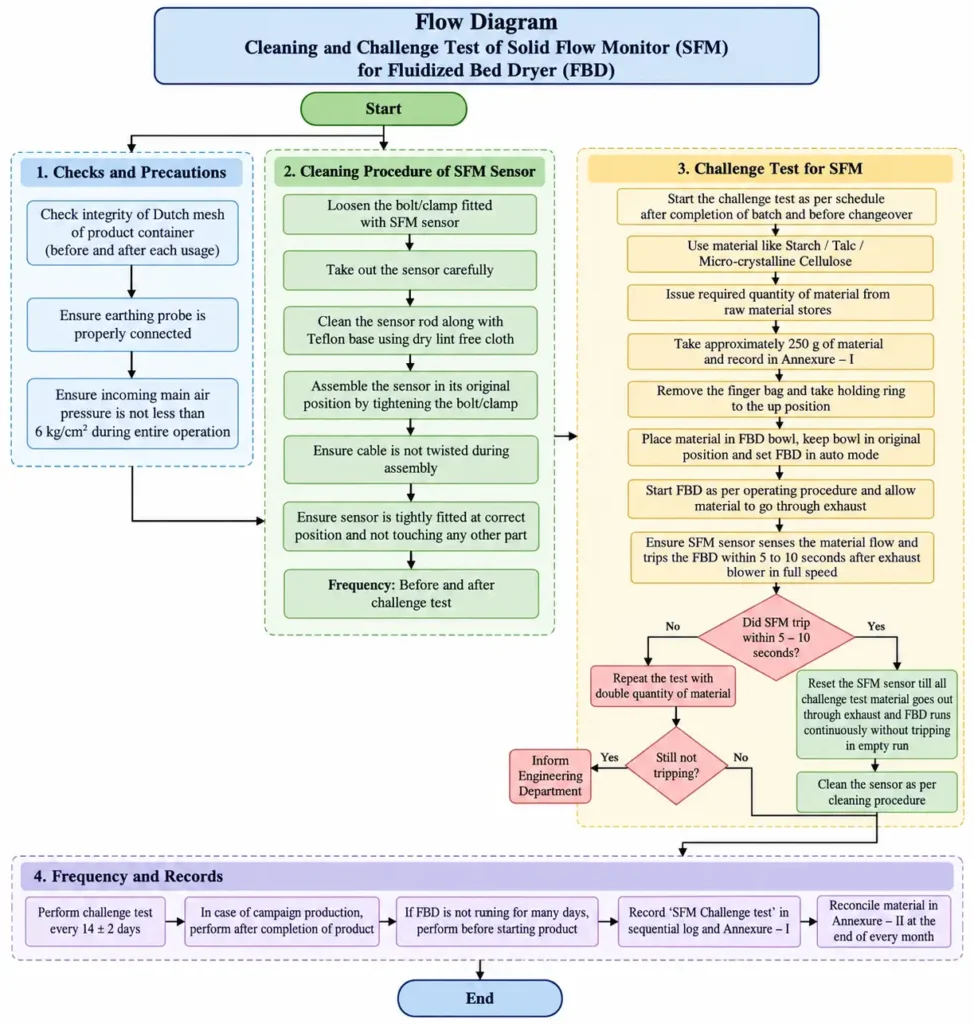
For the challenge test, approximately 250 g of starch, talc, or microcrystalline cellulose is introduced into the FBD so the material contacts the SFM sensor. The sensor should detect the material flow and trip the FBD within 5–10 seconds. If unsuccessful, the test is repeated with double material quantity and Engineering is informed if failure persists. The challenge test is performed every 14 ± 2 days, with records maintained in the equipment log and annexures.
3. Brainstorming:
The brainstorming exercise for “SOP for Cleaning and Challenge Test of Solid Flow Monitor (SFM) for Fluidized Bed Dryer (FBD) Not Followed” identifies the possible factors that may lead to non-compliance with the procedure. The causes are grouped under major areas such as Personnel, Procedure, Equipment, Challenge Material, Operating Conditions, Testing, Documentation, and Management.
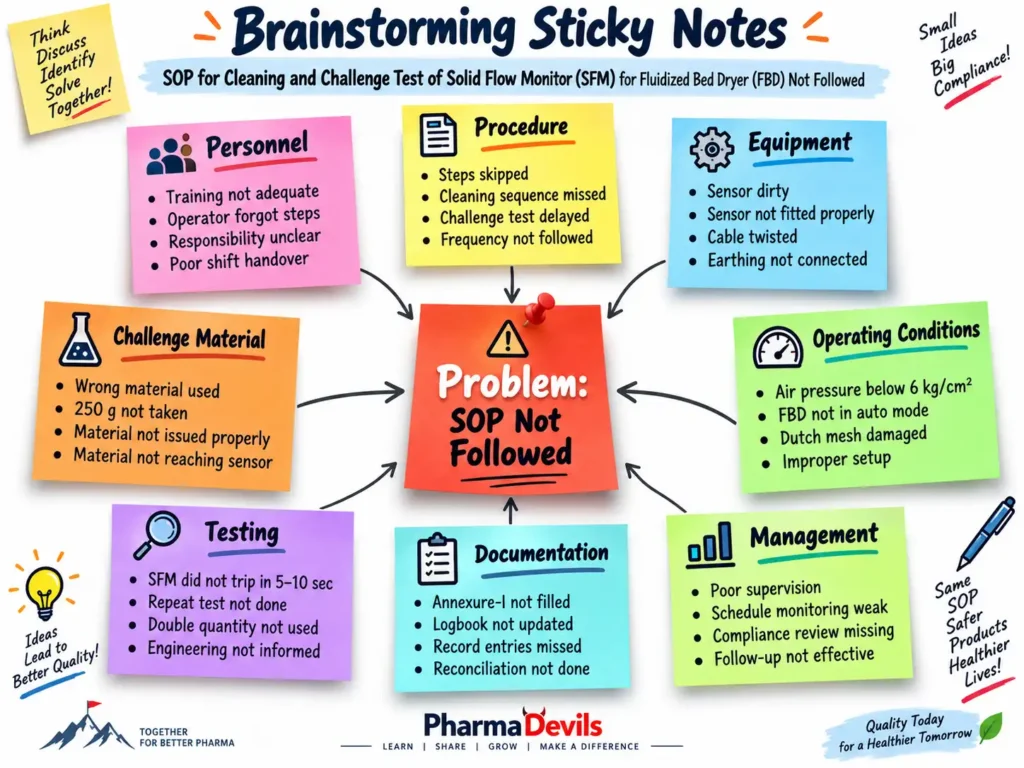
Potential issues include inadequate training, skipped cleaning steps, incorrect sensor fitting, twisted cables, improper earthing, damaged Dutch mesh, low air pressure, incorrect challenge material quantity, failure of the SFM to trip within 5–10 seconds, missed repeat testing, and failure to inform Engineering. Documentation-related causes include incomplete Annexure-I, missing logbook entries, and failure to perform reconciliation. Management-related causes include weak supervision, poor schedule monitoring, and ineffective follow-up. This brainstorming helps identify likely causes before performing detailed root-cause analysis and CAPA planning.
4. 5 Why Analysis:
The 5 Why Analysis for the SOP on Cleaning and Challenge Test of Solid Flow Monitor (SFM) for Fluidized Bed Dryer (FBD) Not Followed traces the non-compliance from the immediate event to a likely systemic root cause. It begins with the operator skipping or incorrectly performing required cleaning and challenge-test steps. The analysis then links this to insufficient understanding of the correct procedure, inadequate SOP training and practical demonstration, ineffective refresher training and supervision, and finally weak routine monitoring and accountability.
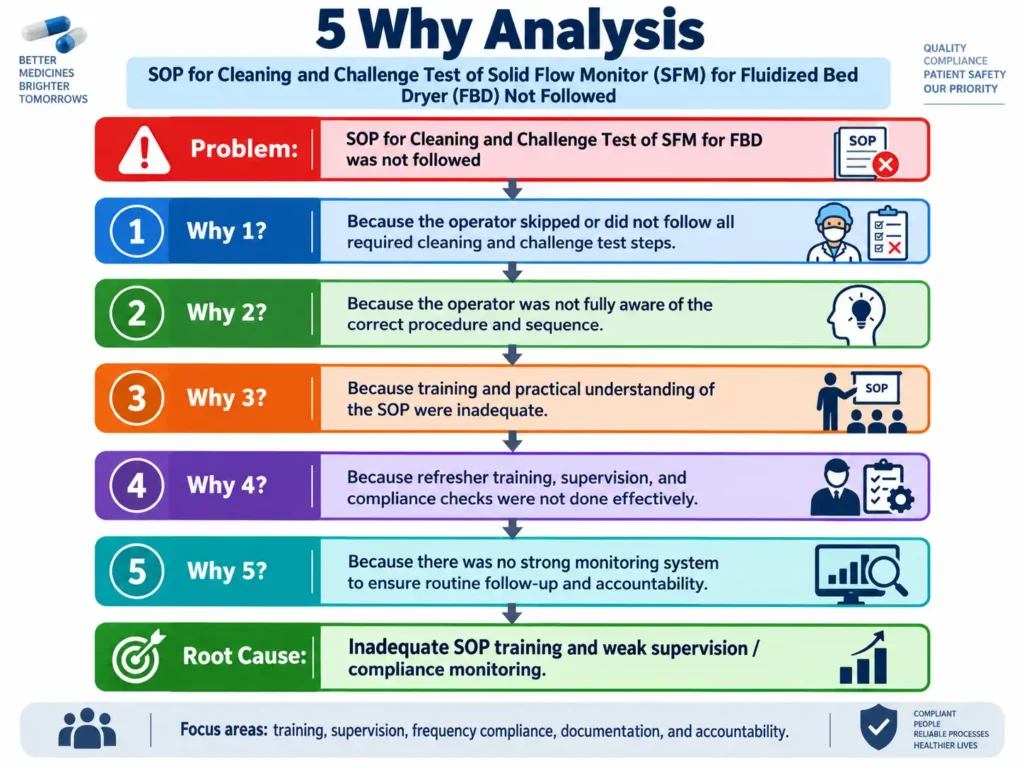
The resulting potential root cause is identified as inadequate SOP training combined with weak supervision and compliance monitoring. Corrective focus should therefore include effective operator training, practical demonstration, periodic refresher training, supervisory verification, schedule monitoring, and documentation review. The SOP itself requires defined cleaning steps, challenge testing, specified testing frequency, and recording of results, making these suitable areas for compliance checks.
5. FMEA:
The Failure Mode and Effects Analysis (FMEA) for the SOP on Cleaning and Challenge Test of Solid Flow Monitor (SFM) for Fluidized Bed Dryer (FBD) Not Followed evaluates potential failures according to Severity (S), Occurrence (O), Detection (D), and Risk Priority Number (RPN). Major failure modes include missing pre-checks, improper sensor cleaning, incorrect sensor assembly, wrong challenge material or quantity, missed challenge-test scheduling, and failure to repeat, escalate, or document an unsuccessful test.
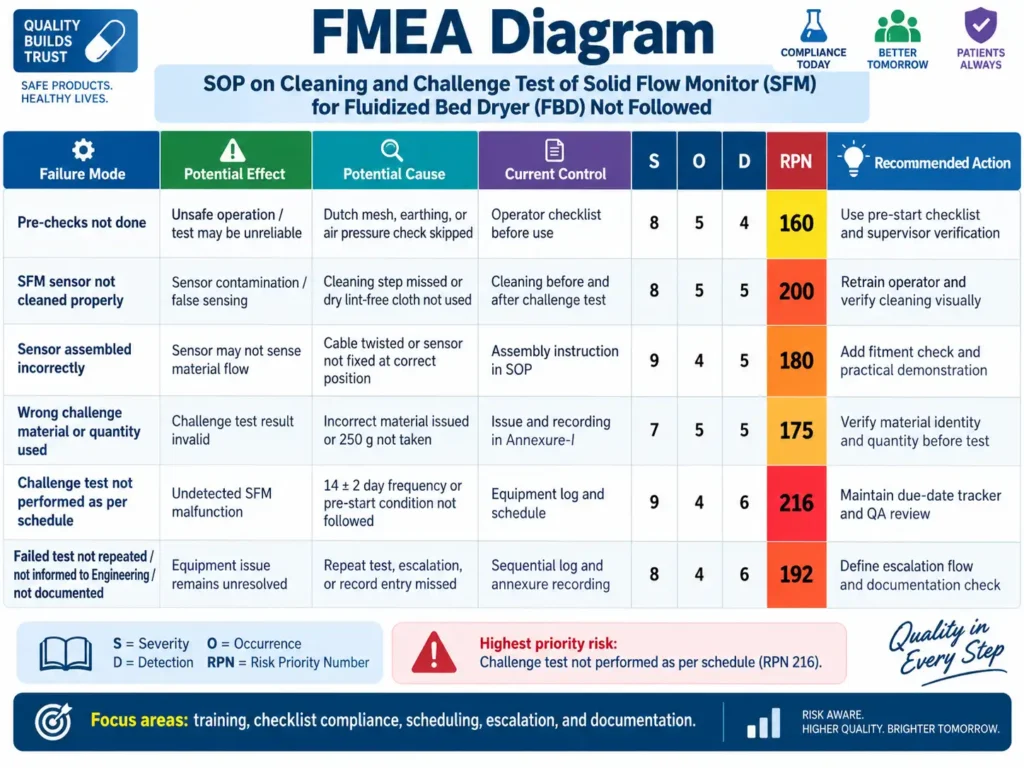
The assessment identifies “Challenge test not performed as per schedule” as the highest-priority risk with an RPN of 216, followed by improper sensor cleaning and inadequate escalation/documentation. The SOP requires sensor cleaning, approximately 250 g of suitable challenge material, verification of SFM tripping within 5–10 seconds, and testing every 14 ± 2 days. Recommended controls include operator retraining, checklists, due-date tracking, supervisor/QA verification, engineering escalation, and complete documentation.
Impact Assessment:
Failure to follow the SOP for Cleaning and Challenge Test of the Solid Flow Monitor (SFM) of the Fluidized Bed Dryer (FBD) may adversely affect equipment safety, process control, and GMP compliance. If the SFM sensor is not cleaned properly, is incorrectly assembled, or its cable is twisted, the sensor may not reliably detect material flow through the exhaust. The SOP specifically requires correct sensor cleaning and positioning before and after the challenge test.
If the challenge test is missed or not performed correctly, an SFM malfunction may remain undetected. The procedure requires suitable challenge material, approximately 250 g, and verification that the FBD trips within 5–10 seconds after full exhaust-blower speed.
Potential impacts include undetected sensor failure, unreliable FBD protection, process interruption, equipment malfunction, incomplete documentation, deviation generation, and regulatory non-compliance. Missed testing frequency or records may also weaken traceability and preventive control.
Questions & Answers
- What is the objective of this SOP?
To define the procedure for cleaning and challenge testing of the Solid Flow Monitor (SFM) installed on the Fluidized Bed Dryer (FBD). - Where is this SOP applicable?
It is applicable to the SFM of the FBD used in the granulation area. - Who is responsible for performing the procedure?
Production personnel such as Technical Associate, Officer, Executive, or Assistant Manager are responsible for execution. Head Production and Head QA ensure compliance. - What checks are required before operation?
Verify Dutch mesh integrity, proper earthing connection, and incoming main air pressure. - What is the minimum incoming air pressure required?
The pressure should not be less than 6 kg/cm² during operation. - How is the SFM sensor cleaned?
The sensor is removed carefully and the sensor rod with Teflon base is cleaned using a dry lint-free cloth. - What precaution is required while assembling the sensor?
The sensor cable should not be twisted, and the sensor must be tightly fitted in the correct position without touching other parts. - When should the SFM sensor be cleaned?
It should be cleaned before and after the challenge test. - Which materials can be used for the SFM challenge test?
Starch, Talc, or Microcrystalline Cellulose can be used. - What quantity of challenge material is normally used?
Approximately 250 g of material is taken and recorded in Annexure-I. - How is the challenge material introduced?
The material is placed in the FBD bowl and allowed to pass through the exhaust so that it contacts the SFM sensor. - What is the acceptance criterion for the SFM challenge test?
The SFM should sense material flow and trip the FBD within 5–10 seconds after the exhaust blower reaches full speed. - What should be done if the SFM does not trip during the first challenge?
Repeat the test using double the quantity of challenge material. - What should be done if the SFM still fails after repeating the test?
Inform the Engineering Department. - What should be done after a successful challenge test?
Reset the SFM until the challenge material exits through the exhaust and the FBD runs continuously without tripping during the empty run. Then clean the sensor. - What is the routine frequency of the SFM challenge test?
The test should be performed every 14 ± 2 days. - When should the test be performed during campaign production?
It should be performed after completion of the product if the scheduled test falls during the campaign. - What should be done if the FBD has not been operated for many days?
The challenge test should be performed before starting the product. - Where should the challenge test be documented?
It should be recorded in the sequential equipment log and Annexure-I. - How is challenge material reconciliation controlled?
Material reconciliation is performed in Annexure-II at the end of every month.