




1. Brief Description:
The SOP for Cleaning of the Lifting and Positioning Device (LPD) for the Rapid Mixer Granulator (RMG), Make: SAAN, defines the standardized cleaning process to maintain equipment cleanliness and prevent contamination in the granulation area. It assigns responsibility to Production personnel for performing the activity, while the Head of Production and Head QA ensure execution and compliance. Two cleaning categories are specified. Type A cleaning is used during batch-to-batch changeover of the same product and potency, or similar products with ascending potency, and involves status labeling, switching off power, and dry cleaning with lint-free cloth. Type B cleaning applies to product changeovers involving different actives, colors, descending potency, or maintenance of contact parts. It includes electrical protection, dry cleaning, washing with approximately 30–40 kg purified water, wet wiping, drying, and sanitization with 70% v/v IPA. After completion, the equipment is labeled “CLEANED” for controlled reuse in subsequent production operations safely.
Skip to PDF content2. Flow Diagram:
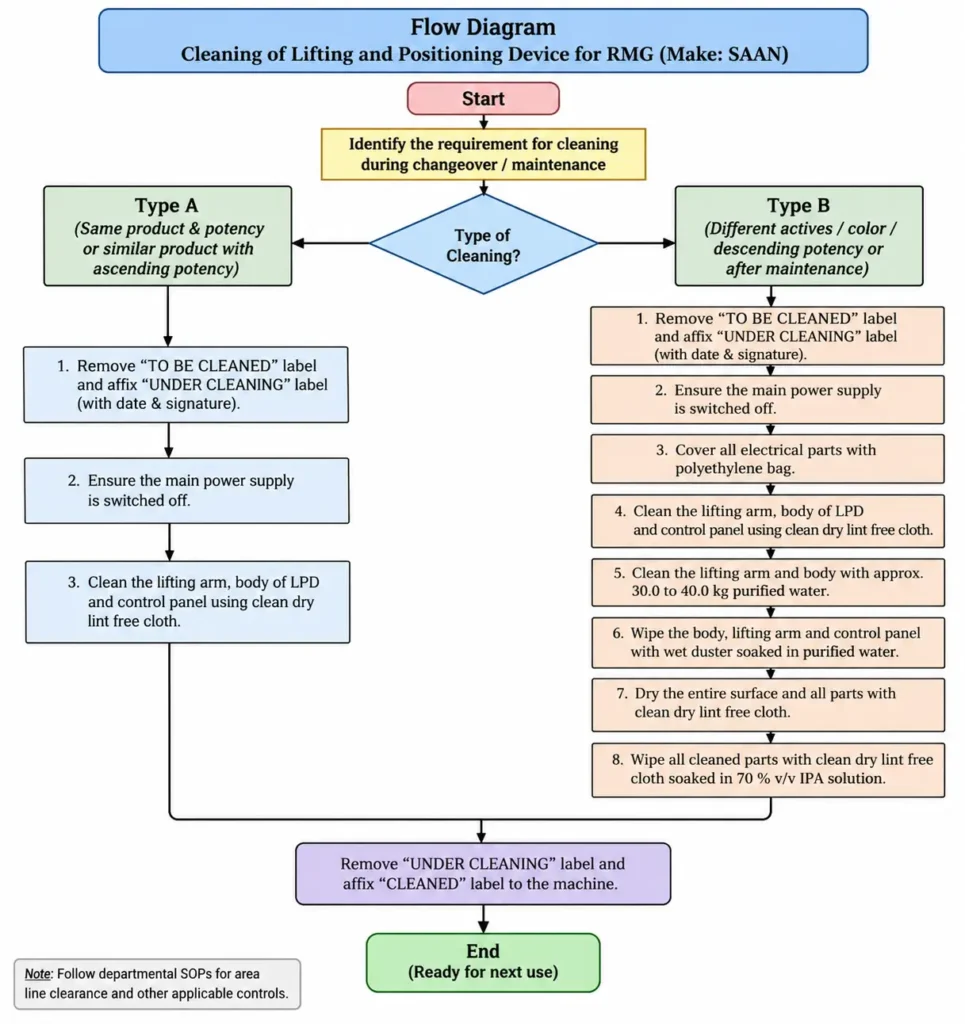
The flow diagram illustrates the systematic cleaning procedure for the Lifting and Positioning Device (LPD) used with the Rapid Mixer Granulator (RMG), Make: SAAN. The process begins by identifying the cleaning requirement and selecting either Type A or Type B cleaning. Type A cleaning is performed during batch-to-batch changeover of the same product and potency, or similar products with ascending potency. It includes changing the equipment status label, switching off the main power supply, and dry cleaning the lifting arm, LPD body, and control panel with a lint-free cloth. Type B cleaning is required for different actives, colors, descending potency, or after maintenance. It involves protecting electrical components, dry cleaning, washing with approximately 30–40 kg purified water, wet wiping, drying, and final wiping with 70% v/v IPA. After cleaning, the “UNDER CLEANING” label is replaced with a “CLEANED” label, indicating readiness for subsequent use.
3. Brainstorming:
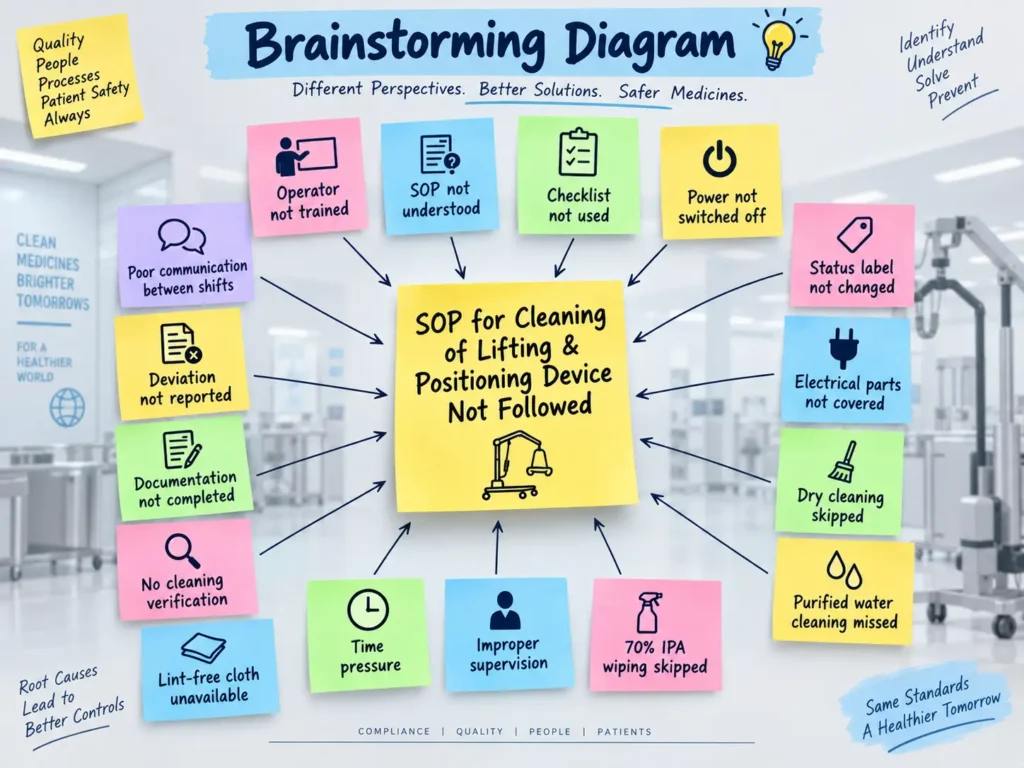
The brainstorming diagram identifies possible reasons why the SOP for Cleaning of the Lifting and Positioning Device (LPD) may not be followed correctly. Potential causes include inadequate operator training, poor understanding of the SOP, failure to use a cleaning checklist, insufficient supervision, time pressure, and poor communication between shifts. Equipment-related issues may include not switching off the power supply, failure to cover electrical parts, and incorrect status labeling. Cleaning steps may also be skipped, such as dry wiping with lint-free cloth, purified-water cleaning, drying, and final wiping with 70% v/v IPA. Other contributing factors include unavailability of cleaning materials, incomplete documentation, lack of cleaning verification, and failure to report deviations. The brainstorming exercise helps the team identify human, procedural, material, supervision, and documentation-related weaknesses so that appropriate corrective and preventive actions can be implemented to improve SOP compliance.
4. 5 Why Analysis:
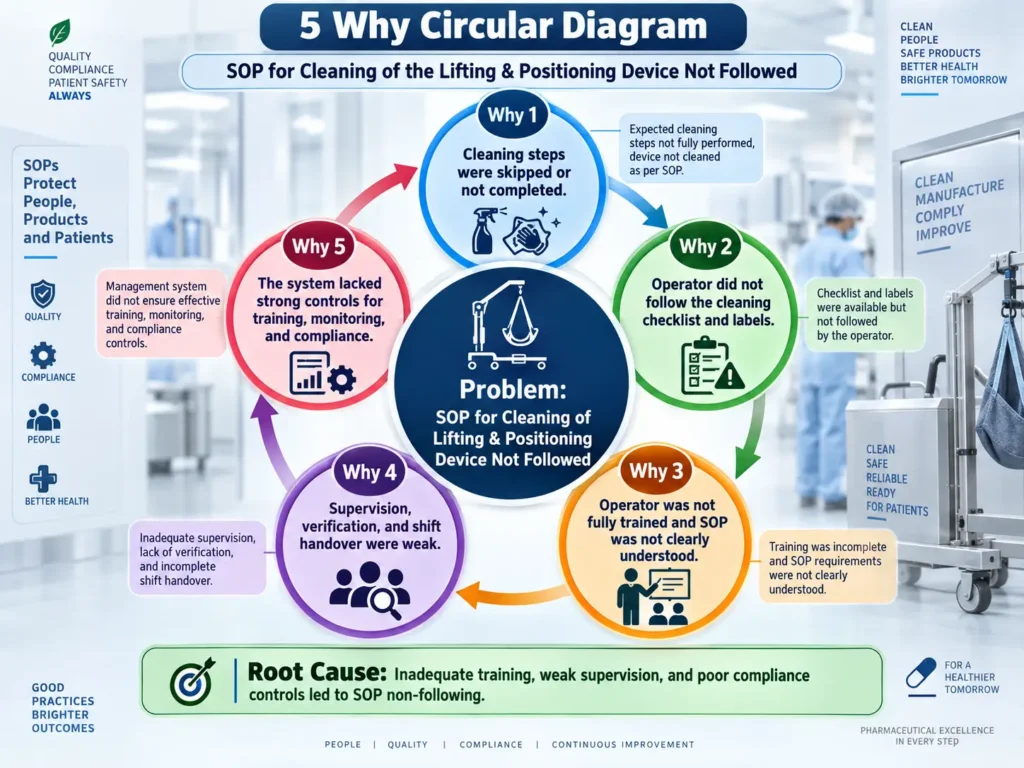
The 5 Why analysis identifies the underlying reasons for non-compliance with the SOP for Cleaning of the Lifting & Positioning Device (LPD). The first issue is that required cleaning steps were skipped or not fully completed. This occurred because the operator did not consistently follow the prescribed cleaning checklist, status labeling, and defined cleaning sequence. Further analysis indicates that the operator may not have been adequately trained or may not have clearly understood the SOP requirements. Weak supervision, insufficient verification of completed cleaning activities, and poor shift handover can further contribute to repeated non-compliance. At the management-system level, inadequate monitoring, ineffective training controls, and insufficient compliance checks may allow the problem to continue. The analysis therefore points to inadequate training, weak supervision, poor verification, and ineffective compliance controls as the key root causes. Corrective actions should focus on retraining, checklist enforcement, supervisory verification, documentation review, and periodic effectiveness monitoring.
5. Heat Map:
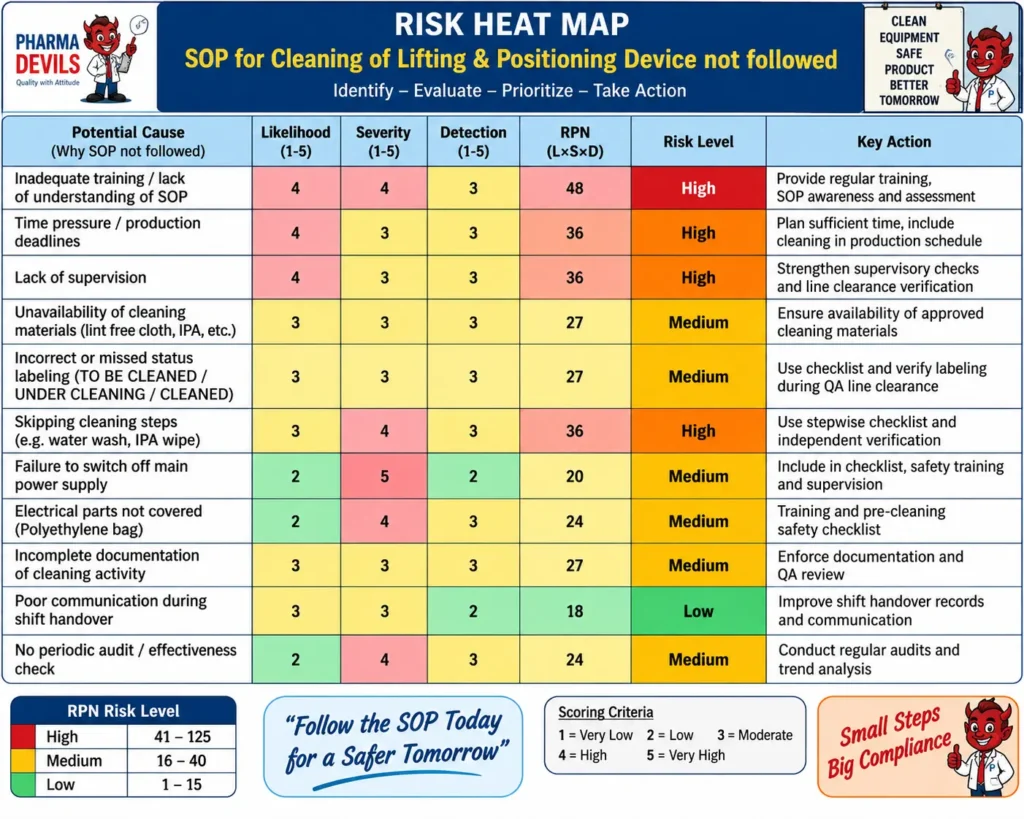
The heat map evaluates the potential risks associated with failure to follow the SOP for Cleaning of the Lifting & Positioning Device (LPD). Possible causes include inadequate training, lack of SOP understanding, time pressure, weak supervision, unavailable cleaning materials, incorrect status labeling, skipped cleaning steps, failure to switch off the power supply, unprotected electrical parts, incomplete documentation, and poor shift communication. Each failure is assessed using likelihood, severity, and detection, and an overall risk level is assigned. High-risk issues generally include inadequate training, insufficient supervision, production pressure, and omission of critical cleaning steps such as purified-water washing or IPA wiping. Medium-risk issues include labeling errors, documentation gaps, and equipment safety controls. The assessment helps prioritize corrective actions such as retraining operators, strengthening supervision, using cleaning checklists, ensuring material availability, improving documentation, and conducting periodic compliance audits to prevent recurrence.
Impact Assessment:
Failure to follow the SOP for Cleaning of the Lifting and Positioning Device (LPD) can have significant quality, safety, compliance, and operational impacts. The SOP requires defined Type A and Type B cleaning, equipment status labeling, switching off the main power supply, use of lint-free cloth, protection of electrical parts, purified-water cleaning, drying, and final wiping with 70% v/v IPA. If these steps are not followed, potential impacts may include inadequate equipment cleanliness, carryover of residues, cross-contamination between products, incorrect equipment status identification, and possible exposure of electrical components to moisture. Skipping power isolation may also increase operator safety risk. Incomplete cleaning or labeling may affect line-clearance confidence and could lead to use of equipment before satisfactory cleaning is completed. Since Production is responsible for execution and Production/QA heads for compliance, repeated non-adherence may also indicate weakness in training, supervision, documentation, and GMP controls.
Questions & Answers:
- What is the objective of this SOP?
To define the procedure for cleaning the Lifting and Positioning Device used with the RMG, Make: SAAN. - Where is this SOP applicable?
It is applicable to the Lifting and Positioning Device for RMG in the granulation area. - Who is responsible for performing the cleaning activity?
Production Technical Associate, Officer, Executive, or Assistant Manager. - Who ensures execution and compliance of the SOP?
Head Production ensures execution and compliance, while Head QA ensures compliance. - When is Type A cleaning performed?
During changeover from one batch to the next batch of the same product with the same potency, or similar product with ascending potency. - What status label is applied before cleaning?
The “TO BE CLEANED” label is removed and the “UNDER CLEANING” label is affixed with date and signature of the Production Officer. - What safety step must be taken before cleaning?
The main power supply must be switched off. - How is Type A cleaning performed?
The lifting arm, body of the LPD, and control panel are cleaned using a clean, dry lint-free cloth. - When is Type B cleaning required?
For changeover involving different actives, different colors, descending potency, or after maintenance of contact parts. - Why are electrical parts covered during Type B cleaning?
The SOP requires all electrical parts to be covered with a polyethylene bag before wet cleaning. - How much purified water is used for Type B cleaning?
Approximately 30.0 to 40.0 kg of purified water is used to clean the lifting arm and body. - How is the equipment dried after wet cleaning?
The entire surface and all parts are dried using a clean, dry lint-free cloth. - Which sanitizing solution is used after cleaning?
A clean dry lint-free cloth soaked in 70% v/v IPA solution is used for wiping the LPD and cleaned parts. - What label is applied after completion of cleaning?
The “UNDER CLEANING” label is removed and the “CLEANED” label is affixed to the machine. - What does LPD stand for?
LPD stands for Lifting and Positioning Device.