



1. Brief Description:
This Standard Operating Procedure (SOP) describes the requirements for Cleaning Validation to ensure that pharmaceutical manufacturing equipment is cleaned effectively and consistently. It provides guidance for validating manual, semi-automated, and automated cleaning procedures and for preparing the Cleaning Validation Master Plan, protocol, and summary report. Cleaning validation helps control cross-contamination from product residues, cleaning agents, solvents, and microorganisms to predetermined acceptable levels. The SOP explains selection of the worst-case product based on toxicological assessment, solubility, potency, and cleanability. It also defines acceptance criteria using visual inspection, swab and rinse analysis, MACO, PDE, therapeutic dose, and 10-ppm criteria. Sampling locations are selected considering equipment design and difficult-to-clean areas. The procedure also covers analytical method validation, residue recovery, continuous monitoring, revalidation, change control, deviation handling, CAPA, and quality risk management to maintain effective cleaning throughout equipment use.
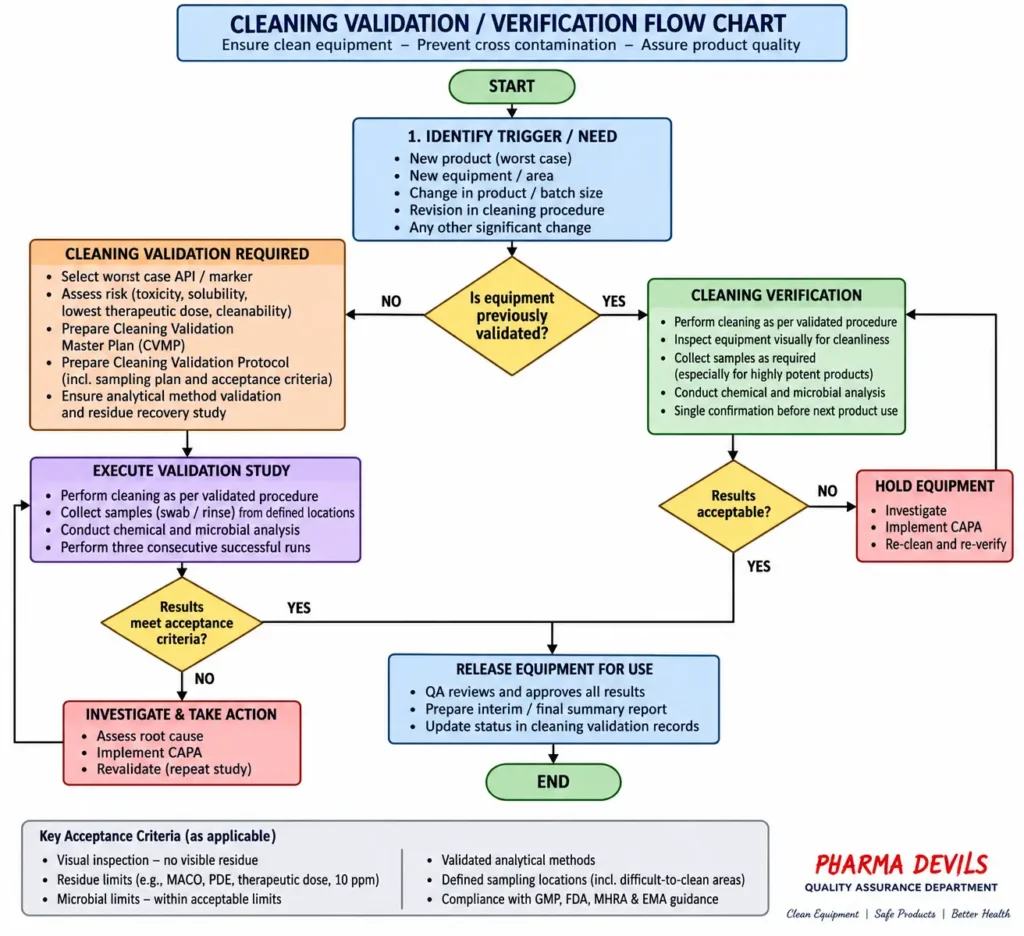
Skip to PDF content2. Flow Diagram:
The flow diagram explains the complete Cleaning Validation and Cleaning Verification process in a simple step-by-step manner. The process starts when a trigger is identified, such as introduction of a new product, new equipment, change in batch size, change in manufacturing area, or revision of the cleaning procedure. The need for cleaning validation is then assessed. For validation, the worst-case API or marker is selected based on factors such as toxicity, solubility, therapeutic dose, and cleanability. A Cleaning Validation Master Plan and protocol are prepared, followed by execution of three consecutive successful validation runs with swab/rinse sampling and chemical and microbiological testing. If results meet predefined acceptance criteria, QA reviews and approves the results before equipment release. If results fail, investigation, deviation handling, CAPA, re-cleaning, and repeat validation may be required. The process also includes continued monitoring, periodic review, and revalidation to maintain cleaning effectiveness.
3. 5 Why Analysis for Cleaning Validation SOP Failure:
The 5 Why Analysis is a simple root-cause investigation tool used to understand why a Cleaning Validation SOP activity has failed. The analysis starts with the main problem, such as a failed swab or rinse result, and repeatedly asks “Why?” until the underlying cause is identified. Typical investigation areas include ineffective cleaning, residues remaining on difficult-to-clean equipment surfaces, incorrect sampling locations, improper execution of the cleaning or sampling procedure, and inadequate training or supervision. The SOP itself requires representative sampling from difficult-to-clean locations and appropriate swab or rinse techniques.
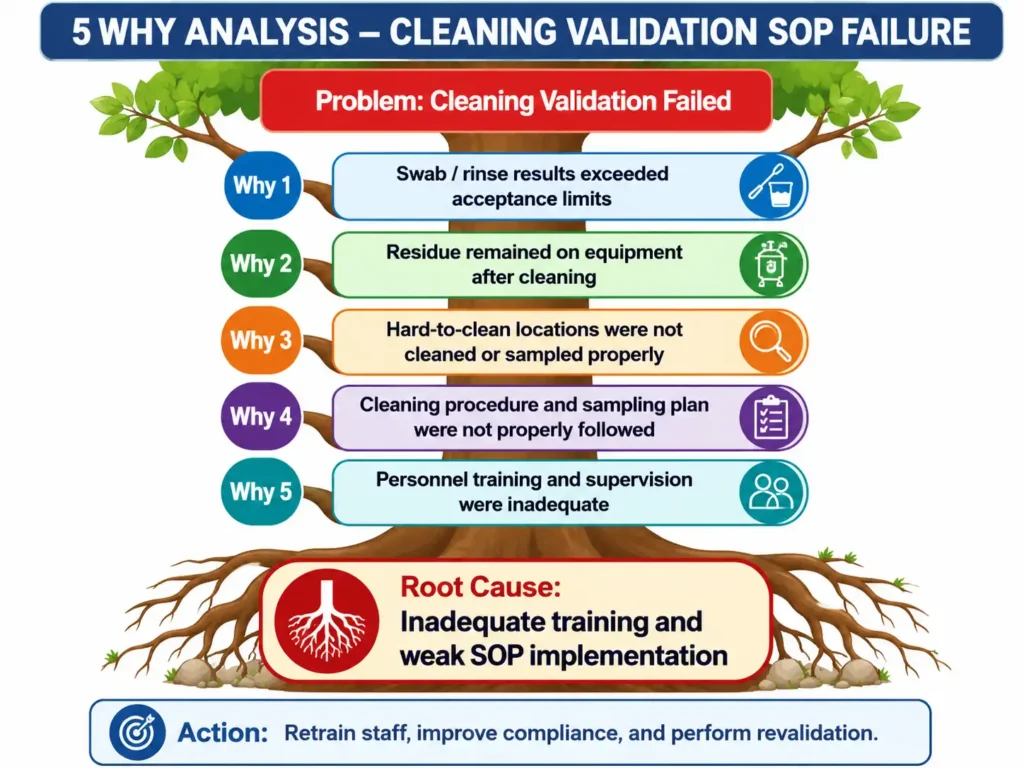
Once the probable root cause is identified, suitable corrective actions may include retraining personnel, improving cleaning steps, revising the sampling plan, strengthening SOP compliance, and performing revalidation where required. The SOP specifically provides for failure investigation, corrective action, and revalidation criteria. This approach helps prevent recurrence and improves the effectiveness and reliability of the Cleaning Validation program.
4. Brainstorming for SOP failure:
The Brainstorming Sticky Notes technique is used to identify possible causes of Cleaning Validation SOP failure in a simple and visual way. Each sticky note represents one potential problem so that QA, Production, QC, and Engineering teams can discuss risks systematically. The brainstorming is grouped into key areas such as People, Procedure, Sampling & Analysis, Equipment, and Documentation & Control. Possible causes may include inadequate operator training, incorrect cleaning steps, wrong worst-case product selection, improper swab locations, poor recovery studies, insensitive analytical methods, hard-to-clean equipment parts, incorrect surface-area calculations, incomplete records, and failure to perform revalidation when required.
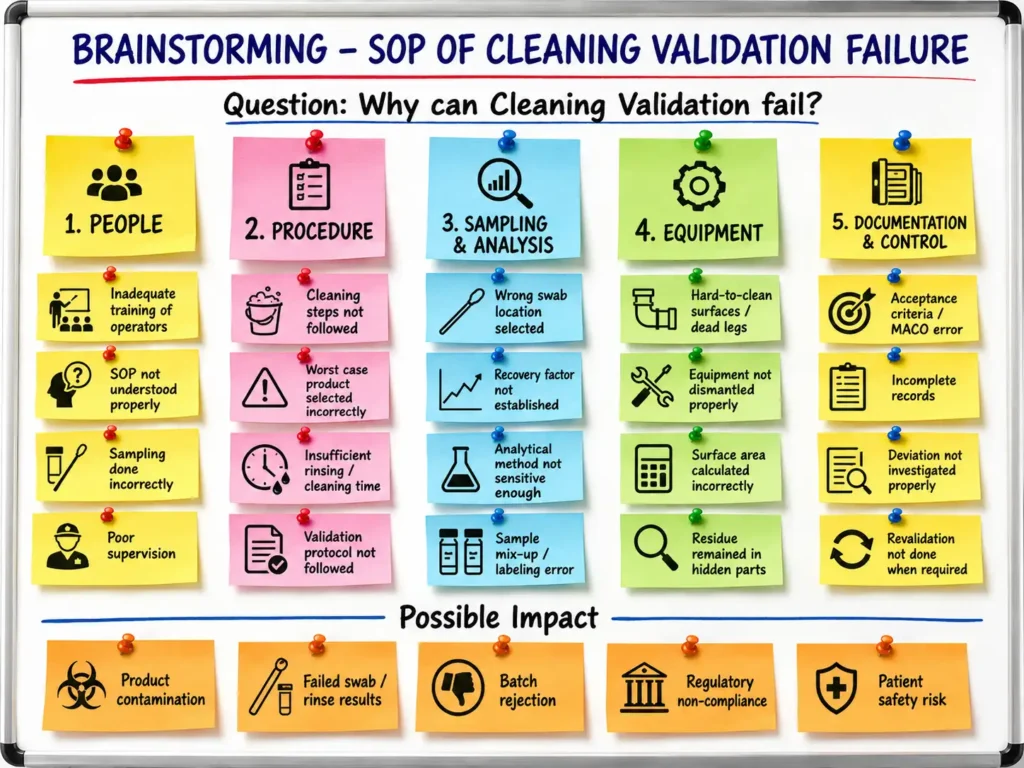
The sticky-note method helps the team collect ideas quickly, compare possible causes, and identify areas requiring deeper investigation. It also highlights potential impacts such as product contamination, failed swab or rinse results, batch rejection, regulatory non-compliance, and patient safety risk.
5. Heat Map (FMEA) for Cleaning Validation SOP Failure:
A Heat Map is a visual risk-assessment tool used to identify and prioritize potential failures in the Cleaning Validation SOP. It helps the investigation team compare risks based on factors such as severity, occurrence, and detectability. Higher-risk issues are highlighted so that corrective actions can be focused on the most critical areas first. For Cleaning Validation SOP failure, the heat map may include risks such as inadequate operator training, failure to follow cleaning procedures, incorrect worst-case product selection, improper sampling locations, incorrect swab or rinse technique, unsuitable analytical methods, inadequate recovery studies, hard-to-clean equipment areas, inaccurate surface-area calculations, and incomplete documentation.
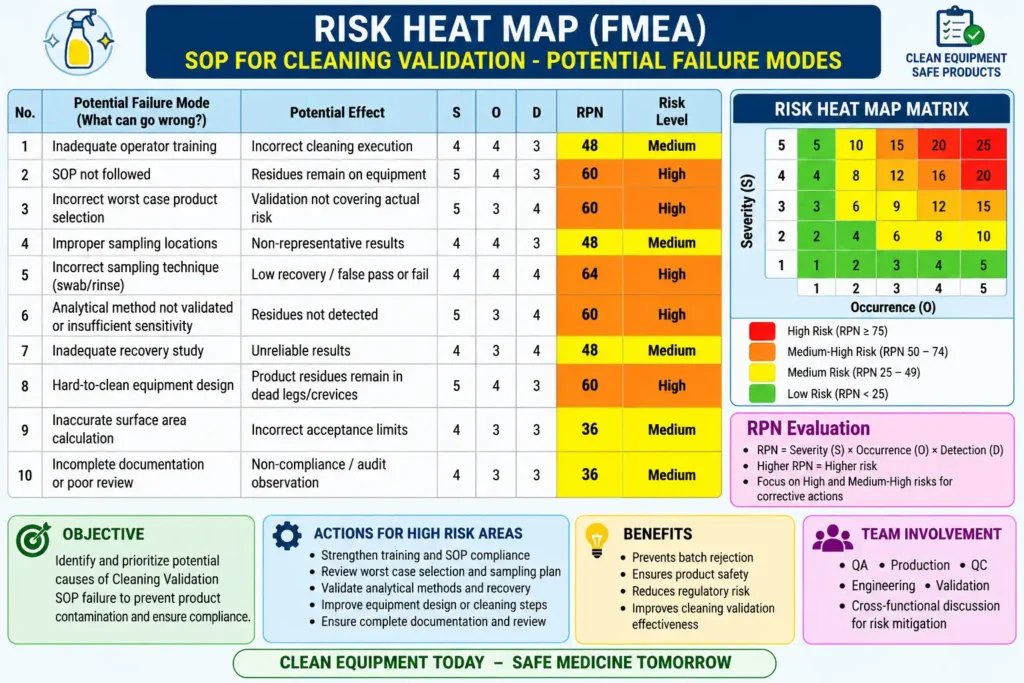
The main purpose of the heat map is to support systematic risk evaluation, improve cleaning effectiveness, reduce the possibility of product contamination or failed validation results, and strengthen GMP compliance. It also helps QA, Production, QC, Engineering, and Validation teams decide which risks require immediate corrective and preventive action.
6. Critical Process Parameters & Critical Quality Attributes:
The SOP does not formally label items as “CPP” or “CQA,” but the following parameters and attributes are clearly supported by the cleaning validation requirements described in the document.
| Critical Process Parameters (CPPs) | Why Critical |
|---|---|
| Cleaning procedure / method | Must be controlled, reproducible, and validated to achieve consistent cleaning. |
| Cleaning agent and concentration | Changes in cleaning agent or its concentration can trigger cleaning validation or revalidation. |
| Worst-case product / API selection | Selection is based on toxicity, solubility, therapeutic dose, potency, and cleanability. |
| Equipment / equipment train | Equipment is grouped based on similarity, operating principle, and cleaning procedure. |
| Sampling locations | Locations are selected based on equipment design, product flow, difficult-to-disassemble areas, crevices, moisture, and rough surfaces. |
| Swab and rinse sampling method | Swab is used for cleaning-agent and microbial residues; swab/rinse methods are used for chemical residues. |
| Swab sampling area | A defined sampling area is required for chemical and microbial residue evaluation. |
| Rinse solvent and rinse quantity | A fixed amount of suitable rinse solvent must adequately cover equipment surfaces. |
| Dirty and clean equipment hold time | Maximum hold times should be considered in the sampling plan. |
| Analytical method performance | The method should be validated for specificity, LOD, LOQ, linearity, accuracy, precision, range, intermediate precision, and solution stability. |
| Recovery factor | Residue recovery studies are required, with recovery factor stated as NLT 75%. |
| Number of validation runs | Three consecutive successful runs are required for cleaning validation. |
Critical Quality Attributes (CQAs)
| Critical Quality Attributes | Acceptance / Requirement |
|---|---|
| Visual cleanliness | Product-contact surfaces should be visually clean. |
| API residue | Must comply with the established MACO limit. |
| PDE/HBEL-based residue limit | Toxicological data and PDE/HBEL are used to establish safe carryover limits. |
| Therapeutic-dose residue limit | Based on 1/1000 of the lowest therapeutic dose. |
| 10 ppm criterion | No more than 10 ppm of one product should appear in the next product where applicable. |
| Cleaning-agent / solvent residue | Residues should remain within predefined acceptable limits. |
| Microbial cleanliness | Microbial residues must comply with defined limits; the SOP specifies TAMC NMT 30 CFU/100 cm². |
| Swab / rinse appearance | Samples should be visually clean/clear and free from extraneous matter or oily residue. |
| Analytical detectability | The method must be able to detect API, detergent, and solvent at levels consistent with acceptance criteria. |
| Overall cleaning effectiveness | Chemical and microbiological results must meet predefined limits before equipment release. |
In simple terms: CPPs control how the cleaning and sampling are performed, while CQAs confirm whether the equipment is clean enough for safe next-product use.
7. Impact Assessment:
Cleaning Validation has a direct impact on product quality, patient safety, equipment suitability, and GMP compliance. If the cleaning process is not properly validated, residues of previous products, cleaning agents, solvents, or microorganisms may remain on equipment surfaces and can cause cross-contamination of the next product. The impact becomes more critical for highly potent or toxic products, where even a small amount of residue may create a safety risk. Therefore, acceptance limits are established using visual cleanliness, MACO, PDE/HBEL, therapeutic dose, 10-ppm criteria, and microbiological limits. Changes in products, equipment, batch size, manufacturing area, or cleaning procedures may affect validated cleaning effectiveness and should be evaluated through change control and risk assessment. Equipment should remain under control until acceptable chemical and microbiological results are reviewed by QA. Failure requires deviation investigation, root-cause analysis, CAPA, and possible revalidation.
Questions & Answers:
Q1. What is Cleaning Validation?
Cleaning Validation is documented evidence showing that a defined cleaning procedure can consistently clean equipment to a predetermined acceptable level.
Q2. What is the main objective of Cleaning Validation?
The objective is to establish a defined approach for carrying out cleaning validation studies and ensuring equipment cleaning procedures are suitable and effective.
Q3. Why is Cleaning Validation important?
It helps control cross-contamination from product residues, cleaning agents, and microorganisms and ensures equipment is suitably clean before further use.
Q4. How many successful runs are required for Cleaning Validation?
Three consecutive successful runs are required for the cleaning validation study.
Q5. What can trigger Cleaning Validation or revalidation?
Triggers include introduction of a new worst-case product, new equipment, transfer of a product to another equipment or area, batch-size revision, or change in the cleaning procedure.
Q6. How is the worst-case product selected?
It is selected based on toxicological assessment, risk rating, solubility, potency, and difficulty of cleaning.
Q7. What acceptance criteria are used in Cleaning Validation?
Acceptance criteria include visual cleanliness, chemical residue limits, microbial contamination limits, MACO based on PDE, therapeutic-dose criteria, and 10-ppm criteria.
Q8. What is MACO?
MACO means Maximum Allowable Carry Over and represents the acceptable amount of residue that may carry over from one product to the next.
Q9. What is the visual-clean acceptance criterion?
All equipment surfaces should be clean to the unaided eye and should not show visible residues or contamination.
Q10. Which sampling methods are used?
Swab sampling is used for cleaning-agent and microbial residues, while both swab and rinse sampling can be used for chemical residues.
Q11. How are sampling locations selected?
Sampling locations are selected considering equipment design, product flow, locations difficult to disassemble, crevices, residual moisture, temperature, and rough surfaces.
Q12. What is the microbial acceptance limit mentioned in the SOP?
The SOP specifies a TAMC limit of NMT 30 CFU/100 cm².
Q13. What is the minimum acceptable residue recovery factor?
The residue recovery factor should be NLT 75% for the worst-case API study using swab and rinse techniques.
Q14. What analytical parameters should be validated?
Parameters include specificity, LOD, LOQ, linearity, accuracy, precision, range, intermediate precision, and solution stability.
Q15. When can equipment be released for further use?
Equipment should be released only after cleaning results are documented, verified, and reviewed by Quality Assurance.
Q16. What happens if Cleaning Validation results fail?
The failure should be reported to the QA Head, an unplanned deviation should be raised, root cause should be identified, and CAPA should be defined and implemented.
Q17. Is Cleaning Validation monitored after successful validation?
Yes. Cleaning effectiveness should be continuously monitored through visual inspection, swab testing, periodic review, and evaluation of changes.
Q18. How often should Cleaning Validation be verified according to this SOP?
The SOP states that cleaning validation should be verified once every three years ± 3 months, using a single verification run.