





1. Introduction:
Corrective and Preventive Action, commonly known as CAPA, is an important part of the pharmaceutical Quality Management System. It provides a structured method to identify problems, determine their root causes, correct existing non-conformities, and prevent similar problems from happening again. The SOP covers CAPA arising from activities such as deviations, change controls, laboratory deviations, OOS results, market complaints, document reviews, APQR, internal or external audits, and regulatory recommendations.The CAPA process starts with proper identification and documentation of the issue, followed by root cause analysis, corrective action, preventive action, impact assessment, implementation, and effectiveness review. Quality Assurance is responsible for issuing, tracking, reviewing, following up, and closing CAPAs, while the concerned department is responsible for implementing the approved actions within the defined timeline. Corrective actions focus on resolving an existing problem and eliminating its cause, whereas preventive actions focus on assessing risks and improving systems to avoid future non-conformities. The SOP also requires documented review of implementation and effectiveness before CAPA closure. A well-managed CAPA system supports continuous improvement, product quality, GMP compliance, traceability, and prevention of recurring failures in pharmaceutical operations.
Skip to PDF content2. Flow Diagram:
The CAPA flow diagram shows the simple steps used to identify, correct, and prevent problems in a pharmaceutical quality system. The process starts when an issue is found through a deviation, OOS, complaint, audit, change control, APQR, or another quality activity. QA records the issue, reviews it, assigns a unique CAPA number, and issues the CAPA to the concerned department.
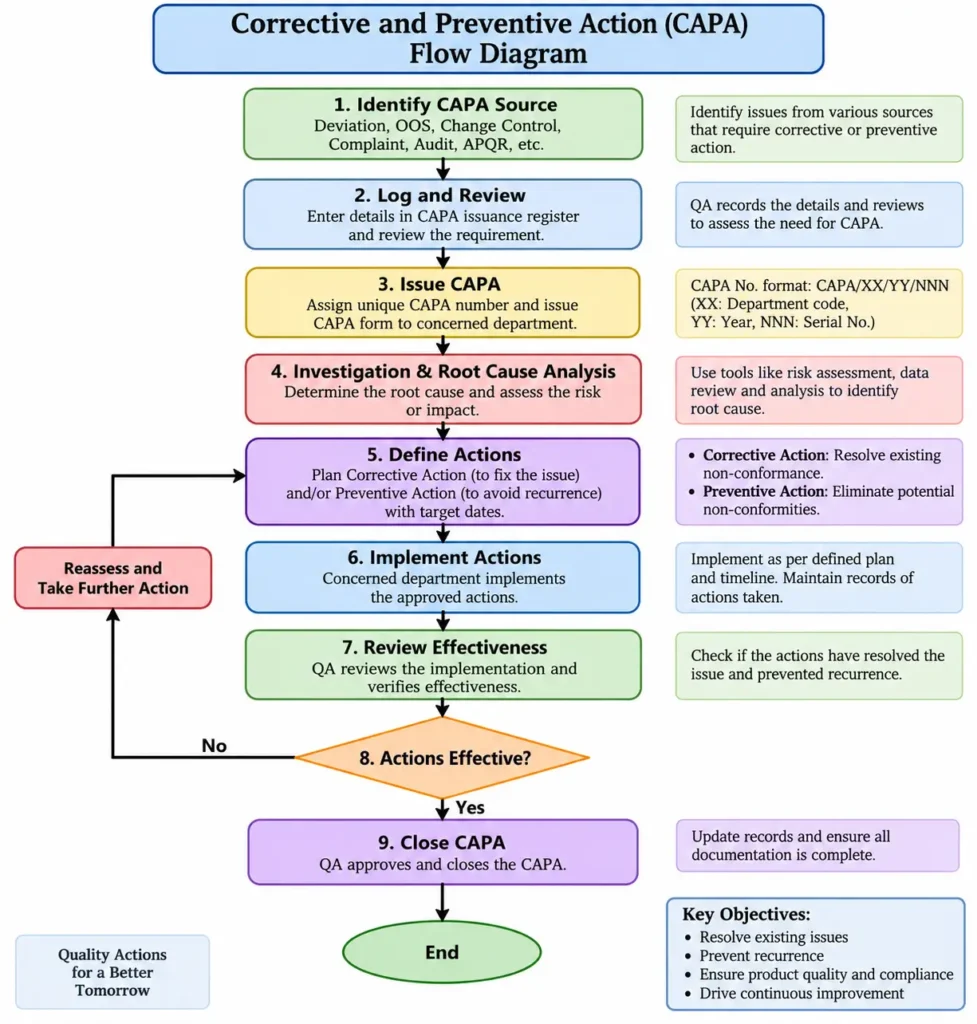
The problem is then investigated to find the actual root cause. Based on the investigation, suitable corrective actions are planned to fix the existing problem and preventive actions are planned to stop the problem from happening again.The concerned department implements the approved actions within the target time. After implementation, QA checks whether the actions are effective. If the problem is not fully controlled, further action is taken. When the actions are found effective and all supporting documents are complete, the Head QA reviews and closes the CAPA.
3. Benefits of Following the CAPA SOP:
The image explains in simple language why following the CAPA SOP is important in a pharmaceutical company. A proper CAPA system helps the team identify a problem, investigate its root cause, take corrective action, prevent recurrence, reduce risk, maintain records, and check whether the actions are actually effective.
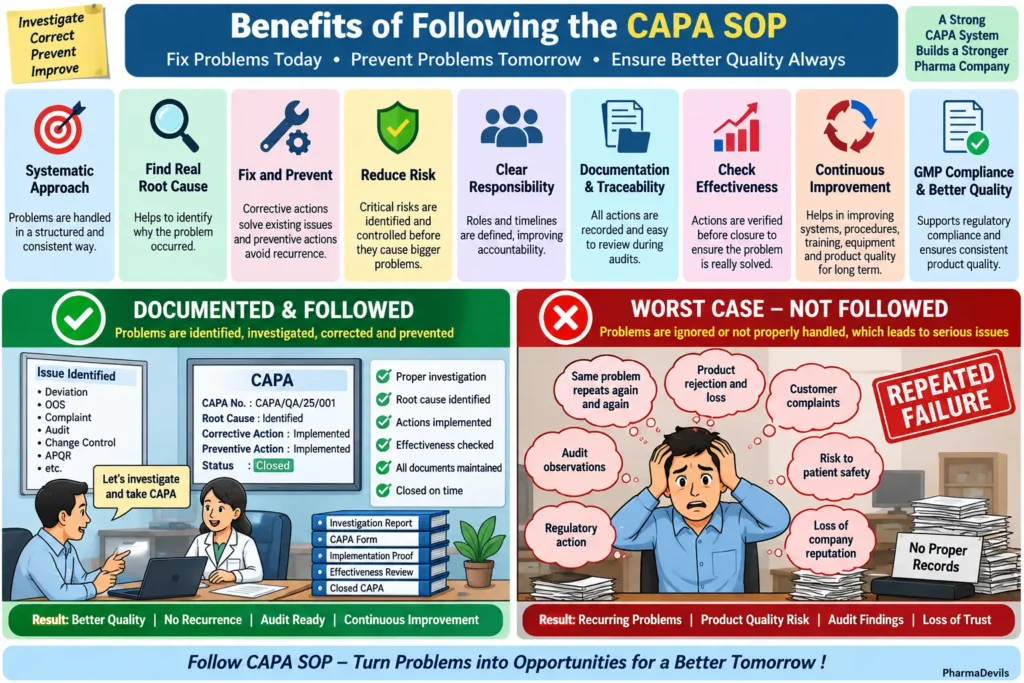
The “Documented & Followed” side shows a controlled situation where deviations, OOS results, complaints, audits, or other issues are properly investigated. The CAPA is recorded, responsibilities are clear, actions are completed on time, supporting documents are maintained, and effectiveness is checked before closure. This leads to better quality, fewer repeated problems, audit readiness, and continuous improvement.The “Worst Case – Not Followed” side shows what may happen when CAPA is ignored or poorly managed. Problems can repeat, product rejection may occur, customer complaints can increase, audit observations may arise, and risks to product quality and patient safety can become more serious. In simple words, following the CAPA SOP turns problems into controlled improvements instead of repeated failures.
4. Brainstorming for SOP Failure:
This brainstorming diagram shows the common reasons why an SOP may not be followed properly in a manufacturing area. The main purpose is to collect possible causes before starting a detailed investigation.
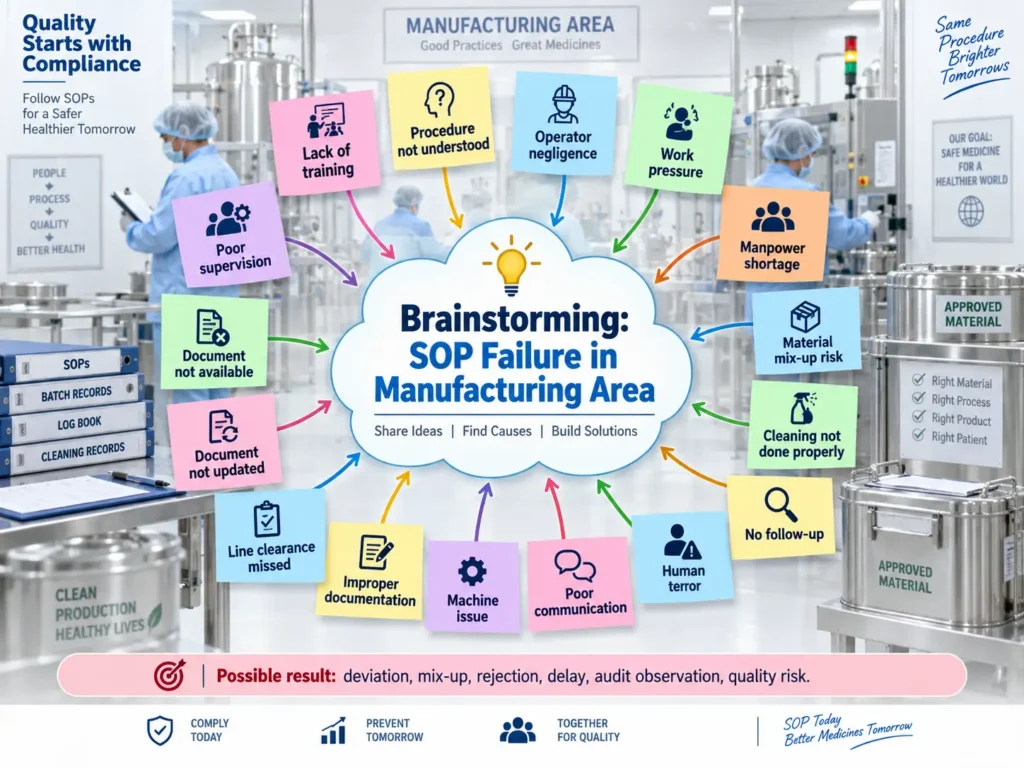
Possible reasons include lack of training, poor supervision, operator negligence, work pressure, manpower shortage, unclear procedure, outdated or unavailable documents, improper documentation, machine problems, poor communication, missed line clearance, cleaning not done properly, material mix-up risk, and lack of follow-up. By discussing all these possible causes, the team can better understand where the failure may have started. The next step is to verify the actual cause using investigation tools such as 5-Why Analysis, Fishbone Analysis, or Root Cause Analysis. In simple words, brainstorming helps the team think of all possible reasons for SOP failure before deciding the real root cause. This helps prevent repeated mistakes, deviations, mix-ups, product rejection, audit observations,
5. 5-Why Analysis for SOP Failure:
The 5-Why diagram explains how repeated questioning can help find the real root cause of an SOP failure in the manufacturing area.The analysis starts with the basic problem: the SOP was not followed. The first reason may be that the operator missed the required steps. Asking “Why?” again may show that the operator was not fully clear about the procedure. Further questioning can reveal that proper SOP training or refresher training was not provided. The next level may show that the training plan was not updated after the SOP was revised. Finally, the root cause may be an ineffective training management and follow-up system.
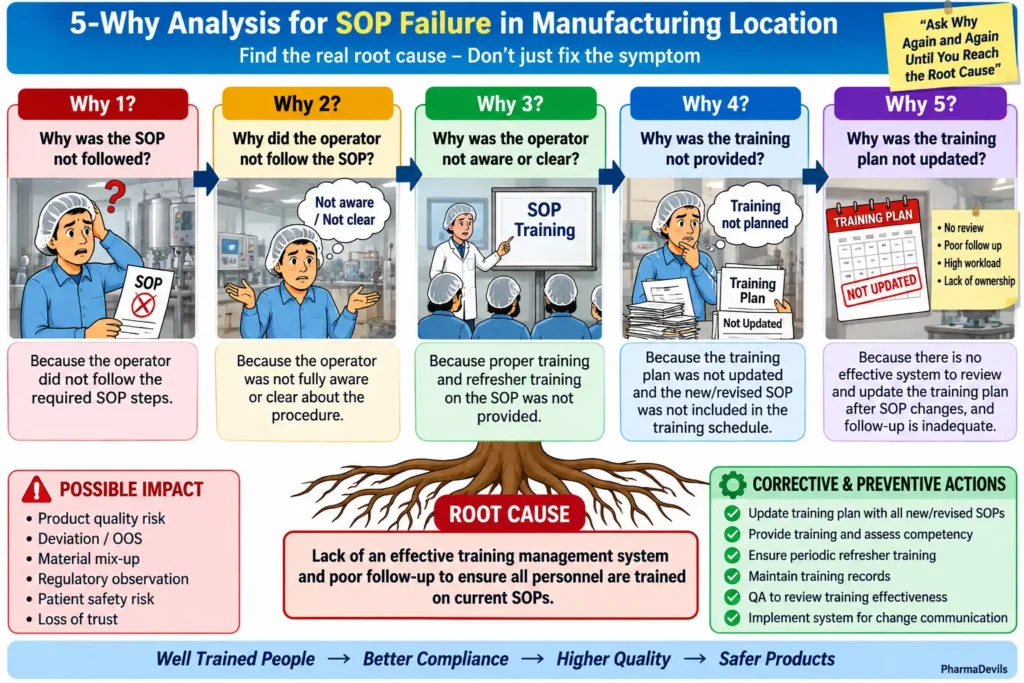
This type of analysis helps the team avoid stopping at a simple answer such as “operator error.” Instead, it looks deeper into the system.In simple words, 5-Why Analysis helps identify why the SOP failure really happened so that suitable corrective and preventive actions can be taken and the problem does not happen again.
6. Fishbone Analysis for SOP Failure:
The Fishbone Analysis diagram shows the possible reasons why an SOP may fail or may not be followed properly in a pharmaceutical core manufacturing area.The causes are grouped into six simple categories: Man, Method, Machine, Material, Environment, and Documentation. Under Man, possible causes include lack of training, operator negligence, poor supervision, and manpower shortage. Under Method, the procedure may not be understood, some steps may be skipped, line clearance may be missed, or follow-up may be weak.
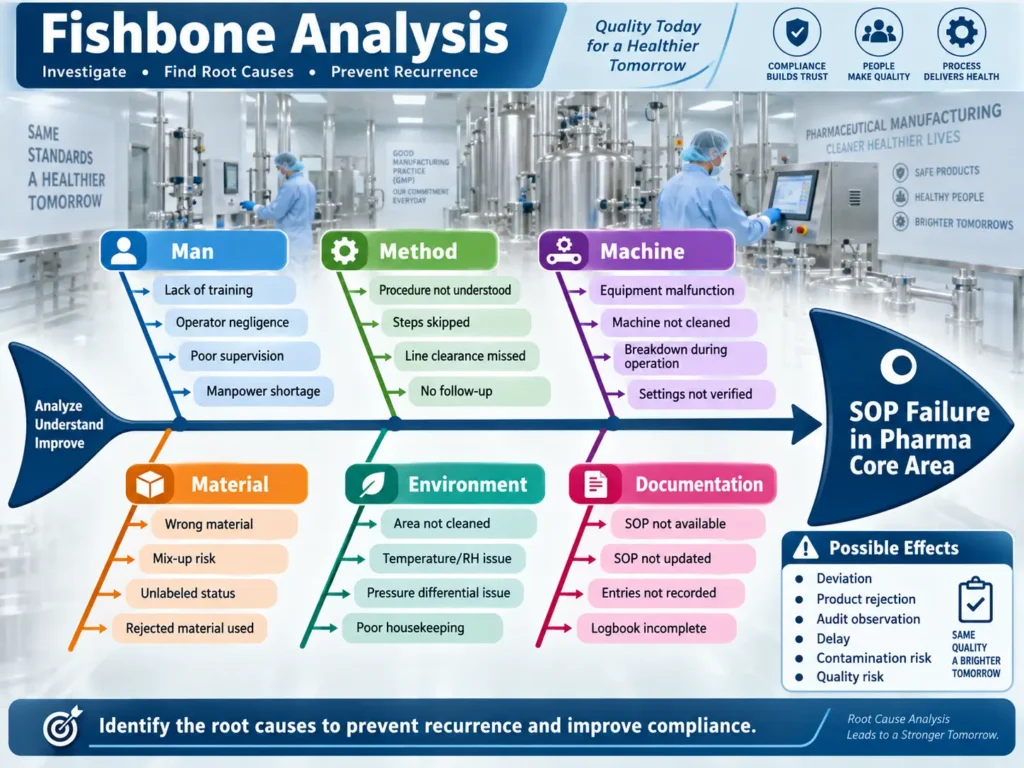
Machine-related causes may include equipment malfunction, improper cleaning, breakdown, or unverified settings. Material-related causes may involve wrong material, mix-up, unlabeled status, or use of rejected material. Environmental causes can include poor cleaning, temperature or humidity problems, pressure differential issues, and poor housekeeping. Documentation-related causes include unavailable or outdated SOPs, missing entries, and incomplete logbooks. In simple words, the fishbone diagram helps the investigation team look at all possible causes of SOP failure in one place, identify the real root cause, and take suitable CAPA to prevent recurrence.
7. Fault Tree Analysis for SOP Failure:
The Fault Tree Analysis diagram shows how different problems can lead to the main event: SOP failure in the manufacturing area. The possible causes are divided into major groups such as personnel failure, procedure/documentation failure, equipment or machine failure, and environment/material failure. Personnel-related causes may include lack of training, operator negligence, poor supervision, or manpower shortage. Procedure-related causes may include an unavailable or outdated SOP, unclear instructions, missed line clearance, or incomplete records.Equipment-related causes can include machine malfunction, improper cleaning, incorrect settings, or breakdown during operation. Environment and material-related causes may include poor area cleaning, temperature or humidity problems, pressure differential issues, or material mix-ups.
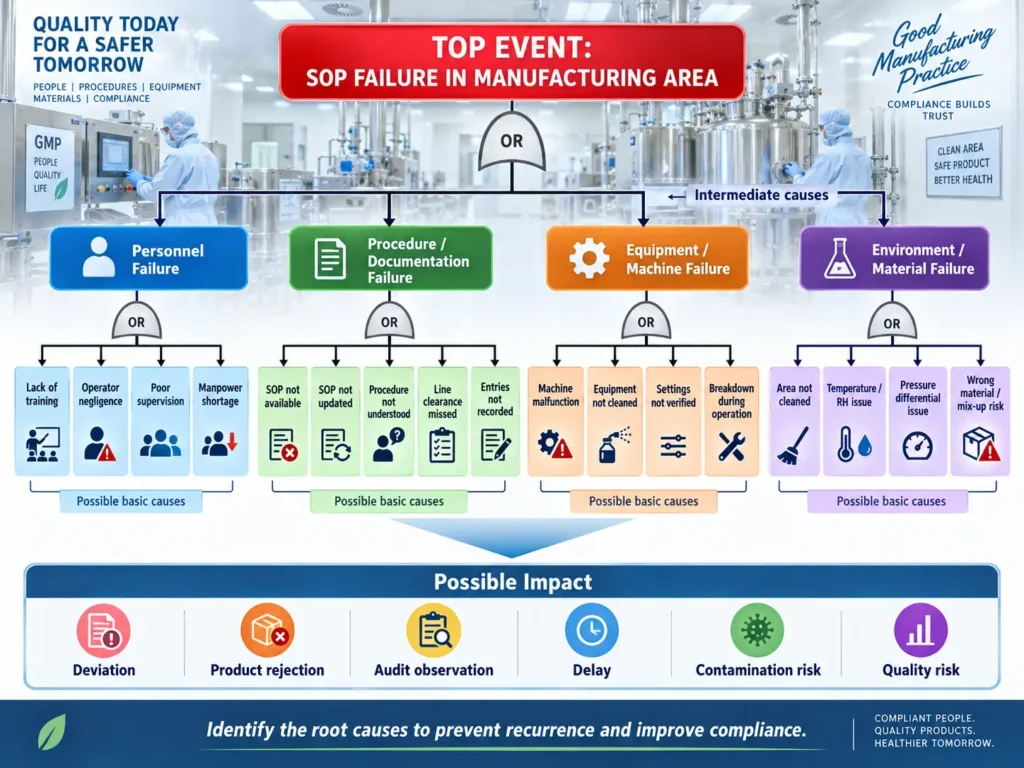
These causes can result in deviations, product rejection, audit observations, delays, contamination risk, and other quality problems. In simple words, Fault Tree Analysis helps the team work backward from the SOP failure and identify the possible basic causes so suitable corrective and preventive actions can be taken.
8. Impact Assessment:
The Impact Assessment diagram explains what can happen when an SOP is not followed properly in a pharmaceutical manufacturing area. The failure may be caused by skipped steps, inadequate training, poor supervision, improper documentation, or weak implementation on the shop floor.
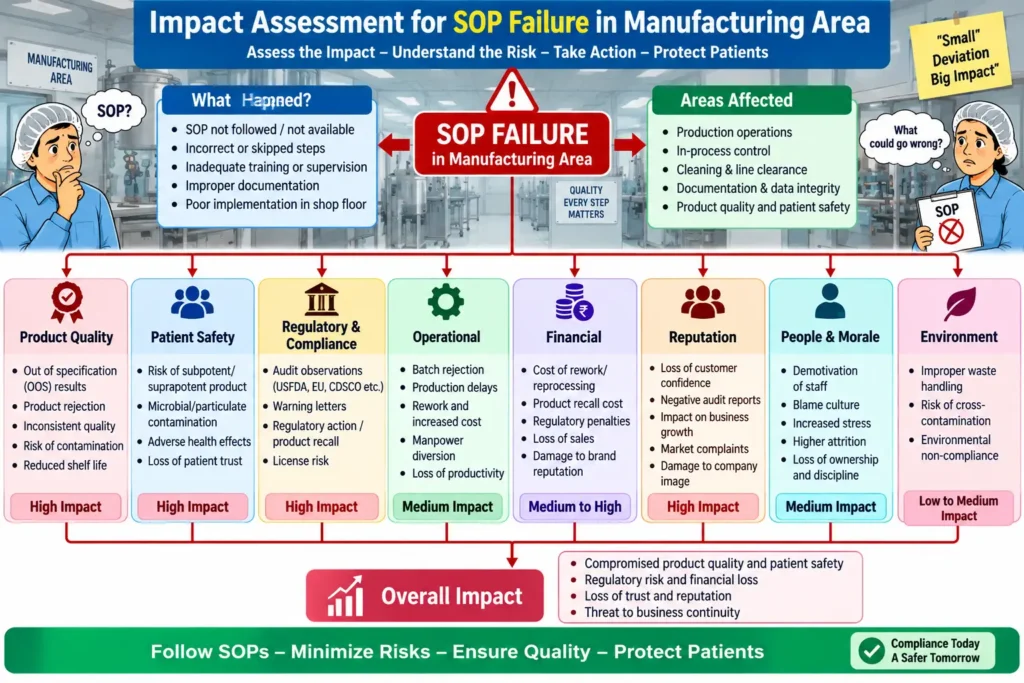
The impact can affect several areas, including product quality, patient safety, regulatory compliance, production activities, financial performance, company reputation, employee morale, and the manufacturing environment. For example, SOP failure may lead to OOS results, batch rejection, contamination, production delays, rework, audit observations, complaints, and additional costs. In serious cases, product quality and patient safety may also be affected. The diagram shows that even a small SOP failure can create a much bigger problem if it is not identified and controlled in time. In simple words, impact assessment helps the company understand how serious an SOP failure may be, what areas can be affected, and where immediate corrective and preventive actions are required.
Questions & Answers:
1. What is CAPA?
CAPA means Corrective and Preventive Action. It is a system used to correct an existing problem and prevent the same or similar problem from happening again.
2. Why is CAPA important in pharmaceutical manufacturing?
CAPA helps control quality problems, identify their causes, implement suitable actions, and verify that the actions are effective before closure.
3. From which activities can a CAPA be initiated?
CAPA may arise from deviations, change controls, laboratory deviations, OOS results, market complaints, document reviews, APQR, audits, and regulatory recommendations.
4. What is corrective action?
Corrective action is taken to address an existing non-conformance. It may include an immediate remedial action followed by investigation of the root cause.
5. What is preventive action?
Preventive action is taken to reduce the possibility of future problems. It can include risk assessment, training, improvement of systems, and other planned actions.
6. Who is responsible for implementing CAPA?
The concerned department is responsible for implementing the CAPA, while QA is responsible for issuing, tracking, reviewing, following up, and closing it.
7. Why is root cause analysis required?
Root cause analysis helps identify the actual reason behind a non-conformance so that the action taken addresses the real problem instead of only the symptom.
8. What happens if an SOP is not followed in the manufacturing area?
It can lead to deviations, documentation errors, process problems, repeated failures, product quality concerns, and the need for investigation and CAPA.
9. Why should CAPA effectiveness be checked?
Effectiveness review confirms whether the corrective and preventive actions were properly implemented and whether they successfully controlled the problem.
10. What happens if CAPA is not effective?
An ineffective CAPA remains open and requires further follow-up and action until effective implementation and closure are achieved.
11. Why is documentation important in CAPA?
Documentation provides traceability of the problem, investigation, actions, responsibilities, target dates, implementation, review, and closure. The SOP requires CAPA details to be recorded in the CAPA log and CAPA form.
12. Who finally closes the CAPA?
After confirming that the CAPA plan has been effectively implemented, the Head QA reviews and closes the CAPA.
13. What is the main benefit of following the CAPA SOP?
It helps the organization solve problems systematically, prevent recurrence, improve the quality system, maintain compliance, and protect product quality.
14. Can a CAPA target date be extended?
Yes. If the CAPA cannot be completed within the original target date, an extension may be approved with proper justification and review.
15. What is the simple CAPA sequence?
The SOP flow is: CAPA initiation → numbering → description of situation → root cause → corrective action → impact analysis → preventive action → impact analysis → approval → review and closure.
Reference Guidelines:
- WHO Technical Report Series (TRS) No. 908, Annex 4 – Good Manufacturing Practices for Pharmaceutical Products: Main Principles. This provides the GMP framework supporting investigation, corrective actions, preventive actions, documentation, and quality-system improvement.
- PIC/S Guide to Good Manufacturing Practice for Medicinal Products – PE 009-09 – Provides GMP expectations for pharmaceutical quality systems, investigation of quality failures, implementation of corrective and preventive measures, and follow-up of quality issues.