




1. Introduction:
The Development of New Formulations is a controlled pharmaceutical process used to ensure that any new product formulation, modification to an existing formulation, or significant change in raw-material source is properly planned, manufactured, evaluated, and documented before routine manufacturing. The SOP defines the procedure for developing new formulations intended for manufacturing in the Production Department. A new formulation activity may be initiated when a completely new formulation is proposed, an existing product formulation is changed, or the vendor of an active ingredient or important excipient is changed. The formulation is planned by Production in consultation with Quality Control (QC) and is subsequently reviewed and authorized by Quality Assurance (QA) and the Plant Head. During development, raw materials are issued according to the approved Batch Manufacturing Record (BMR). The development batch is manufactured using suitable equipment while following relevant SOPs, and important manufacturing process parameters are recorded in the BMR. Where required, a validation study is performed to evaluate changes in the formulation or manufacturing process.A portion of the manufactured batch may be packed according to approved packing specifications and placed on accelerated stability study for three months, while material may also be retained for further quality review or reference. Stability results are reviewed and summarized in a formal report. Any remaining material that is no longer required is destroyed only after appropriate authorization and documentation. Overall, this SOP provides a systematic approach for developing new formulations while maintaining product quality, process control, traceability, and proper authorization throughout the development process.
Skip to PDF content2. Flow Diagram:
This flow diagram explains the development of a new pharmaceutical formulation in simple steps. The process starts when a new product is proposed, an existing formulation is changed, or there is an important change in the vendor of an active ingredient or excipient. Production prepares the formulation plan in consultation with QC, and the plan is then approved by QA and the Plant Head.After approval, the required raw materials are issued according to the approved Batch Manufacturing Record (BMR). The development batch is manufactured using suitable equipment, relevant SOPs are followed, and important process parameters are recorded in the BMR. If required, a validation study is also performed.
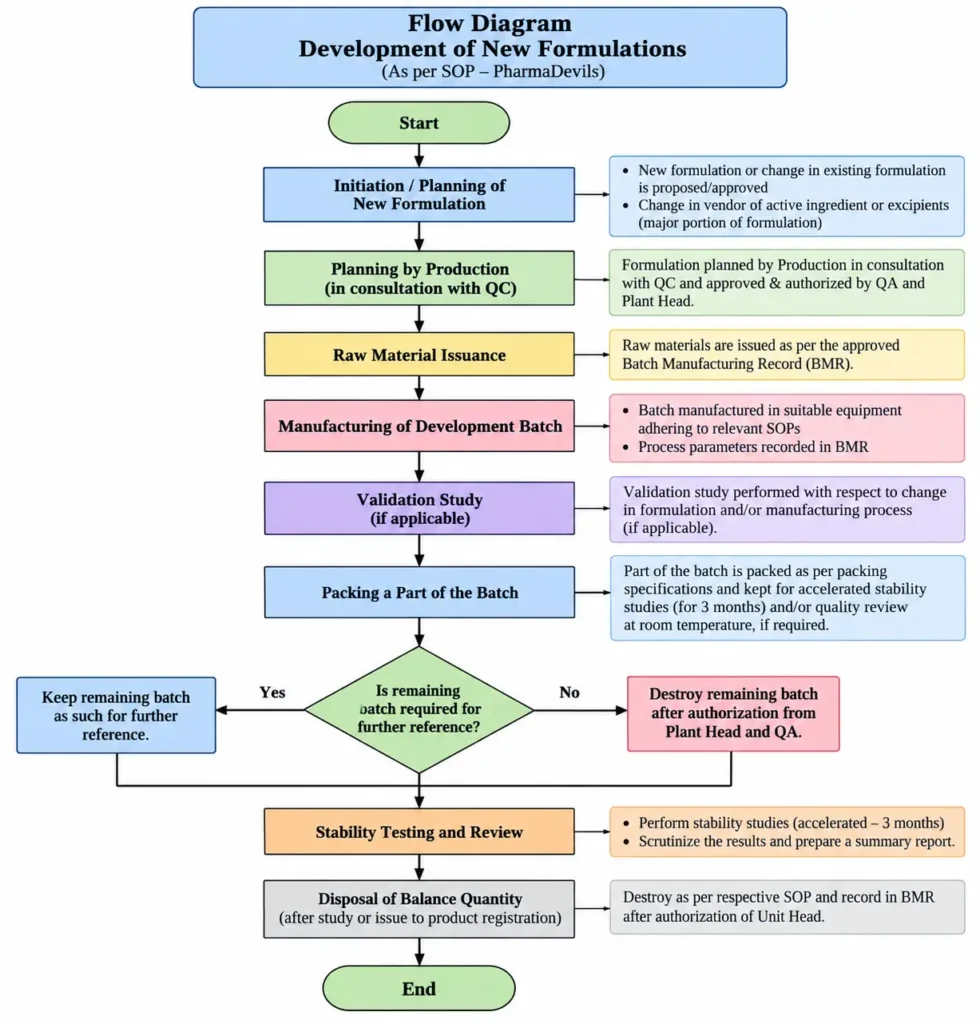
A portion of the batch is packed and kept for accelerated stability testing for three months. The remaining material may be kept for future reference or destroyed after authorization. Finally, stability results are reviewed and summarized in a report, and any balance quantity is disposed of according to the applicable SOP with proper approval and documentation.
3. Benefits of Following SOP:
Following an SOP in the pharmaceutical core area helps employees perform every activity in a safe, clean, controlled, and consistent manner. It gives clear instructions for operating equipment, handling materials, recording activities, and maintaining the required manufacturing conditions. Proper SOP compliance helps to maintain cleanliness and reduce contamination risk. It also prevents product mix-ups and ensures that equipment is operated correctly and safely. When all operators follow the same approved procedure, the chances of mistakes and process variation are reduced. Following the SOP also supports GMP compliance, improves product quality, and ensures that each activity is properly documented. Complete and accurate records make it easier to trace what was done, when it was done, and by whom.
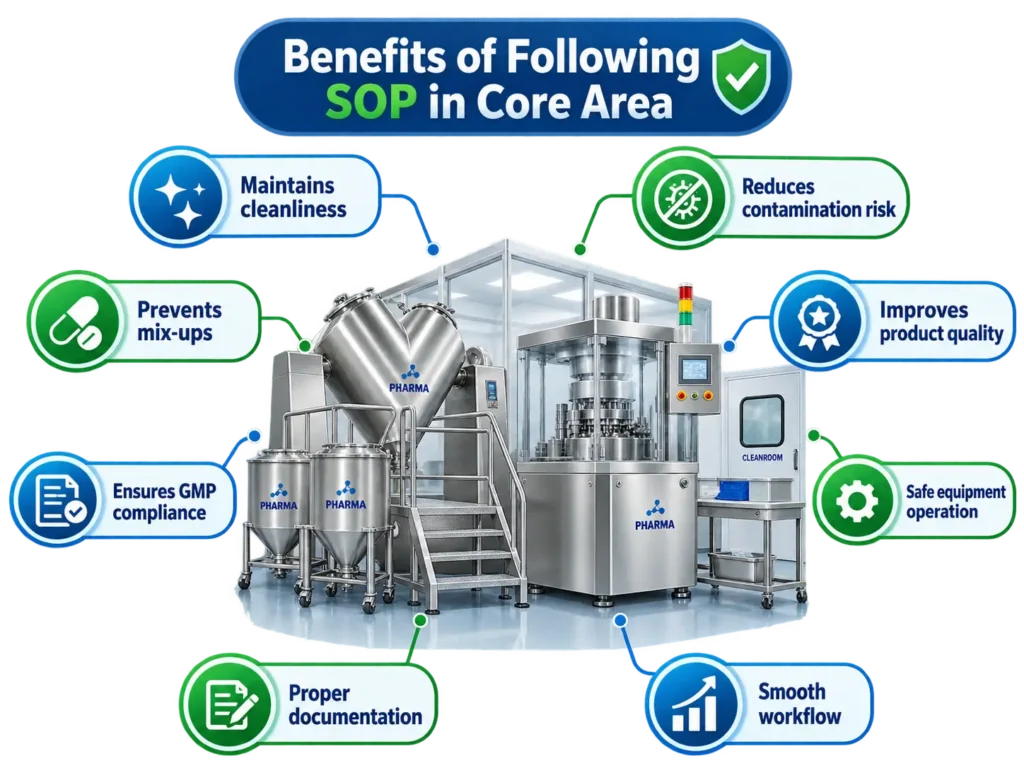
Overall, SOP compliance helps maintain a smooth workflow, safe equipment operation, proper documentation, better product quality, and controlled pharmaceutical manufacturing, which ultimately protects both the product and the patient.
4. Brainstorming for SOP Failure:
This brainstorming diagram shows the possible reasons why an SOP may not be followed properly in a pharmaceutical manufacturing area. The main purpose is to collect different ideas before starting a detailed root cause investigation. Possible causes include inadequate training, lack of awareness, SOP not available at the point of use, unclear instructions, documentation errors, improper line clearance, poor supervision, communication gaps, equipment problems, time pressure, and failure to report deviations. Non-compliance with gowning or cleaning procedures can also lead to SOP failure.
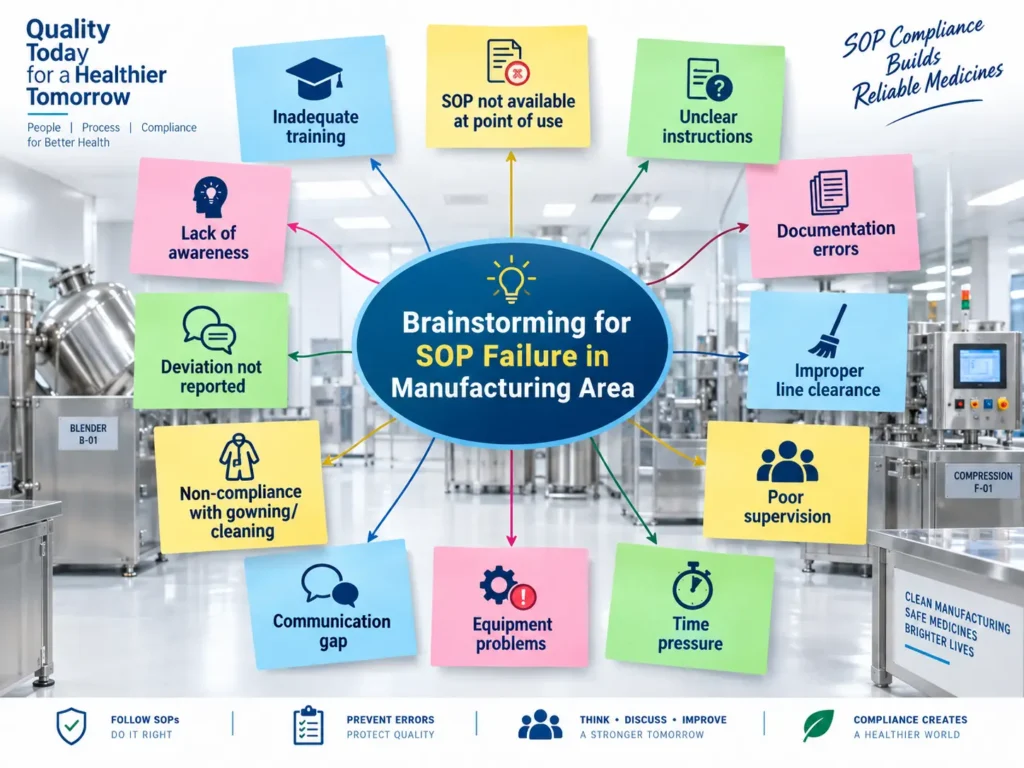
Brainstorming helps the QA and Production teams discuss all possible causes without immediately blaming any individual. Each cause can then be reviewed with supporting evidence to identify the actual root cause. Proper investigation and corrective actions can improve SOP compliance, employee understanding, documentation, equipment handling, product quality, and GMP compliance, while reducing the risk of errors, mix-ups, contamination, and repeated deviations.
5. 5 Why Analysis for SOP Failure:
The 5 Why Analysis is a simple method used to find the real reason behind an SOP failure in the manufacturing area. Instead of stopping at the first mistake, the team keeps asking “Why did this happen?” until the root cause is identified. In this example, the SOP was not followed because the operator was not fully aware of the correct procedure. The next question shows that proper training was not provided. Further analysis indicates that the training plan was not effectively implemented, management follow-up was weak, and responsibilities for training and SOP compliance were not clearly defined.
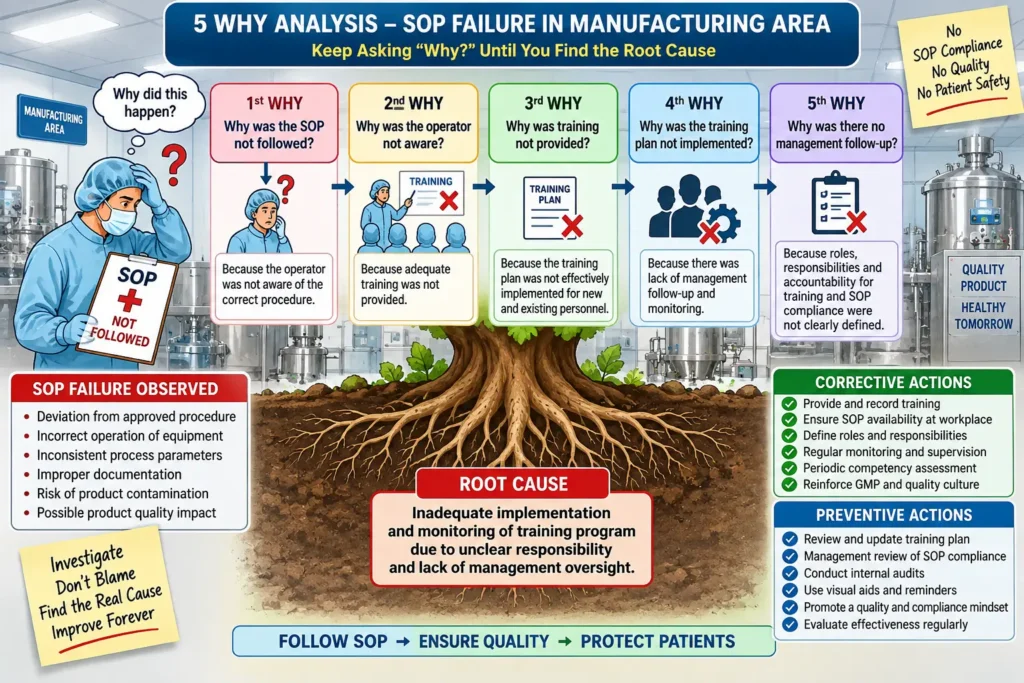
The analysis shows that the main problem is not only the operator’s mistake, but also weaknesses in training, supervision, responsibility, and monitoring. After identifying the root cause, corrective and preventive actions can be taken, such as proper training, clear responsibilities, regular supervision, competency checks, SOP availability, and periodic compliance review. This helps prevent repeat failures and supports product quality, GMP compliance, and patient safety.
6. Fishbone Analysis for SOP Failure:
The Fishbone Analysis shows the possible reasons why an SOP may fail in a pharmaceutical manufacturing area, especially under poor or uncontrolled conditions. It groups the causes into major categories so the investigation team can understand the problem clearly. Under Man, possible causes include inadequate training, lack of awareness, poor supervision, and negligence. Under Method, causes may include SOPs not being available, unclear instructions, procedures not being followed, and improper line clearance. Machine-related causes include equipment malfunction, poor maintenance, unclean equipment, or breakdown during operation.
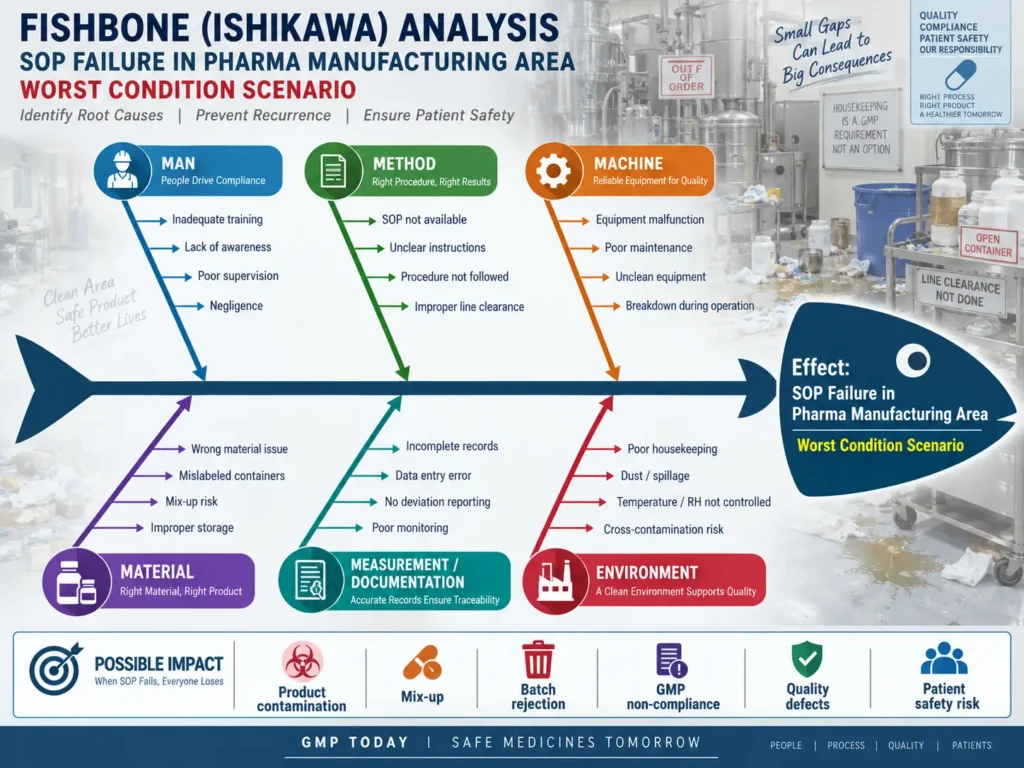
The analysis also considers Material issues such as wrong material issuance, mislabeled containers, mix-up risk, and improper storage. Measurement and Documentation problems may include incomplete records, data-entry errors, poor monitoring, and failure to report deviations. Environment problems can include poor housekeeping, dust or spillage, uncontrolled temperature or humidity, and cross-contamination risk. These failures can lead to product contamination, mix-ups, batch rejection, GMP non-compliance, quality defects, and patient safety risks. The Fishbone Analysis helps identify all possible causes so the actual root cause can be investigated and controlled.
7. Fault Tree Analysis for SOP Failure:
The Fault Tree Analysis (FTA) diagram shows how different problems can lead to SOP failure in a pharmaceutical manufacturing area. The main event is “SOP not followed,” and the causes are divided into three major groups: People-related failure, Process/System-related failure, and Equipment/Facility-related failure. People-related causes include lack of training, poor awareness, negligence, distraction, or heavy workload. Process-related causes include SOP not being available, unclear instructions, weak supervision, poor deviation handling, and improper change control. Equipment and facility causes include machine malfunction, poor maintenance, poor housekeeping, unsuitable environmental conditions, wrong material issuance, and mix-up or mislabeling.
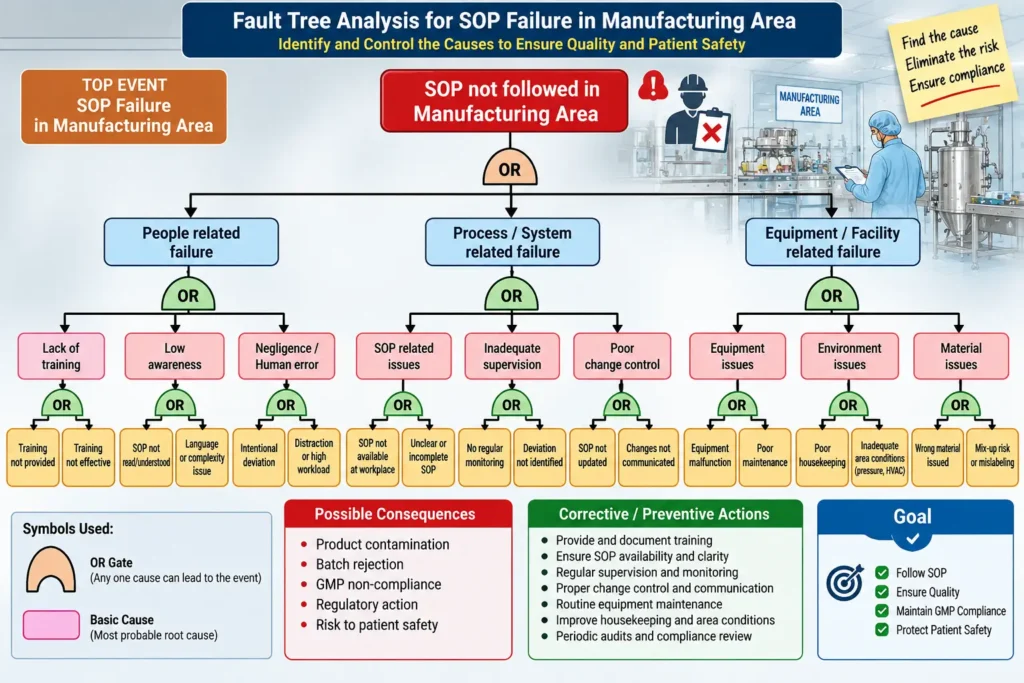
The diagram also shows possible consequences such as product contamination, batch rejection, GMP non-compliance, regulatory action, and risk to patient safety.To prevent recurrence, the company should provide proper training, ensure clear SOPs, improve supervision, maintain equipment, strengthen change control, improve housekeeping, and conduct regular audits.
8. Impact Assessment of SOP Failure:
The impact assessment explains what can happen when an SOP is not followed properly in a pharmaceutical manufacturing area. SOP failure can affect people, product quality, process, compliance, cost, facility, and company reputation. Employees may perform activities incorrectly, make more mistakes, or require retraining. The product may face contamination, mix-up, out-of-specification results, reduced quality, or even batch rejection.
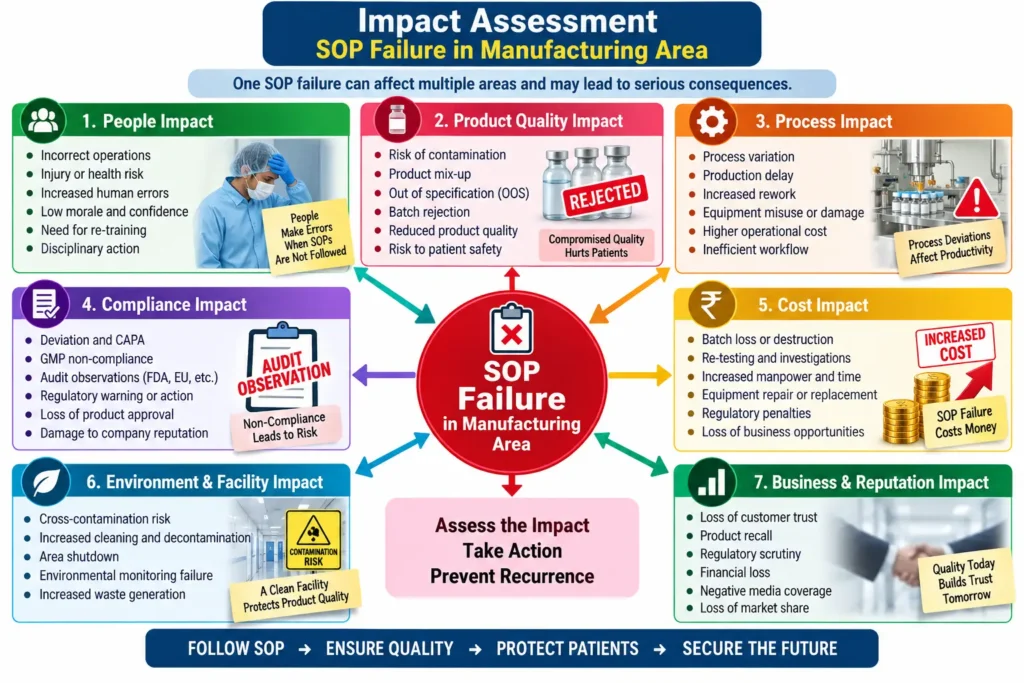
The manufacturing process may also be disturbed, causing delays, rework, equipment misuse, and higher operating costs. From a compliance point of view, SOP failure can lead to deviations, CAPA, audit observations, GMP non-compliance, and regulatory action. Poor SOP compliance may also increase cleaning requirements, cross-contamination risk, waste generation, and even area shutdown. In serious cases, it can result in product recall, financial loss, and loss of customer trust. Therefore, every SOP failure should be properly assessed, investigated, corrected, and prevented from happening again.
Questions & Answers:
1. What is the objective of the SOP?
The objective is to define the procedure for the development of new formulations for manufacturing.
2. Where is this SOP applicable?
It is applicable to the development of new formulations manufactured in the Production Department.
3. Who is responsible for executing this SOP?
The QA person is responsible for execution of the SOP.
4. Who is responsible for effective implementation of the SOP?
The Assistant Manager and Head-QA/QC are responsible for effective implementation.
5. When should a new formulation be planned?
It should be planned when a new formulation is proposed, an existing formulation is changed, or the vendor of an active ingredient or major excipient is changed.
6. Who plans and approves a new formulation?
Production plans the formulation in consultation with QC, and it is approved and authorized by QA and the Plant Head.
7. How are raw materials issued for the development batch?
Raw materials are issued according to the approved Batch Manufacturing Record (BMR).
8. How should the development batch be manufactured?
The batch should be manufactured using suitable equipment, following relevant SOPs, and process parameters should be recorded in the BMR.
9. Is validation required during formulation development?
Yes, a validation study is performed for changes in formulation or manufacturing process when applicable.
10. What happens to a portion of the development batch?
A part of the batch is packed as per packing specifications and kept for accelerated stability studies for three months and, if required, quality review at room temperature.
11. What happens to the remaining part of the batch?
It may be kept for further reference. If it is not required, it can be destroyed after authorization from the Plant Head and QA.
12. What is done with stability test results?
The stability test results are reviewed and summarized in a report.
13. How should the balance quantity be destroyed after the study?
It should be destroyed according to the respective SOP and recorded in the BMR after authorization from the Unit Head.
14. What does BMR stand for?
BMR stands for Batch Manufacturing Record.
15. Why is this SOP important?
It provides a controlled process for planning, manufacturing, validating, stability testing, reviewing, and disposing of development batches so that formulation-development activities remain properly documented and authorized.
Reference Guidelines:
- ICH Q8(R2) – Pharmaceutical Development: Primary reference for formulation development, selection of drug substance/excipients, formulation optimization, manufacturing-process development, CQAs and CPPs. (ICH Database) ICH Q8(R2) – Pharmaceutical Development
- ICH Q9(R1) – Quality Risk Management: Applicable for risk assessment during formulation, material, process, equipment and supplier-related changes. (ICH Database) ICH Q9(R1) – Quality Risk Management
- ICH Q10 – Pharmaceutical Quality System: Provides the lifecycle pharmaceutical quality-system framework supporting development, knowledge management, change management and continual improvement. (ICH Database) ICH Q10 – Pharmaceutical Quality System
- ICH Q1A(R2) – Stability Testing of New Drug Substances and Products: Relevant to stability planning and evaluation of development/formulation batches. (ICH Database) ICH Q1A(R2) – Stability Testing
- WHO TRS 1044, Annex 6 – Good Practices for Research and Development Facilities of Pharmaceutical Products: Useful for GMP-based controls within pharmaceutical R&D and development activities. (World Health Organization)
- WHO TRS 1019, Annex 3 – GMP: Guidelines on Validation: Relevant where a formulation or manufacturing-process change requires validation. WHO recommends a risk-based, lifecycle approach to validation. (World Health Organization) WHO GMP Guidelines on Validation
- Revised Schedule M, Drugs Rules, 1945 – India: Requires a documented Pharmaceutical Quality System incorporating GMP and Quality Risk Management and is directly relevant for Indian pharmaceutical manufacturers. (CDSCO) CDSCO Revised Schedule M
- US FDA – Process Validation: General Principles and Practices: Useful when development leads to establishment or modification of a commercial manufacturing process requiring process validation. (U.S. Food and Drug Administration) FDA Process Validation Guidance