





1. Introduction:
Deviation handling is an important part of the pharmaceutical quality system used to manage any departure from an approved procedure, specification, process, instruction, or GMP requirement. A deviation may occur during manufacturing, packing, testing, maintenance, documentation, equipment operation, utilities, or other pharmaceutical activities. The purpose of this SOP is to provide a systematic method for identifying, reporting, investigating, approving, closing, and trending deviations. A deviation may be planned or unplanned. Planned deviations are approved in advance for a specific activity or limited period, whereas unplanned deviations occur unexpectedly when an approved requirement, SOP, batch record, work instruction, or standard is not followed. Whenever a deviation occurs, the concerned department should take appropriate immediate action and inform Quality Assurance. The possible effect on product quality, patient safety, process performance, equipment, documentation, and GMP compliance should be evaluated. Depending on its impact, the deviation may be classified as Minor, Major, or Critical. A proper investigation helps identify the root cause of the problem and determine suitable Corrective and Preventive Actions (CAPA). The effectiveness of these actions should also be verified to prevent recurrence. Regular tracking and trending of deviations helps management identify repeated problems, improve processes, strengthen the quality system, and maintain continuous compliance with GMP requirements.
Skip to PDF content2. Flow Diagram:
The flow diagram explains how a deviation should be handled in a pharmaceutical company in a simple step-by-step manner. First, any deviation from an approved SOP, process, specification, batch record, or GMP requirement is identified and recorded. The concerned department then takes immediate action to control the situation and reduce any possible impact.
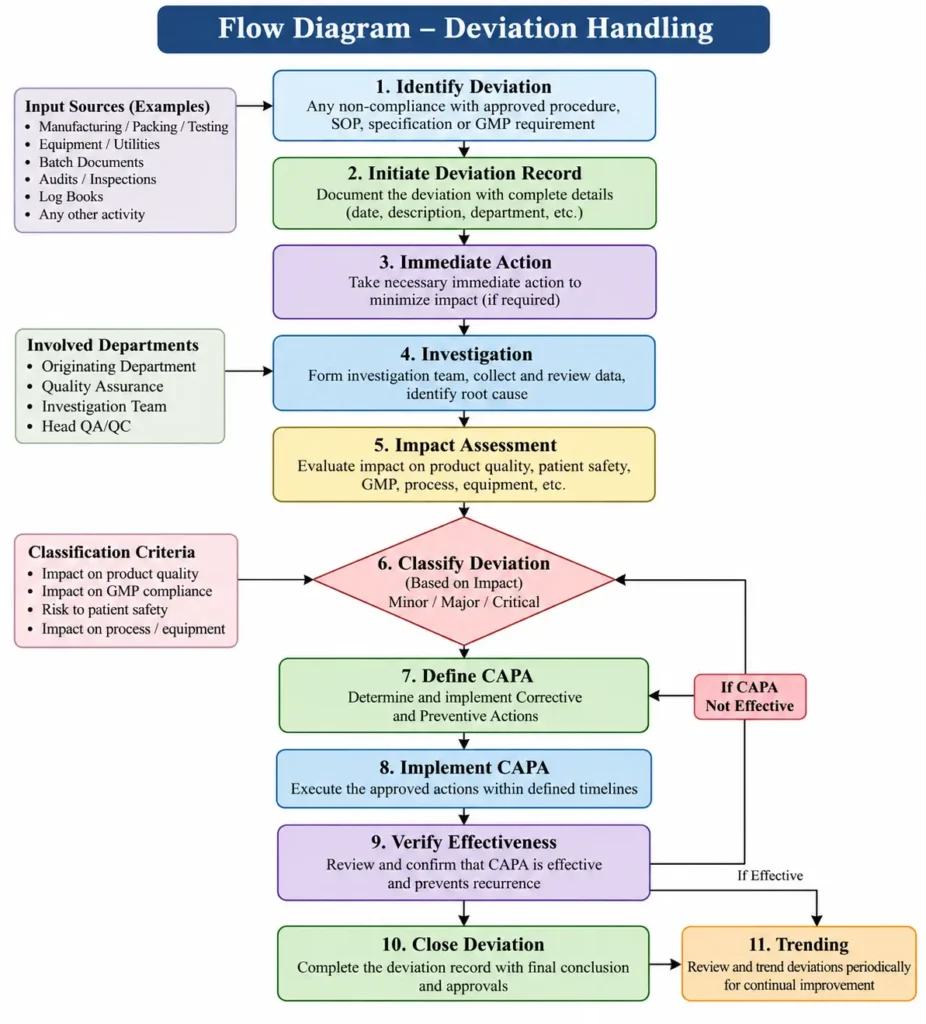
After this, an investigation is performed to find the actual root cause of the deviation. The possible impact on product quality, GMP compliance, process, equipment, and patient safety is evaluated. Based on this impact, the deviation is classified as Minor, Major, or Critical.Suitable Corrective and Preventive Actions (CAPA) are then decided and implemented. Their effectiveness is checked to confirm that the same problem will not happen again. If the CAPA is effective, the deviation is closed with proper documentation and approval. Finally, deviations are periodically reviewed and trended to identify repeated problems and support continuous improvement.
3. Benefits of Following SOP:
Following the Deviation Handling SOP helps a pharmaceutical company manage unexpected problems in a controlled and systematic way. It ensures that every deviation is properly reported, investigated, evaluated, and documented. This supports GMP compliance and helps maintain consistent product quality. Proper SOP compliance also helps identify the root cause of a problem so that suitable Corrective and Preventive Actions (CAPA) can be implemented. This reduces the chance of the same deviation happening again. The process also evaluates possible effects on product quality, manufacturing processes, equipment, documentation, and regulatory compliance.
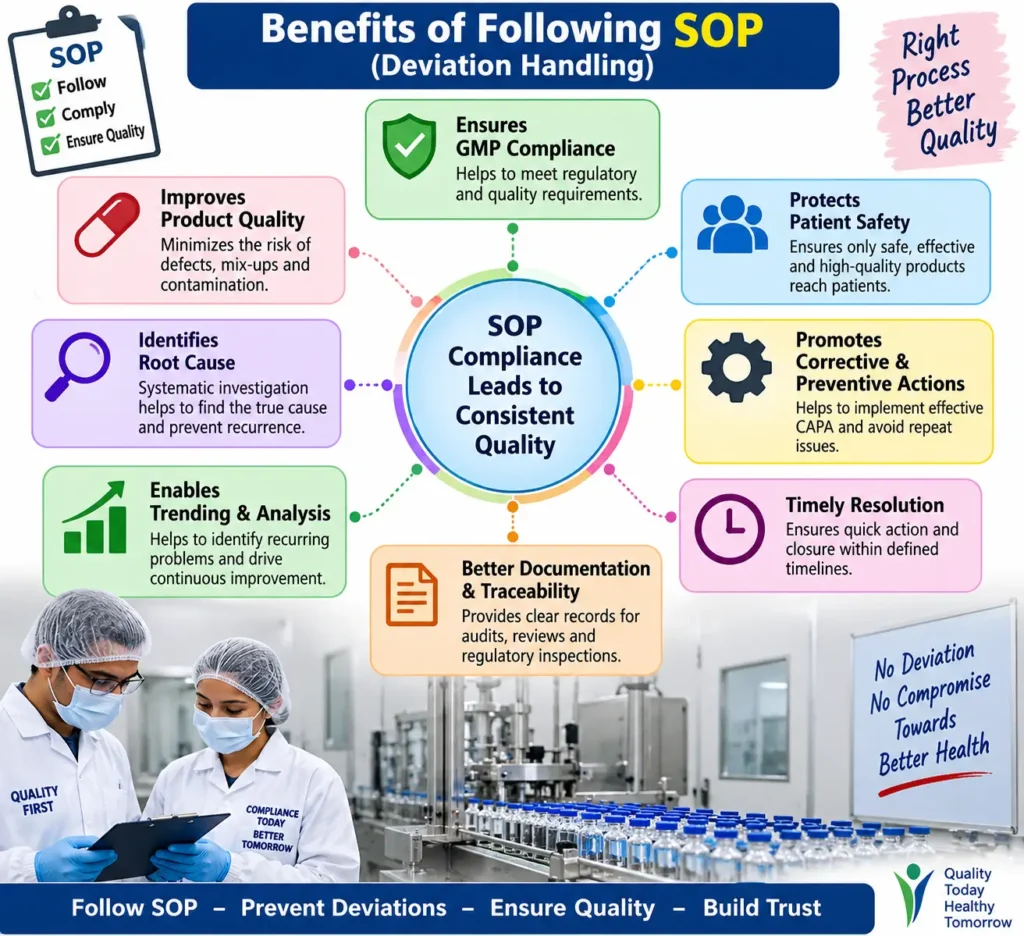
Following the SOP improves patient safety, traceability, timely decision-making, and audit readiness. Periodic review and trending of deviations can highlight repeated problems and areas requiring improvement. In simple words, proper deviation handling means better control, fewer repeated mistakes, stronger compliance, safer products, and continuous improvement in the pharmaceutical quality system.
4. Brainstorming for SOP Failure:
This brainstorming diagram shows the possible reasons why the Deviation Handling SOP may not be followed properly. The purpose of brainstorming is to collect different ideas from the team before deciding the actual root cause. Common reasons may include lack of training, poor understanding of the SOP, unclear procedures, time pressure, fear of blame, poor communication, insufficient resources, weak supervision, incomplete documentation, lack of ownership, low risk awareness, and poor CAPA follow-up.
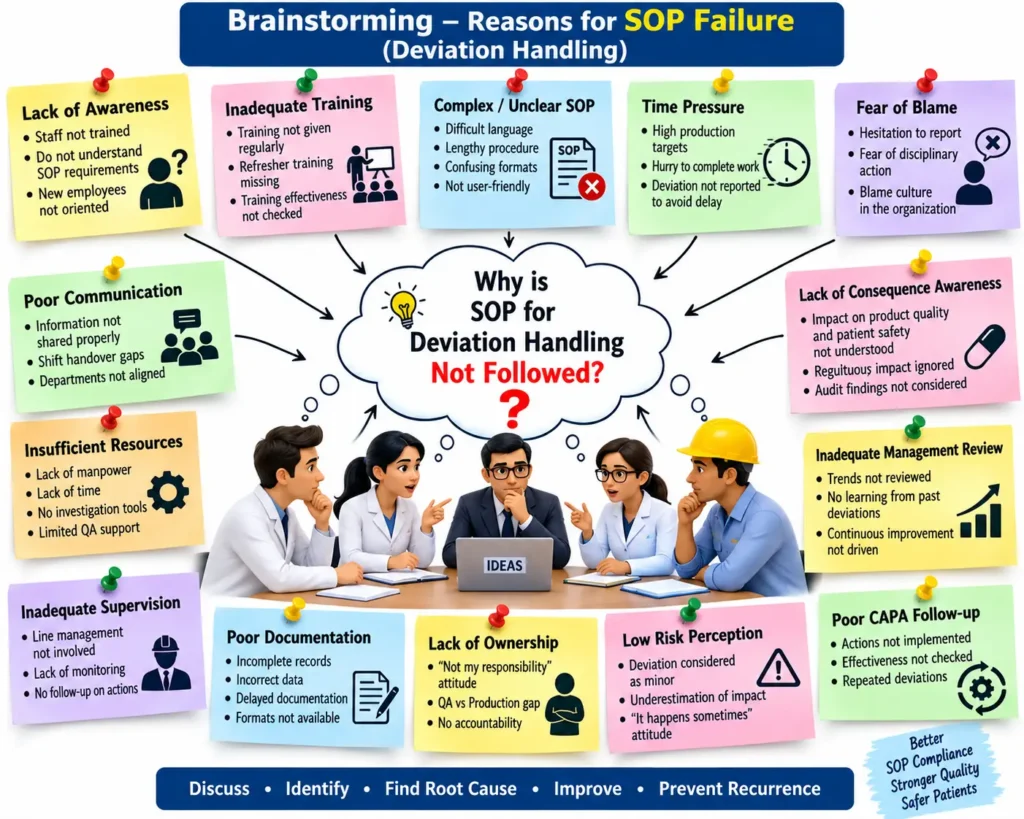
The team should discuss each possible reason and check it with facts and records. For example, they may review training records, deviation forms, shift handover details, investigation reports, and previous CAPA effectiveness. This process helps the team understand where the system is failing. After identifying the most likely causes, suitable corrective and preventive actions can be planned. In simple words, brainstorming helps find possible causes, improve SOP compliance, prevent repeated deviations, and protect product quality and patient safety.
5. 5-Why Analysis for SOP Failure:
The 5-Why Analysis helps find the real reason why the Deviation Handling SOP was not followed. Instead of stopping at the first reason, the team repeatedly asks “Why?” until the main cause becomes clear. In this example, the SOP was not followed because the employee did not follow the required procedure. Further questioning showed that the employee was not properly trained and did not fully understand the SOP. The training problem occurred because refresher training was not planned or effectively conducted. This was linked to weak training planning, poor supervisory follow-up, and insufficient management monitoring.
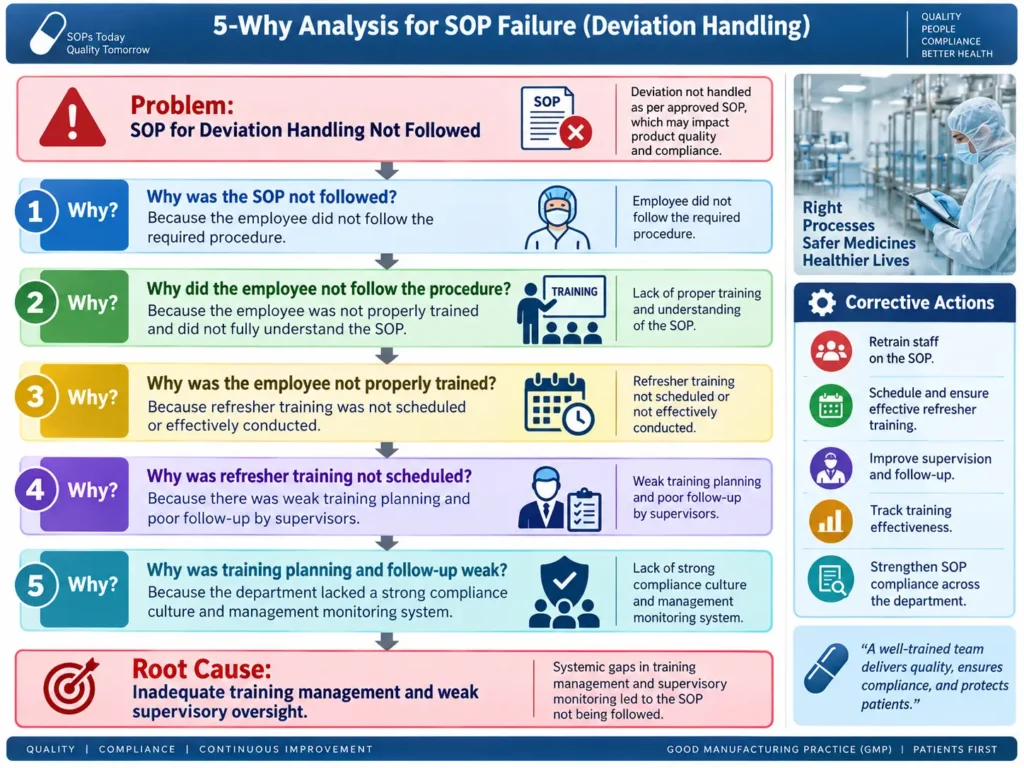
The analysis finally points to a possible root cause: inadequate training management and weak supervision. Based on this finding, the company should retrain employees, schedule regular refresher training, check training effectiveness, strengthen supervision, and monitor SOP compliance. In simple words, 5-Why Analysis helps move from the visible problem to the actual root cause, so effective CAPA can be taken and the same failure can be prevented from happening again.
6. Fishbone Analysis for SOP Failure:
The Fishbone Analysis diagram is used to identify the possible reasons why the Deviation Handling SOP was not followed. It groups the causes into different categories so the investigation team can review the problem in a systematic way. Possible causes may come from people, procedures, equipment, materials, measurement, work environment, management, or external factors. For example, the failure may be related to inadequate training, unclear SOP instructions, equipment problems, poor documentation, lack of supervision, high workload, weak monitoring, or communication gaps.
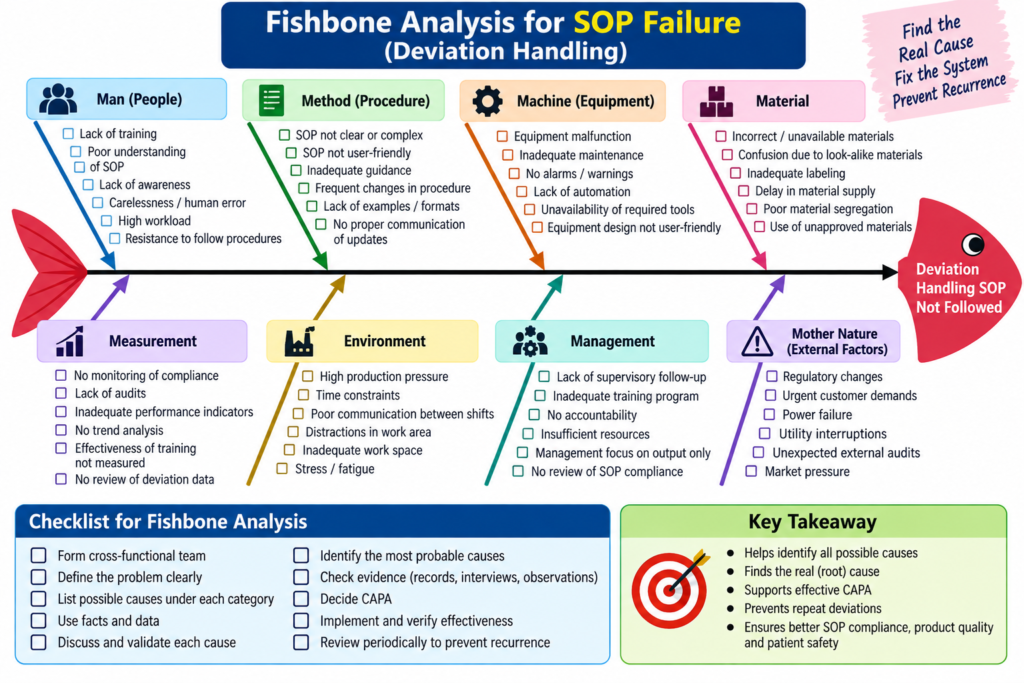
The checklist shown in the diagram helps the team review each possible cause using facts, records, observations, and discussion. The team should not assume that the first identified cause is the actual root cause. Each cause should be verified with evidence. In simple words, Fishbone Analysis helps the team look at the problem from all directions, identify the most probable root cause, plan suitable CAPA, and prevent the same SOP failure from happening again.
7. Fault Tree Analysis for SOP Failure:
The Fault Tree Analysis diagram shows how different problems can lead to failure in following the Deviation Handling SOP. The main problem is placed at the top, and possible causes are divided into different branches. The causes may be related to people, SOP or process, system/resources, and external factors. Examples include lack of training, low awareness, human error, unclear or outdated SOPs, poor communication, insufficient resources, high workload, weak supervision, regulatory changes, urgent demands, and unexpected events.
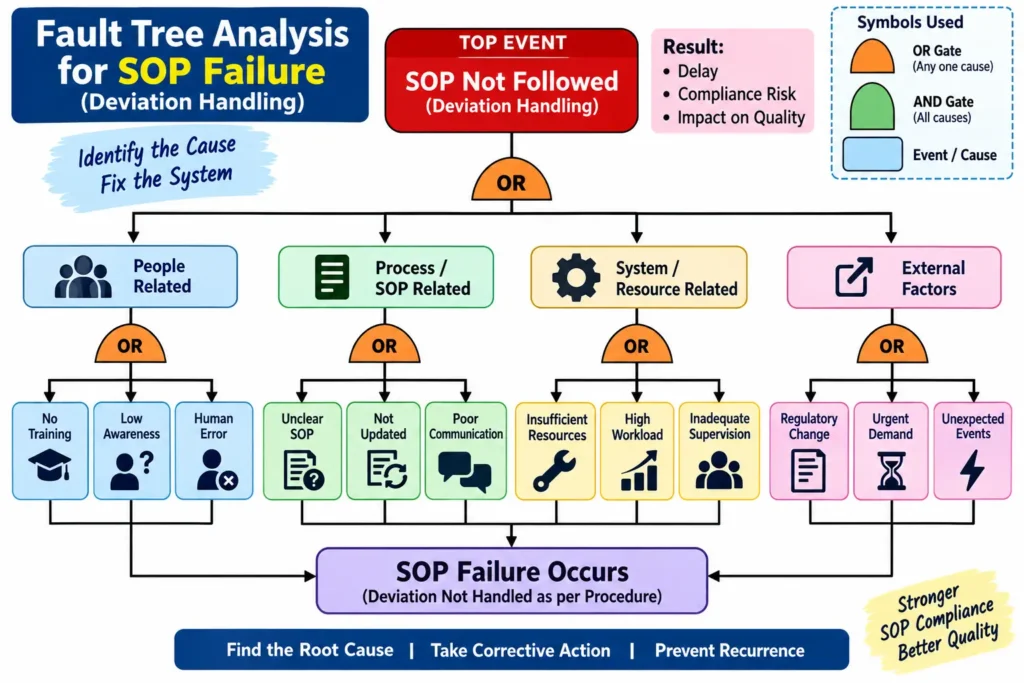
The OR gate means that even one of these causes may contribute to SOP failure. By reviewing each branch, the investigation team can identify the most likely cause and verify it with evidence. In simple words, Fault Tree Analysis helps the team understand how and why the SOP failed, identify the root cause, take suitable corrective action, and prevent the same deviation from happening again.
8. Impact Assessment:
The impact assessment diagram explains what may happen when the Deviation Handling SOP is not followed properly. Failure to report, investigate, assess, and close a deviation can affect several important areas of the pharmaceutical quality system. The most important impact is on product quality and patient safety. An uninvestigated deviation may allow a quality problem to remain unnoticed and, in serious cases, may lead to batch rejection, recall, reduced product performance, or risk to the patient. The SOP itself requires evaluation of product-quality and GMP impact before final decisions are taken.
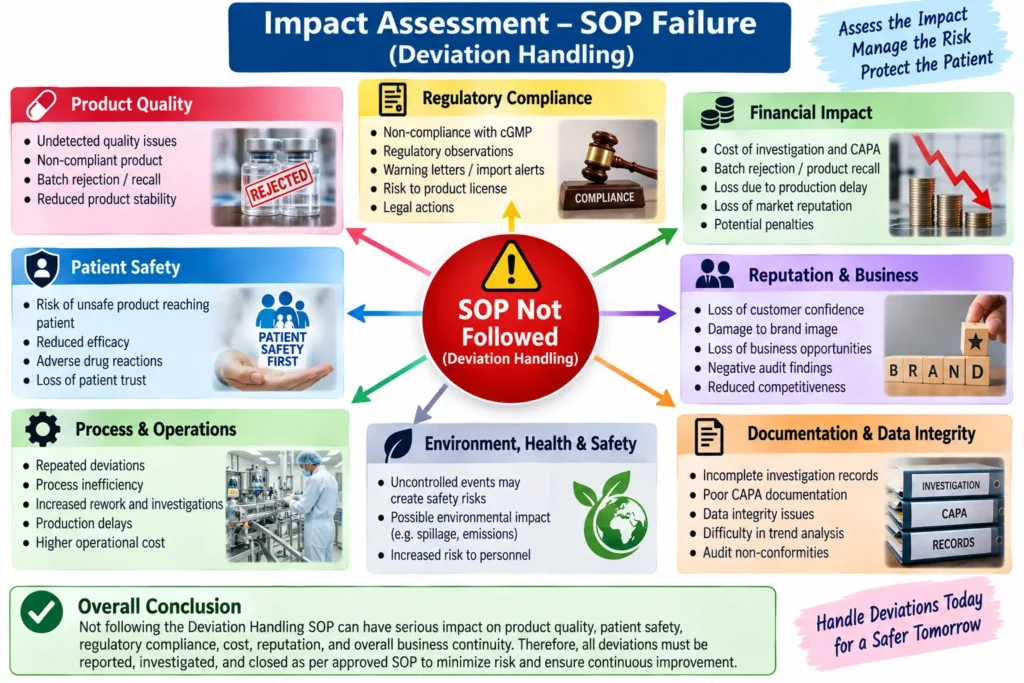
SOP failure can also lead to regulatory non-compliance, repeated deviations, production delays, additional investigations, increased cost, poor documentation, and data-integrity concerns. It may also create negative audit observations and reduce customer confidence. In simple words, impact assessment helps determine how serious the SOP failure is and what areas may be affected. Based on this assessment, the deviation can be properly classified, suitable CAPA can be implemented, and further risk can be controlled.
Questions & Answers:
Q1. What is a deviation?
A deviation is any non-compliance with an established GMP standard or approved requirement such as an SOP, STP, batch record, or work instruction.
Q2. What are the main types of deviation?
Deviations are mainly classified as Planned Deviation and Unplanned Deviation.
Q3. What is a planned deviation?
A planned deviation is a pre-approved temporary departure from an approved procedure for a particular activity, batch, or limited number of batches.
Q4. What is an unplanned deviation?
An unplanned deviation is an unintentional departure from an approved procedure, standard, batch record, work instruction, or other established requirement.
Q5. How are deviations classified according to severity?
Based on GMP impact and product-quality impact, deviations are categorized as Minor, Major, or Critical.
Q6. What is a minor deviation?
A minor deviation is one that does not affect a quality attribute, critical process parameter, or critical equipment/instrument.
Q7. What is a major deviation?
A major deviation affects a quality attribute, critical process parameter, or critical equipment/instrument, but significant impact to patients, personnel, or the environment is considered unlikely.
Q8. What is a critical deviation?
A critical deviation is one where the impact on patients, personnel, or the environment may be highly probable, including potentially life-threatening situations.
Q9. When should a deviation be reported?
The person observing the deviation should report it to the supervisor or concerned department head and inform Head Quality or the designee immediately, normally within 24 hours.
Q10. Who is responsible for initiating a deviation?
The originating department is responsible for initiating the deviation, taking immediate action, participating in the investigation, and implementing CAPA.
Q11. What should be done immediately after a deviation is observed?
The originating department should assess the situation, take suitable immediate action, decide whether the activity should be stopped or continued, and inform QA.
Q12. What is root cause analysis?
Root cause analysis is the process of identifying the actual factor responsible for the deviation using objective evidence.
Q13. Which investigation tools can be used for deviation investigation?
The SOP mentions tools such as Fishbone Analysis, Why-Why Analysis, Fault Tree Analysis, and FMEA for identifying causes and assessing failures.
Q14. What is CAPA in deviation handling?
CAPA means Corrective and Preventive Action. Corrective action addresses the cause of an existing problem to prevent recurrence, while preventive action addresses a potential cause to prevent occurrence.
Q15. Who decides the final batch disposition?
The investigation team may recommend whether the batch should be released, rejected, reworked, or quarantined, while the final disposition is documented and justified by Quality Assurance.
Q16. What happens if the same deviation occurs repeatedly?
Repeat deviations require further evaluation, including review of previous CAPA effectiveness and possible reclassification to a higher severity.
Q17. Why is deviation trending important?
Trending helps identify recurring problems, common root causes, and opportunities for continuous improvement. The SOP requires periodic trend analysis by QA.
Q18. What documents should be available before closing a deviation?
Applicable investigation reports, root-cause analysis, risk evaluation, CAPA records, and other supporting documents should be reviewed before QA closes the deviation.
Q19. Why is deviation handling important in pharmaceutical manufacturing?
It helps ensure that deviations are properly investigated, CAPA is implemented, recurring problems are tracked, and GMP compliance is maintained.
Q20. What is the main objective of the Deviation Handling SOP?
The main objective is to establish a consistent system for identification, investigation, approval, CAPA, follow-up, and trending of deviations occurring during manufacturing, packaging, or other activities.
Reference Guidelines:
- Schedule M – Good Manufacturing Practices and Requirements of Premises, Plant and Equipment for Pharmaceutical Products – applicable Indian GMP requirements for pharmaceutical manufacturing and quality systems.
- WHO Technical Report Series (TRS) No. 908, Annex 4 – WHO guidance supporting Good Manufacturing Practices and pharmaceutical quality-system requirements.
- EU Guidelines for Good Manufacturing Practice – Volume 4, Chapter 1: Pharmaceutical Quality System – provides requirements for quality-system management, investigation of deviations, CAPA, and continuous improvement.
- EU Guidelines for Good Manufacturing Practice – Volume 4, Chapter 4: Documentation – provides requirements for controlled GMP documentation, records, investigation documentation, and traceability.
- PIC/S Guide to Good Manufacturing Practice for Medicinal Products – Part I & Part II – provides GMP expectations applicable to pharmaceutical manufacturing, quality management, documentation, investigations, and related systems.