







1. Introduction:
Proper documentation is an essential part of the pharmaceutical Quality Management System because every important activity must be recorded, controlled, reviewed, and traceable. The SOP for Document Preparation, Issuance and Retrieval defines a systematic method for preparing, approving, issuing, retrieving, revising, and controlling cGMP documents used by different departments. Its purpose is to make sure that employees always use the correct and currently approved version of a document. Documents are prepared by the concerned department, reviewed by responsible department heads and Quality Assurance, and finally approved by the Head of Quality Assurance. Approved master documents are maintained under QA control, while controlled copies are issued to departments according to their requirements. An important requirement of this SOP is that the previous version of a document must be retrieved before a new version is issued. QA records the issuance and retrieval details in the appropriate document-control registers, helping prevent accidental use of obsolete documents. The procedure also covers important pharmaceutical records such as BMR/BPR, validation protocols and reports, qualification documents, specifications, SOPs, formats, and logbooks. Completed documents are reviewed and maintained by QA to provide proper documentation history and traceability. Following this SOP supports data integrity, document traceability, regulatory compliance, accountability, and effective cGMP implementation throughout pharmaceutical operations.
Skip to PDF content1. Flow Diagram:
The flow diagram explains the complete process of Document Preparation, Issuance and Retrieval in a simple step-by-step manner. The process starts when the concerned department prepares a document such as an SOP, format, BMR/BPR, specification, validation document, or qualification record. The draft is then circulated to the concerned department heads and Quality Assurance for review and comments. After satisfactory review, the document is approved by the QA Head, and the approved master copy is kept under the control of Quality Assurance.
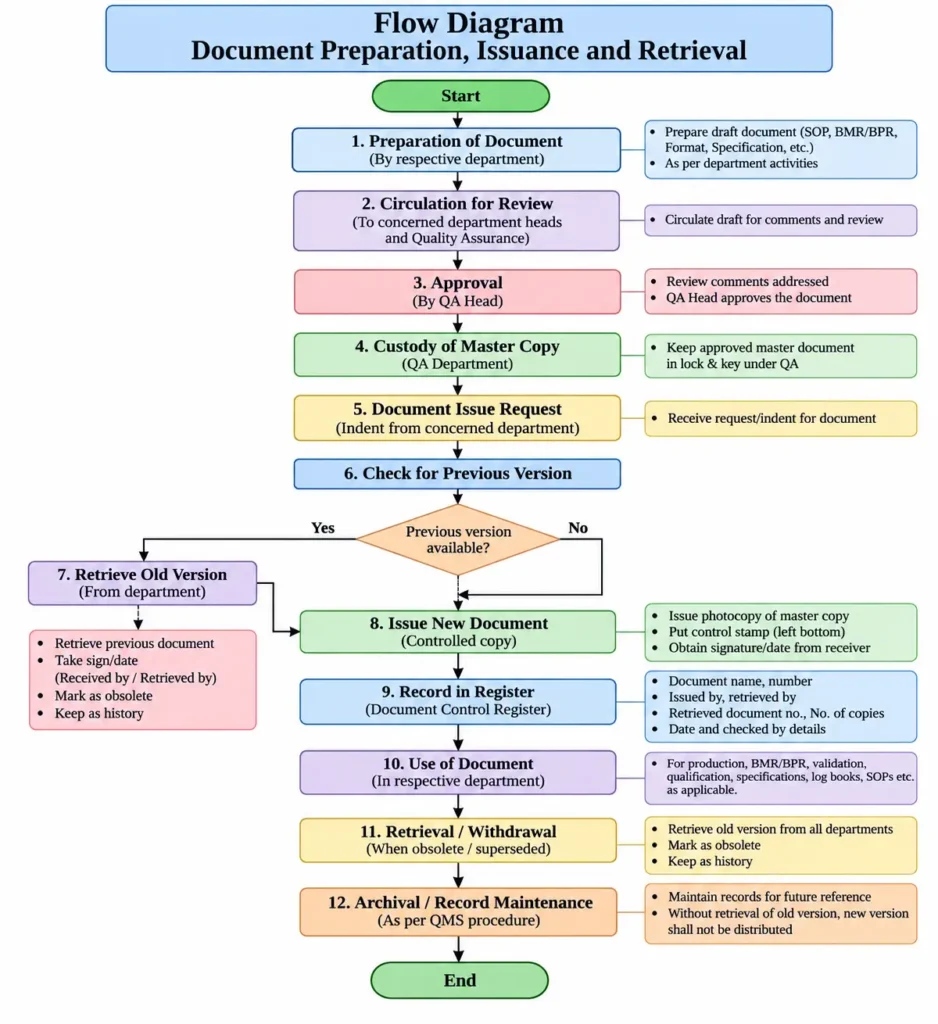
When a department requires a document, it raises a request or indent. Before issuing a new version, QA checks whether an older version is already available. If an old version exists, it must first be retrieved. The new controlled copy is then issued with proper signature, date, and document-control details.All issuance and retrieval activities are recorded in the appropriate registers. When documents become obsolete or are replaced, QA retrieves them from departments, marks previous copies as obsolete, and keeps them as historical records. The SOP clearly states that a new version should not be distributed until the old version has been retrieved.
3. Benefits of Following the SOP:
Following the SOP for Document Preparation, Issuance and Retrieval helps ensure that pharmaceutical documents are properly prepared, reviewed, approved, issued, used, retrieved, and maintained under controlled conditions. The SOP requires documents to be reviewed by concerned departments and Quality Assurance before approval, which supports consistent and authorized documentation. A major benefit is the prevention of outdated or obsolete documents being used in routine work. Before a new document is issued, the previous version must be retrieved, and issuance and retrieval details are recorded in the document-control register.
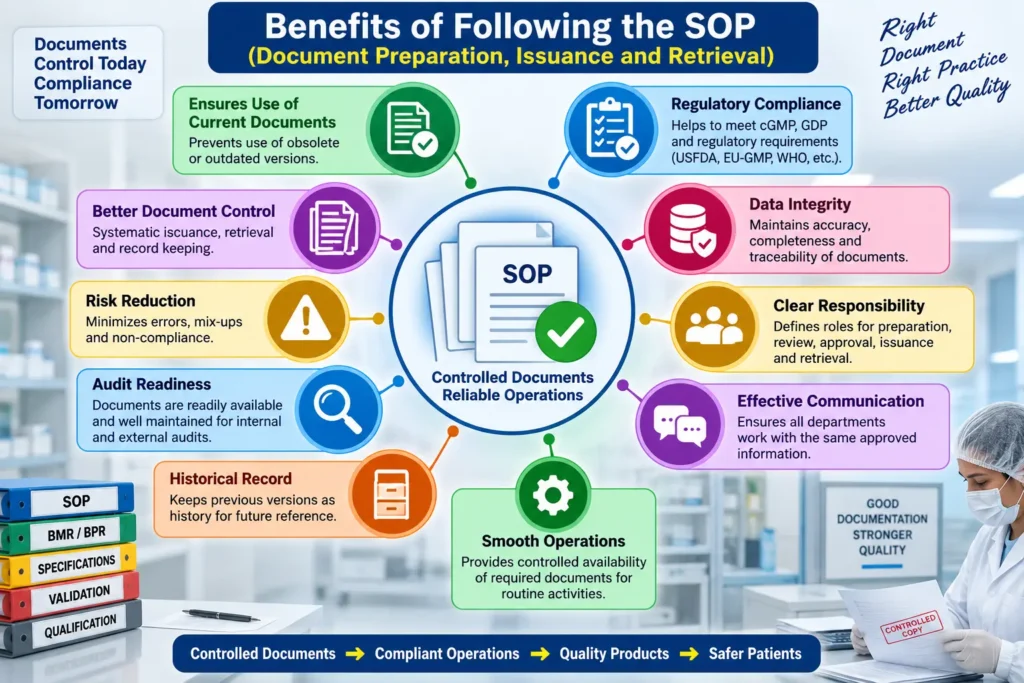
The SOP also improves traceability because BMR/BPR, validation documents, qualification records, specifications, SOPs, formats, and logbooks are maintained through controlled systems. Overall, following this SOP supports better document control, clear responsibility, reduced errors and mix-ups, improved data integrity, audit readiness, historical traceability, and smooth pharmaceutical operations. It also helps ensure that employees work only with the correct and approved version of each document.
4. Brainstorming for SOP Failure:
The brainstorming diagram shows the possible reasons why the SOP for Document Preparation, Issuance and Retrieval may fail in a pharmaceutical core manufacturing area. The central “SOP Failure” cloud is surrounded by different possible causes so the investigation team can discuss each one before deciding the actual root cause.
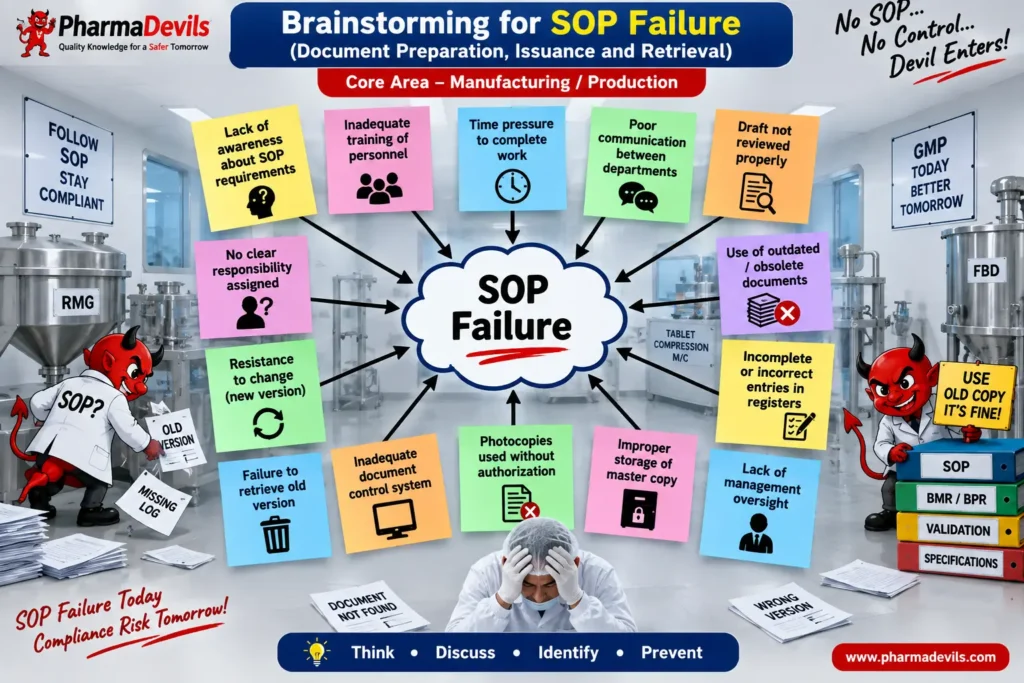
The diagram highlights issues such as lack of SOP awareness, inadequate training, work pressure, poor communication between departments, improper document review, unclear responsibilities, resistance to revised documents, unauthorized photocopies, incomplete register entries, improper storage of master copies, weak management oversight, and use of outdated or obsolete documents. A major risk shown is the failure to retrieve the previous version before issuing a new version. This is important because the SOP requires the old document to be retrieved and the issuance/retrieval details to be recorded by QA.The cartoon devils symbolically represent bad documentation practices entering the core area when document control is weak. Overall, this brainstorming exercise helps the QA team identify possible causes, discuss risks, investigate systematically, and establish suitable corrective and preventive actions to avoid repeated SOP failures.
5. 5-Why Analysis for SOP Failure:
The 5-Why diagram explains how a failure in the SOP for Document Preparation, Issuance and Retrieval can develop in a pharmaceutical core area.The problem starts when personnel use an outdated or incorrect document copy during manufacturing activities. The first reason identified is that the previous version of the document was not retrieved before the new version was issued. This directly conflicts with the SOP requirement that the old document must be retrieved before a new version is distributed. The next reason is that the issuance and retrieval details were not properly recorded by Quality Assurance. The SOP requires these activities to be entered in the appropriate document-control register with details such as document name, number, issued by, retrieved by, number of copies retrieved, date, and checking details.
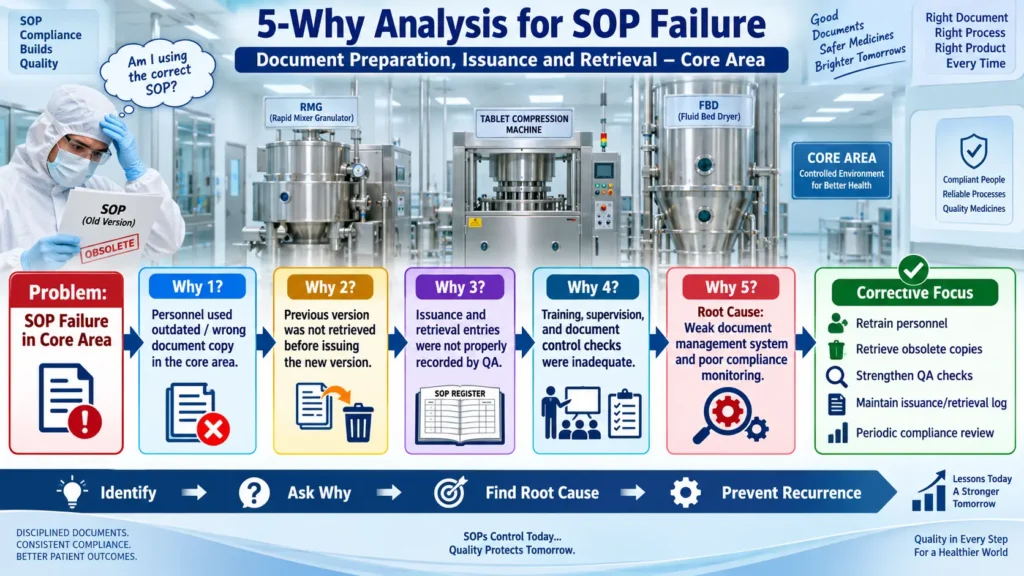
Further investigation points toward inadequate training, supervision, and document-control checks. These weaknesses can allow obsolete copies to remain in the core area and continue to be used. The probable root cause shown in the diagram is a weak document-management system and insufficient compliance monitoring. Corrective focus should therefore include retraining personnel, retrieving obsolete copies, strengthening QA verification, maintaining accurate issuance/retrieval logs, and periodically reviewing document-control compliance. The SOP also clearly states that without retrieval of the old version, the new version should not be distributed, making this control critical for preventing recurrence.
6. Fishbone Analysis for SOP Failure:
The Fishbone Analysis diagram shows the possible causes that can lead to SOP failure in the pharmaceutical core area for Document Preparation, Issuance and Retrieval. The analysis groups the causes into six major categories: Man, Method, Machine/System, Material/Documents, Measurement/Records, and Environment/Management. Under Man, common causes include lack of training, poor SOP awareness, negligence, and failure to follow instructions. Method-related causes include issuing documents without proper review, failure to retrieve old versions, unclear document-control procedures, and unauthorized photocopying. The SOP specifically requires the previous document to be retrieved before a new one is issued.
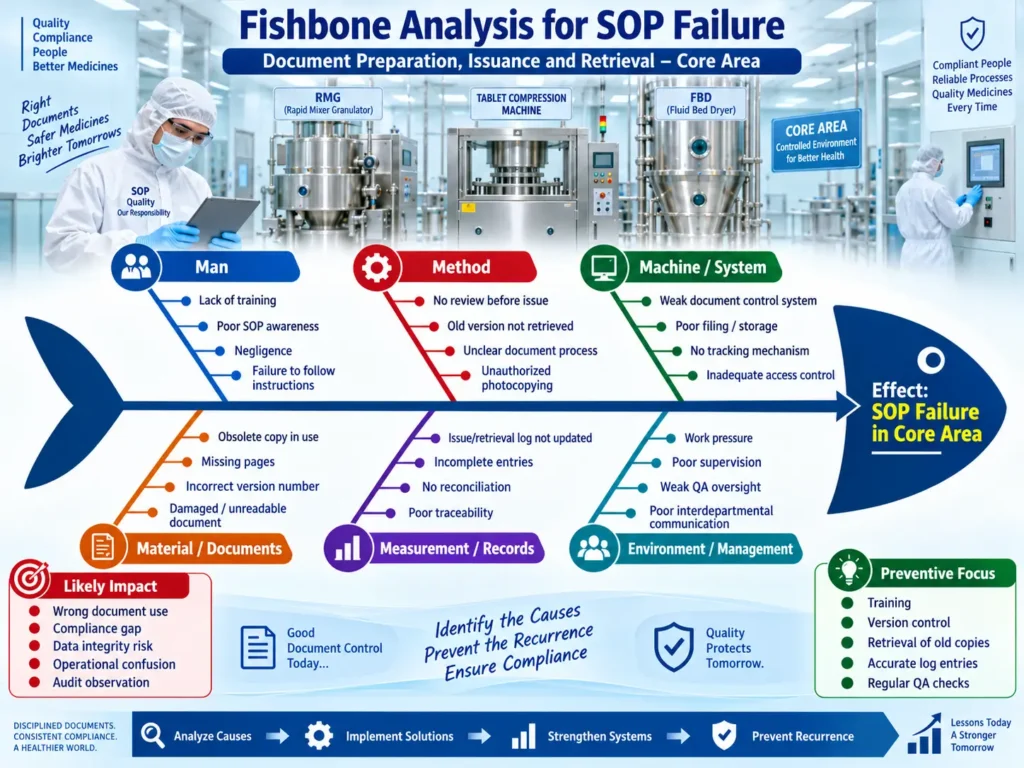
Under Machine/System, possible causes include a weak document-control system, poor storage, lack of tracking, and inadequate access control. Material/Documents may involve obsolete copies, missing pages, incorrect version numbers, or damaged documents. The Measurement/Records category highlights incomplete issuance/retrieval entries, poor reconciliation, and weak traceability. The SOP requires detailed entries in the document-control register, including document name, number, issue and retrieval details, quantity, date, and checking information. Finally, Environment/Management causes may include work pressure, weak supervision, inadequate QA oversight, and poor communication between departments. Overall, the Fishbone Analysis helps the investigation team systematically identify potential causes of SOP failure so that appropriate training, version control, retrieval of obsolete documents, accurate recordkeeping, and stronger QA checks can be implemented to prevent recurrence.
7. Fault Tree Analysis for SOP Failure:
The Fault Tree Analysis diagram explains how different document-control weaknesses can lead to the top event: SOP Failure in the Core Area. In this case, the failure means an incorrect, outdated, or unauthorized document may be available or used during pharmaceutical operations. The diagram divides the failure into major contributing events such as improper issuance of a new document, failure to retrieve the old version, personnel not following the approved document, and availability of uncontrolled or unauthorized copies in the core area.
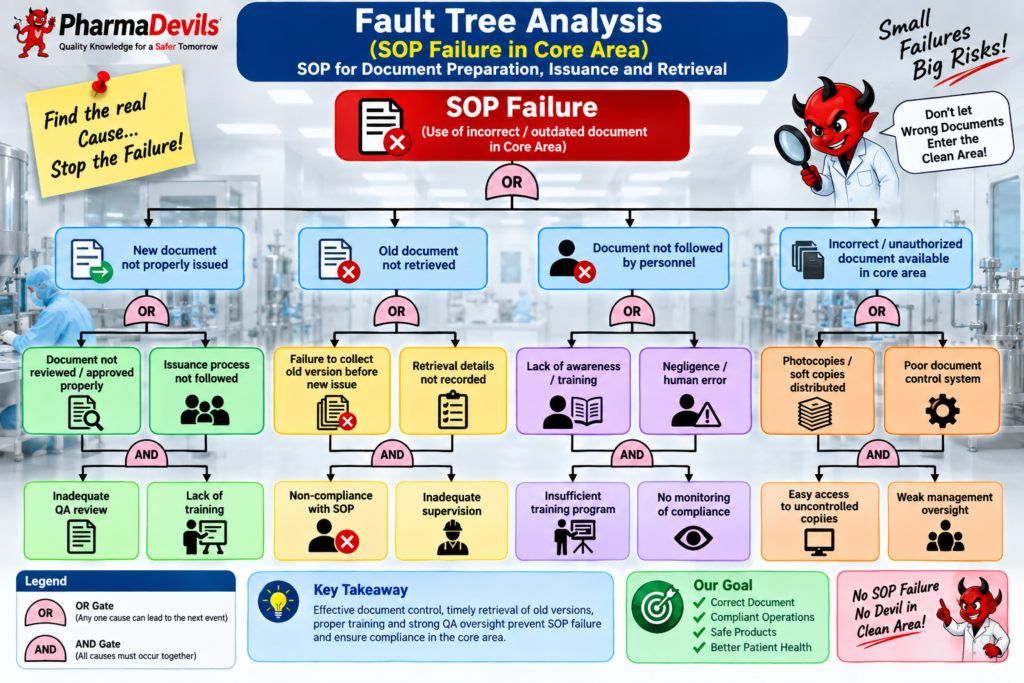
For document issuance, contributing causes may include inadequate review and approval, failure to follow the defined issuance process, weak QA review, and insufficient training. For document retrieval, the diagram highlights failure to collect the old version and failure to record retrieval details. This is important because the SOP requires the previous document to be retrieved before the new document is issued. Personnel-related causes include poor SOP awareness, inadequate training, negligence, insufficient supervision, and lack of compliance monitoring. Uncontrolled copies may also arise from unauthorized photocopying, easy access to soft copies, weak document-control systems, or poor management oversight. The analysis uses OR gates to show that any one of several causes can contribute to a failure, while AND gates indicate situations where multiple conditions together can increase the chance of failure. Overall, the Fault Tree Analysis helps QA systematically trace the failure from the final event back to its possible basic causes. The main preventive focus should be proper document approval, controlled issuance, timely retrieval of obsolete copies, accurate log entries, effective training, and strong QA oversight. The SOP also states that a new version should not be distributed until the old version has been retrieved.
8. Impact Assessment:
The impact assessment diagram explains the possible consequences when the SOP for Document Preparation, Issuance and Retrieval is not properly followed in a pharmaceutical core area. The central issue is the presence or use of an incorrect, outdated, or unauthorized document, which can affect several parts of the quality system. The most important impact is on product quality, because personnel may follow an incorrect procedure, leading to errors, deviations, rework, batch rejection, or inconsistent manufacturing practices. Patient safety may also be affected if incorrect instructions contribute to improper manufacturing, testing, or release activities.
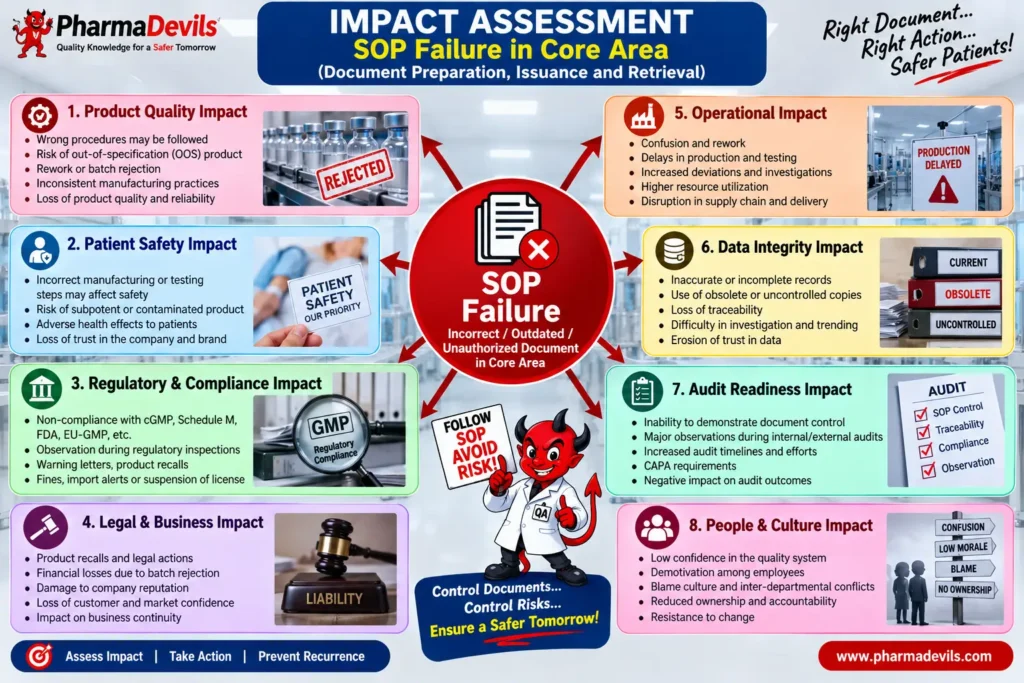
The diagram also highlights regulatory and compliance risks, since weak document control may result in audit observations and difficulty demonstrating cGMP compliance. The SOP requires controlled issuance, retrieval, and recording of documents by Quality Assurance. There can also be operational impacts, such as production delays, repeated investigations, confusion, and additional resource requirements. Data integrity and traceability may be weakened when obsolete copies are used or issuance and retrieval records are incomplete. The SOP requires document-control register entries for issue and retrieval details. Overall, SOP failure can affect product quality, patient safety, compliance, data integrity, audit readiness, operations, and employee accountability. The key control is to ensure that old versions are retrieved before revised documents are distributed.
Questions & Answers:
Q1. What is the objective of this SOP?
The objective is to define the procedure for the preparation, issuance, retrieval, and control of documentation.
Q2. What is the scope of this SOP?
It applies to cGMP documentation of all departments for document preparation, issuance, retrieval, implementation, and control.
Q3. Who is responsible for issuing and retrieving documents?
The Quality Assurance department is responsible for document issuance and retrieval.
Q4. Who prepares documents related to manufacturing activities and systems?
The respective concerned department prepares the documents related to its activities and systems.
Q5. Who reviews draft documents?
Draft documents are circulated to the concerned department heads and Quality Assurance for comments and review.
Q6. Who approves the reviewed document?
The reviewed document is approved by the Quality Assurance Head.
Q7. Where are approved master documents kept?
Approved master documents are kept in the custody of Quality Assurance under lock and key.
Q8. How are controlled documents issued to departments?
Documents are issued according to the indent or request of the concerned department, and a controlled photocopy of the master document is issued.
Q9. What should be done before issuing a new version of a document?
The previous version must first be retrieved, and the new version is then issued with appropriate signature and date.
Q10. Where are document issuance and retrieval details recorded?
They are recorded by QA in the appropriate document control register or issuance/retrieval log.
Q11. What details should be entered in the document control register?
The register should include document name, document number, issued by, retrieved by, retrieved document number, number of copies retrieved, date, and checking details.
Q12. How are BMR/BPR copies controlled?
Photocopies of the master or system-printed BMR/BPR are issued for production, and all sheets should be signed and dated by QA personnel.
Q13. What happens to completed batch records?
Completed batch records are returned to QA for review, and after reviewing the records and QC analytical results, QA releases the batch.
Q14. Who controls validation and qualification documents?
QA prepares and issues validation protocols/reports and equipment qualification documents to the respective departments and maintains completed records.
Q15. Is photocopying of approved usage documents allowed?
No. The SOP states that photocopying of approved usage documents is not allowed; controlled copies are issued by Quality Assurance.
Q16. What happens to old versions after revision?
Old copies are retrieved from departments, marked obsolete by Quality Assurance, and retained as historical records.
Q17. Can a new document version be distributed before retrieving the old version?
No. The SOP clearly states: without retrieval of the old version, the new version shall not be distributed.
Q18. What types of documents are covered under this SOP?
The SOP covers documents such as SOPs, formats, BMR/BPR, validation records, qualification records, specifications, logbooks, and product-study documentation.
Q19. What is the purpose of maintaining revision numbers?
Revision or version numbers help identify the current approved version and distinguish it from previous versions.
Q20. Why is this SOP important in a pharmaceutical facility?
It helps maintain controlled, traceable, approved, and current documentation, reducing the risk of using obsolete documents and supporting proper cGMP documentation practices.
Reference Guidelines:
- EU Guidelines for Good Manufacturing Practice – EudraLex Volume 4, Chapter 4: Documentation
Covers generation and control of documents, approval, issuance, revision, retention, records, and good documentation practices. The European Commission currently lists Chapter 4 under Volume 4 GMP requirements. (Public Health)
EU GMP – EudraLex Volume 4 - PIC/S GMP Guide PE 009-17, Part I – Chapter 4: Documentation
Provides requirements for controlled GMP documentation, specifications, manufacturing instructions, records, document authorization, and retention. (PIC Scheme)
PIC/S Publications and GMP Guide - WHO Good Manufacturing Practices for Pharmaceutical Products – Main Principles, TRS 986, Annex 2
Provides GMP principles for pharmaceutical quality systems, documentation, manufacturing, quality control, and record management. (World Health Organization)
WHO GMP Main Principles - WHO Quality Assurance of Pharmaceuticals, Volume 2 – GMP and Inspection, 10th Edition, 2024
A current WHO compendium covering pharmaceutical GMP systems and inspection expectations, including documentation and quality-system controls. (World Health Organization)
WHO GMP Compendium 2024 - US FDA – 21 CFR Parts 210 and 211, Current Good Manufacturing Practice for Finished Pharmaceuticals
Particularly relevant sections include 21 CFR 211.100 for written procedures and deviations and 21 CFR 211.180, 211.186, 211.188 and 211.192 for GMP records, master production records, batch records, and production-record review. (U.S. Food and Drug Administration)
FDA CGMP Regulations - Indian Drugs Rules, 1945 – Schedule M: Good Manufacturing Practices and Requirements of Premises, Plant and Equipment for Pharmaceutical Products
Schedule M requires pharmaceutical manufacturers to establish documented systems and procedures and maintain appropriate GMP documentation and records. (CDSCO)
CDSCO Drugs Rules and Schedule M