







Brief Description
This SOP provides a systematic procedure for establishing alert and action limits for total aerobic microbial counts in potable water, purified water, and environmental monitoring activities. Its purpose is to ensure that microbiological monitoring data are scientifically evaluated so that changes in environmental or water-system conditions can be detected and controlled. The procedure requires collection of historical monitoring data from relevant water sampling points and environmental monitoring locations. Data are evaluated using the mean, standard deviation, and Mean + 2SD through Mean + 6SD, together with maximum/minimum counts, outliers, existing limits, and excursions. For water systems, action limits are established using the calculated alert limit and specified maximum criteria. The final limits must be documented with appropriate rationale and approval. Limits are reviewed every two years or whenever changes occur in the water system or facility.The SOP also provides annexures for calculation, water microbial limits, environmental monitoring limits, and alert/action limit evaluation.
Skip to PDF content1. Flow Diagram:
The flow diagram explains the stepwise process for establishing alert and action limits for microbiological monitoring. It begins with collecting data from water sampling points and environmental monitoring locations, followed by tabulation and verification of data.
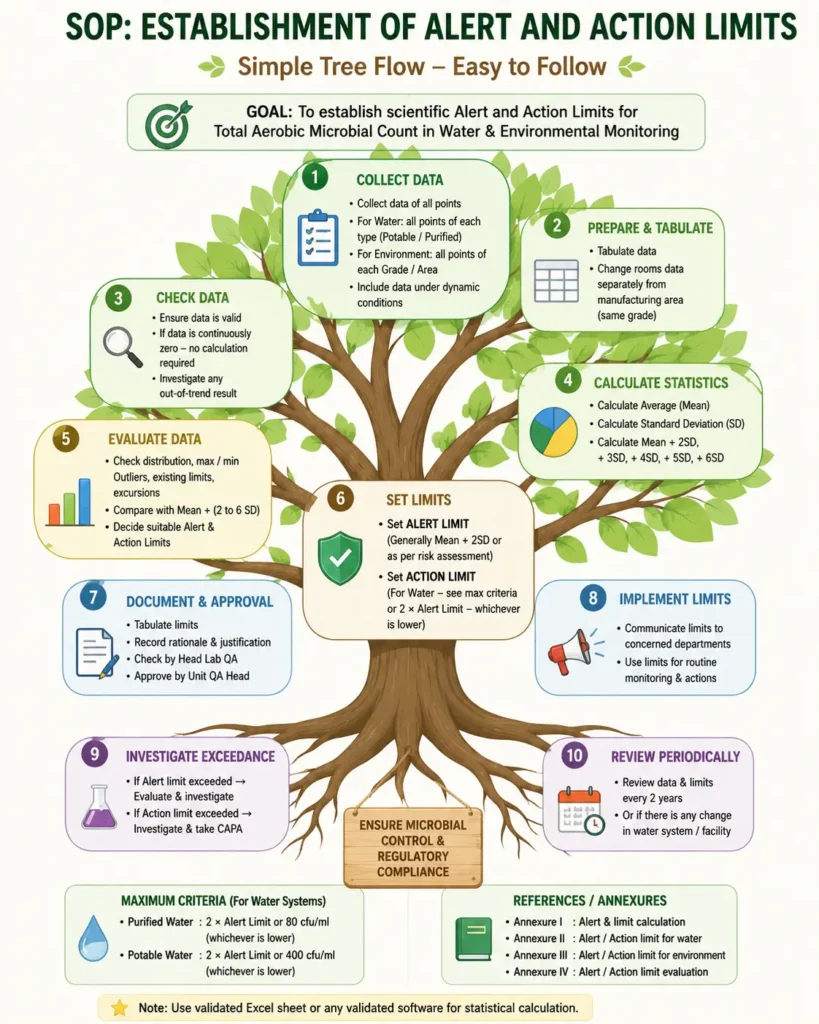
Mean and standard deviation are calculated, and values from Mean +2SD to Mean +6SD are evaluated. Suitable alert and action limits are then selected, justified, reviewed, and approved. The established limits are implemented for routine monitoring, excursions are investigated, CAPA is initiated when required, and limits are periodically reviewed for continued control and compliance.
2. Brainstorming for SOP Failure:
Brainstorming for SOP failure is used to identify possible causes that may lead to ineffective establishment, implementation, or review of alert and action limits. The causes can be grouped under People, Process, Method, Documentation, Equipment/Tools, Management, and External Factors.
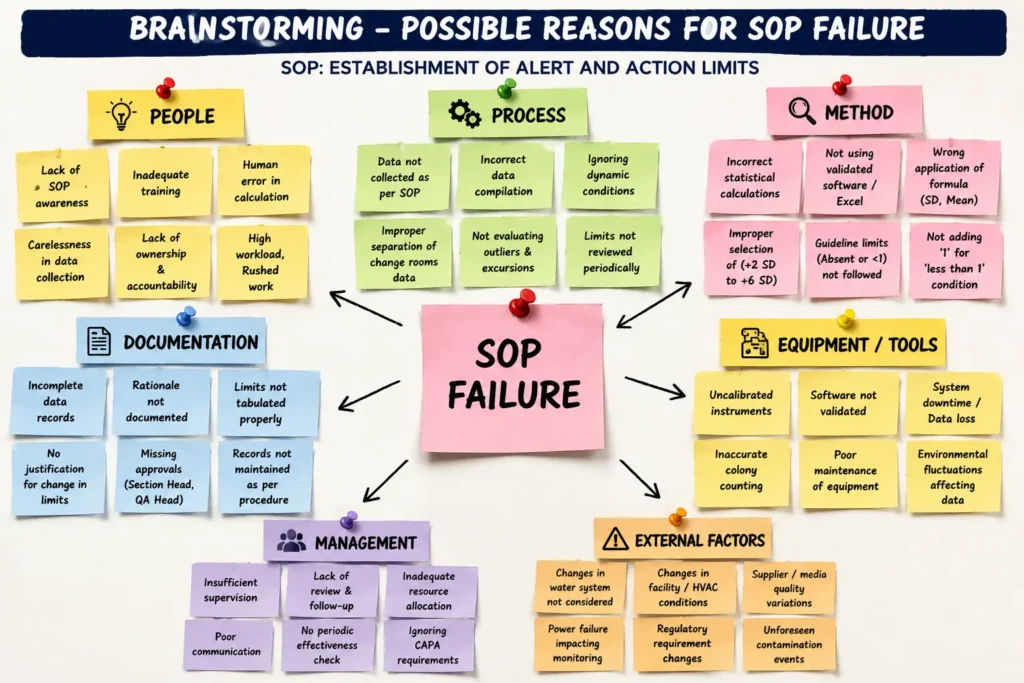
Typical issues include inadequate training, incorrect data collection, calculation errors, improper use of statistical methods, use of unvalidated software, incomplete records, missing approvals, poor supervision, and failure to review limits periodically. Changes in the water system, facility conditions, or environmental monitoring conditions may also contribute. This brainstorming approach helps the investigation team identify potential root causes systematically and supports suitable corrective and preventive actions.
3. 5-Why Analysis for SOP Failure:
The 5-Why Analysis is used to systematically identify the underlying cause of failure in the SOP for Establishment of Alert and Action Limits. The analysis starts with the problem of limits not being properly established or followed and progressively examines possible reasons such as inaccurate or incomplete data, improper data collection, insufficient personnel training, and inadequate periodic training.
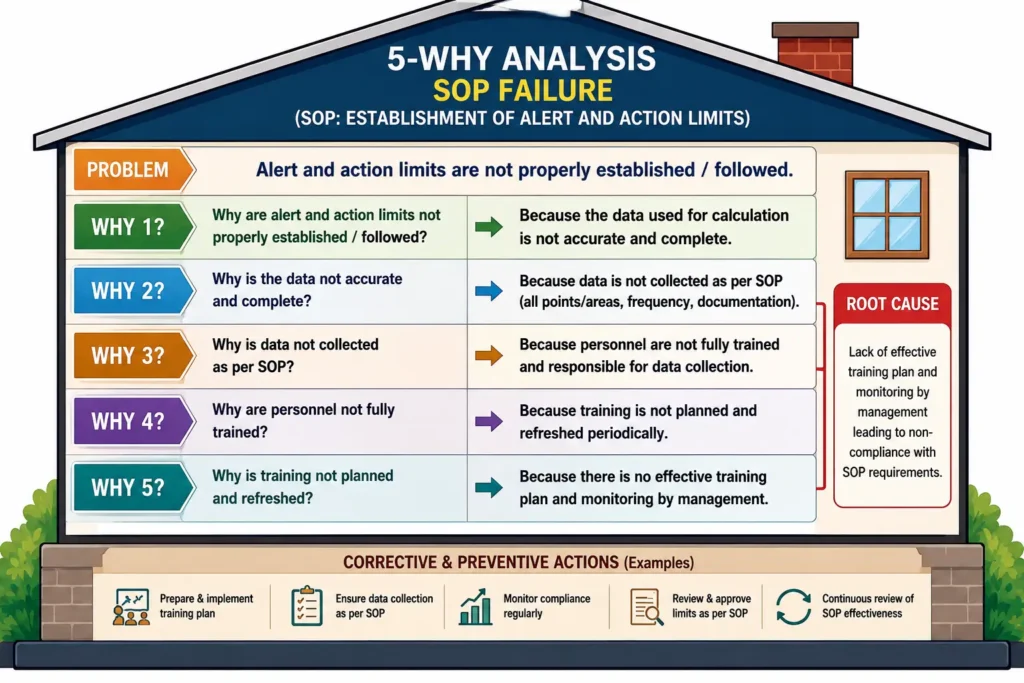
It ultimately identifies weak training planning and insufficient management monitoring as potential root causes. The analysis supports development of appropriate CAPA, including retraining, improved data collection, compliance monitoring, periodic review, and effective implementation of the SOP.
4. Fishbone Analysis for SOP Failure:
The Fishbone Analysis is a structured root-cause investigation tool used to identify possible reasons for failure in the SOP for Establishment of Alert and Action Limits. The analysis groups potential causes into major categories such as People, Process, Method, Material/Data, Equipment/Tools, and Management. People-related causes may include inadequate training, poor awareness, or human error. Process failures may involve incomplete data collection, improper separation of monitoring data, or failure to consider dynamic conditions.
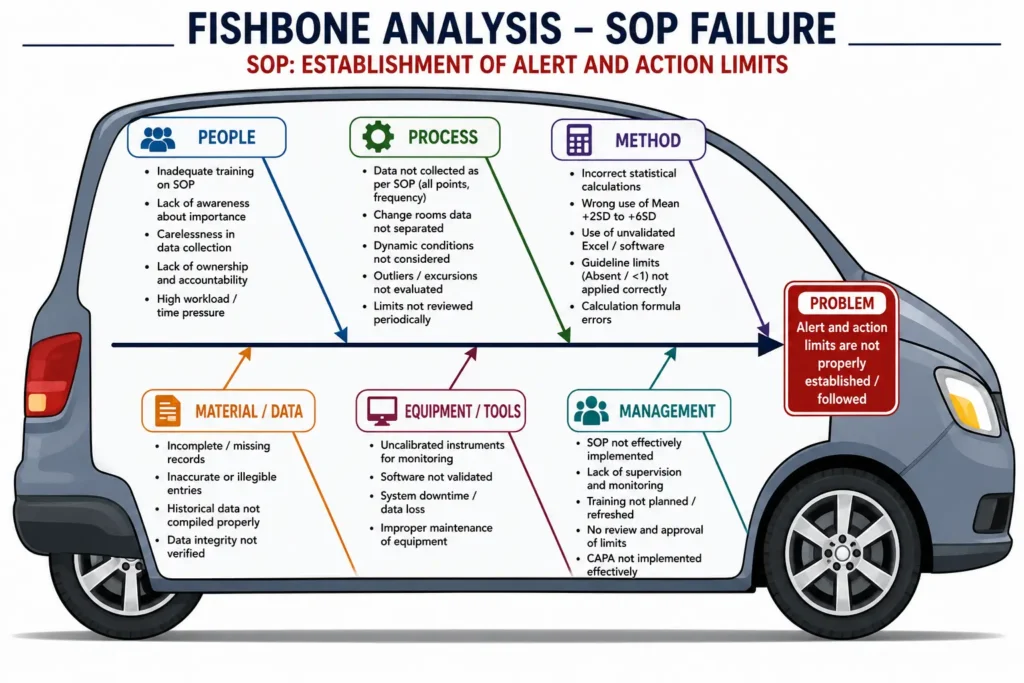
Method-related issues can include incorrect calculation of mean and standard deviation, inappropriate selection of statistical limits, or use of unvalidated software. Documentation failures may involve incomplete records, missing rationale, or improper approval. Equipment-related issues may affect monitoring accuracy, while management failures can include poor supervision, weak review, and ineffective CAPA follow-up. This analysis helps systematically identify contributing factors and supports effective corrective and preventive actions.
5. Fault Tree Analysis for SOP Failure:
Fault Tree Analysis (FTA) is a systematic investigation tool used to identify potential causes that may lead to failure of the SOP for Establishment of Alert and Action Limits. The top event is considered as improper establishment, implementation, or review of alert and action limits. The fault tree breaks this failure into major contributing areas such as inadequate data, incorrect statistical calculations, improper implementation, and insufficient review or follow-up.
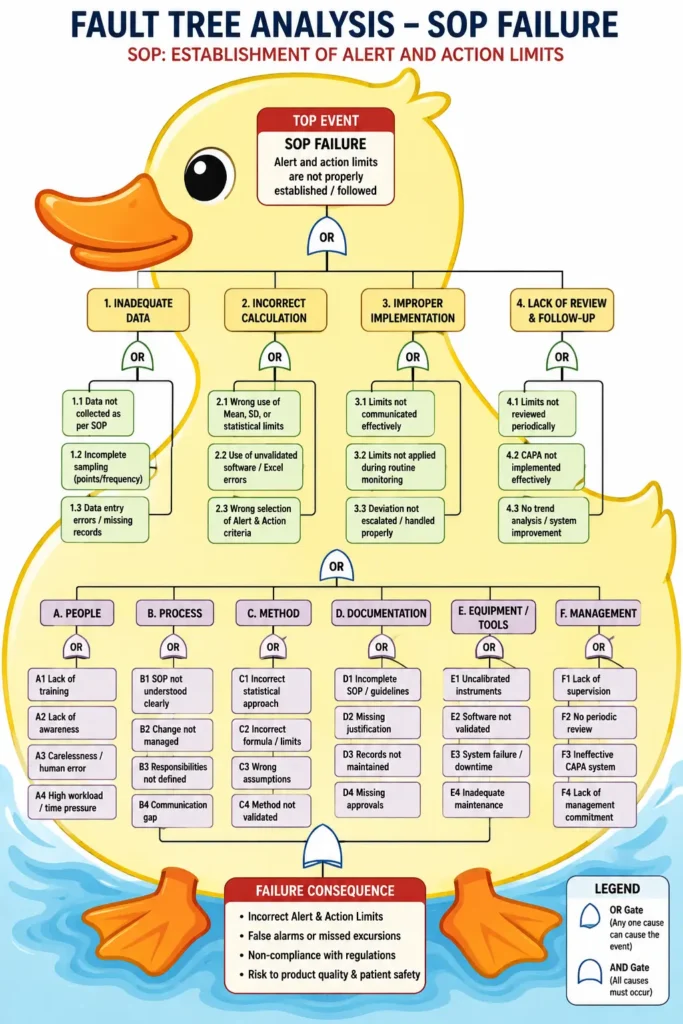
These causes may further originate from inadequate training, incomplete monitoring data, incorrect use of mean and standard deviation, poor documentation, use of unvalidated calculation tools, missing approvals, or weak management oversight. The SOP itself requires proper data collection, statistical evaluation, documentation of rationale, approval of limits, and periodic review. FTA helps visualize how individual failures can combine to cause SOP failure and supports identification of appropriate CAPA for improved compliance and control.
Questions & Answers – Establishment of Alert and Action Limits
1. What is the objective of this SOP?
The objective is to provide a guideline for establishing alert and action limits for total aerobic microbial counts during water analysis and environmental monitoring.
2. Where is this SOP applicable?
It applies to microbiological testing of potable water, purified water, and environmental monitoring.
3. What is an Alert Limit?
An alert limit is a level which, when exceeded, may trigger an investigation to determine whether the process remains under control. It is always lower than the action limit.
4. What is an Action Limit?
An action limit is a level which, when exceeded, should trigger an investigation and appropriate corrective and preventive action based on the investigation.
5. Who is responsible for execution of the SOP?
Quality Control personnel are responsible for execution, while QC management and Head-QA/QC are responsible for effective implementation.
6. How is data collected for establishing water limits?
Data from all sampling points of each water type must be collected and evaluated.
7. How should environmental monitoring data be handled?
Data should be collected for all points within each grade/classification, with change-room data evaluated separately from manufacturing-area data of the same grade.
8. Should dynamic monitoring data be considered?
Yes. Data generated during dynamic conditions should be included when calculating environmental monitoring limits.
9. When is calculation of alert and action limits not required?
Calculation is not required where guideline limits are stated as absent or less than 1, or where monitoring data are continuously zero. Any out-of-trend result should still be investigated.
10. Which statistical values are calculated?
The SOP requires calculation of the mean, standard deviation, and Mean +2SD, +3SD, +4SD, +5SD, and +6SD.
11. What is the action limit criterion for purified water?
The action limit is 2 × the calculated alert limit or 80 CFU/mL, whichever is lower.
12. What is the action limit criterion for potable water?
The action limit is 2 × the calculated alert limit or 400 CFU/mL, whichever is lower.
13. What data should be considered before finalizing limits?
Distribution of counts, maximum and minimum values, outliers, existing limits, excursions, and calculated Mean +2SD through Mean +6SD should be evaluated.
14. What software should be used for statistical calculations?
A validated Excel sheet or validated software should be used for statistical calculations.
15. How often should alert and action limits be reviewed?
Data and established limits should be reviewed every two years or whenever there is a change in the water system or facility. The previous two years of data should be considered during the review.