







Brief Description
This SOP describes the fortnightly maintenance procedure for HPLC systems, FTIR instruments, and UV-Visible spectrophotometers used in the Quality Control department. Its purpose is to keep the instruments clean, functional, and ready for reliable analytical testing. The QC chemist and Executive-QC are responsible for performing the maintenance, while Lab QA Manager, Manager-QC, and Head QA/QC ensure proper implementation. For HPLC, the procedure includes checking buffer deposits, cleaning pump heads, autosampler and column oven, cleaning glass and metal inlet filters, purging and flushing the system, and checking lamp intensity. FTIR maintenance includes cleaning the instrument and checking the vacuum gauge, energy level, and polystyrene film. UV-Visible maintenance includes cleaning the instrument and checking cuvettes for breakage. All observations are recorded in the prescribed fortnightly checklist, and due and completed dates are maintained in the maintenance schedule. This helps support consistent instrument performance and proper maintenance documentation within the Quality Control laboratory.
Skip to PDF content1. Flow Diagram:
The flow diagram explains the fortnightly maintenance process for HPLC, FTIR, and UV-Visible Spectrophotometer in simple steps. The process starts by checking the maintenance schedule and selecting the instrument due for maintenance. For HPLC, the QC person checks for buffer deposits, cleans the pump head, autosampler, column oven and inlet filters, purges and flushes the system, and checks lamp intensity.
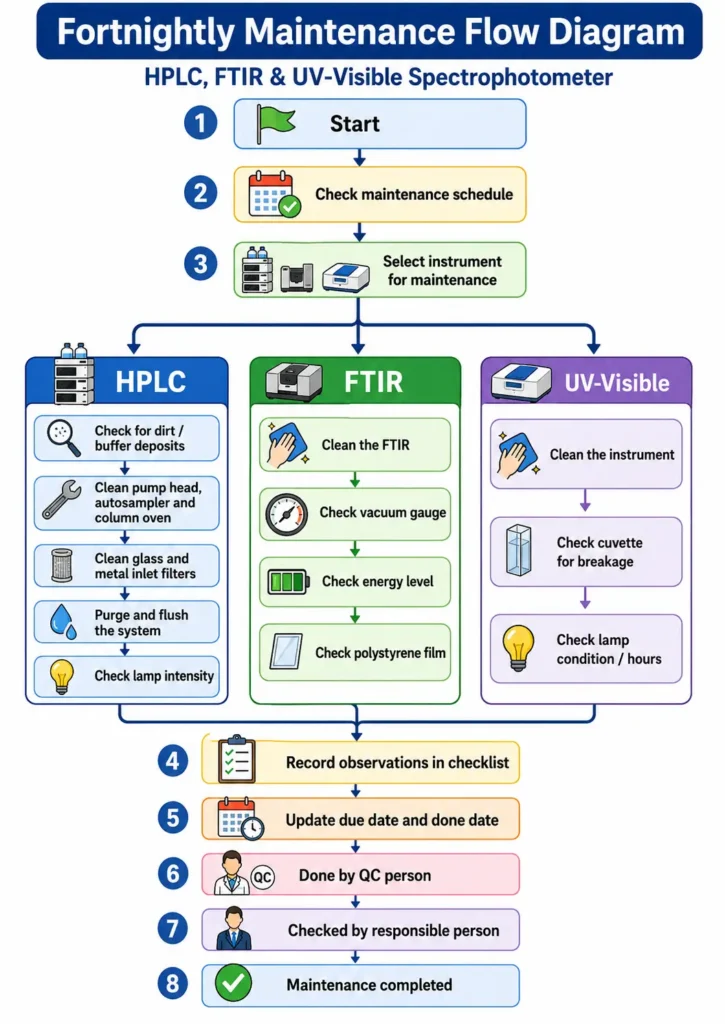
For FTIR, the instrument is cleaned and the vacuum gauge, energy level, and polystyrene film are checked. For the UV-Visible Spectrophotometer, cleaning is performed and the cuvette is checked for breakage. Finally, all observations are entered in the fortnightly checklist, due and completion dates are updated, and the activity is documented by the responsible QC personnel. This systematic flow helps ensure that laboratory instruments remain properly maintained and ready for routine analysis.
2. Brainstorming for SOP Failure:
Brainstorming is used to identify possible reasons for failure of the fortnightly maintenance SOP for HPLC, FTIR, and UV-Visible Spectrophotometer. The discussion focuses on areas such as personnel, maintenance schedule, procedure, instrument-specific activities, documentation, availability of materials, and supervision. Possible causes may include missed maintenance dates, lack of training, high workload, use of an old SOP, skipped cleaning steps, improper HPLC purging, missed FTIR checks, damaged UV cuvettes, incomplete checklists, and unavailable cleaning materials.
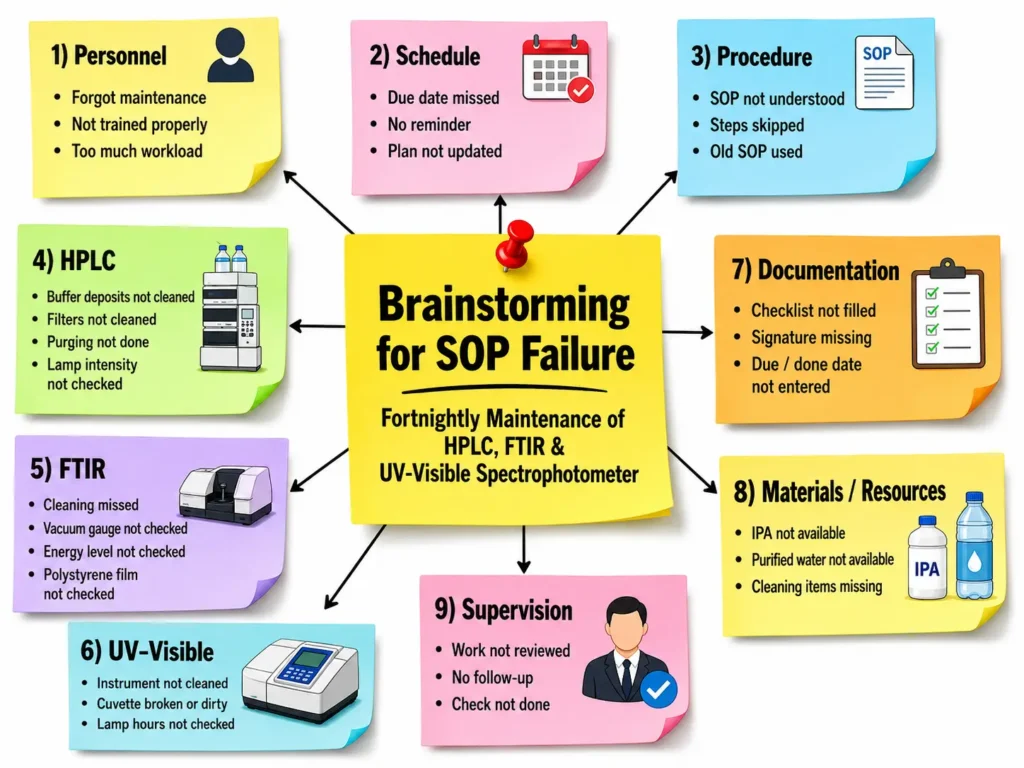
These are potential causes generated during brainstorming and are not confirmed failures. The SOP requires QC personnel to carry out maintenance activities and responsible managers to ensure proper implementation. It also requires specific HPLC, FTIR, and UV-Visible maintenance checks and recording of observations in the prescribed checklist.Brainstorming helps the investigation team collect possible causes before performing detailed root cause analysis.
3 5-Why Analysis for SOP Failure:
The 5-Why Analysis is a simple root cause investigation tool used to understand why the fortnightly maintenance SOP was not followed on time. The analysis starts with the main problem and repeatedly asks “Why?” until the basic cause is identified. In this example, the maintenance was missed because the schedule was not followed. This may be linked to lack of reminders, high workload, inadequate manpower planning, or gaps in the maintenance control system.
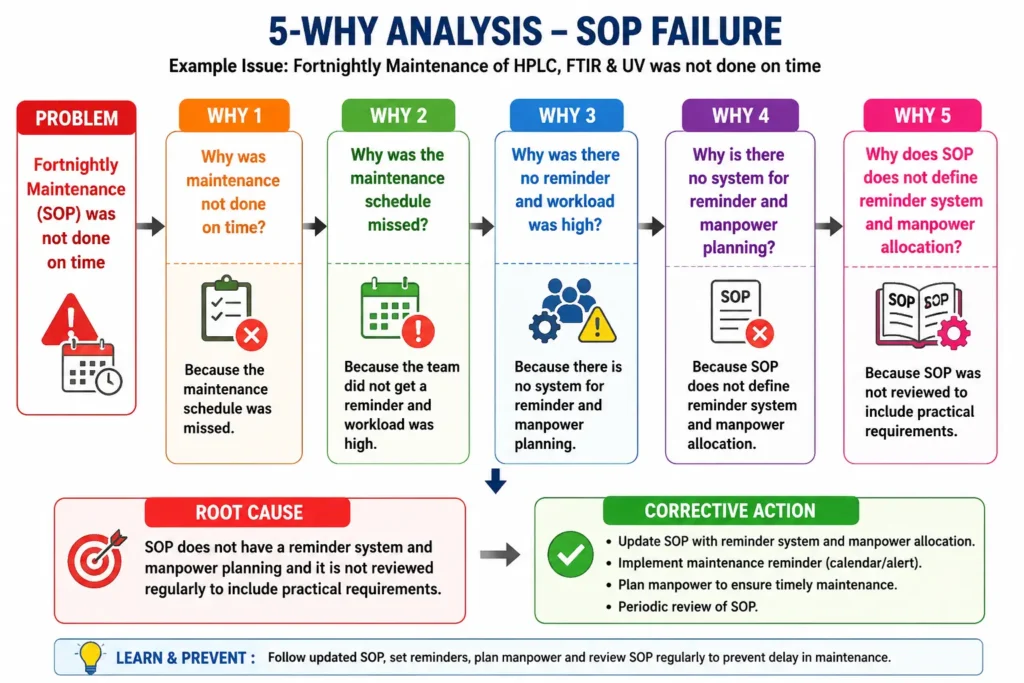
The actual SOP assigns execution responsibility to QC personnel and requires effective implementation by responsible QC/QA management. The SOP also requires regular maintenance activities for HPLC, FTIR and UV-Visible instruments and recording of observations in the prescribed checklist.The 5-Why method helps identify the true root cause, so suitable corrective and preventive actions can be taken to avoid recurrence.
4. Fishbone Analysis for SOP Failure:
The Fishbone Analysis (Ishikawa Diagram) is used to identify and organize possible causes of failure in the fortnightly maintenance SOP for HPLC, FTIR, and UV-Visible Spectrophotometer. The main problem is that scheduled maintenance may be missed or the SOP may not be followed correctly. Possible causes are grouped into major categories such as Personnel, Method/SOP, Schedule/Management, Instruments, Materials/Resources, and Documentation.
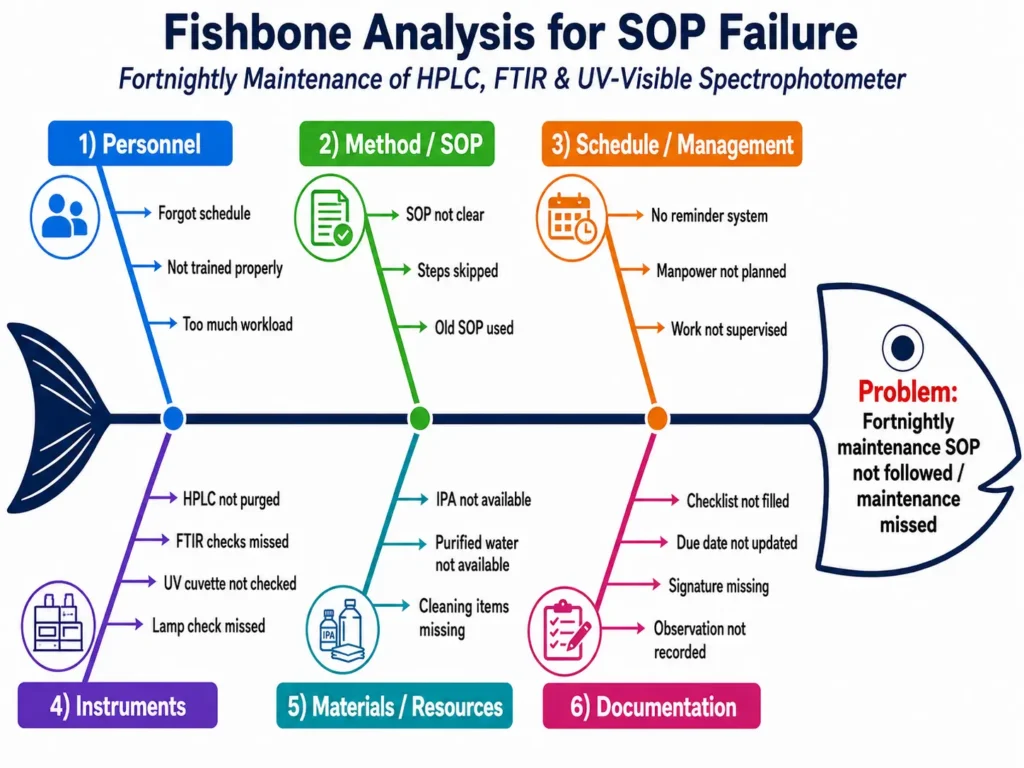
Personnel-related causes may include missed schedules, inadequate training, or excessive workload. Method-related causes may include unclear instructions, skipped steps, or use of an outdated SOP. Instrument-related causes can include missed HPLC purging, FTIR checks, UV cuvette checks, or lamp checks. The SOP itself requires defined maintenance activities for these instruments. Documentation-related issues may include incomplete checklists, missing signatures, or failure to update maintenance dates. The SOP requires observations to be recorded in the prescribed checklist and maintenance schedule.Fishbone analysis helps the investigation team systematically review all possible causes and select the most likely root cause for further investigation.
5. Fault Tree Analysis (FTA) for SOP Failure:
Fault Tree Analysis (FTA) is a systematic method used to identify possible causes of failure of the Fortnightly Maintenance SOP for HPLC, FTIR, and UV-Visible Spectrophotometer. The top event is considered as: “Fortnightly maintenance was not performed or completed as required.”The possible causes can be divided into major branches such as Personnel, Method/SOP, Schedule/Management, Instrument, Materials/Resources, and Documentation. Examples include missed maintenance schedules, inadequate training, unclear responsibility, skipped maintenance steps, lack of reminders, insufficient manpower, unavailable IPA or purified water, incomplete instrument checks, and missing checklist entries. These are investigation possibilities, not confirmed failures stated in the SOP.
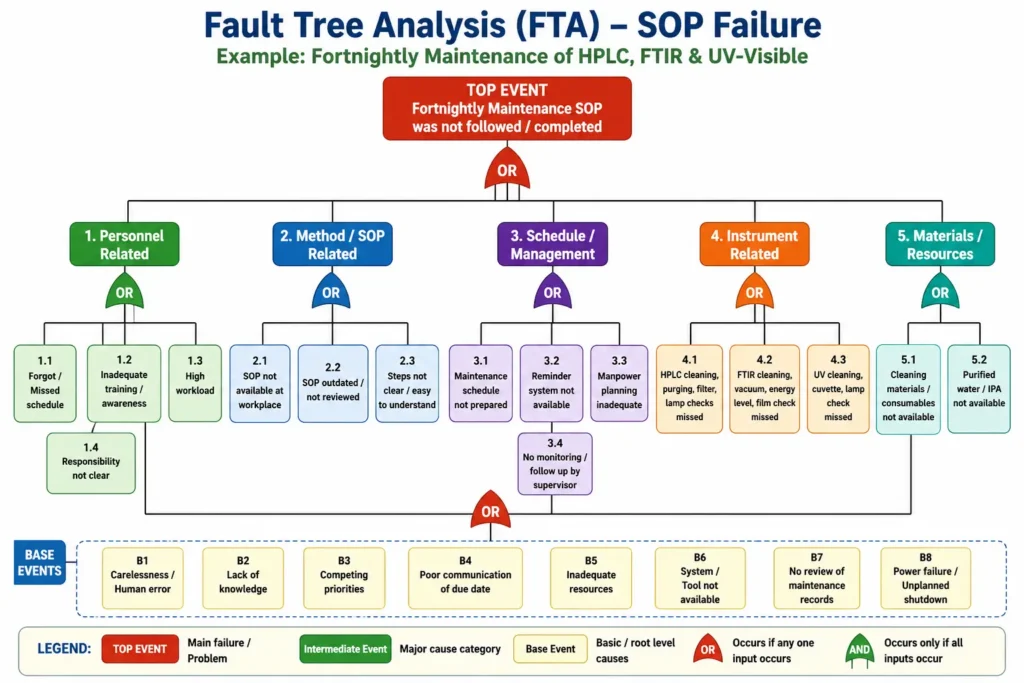
The SOP assigns maintenance execution to QC personnel and implementation oversight to QC/QA management. It also specifies HPLC, FTIR, and UV maintenance activities that must be performed. Maintenance observations are required to be documented in the prescribed checklist and schedule.FTA helps investigators move from the main failure to possible basic causes so that suitable CAPA can be established.
Questions & Answers – Fortnightly Maintenance of HPLC, FTIR & UV-Visible Spectrophotometer
Q1. What is the purpose of this SOP?
The purpose is to define the procedure for fortnightly maintenance of the HPLC system.
Q2. Where is this SOP applicable?
It is applicable to fortnightly maintenance activities performed in the Quality Control department.
Q3. Who is responsible for performing the maintenance?
The QC Chemist and Executive-QC are responsible for executing the SOP.
Q4. Who is responsible for effective implementation of the SOP?
The Lab QA Manager, Manager-QC, and Head QA/QC are responsible for effective implementation.
Q5. What should be checked first during HPLC maintenance?
The HPLC should be visually checked for buffer deposits around areas such as the pump head, autosampler, and column oven.
Q6. How is the HPLC glass inlet filter cleaned?
The glass filter is placed in 10% dilute nitric acid and warmed for about 10 minutes, followed by warming with purified water for about 10 minutes. It should not be sonicated.
Q7. How is the metal inlet filter cleaned?
The metal filter is sonicated in IPA for about 10 minutes, followed by methanol and water, and then washed with purified water.
Q8. Why is the HPLC system purged and flushed?
Purging and flushing help clean the line filter, pump heads, tubing, injection needle, injection port, and flow cell.
Q9. What additional test is performed during HPLC maintenance?
The lamp intensity test is performed as per the applicable protocol.
Q10. What checks are performed during FTIR maintenance?
The FTIR is cleaned, and the vacuum gauge, energy level, and polystyrene film are checked.
Q11. What checks are performed for the UV-Visible Spectrophotometer?
The instrument is cleaned and the cuvette is checked for any breakage.
Q12. Where are fortnightly maintenance observations recorded?
The observations are recorded in Annexure-I, the fortnightly maintenance checklist.
Q13. What is Annexure-II used for?
Annexure-II is used as the maintenance schedule for HPLC, FTIR, and UV-Visible Spectrophotometers.
Q14. Who receives training on this SOP?
Quality Control personnel are the trainees, and the Head QA/QC is listed as the trainer.
Q15. What is the recommended training duration?
The training period is half an hour.