







1. Brief Description:
The SOP on Good Documentation Practices defines a uniform method for recording, correcting, and maintaining GMP-related documentation. It applies to all site employees and requires data to be entered clearly, legibly, directly on the relevant document, using indelible blue ink and at the time the activity is performed. Pencils, erasers, correction fluid, overwriting, and ditto marks are prohibited. Each entry must include the required signature or initials and date, while time is recorded in 24-hour format. Missed entries must be added with the current signature/date and a note indicating the actual date of work. Errors are corrected by a single-line strikeout, followed by the correct entry, initials, date, and reason where applicable. For significant typographical, recorded, or missing-data corrections, a Document Ratification Request must be raised and approved by QA. The SOP also defines controls for Master Copies, Controlled Copies, ratification, replacement, and record retention, ensuring document accuracy and traceability.
Skip to PDF content2. Flow Diagram:
The flow diagram explains the step-by-step process for maintaining Good Documentation Practices (GDP) in a simple and organized manner. It begins with performing the activity and recording the information immediately on the respective document using indelible blue ink. Entries must be clear, legible, and completed with signature or initials, date, and time in 24-hour format. Pencils, erasers, correction fluid, overwriting, and ditto marks are not permitted.
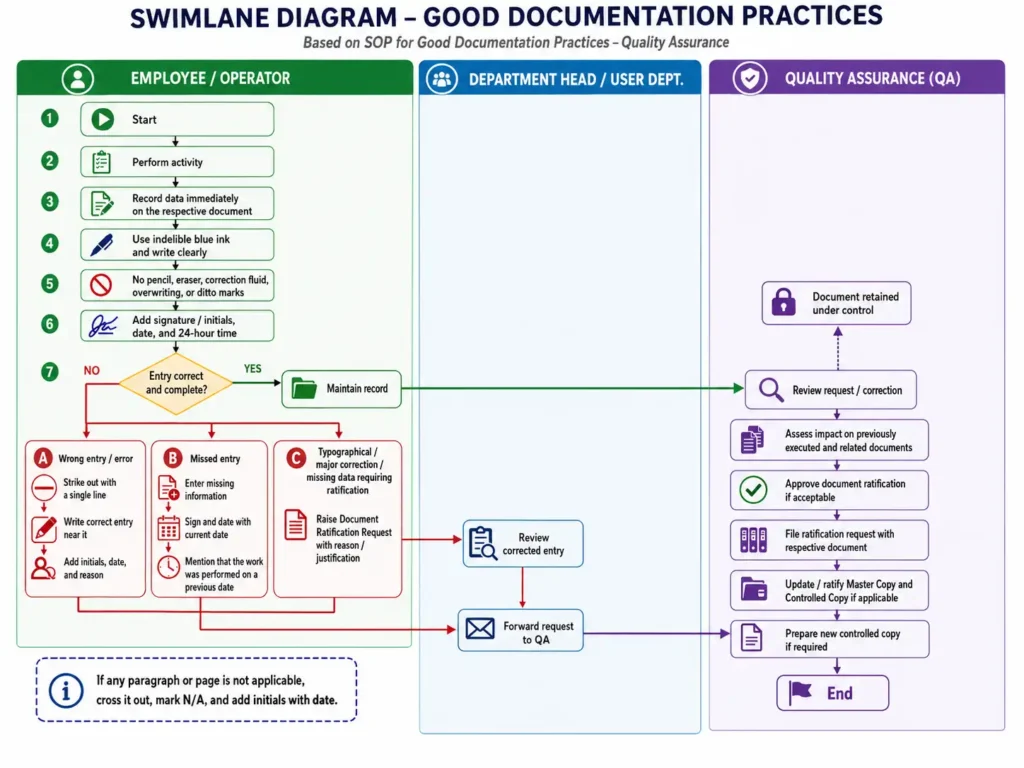
If an entry is correct and complete, the record is maintained as documented. If an error is found, it is corrected by striking it out with a single line, entering the correct information, and adding initials and date. Missing entries are recorded with the current date and reference to the actual date of activity. Significant corrections or missing data may require a Document Ratification Request, QA review, impact assessment, approval, and filing with the respective document.
3. Brainstorming:
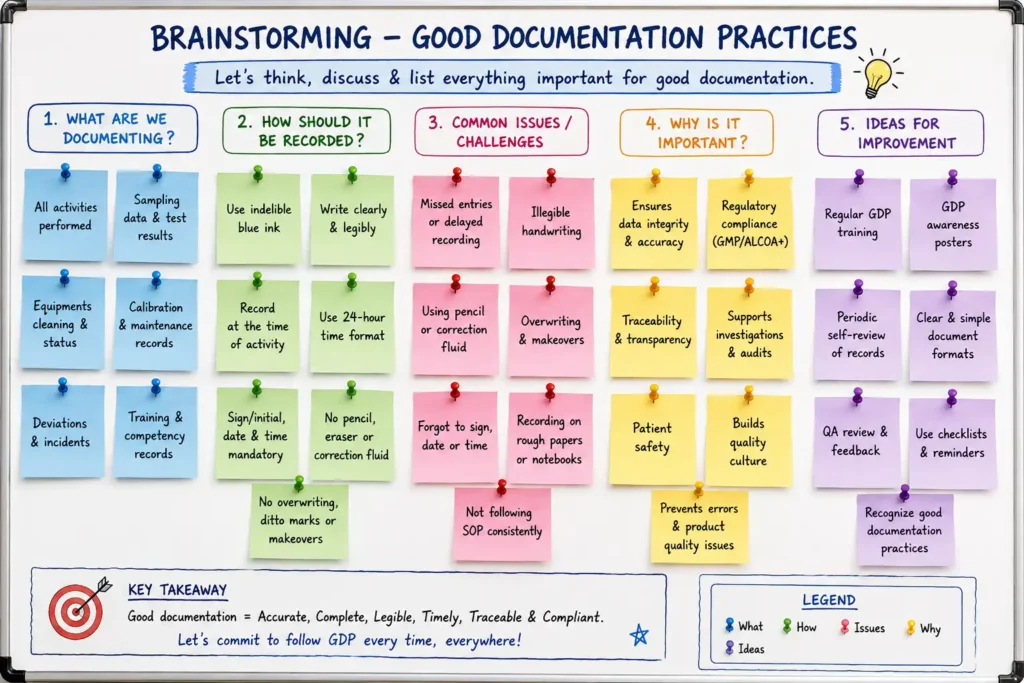
Brainstorming is a simple team-based technique used to identify possible problems, causes, and improvement opportunities related to Good Documentation Practices (GDP). During the session, employees discuss common documentation issues such as delayed or missed entries, illegible handwriting, use of pencil or correction fluid, overwriting, recording information on rough paper, and missing signatures, dates, or time entries. The SOP requires entries to be made directly on the respective document, contemporaneously, in indelible blue ink, and with proper signature/date details. The discussion can also focus on correct handling of documentation errors, including single-line strikeout, entering the correct information, initials/date, and use of a Document Ratification Request when required. Brainstorming helps teams recognize documentation risks early and supports consistent compliance with the approved SOP.
4. 5-Why Analysis for SOP Failure:
The 5-Why Analysis is a simple root-cause investigation tool used to identify why a failure of the Good Documentation Practices SOP occurred. The investigation starts with the problem, such as a documentation entry being missed, delayed, or recorded incorrectly. Each “Why?” is asked in sequence to move from the immediate error toward the underlying cause. The SOP requires entries to be made at the time of the activity, directly on the respective document, using indelible blue ink, with proper signature, date, and time.
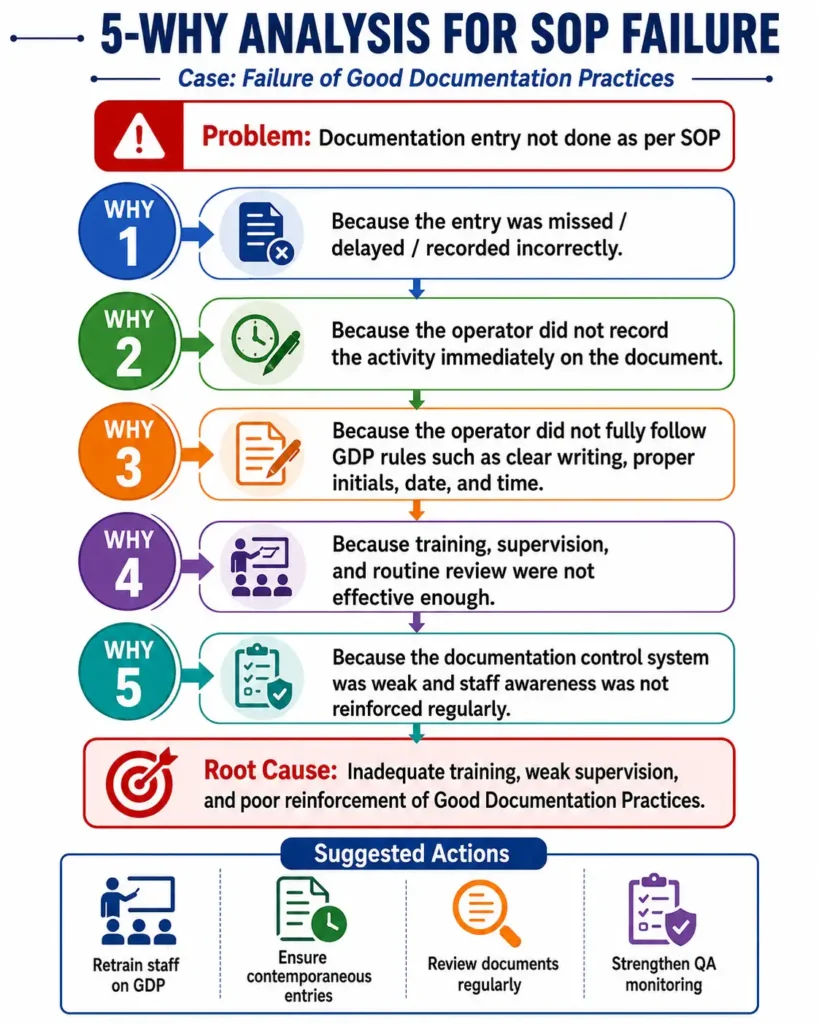
In the example diagram, repeated questioning points toward possible weaknesses in training, supervision, routine review, and reinforcement of GDP requirements. The identified root cause can then be addressed through appropriate CAPA, such as retraining personnel, strengthening QA monitoring, ensuring contemporaneous documentation, and periodically reviewing records to prevent recurrence.
5. Heat Map FMEA:
The Heat Map FMEA (Failure Mode and Effects Analysis) is used to identify, evaluate, and prioritize possible documentation failures in the Good Documentation Practices process. Typical failure modes include delayed entries, illegible handwriting, use of pencil or correction fluid, improper corrections, missing signatures/date/time, and delays in document ratification. These risks are relevant because the SOP requires entries to be made contemporaneously, directly on the applicable document, using indelible blue ink, with proper signature, date, and 24-hour time.
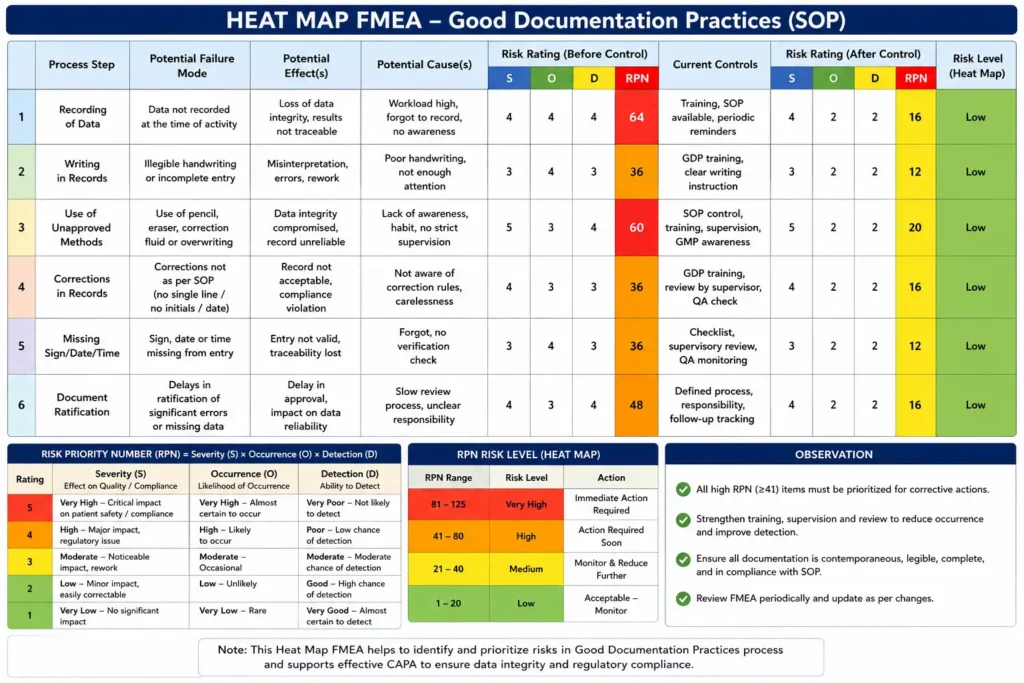
Each failure is assessed using Severity (S), Occurrence (O), and Detection (D) to calculate the Risk Priority Number (RPN = S × O × D). Higher-risk areas are prioritized for corrective actions such as training, supervision, QA review, checklists, and stronger document controls. The heat-map colors make risk levels easy to understand and support systematic CAPA and periodic review.
Questions & Answers:
- Q: What is the purpose of the Good Documentation Practices SOP?
A: The purpose is to define the procedure for recording document entries and correcting documentation errors. - Q: Who is responsible for following this SOP?
A: All employees at the site are responsible for implementing the procedure. - Q: Which ink should be used for recording data?
A: Indelible blue ink should be used for data recording. - Q: When should an entry be recorded?
A: The entry should be made at the time the respective activity is performed. - Q: Can data be written on rough paper before entering it in the document?
A: No. Data should be recorded directly on the respective document and not on rough books, papers, or legal pads. - Q: Are pencils, erasers, and correction fluid allowed?
A: No. Pencils, erasers, and correction fluid are prohibited for documentation purposes. - Q: What information should accompany an entry?
A: The entry should be recorded with signature and date. - Q: How should time be recorded?
A: Time should be recorded using the 24-hour time format. - Q: What should be done if an entry is missed?
A: The missing information should be entered, signed and dated with the current date, and a notation should mention the actual previous date on which the work was performed. - Q: How should an incorrect entry be corrected?
A: The incorrect entry should be crossed out with a single line, the correct information written nearby, and initials with the correction date recorded. - Q: What should be done when a paragraph or page is not applicable?
A: It should be crossed out with a line, marked “N/A,” and initialed with the date. - Q: What is a Document Ratification Request?
A: It is a request raised for typographical errors, errors in recorded data, or missing entries, along with the reason or justification for the proposed correction. - Q: Who approves the Document Ratification Request?
A: Approval is taken from Quality Assurance (QA). - Q: What does QA assess before approving document ratification?
A: QA evaluates the impact of the change on previously executed documents and other related documents. - Q: Where should the Document Ratification Request be filed?
A: It should be filed along with the respective document. - Q: What should be done with an old Controlled Copy after ratification?
A: The old Controlled Copy should be destroyed by shredding and a new Controlled Copy should be prepared from the ratified document. - Q: Within what period should the corrected original or master document be replaced?
A: It should be replaced within a period of not more than six months after manual rectification of errors. - Q: What attachment is included in this SOP?
A: Attachment 01 is the Document Ratification Request form.