






1. Introduction:
An Out of Trend (OOT) result is a test or monitoring result that shows an unusual shift or deviation from the normally established trend, even though the result may not necessarily be outside the approved specification. The SOP for Handling of Out of Trend Results provides a systematic approach for identifying, reporting, investigating, documenting, and closing such results. It applies to trends observed in water monitoring, environmental monitoring, and physical and chemical parameters of pharmaceutical products. The purpose of the procedure is to ensure that every OOT result is properly evaluated so that its actual cause can be understood before any decision is taken. According to the SOP, OOT events may generally arise from laboratory error, non-process/operator-related error, or process/manufacturing-related error. The investigation is carried out in a structured manner. Phase I involves assessment by the analyst and Quality Control personnel to check analytical procedures, calculations, sample preparation, instruments, reagents, reference standards, and other possible laboratory-related causes. If the cause cannot be clearly established, the investigation proceeds to Phase II, which may include additional review, justified retesting, or re-sampling. Where the issue appears to originate from manufacturing or processing, a Phase III investigation involving Production, Quality Assurance, and Process Development is performed. Proper handling of OOT results helps maintain reliable analytical data, identify recurring problems, determine appropriate corrective and preventive actions, and support scientifically justified decisions regarding product quality and batch disposition.
Skip to PDF content1. Flow Diagram:
The flow diagram explains the step-by-step process for handling an Out of Trend (OOT) result in a pharmaceutical quality system. The process begins with trend analysis of data such as water quality, environmental monitoring, and product parameters. When an unusual result is identified, the analyst reports it to the concerned section head and preserves the relevant samples, standards, and solutions for investigation.
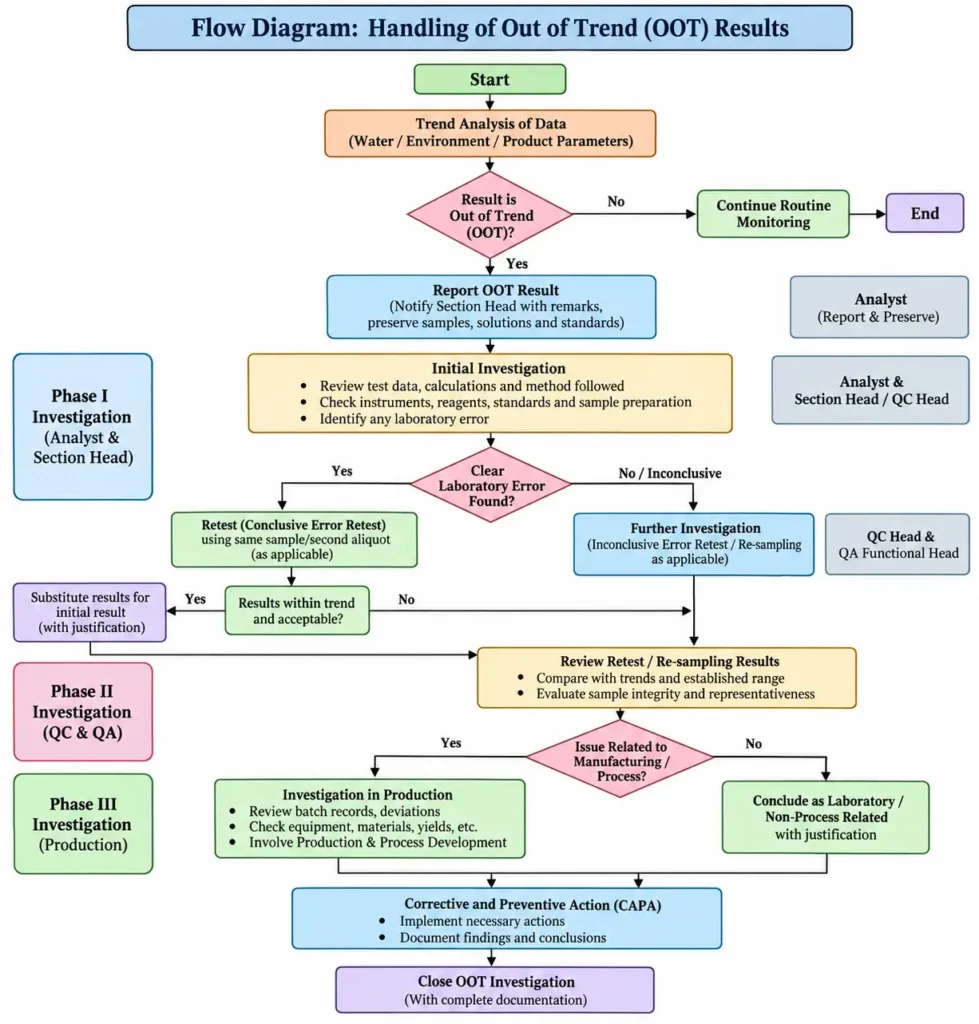
In Phase I Investigation, the analyst and QC/section head review the test method, calculations, instruments, reagents, standards, sample preparation, and other laboratory factors to identify any clear laboratory error. If the cause is clear, justified retesting may be performed. If the cause remains inconclusive, the case proceeds to Phase II, where further investigation, retesting, or justified re-sampling may be carried out under QC and QA oversight. When the issue appears to be related to manufacturing or processing, Phase III Investigation is initiated with Production, QA, and Process Development. Batch records, deviations, materials, yields, equipment, and process conditions are reviewed. Finally, appropriate corrective and preventive actions (CAPA) are implemented, findings are documented, and the OOT investigation is formally closed.
2. Benefits of Following SOP:
Following the SOP for Handling of Out of Trend (OOT) Results helps the organization detect unusual changes in quality data at an early stage and investigate them in a systematic and documented manner. The SOP requires evaluation of possible laboratory errors, operator-related issues, and manufacturing or process-related causes, which supports proper identification of the actual reason behind an OOT result. It also helps ensure that samples, standards, solutions, instruments, calculations, test methods, and analytical records are properly reviewed before any decision is made. This improves the reliability and credibility of analytical data.
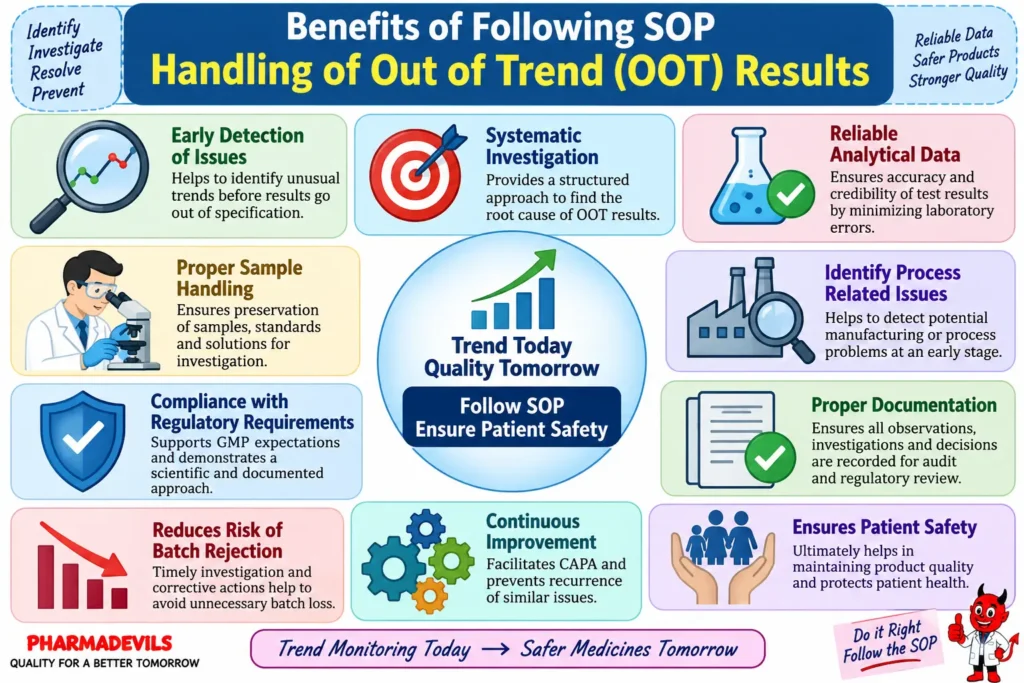
Where required, the investigation can be expanded to include retesting, re-sampling, review of batch records, equipment performance, input materials, yields, deviations, and manufacturing conditions. This allows potential process-related problems to be identified before they affect future batches. Proper implementation of the SOP also supports complete documentation, appropriate corrective and preventive actions, traceability of investigations, and scientifically justified decisions. These controls help maintain consistent product quality, reduce recurrence of similar problems, support regulatory compliance, and ultimately contribute to patient safety.
3. Brainstorming for SOP Failure:
The brainstorming image shows a worst-case situation where the SOP for Handling of Out of Trend (OOT) Results is not followed properly. The central problem is “SOP Failure – Handling of OOT Results,” surrounded by several possible causes that can lead to serious quality-system weaknesses.The major causes shown include no trend review, delayed reporting, analyst error, improper sample handling, poor documentation, no investigation, instrument issues, failure to follow the analytical method, lack of training, weak QA oversight, sampling errors, manufacturing deviations, absence of risk assessment, improper retesting, communication gaps, and failure to initiate CAPA.
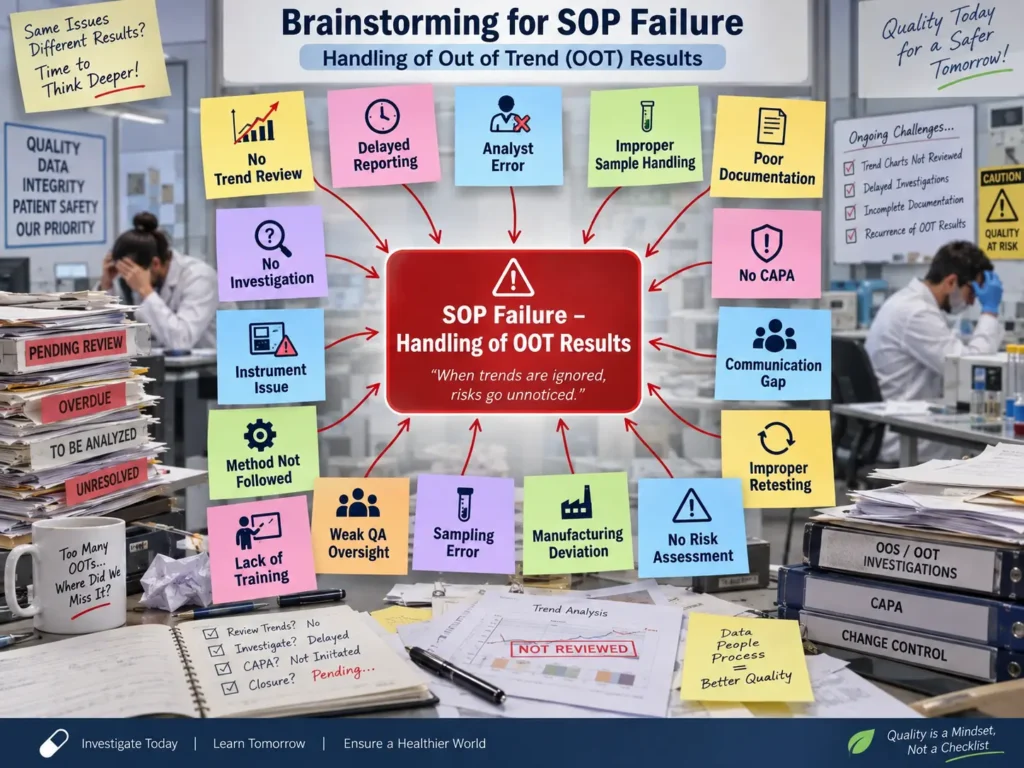
The SOP itself requires OOT results to be reported, investigated, documented, and categorized based on possible laboratory, operator, or manufacturing-related causes. If these activities are delayed or ignored, recurring OOT results may remain unresolved, investigations may become incomplete, data reliability may be affected, and potential product-quality risks may not be identified in time. The brainstorming exercise therefore helps the team identify possible failure points and develop effective corrective and preventive actions.
5-Why Analysis for SOP Failure:
The 5-Why Analysis image shows how repeated questioning can be used to identify the root causes behind failure to follow the SOP for Handling of Out of Trend (OOT) Results. Instead of stopping at the visible problem, the analysis moves step-by-step from the immediate failure to deeper system weaknesses. The diagram examines common failure situations such as late reporting of OOT results, incomplete investigation, incorrect analytical results, improper retesting or re-sampling, and recurrence of OOT events. The SOP itself requires OOT results to be reported promptly, investigated in defined phases, and reviewed for laboratory, sampling, operator, or manufacturing-related causes.
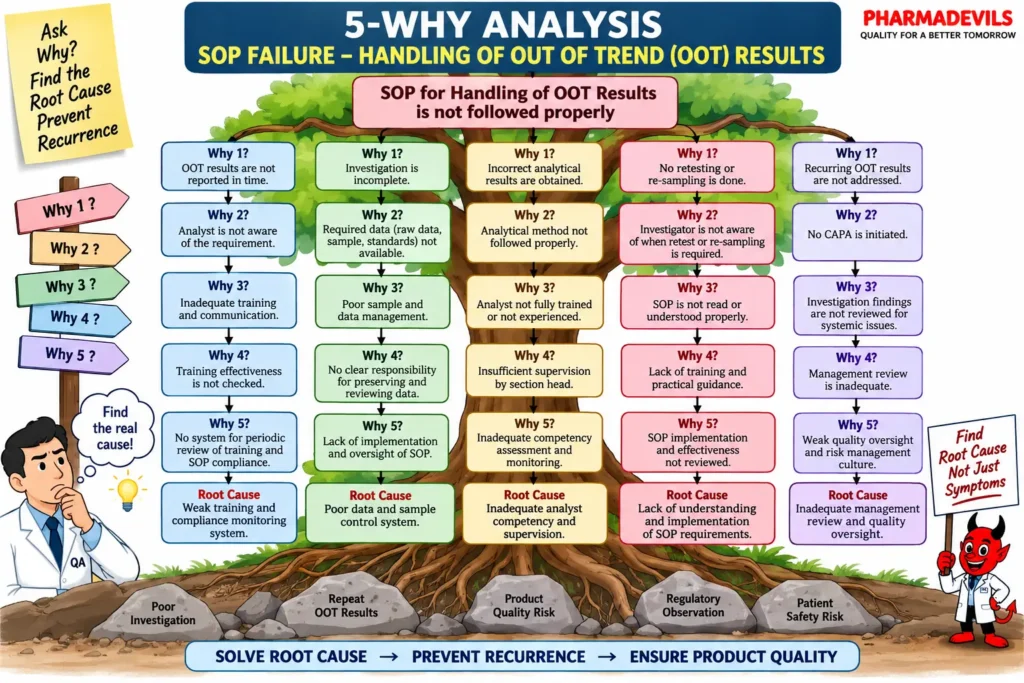
The 5-Why paths highlight possible deeper causes such as inadequate training, weak analyst competency, poor sample and data control, insufficient supervision, unclear SOP implementation, ineffective management review, and weak quality oversight. The purpose of the analysis is to move beyond symptoms and identify the real reason the SOP failed. Once the root cause is established, appropriate corrective and preventive actions (CAPA) can be implemented to prevent recurrence. The SOP also requires documented corrective actions and investigation records before closure. In simple terms, the message of the diagram is: find the actual cause, correct the system, prevent repeat OOT events, and protect product quality.
6. Fishbone Analysis for SOP Failure:
The Fishbone Analysis diagram shows the possible causes that can lead to failure of the SOP for Handling of Out of Trend (OOT) Results. The causes are grouped into major categories so that the investigation team can systematically identify where the failure may have originated. Under Man (People), possible causes include inadequate training, analyst error, poor communication, and inexperienced personnel. Method (Procedure) covers issues such as the SOP not being followed, unclear procedures, inadequate investigation steps, and improper retesting or re-sampling. The SOP specifically requires structured investigation and review of testing methods, instruments, standards, reagents, and sample preparation.
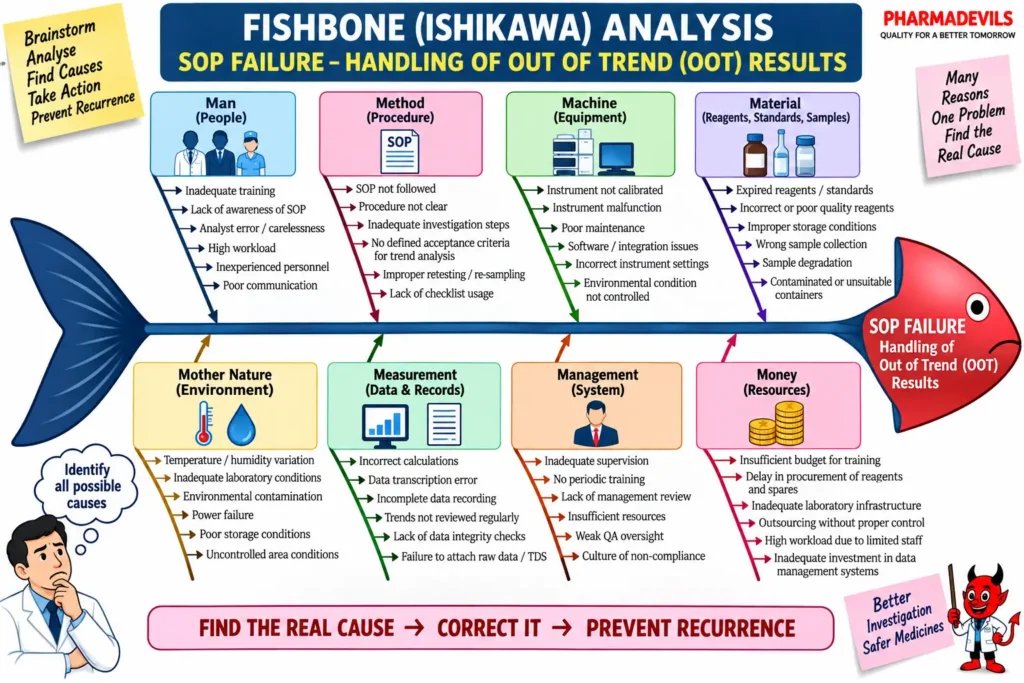
Machine (Equipment) includes calibration problems, equipment malfunction, maintenance deficiencies, and incorrect settings. Material considers expired reagents, unsuitable standards, improper samples, and storage problems. Environment addresses temperature, humidity, contamination, power failure, and storage conditions. The diagram also highlights Measurement/Data, Management, and Resources, including calculation errors, incomplete records, inadequate supervision, weak QA oversight, insufficient training resources, and excessive workload. Overall, the Fishbone Analysis helps the team examine all potential contributing factors, identify the true root cause, implement suitable CAPA, and prevent recurrence of OOT-related failures.
7. Fault Tree Analysis for SOP Failure:
The Fault Tree Analysis image presents a worst-case view of how failure to follow the OOT SOP can develop into a serious pharmaceutical quality-system problem. The top event is defined as failure to properly follow the SOP for Handling of Out of Trend Results. The diagram breaks this failure into four major branches: investigation not initiated or incomplete, incorrect analytical result obtained, retesting or re-sampling performed incorrectly, and investigation findings not properly reviewed or followed by CAPA. These branches are further linked to possible basic causes such as delayed OOT reporting, lack of trend review, inadequate analyst training, calibration or equipment problems, unsuitable reagents or standards, improper sample handling, weak documentation, insufficient QA review, and ineffective follow-up.
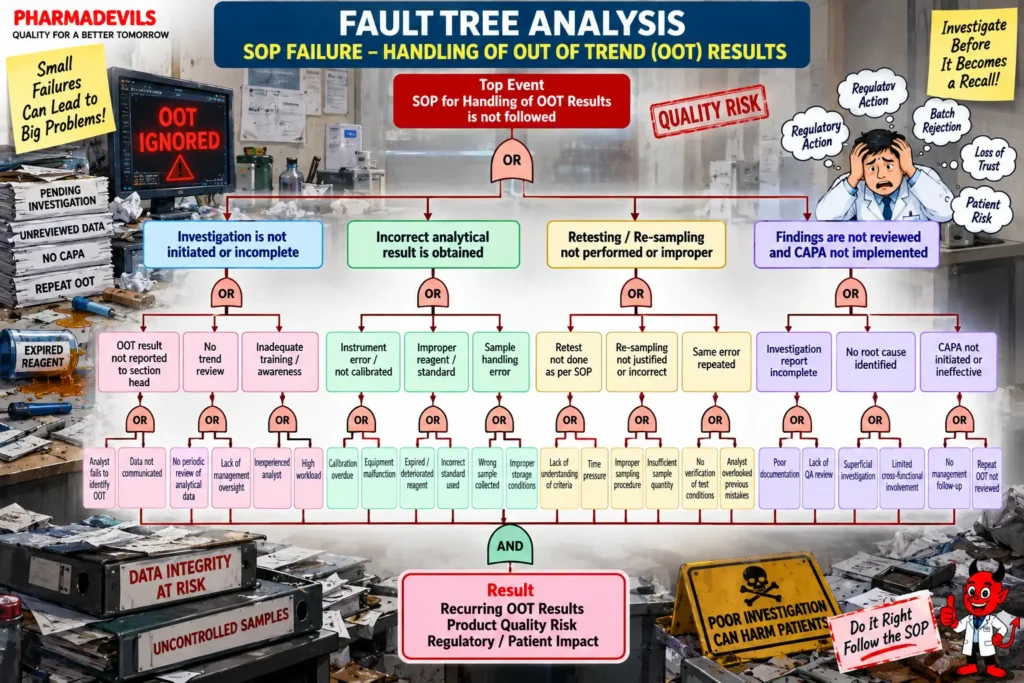
The SOP requires OOT results to be reported to the section head, relevant samples and standards to be preserved, and a structured investigation to be started promptly. It also describes controlled retesting, re-sampling, and escalation to manufacturing investigation when the laboratory cause cannot adequately explain the result. In the worst-case scenario illustrated, several unresolved failures can combine and result in recurring OOT events, unreliable data, product-quality risk, batch rejection, regulatory observations, and potential patient impact. The purpose of the Fault Tree Analysis is therefore to identify the basic causes before they combine into a larger failure and to support appropriate corrective and preventive actions.
8. Impact Assessment :
The Impact Assessment image shows the possible consequences when the SOP for Handling of Out of Trend (OOT) Results is not followed properly. It evaluates the effect of SOP failure on major areas of the pharmaceutical quality system, including product quality, patient safety, regulatory compliance, business performance, operations, data integrity, personnel, and continuous improvement. For product quality, improper handling of OOT results can lead to incorrect quality decisions, repeated failures, rework, or rejection of batches. From a patient-safety perspective, failure to properly investigate an unusual trend may allow an underlying quality problem to remain undetected. The SOP requires the investigation to be extended to manufacturing-related factors such as deviations, input materials, yields, equipment changes, breakdowns, calibration, and process validation when needed.
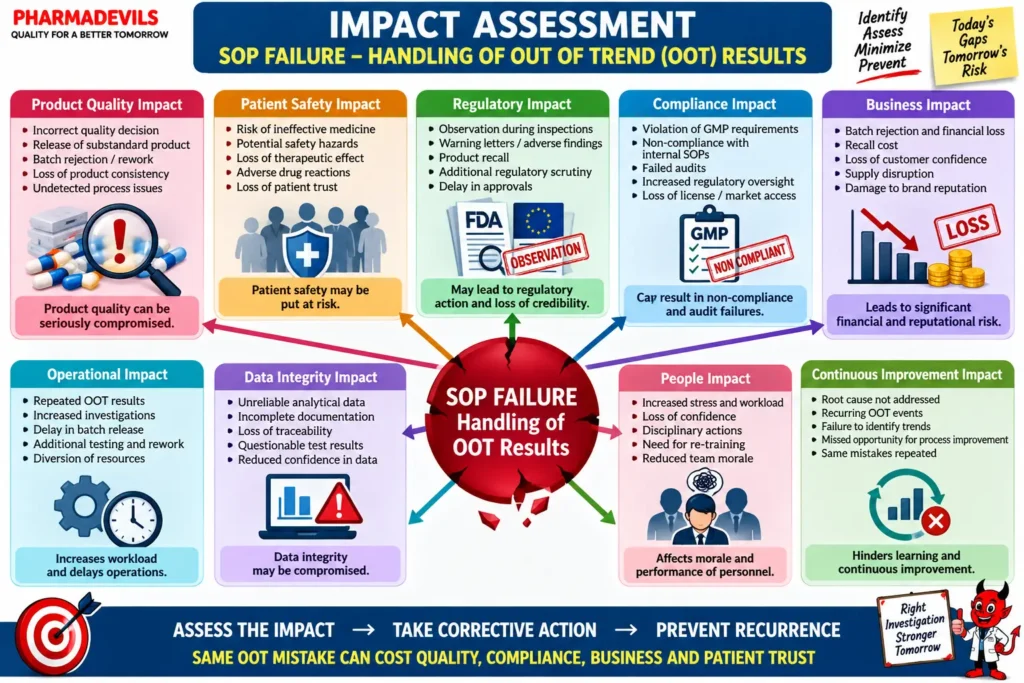
The image also highlights data-integrity and compliance risks, such as incomplete investigations, poor traceability, unreliable analytical conclusions, and inadequate documentation. These weaknesses can increase the risk of audit observations and regulatory concerns. Operationally, unresolved OOT results may cause repeated investigations, additional testing, delays in batch disposition, and increased workload. The SOP requires findings to be documented, actions for current and future batches to be defined, and corrective measures to be implemented. Overall, the assessment emphasizes that proper OOT investigation and CAPA help control quality risk, prevent recurrence, maintain reliable data, and protect product quality and patient safety.
Questions & Answers:
1. What is the objective of the OOT SOP?
The objective is to provide a defined procedure for handling Out of Trend results identified during trend analysis.
2. Where is this SOP applicable?
It applies to OOT results observed during trend analysis of water, environmental monitoring, and physical and chemical parameters of products.
3. Who is responsible for executing the SOP?
The Analyst and Executive-QC are responsible for execution, while the Assistant Manager QA and Head QA/QC are responsible for effective implementation.
4. What are the main categories of OOT results?
The SOP classifies OOT results into three categories: laboratory error, non-process/operator error, and process/manufacturing error.
5. What should an analyst do when an OOT result is obtained?
The analyst should immediately inform the section head with remarks and preserve all relevant solutions and standards for investigation.
6. What is checked during Phase I investigation?
Phase I includes review of the test data, analytical method, instrument calibration, reference standards, solvents, reagents, sample preparation, and possible laboratory errors.
7. What happens if a clear laboratory error is identified?
If a clear error is confirmed, a justified retest using the second aliquot or the same original sample portion may be performed as described in the SOP.
8. What happens when the initial investigation is inconclusive?
If no clear laboratory error is established and the result remains out of trend, retesting by a second, more experienced analyst may be arranged using an additional portion of the original sample.
9. When can re-sampling be considered?
Re-sampling may be considered when investigation shows that the original sample could have been non-representative or its integrity was affected, after review of the sampling procedure.
10. When is Phase III investigation required?
Phase III is initiated when the OOT result may be related to manufacturing or processing and requires involvement of Production and Process Development.
11. What manufacturing factors are reviewed during Phase III?
The review includes authorized changes, process deviations, input materials, yields, time delays, facility or equipment changes, breakdowns, calibration status, and process validation.
12. Should the investigation be extended to other batches?
Yes. The SOP states that the investigation should be extended to other batches, where appropriate.
13. What actions are taken after identifying the cause?
The observations and findings are recorded, action for the affected batch and future batches is proposed, and the investigation report is reviewed and signed by relevant functions.
14. What corrective action may be taken for a laboratory error?
If laboratory error is confirmed, retraining of the analyst may be required and documented.
15. Why is proper documentation important in OOT investigation?
The SOP requires investigation reports, laboratory records, deviations, and other supporting data to be maintained so that the investigation remains traceable and properly documented.
16. What is the main purpose of proper OOT handling?
The purpose is to identify the true cause of an unusual trend, take suitable corrective action, prevent recurrence, and support reliable decisions related to product quality.
Reference Guidelines:
- US FDA – Investigating Out-of-Specification (OOS) Test Results for Pharmaceutical Production, May 2022. Although focused on OOS results, FDA also refers firms to this guidance for failing, OOT, and other unexpected results and their investigations. (U.S. Food and Drug Administration)
FDA OOS Investigation Guidance - ICH Q9(R1) – Quality Risk Management. Useful for risk assessment, root-cause evaluation, risk control, review, and determining the extent of investigation for quality events. (ICH)
ICH Quality Guidelines - ICH Q10 – Pharmaceutical Quality System. Relevant to deviation/investigation systems, CAPA, management responsibility, continual improvement, and monitoring of product/process performance. (ICH)
- EU GMP – EudraLex Volume 4, Part I, Chapter 6: Quality Control. Provides GMP expectations for laboratory controls, testing, investigation, documentation, and quality-control activities. (Public Health)
EU GMP EudraLex Volume 4 - PIC/S GMP Guide PE 009-17, Part I – Chapter 1 Pharmaceutical Quality System and Chapter 6 Quality Control. Relevant for investigation systems, QC oversight, documentation, CAPA, and ongoing quality monitoring. (PIC Scheme)
PIC/S Publications and GMP Guide - WHO TRS 1052, Annex 4 – Good Practices for Pharmaceutical Quality Control Laboratories, 2024. Provides current WHO expectations for pharmaceutical QC laboratory quality systems, analytical work, records, equipment, investigations, and reliability of test results. (World Health Organization)
WHO Good Practices for Pharmaceutical Quality Control Laboratories